Does the Earth go around the Sun,
or does the Sun go around the Earth?
Rarely a day goes by without people being reminded of the Helio-GeoCentric controversy. This topic is mentioned in almost every science-versus-faith
discussion. There is hardly a book that does not mention it when dealing with science-faith issues. Even Christian authors have succumbed to the myth that
Galileo somehow discovered the true motions of the planets. We are admonished to submit to the pronouncements of scientists, because the Helio-GeoCentric
controversy “proved” that science is a legitimate source of truth.
Before we cite quotations, we need some background information:
Ptolemy Claudius of Alexandria (85-165 AD)
made precise measurements of celestial motions and wrote an influential book called the
Almagest. He believed that the Earth is a Sphere and that Planets move
in Epicycles, i.e. Cycles on Cycles. He based his work on the Greek philosopher Hipparchus, (fl. 147-126 BC) who rejected Heliocentrism as proposed by
Aristarchus of Samos (fl. 270 BC). That the earth is a sphere was known at least 600 years before Christ, and its circumference was accurately estimated by 300 BC.
Nicolaus Copernicus (1473-1543)
was a Heliocentrist and believed that Planets move in Circular orbits of
uniform motion around the sun, even though he knew that the sun was off-center of the solar system. His book called On the Revolutions
of the Heavenly Spheres was published posthumously. He discovered the heliocentric concept from the Greeks.
“[…] it is the job of the astronomer […]
since he cannot by any line of reasoning reach the true cause of [celestial] movements […] to think up or construct whatever hypotheses
he pleases […] it is not necessary that these hypotheses should be true or even probable, it is enough if they provide a calculus which fits the
observations […] let no one expect anything in the way of certainty from astronomy, since astronomy can offer us nothing certain […]”
Nicolaus Copernicus; On the Revolutions of the Heavenly Spheres; 1543
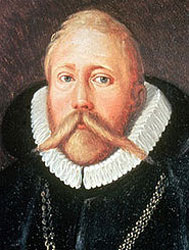 Tycho Brahe (1541-1601)
Danish Astronomer, tried to hold a middle ground between Copernicus & Ptolemy. He believed that the Earth is immobile, some planets revolve
around the sun and all revolve around the earth. He tried to convert Galileo from Copernicanism. He was an instrument maker, and accurate
clocks were invented by his time. He invented the Sextant which he used to make accurate measurements of stellar positions.
Tycho Brahe (1541-1601)
Danish Astronomer, tried to hold a middle ground between Copernicus & Ptolemy. He believed that the Earth is immobile, some planets revolve
around the sun and all revolve around the earth. He tried to convert Galileo from Copernicanism. He was an instrument maker, and accurate
clocks were invented by his time. He invented the Sextant which he used to make accurate measurements of stellar positions.
Johannes Kepler (1571-1630)
A Heliocentrist. He continued the work of Brahe. He was greatly enamored by astrology. He corresponded with Brahe & Galileo and proposed elliptical paths of
planets around the sun, which obviated the need for epicycles.
Both Copernicus and Kepler were of the opinion that the Solar System virtually exhausted the space of the universe.
Galileo Galilei (1564-1642)
Believed in circular planetary orbits. Even though his friend Pope Urban VIII had not discouraged him from publishing his ideas, he had asked Galileo not to insist upon absolute motions. Galileo’s publication was seen as a betrayal of that trust, and he was convicted of heresy and placed under house arrest.
[…]
I think that in discussions of physical problems we ought to begin
not
from the authority of scriptural passages, but from sense-experiences and necessary demonstrations; for the holy Bible and the phenomena of nature
proceed alike from the divine Word, […] It is necessary for the Bible, in order to be accommodated to the understanding of every man, to speak many things which
appear to differ from the absolute truth
so far as the bare meaning of the words is concerned. But
Nature, on the other hand, is inexorable and immutable; she never
transgresses the laws imposed upon her,
or cares a whit whether her abstruse reasons and methods of operation are
understandable to men.”
Galileo Galilei;
Letter to the Grand Duchess Christina; 1615
Since we do not know of a point in the universe which is absolutely fixed, it is impossible to determine which
celestial object is actually in motion.
We can choose ANY star or planet as our reference point, assume that it is “fixed,” and then measure the “motion” of other bodies RELATIVE to that arbitrary point.
The cosmologies of Copernicus [Heliocentrism] & Ptolemy [Geocentrism] are kinematically equivalent; both of them are descriptions of the same facts, and Ptolemy’s epicycles of the planets are the kinematic equivalents of the circular orbits of Copernicus.
Hans Reichenbach; (1891-1953); Philosophy of Space and Time; 1927/1958; p210-211
 Galileo and the Inquisition are only in error in the single affirmation in which they
both agreed, namely that absolute position is a physical fact – the sun for Galileo and the earth for the Inquisition.
Galileo and the Inquisition are only in error in the single affirmation in which they
both agreed, namely that absolute position is a physical fact – the sun for Galileo and the earth for the Inquisition.
Alfred North Whitehead; (1861-1947); An Enquiry Concerning the Principles of Natural Knowledge; 1919/1982; p31
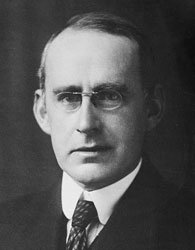 It looks as though all the forces of Nature had entered on a conspiracy
together with the one design of preventing us from measuring or even detecting our motion through the æther.
[…]
It looks as though all the forces of Nature had entered on a conspiracy
together with the one design of preventing us from measuring or even detecting our motion through the æther.
[…]
We now deny the existence of any unique framework of [an æther at rest].
We have failed to obtain experimental knowledge of such a framework since we cannot detect our motion relative to it. Whatever may be the nature of the æther, it is devoid of those material properties which could constitute it a framework of reference in space.
Sir Arthur Eddington; (1882-1944); Gravitation and the Principle of Relativity; Nature; v101; March 1918; p16,17.
The laboratory can devise no method for determining whether the Earth
moves while the Sun stands still or whether the Sun moves while the Earth stands still. […] Neither can physics observe anything moving in a straight line.
Gordon Clark; Christian Philosophy; 2004; v4; p322
 […] the unsuccessful attempts to discover any motion of the earth relative to the “light medium,” suggest that the phenomena of […] mechanics possess no properties corresponding to the idea of absolute rest.
Albert Einstein; (1879-1955);On the Electrodynamics of Moving Bodies; 1905
 The commonly held view is that Copernicus’s heliocentric model vanquished the
competition, especially the geocentric view of Ptolemy, because it yielded better predictions of the positions of the celestial bodies. In actual fact, the
predictions of the Copernican model were a little worse than those obtained via the complicated series of epicycles[…]
the real selling point of the Copernican model was that it was much simpler than the competition yet still gave a reasonably good account of the
observational evidence.
The commonly held view is that Copernicus’s heliocentric model vanquished the
competition, especially the geocentric view of Ptolemy, because it yielded better predictions of the positions of the celestial bodies. In actual fact, the
predictions of the Copernican model were a little worse than those obtained via the complicated series of epicycles[…]
the real selling point of the Copernican model was that it was much simpler than the competition yet still gave a reasonably good account of the
observational evidence.
J. L. Casti & W. DePauli; Gödel; 2000; p166
 Today we cannot say that the Copernican theory is ‘right’ and the Ptolemaic theory ‘wrong’ in any meaningful physical sense.
Fred Hoyle; (1915-2001);
Nicolaus Copernicus; 1973; p78
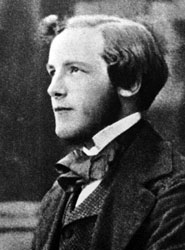 Our primitive notion may have been that to know absolutely where we are, and in what direction we are going, are essential elements of our knowledge as conscious beings.
But this notion, though undoubtedly held by many wise men in ancient times, has been gradually dispelled from the minds of students of physics.
There are no landmarks in space; one portion of space is exactly like every other portion, so that we cannot tell where we are. We are, as it were, on an unruffled sea, without stars, compass, soundings, wind, or tide, and we cannot tell in what direction we are going. We have no log which we can cast out to take a dead reckoning by; we may compute our rate of motion with respect to the neighbouring bodies, but we do not know how these bodies may be moving in space.
James Clerk Maxwell; (1831-1879); Matter and Motion; 1877/1920; p81
So which is real, the Ptolemaic or Copernican system? Although it is not uncommon for people to say that Copernicus proved Ptolemy wrong, that is not true… one can use either picture as a model of the universe, for our observations of the heavens can be explained by assuming either the earth or the sun to be at rest.
Stephen Hawking;
The Grand Design; 2010
The Copernican conception is indeed simpler, but this does not make it any “truer” since this simplicity is descriptive […] One description may
be simplest for some phenomena while a different description may be simplest for others; but no simplest description is distinguished from
other descriptions with regard to truth.
The concept of truth does not apply here, since we are dealing with definitions.
Hans Reichenbach; (1891-1953); Philosophy of Space and Time; 1927/1958; p219
And hence this affirmation: “the earth turns around” has no meaning, since it cannot be verified by experiment; […] such an experiment […] cannot even be conceived of without contradiction […]
Henri Poincaré; (1854-1912);
Science and Hypothesis; 1905/1952; p117
 …
it is meaningless to talk of absolute motion.
…
it is meaningless to talk of absolute motion.
Even the Copernican world-view appears to be shaken by this
consideration. It makes no sense accordingly, to speak of a difference in truth
between Copernicus and Ptolemy: both conceptions are equally permissible
descriptions.
What has been considered as the greatest discovery of western wisdom, as opposed
to that of antiquity, is questioned as to its truth-value […] the doctrine of
relativity does not assert that Ptolemy’s view is correct, it rather contests
the absolute meaning of either view.
Hans Reichenbach; (1891-1953);
From Copernicus to Einstein; 1927/1970; p75, 82
The
aether was thought of as being ― except for minor local variations ― both
uniform and at rest. […]
The first important critic of the orthodox theory
of absolute space and time was Mach […] [who] attacks the assumption that
absolute rotation is observable. All that can be observed is rotation
relative to the fixed stars.
H. G. Alexander; (1925-);
The Leibniz-Clarke Correspondence; 1976; pxlix
There is one more implication that modern science has perceived in the work of Copernicus. The same observational data that Ptolemy organized in his geocentric theory of deferent and epicycle can also be organized under the heliocentric theory of Copernicus. Despite the belief of the latter that the new theory was true, the modern view is that either theory will do and that there is no need to adopt the heliocentric hypothesis except to gain mathematical simplicity. Reality seems far less knowable than Copernicus believed, and today scientific theories are regarded as human inventions.
Morris Kline; (1908-1992);
Mathematics and the Search for Knowledge; 1985; p85
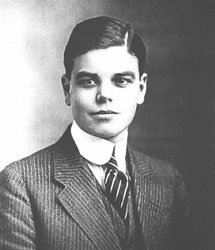 […]
the Ptolemaic theory of the solar system was abandoned in favor of the Copernican not because it failed to “agree” with all the facts, for it explained
as much as the Copernican did, but because the latter, as Copernicus himself said, was “simpler,” more elegant mathematically, and a more harmonious addition
to the body of science than the former.
[…] there was no intellectual inconvenience at one time in regarding the earth as
the fixed center of the universe, nor was there any particular reason, socially
or otherwise, why it should not have been accepted, nor was it inconsistent with
the existent body of knowledge.
J. H. Randall; (1899-1980);
Philosophy: An Introduction; 1957; p135, 139
[…]
the Ptolemaic theory of the solar system was abandoned in favor of the Copernican not because it failed to “agree” with all the facts, for it explained
as much as the Copernican did, but because the latter, as Copernicus himself said, was “simpler,” more elegant mathematically, and a more harmonious addition
to the body of science than the former.
[…] there was no intellectual inconvenience at one time in regarding the earth as
the fixed center of the universe, nor was there any particular reason, socially
or otherwise, why it should not have been accepted, nor was it inconsistent with
the existent body of knowledge.
J. H. Randall; (1899-1980);
Philosophy: An Introduction; 1957; p135, 139
 Two thousand years ago the earth turned; then it remained immobile until recently, when it has again begun to turn.
Nicolas Malebranche; (1638-1715); The Search After Truth; 1674/1997; p371
All the known celestial movements can be explained on a geocentric theory, if it is sufficiently complex.
A. R. Lacey; Dictionary of Philosophy; 1999; p359
[…] in fact simplicity of the mathematical theory was the only argument Copernicus & Kepler could advance in favor of their heliocentric theory as opposed to the older Ptolemaic theory. Is the path of the earth around the sun an ellipse? No. Only if the earth & sun are regarded as points and only if all other bodies in the universe are ignored. Do the four seasons on earth repeat themselves year after year? Hardly. Only in their grossest aspects, which are about all men can perceive anyway, do they repeat.
Morris Kline; (1908-1992); Mathematics: The Loss of Certainty; 1982; p344, 350
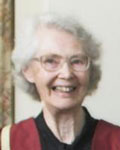 […]
there are no conceivable operations by which the absolute velocity of the earth
could be measured since the attempt to measure this velocity in the aether has
failed. The concept of absolute velocity must therefore be rejected from
physical theories, and all actual velocities of bodies defined by the operations
used to measure them relative to some other body.
Mary Hesse; (1924-2016);
Science and the Human Imagination; 1954; p72
[…]
there are no conceivable operations by which the absolute velocity of the earth
could be measured since the attempt to measure this velocity in the aether has
failed. The concept of absolute velocity must therefore be rejected from
physical theories, and all actual velocities of bodies defined by the operations
used to measure them relative to some other body.
Mary Hesse; (1924-2016);
Science and the Human Imagination; 1954; p72
[…] when describing the motion of the Sun,
moon, and planets relative to the
Earth, it makes little practical difference whether one adopts a
geocentric or a heliocentric model of the Solar System.
[…] the model of
Copernicus is about as complicated, and not appreciably more
accurate, than that described in [Ptolemy’s] The Almagest. In this
respect, Copernicus cannot be said to have demonstrated the
correctness of his heliocentric approach on the basis of
observational data.
Richard Fitzpatrick; A Modern Almagest; {2006}; p10,11
http://farside.ph.utexas.edu/Books/Syntaxis/Almagest.pdf
[6/27/21]
[Copernicus] was able, in fact, to cite as a distinct advantage only the greater simplicity of his system.
[…] Here lies one of the reasons which led scientists to accept the Copernican system, even though it must be conceded that, from the modern standpoint,
practically identical results could be obtained by means of a somewhat revised Ptolemaic system.
Hans Reichenbach; (1891-1953); From Copernicus to Einstein; 1927/1970; p18
The merit of the Copernican hypothesis is not truth, but simplicity; in view of the relativity of motion, no question of truth is involved.
Bertrand Russell; (1872-1970);
A History of Western Philosophy; 1945; p217
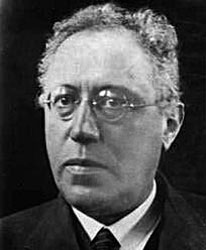 […] relative to the earth the stars are in motion. We therefore need to know first of all what is meant by ‘real motion’ […] it turns out that we cannot quite say what is meant by it […] the question whether the earth is really moving but not the stars or the other way around does not make any sense […]
Hans Hahn; (1879-1934); Empiricism, Logic and Mathematics; 1933/1980; p48
[…] relative to the earth the stars are in motion. We therefore need to know first of all what is meant by ‘real motion’ […] it turns out that we cannot quite say what is meant by it […] the question whether the earth is really moving but not the stars or the other way around does not make any sense […]
Hans Hahn; (1879-1934); Empiricism, Logic and Mathematics; 1933/1980; p48
Absolute space, that is to say, the mark to which it would be necessary to refer the earth to know whether it really moves, has no
objective existence.
[…] the two propositions: “the earth turns
around” and “it’s more convenient to suppose the earth turns around” have the
same meaning; there is nothing more in the one than in the other.
Henri Poincaré; (1854-1912); Science & Hypothesis; 1905/1952; p116-117
 We
must also mention here as a peculiar and valuable auxiliary idea, the fiction of an absolutely fixed point.
We
must also mention here as a peculiar and valuable auxiliary idea, the fiction of an absolutely fixed point.
The empirical perception of all change and motion is always connected with empirical points of reference, and it is only when related to these that we can recognize it as motion. In other words all observed motion is relative, relative to us, to an imaginary origin, relative to a fixed background or relative to the apparently stationary earth or sun. These are all mere points of reference which we must assume in succession. Man begins by assuming himself as a point of reference and science constantly postulates other points of reference because those taken first prove to be illusory, since they turn out to be in motion themselves. In order to prove definitely and absolutely the existence of motion, we must have an absolutely fixed point by means of which the speed and direction of the motion can be measured. Since, however, according to modern views, no such absolutely fixed body can be discovered in the universe, science is faced with a peculiar difficulty.
Hans Vaihinger; (1852-1933);
The Philosophy of “As If”; 1924; p225
[…] the problem of motion remains unsolved.
The reason is that we do not know what motion is. We have no concept
of motion. We have nothing clearly in mind when we use the word. We
simply do not know what we are talking about. Perhaps motion, and science along with it, is just nonsense.
Gordon Clark; (1902-1985);
The Philosophy of Science and Belief in God; 1966; p19
Galileo said that the earth moves and that the
sun is fixed; the Inquisition said that the earth is fixed and the sun
moves; and Newtonian astronomers […] said that both the sun and the
earth move. But now we say that any one of these three statements is equally
true, provided that you have fixed your sense of ‘rest’ and ‘motion’ in the
way required by the statement adopted.
Alfred North Whitehead; (1861-1947);
Science and the Modern World; 1925/1944; p263
Let it be understood at the outset that it
makes no difference, from the point of view of describing planetary
motion, whether we take the Earth or the Sun as the center of the solar
system. Since the issue is one of relative motion only, there are
infinitely many exactly equivalent descriptions referred to different
centers - in principle any point will do, the Moon, Jupiter… So the
passions loosed on the world by the publication of Copernicus’ book,
De revolutionibus orbium caelestium libri VI, were
logically irrelevant…
Astronomer, Fred Hoyle
The Church fathers were convinced that the Copernican worldview conflicted
with the teaching of the Bible (after all, Joshua told the sun, not the
earth, to stand still). Galileo was equally convinced that Copernicus was
right, that the earth moves around the sun rather than the sun around the
earth. At first, the Church fathers took a relaxed approach to Galileo’s
apostasy. They were willing to allow Galileo to teach the Copernican system
as a way of computing the motions of the planets as long as Galileo
did not teach that the planets actually move in the way the
Copernican system describes.
After all, Ptolemy presented his system
as a way of calculating the position of the planets, not as a description of
how the system really worked. So the Church fathers were really asking
Galileo to approach the question in the same fashion as Ptolemy had.
Galileo, however, was not noted for his inclination to compromise. He was
persuaded that Copernicus had not only the better description of nature, but
also the right description. The Church disagreed and in those days
the Church did not have to brook disagreement from anyone. In 1633, the
Inquisition forced Galileo to renounce the Copernican view.
Galileo’s
refusal to temper his viewpoint is often held up as an example of scientific
integrity in the face of religious dogma, but the situation was not quite
that simple. First, the idea that we cannot tell which of two bodies is in
motion is critically important to Copernicus’s model ― we cannot tell from
the apparent motion of the sun whether the sun or the earth is moving.
Second, Galileo himself developed arguments demonstrating that we cannot
tell whether something is in uniform motion or at rest on the basis of
observations made within the system. This principle is familiar to anyone
who has ever traveled in an airplane moving at over 500 miles per hour. In
this situation, an object dropped from a tray falls to the floor in exactly
the same way the object would fall if the plane were motionless on the
ground. As long as the air is smooth and the plane is not turning, climbing,
or descending, we cannot tell, without looking outside, whether the plane is
still or is in motion.
Against these arguments, Galileo’s
intransigence seems courageous but not completely rational.
Bruce Gregory; Inventing Reality; 1988; p14
QUORA Q&A
Q>> The Earth is rotating. If a helicopter takes off in LA
and stays in the air (with what reference frame and velocity?) for 10 hours,
will it land in NY?
A >> No one can prove if the earth is rotating or
moving thru space.
RESPONSEWell, the Ball Earthers show the
Foucault Pendulum, where it swings in a straight line, making it look like
the Earth is rotating under it.
Have you come
across a way to convince people that it’s NOT Earth rotating? If so, then
you’ll have a great way to explain how ‘no one can prove if the Earth is
rotating’.
The other example they give, is how the stars seem to also
rotate around a ‘south pole’, making it look like it must be a sphere.
And (bonus!) the Ball Earthers say this proves Earth is a sphere, too.
Have we got a way, yet, to explain why it CAN’T look like this?
As for orbiting the Sun, the Ball Earther explanation is longer, so I’ll
wait & see how much help you can give, debunking them, and promoting the
Flat Earth Model!
REPLYIt is impossible to demonstrate or “prove” absolute
rest or absolute motion. Those are undefinable and thus meaningless concepts in our universe.
On
the other hand, if you are advocating for a Flat Earth, I will not converse with
you.
See this page on the nature of motion.
All Motion Is
RelativeI will answer only rational question after you have read the
page.
REPLY
Interesting ideas, Berj!
But how do we explain the cases for
rotation, such as Foucault and Coriolis?
Anyone can see how an object
will continue in a straight line (as per Newton), yet there is clearly
visible rotation of another object (the Earth)?
I hope we have more
than, “Well, that can’t be happening due to X Y Z, so there must be some
mysterious thing going on.”
See the problem, Berj?
You are
clearly more knowledgeable than me, so what explanation(s) have you used in
the past that convinced people that the Earth can be motionless yet look
rotating?
—
The other thing is orbits. Anyone can go onto
sites like “The Planets Today”, and verify it uses the gravity-based,
heliocentric model. And that it 100% exactly matches everything we all see,
every day of our lives, from any location on Earth. Yikes!
Do you
happen to know of a Geocentric model that makes the same predictions? How
does it work, then?
This is a tough one, I think!
Especially
the retrograde movement of planets, that only makes sense if all of them
(including Earth) orbit the Sun.
—
I looked over that site,
but it’s what I call “Dead Scientist Quotes”, and there are a few problems -
maybe you know? For one thing, everybody should “do their own research” by
setting up their own experiments. Quotes from DS’s discourage that, right?
Also, how do we know the ‘scientists’ aren’t wrong? Or outdated? Or
flat-out liars? We can only trust ourselves!
Any help you can offer
on this whole “heliocentric” thing is appreciated!
REPLYThanks for your
kind questions.
So many I can only give a very brief reply.
Before
all else though, it must be admitted that Absolute Motion and Absolute Rest
are fictions. There is no possible way to demonstrate either one because of
the way our universe is created. We cannot expect to experience either one,
and we do not experience either one!
I am not surprised by your
questions because we never hear that Geo-centrism is just as viable a model
of the solar system as Helio-centrism. I think few have ever investigated
this topic to the extent that I have done thru the years. The quotations by
these most prominent astronomers and physicists show that to insist on
either Geo- or Helio-centrism as true or false is not a logical point of
view.
I want to make clear again, because I do not want to be accused of
insisting on one model as opposed to the other model. Neither model can be
true and neither model can be false. All motion is relative. It is simply a
matter of convenience which model we want to use for the purpose at hand.
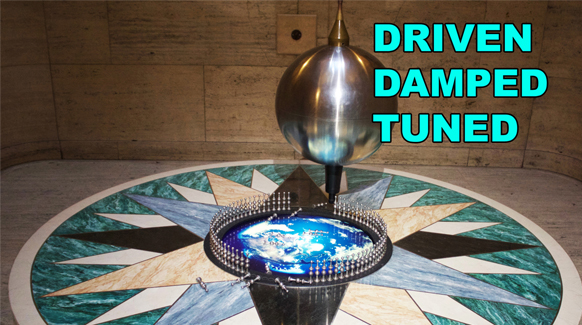
The Foucault Pendulum cannot demonstrate absolute motion. All such
pendulums are Driven, Damped and Tuned because no pendulum can be perfectly
balanced, no pendulum can ever swing in a perfect plane due to friction at
the apex and air resistance in the chord, and the fact that the bob has
volume.
The equation for a pendulum assumes that there is no tension in
the cable, the apex has no friction, and the bob has no volume. But such a
pendulum is an imaginary pendulum, having little in common with pendulums
which are used to “prove” that the earth is rotating on axis. i.e. a
perfectly balanced pendulum is needed to prove absolute motion, and that is
an impossibility.
If the pendulum is not DAMPED, it begins to swing in a
figure 8 path, goes out of control and becomes useless. It needs to be
DRIVEN because it loses momentum with every swing and its path becomes
shorter and shorter. It needs to be TUNED so that it swings the “exact same”
arc length each time. In addition, pendulums precess both clockwise and
counter-clockwise!! That I am sure is a shock to most inquirers!!
Of course each one of these intrusions into the
pendulum’s natural motion make the pendulum an irrelevant tool in
determining the absolute rotation of the earth.
In addition, celestial
forces which control the tides of the oceans will also be working on a
pendulum, making it a useless tool in determining absolute motion. The same
forces apply to Coriolis motions.
There is just no possible way to prove
absolute motion. People much brighter than me have tried it over and over.
Finally they realized that all their efforts were a waste of time and money
because they were longing to prove the unprovable. The quotes on my webpage
prove beyond a shadow of a doubt that absolute motion and rest are
impossible to experience.
A good scientist should first be a good
philosopher. Sadly good epistemology and philosophy of science is hardly
ever taught in our schools!!
Dismissing quotes by dead astronomers is not
how we do scholarly work. Address the point made by each writer. Do not
indulge in personal attacks.
If we do not agree that All motion is
relative, there is no point in continuing this conversation. I deal only
with facts and not with fantasies.
It may be convenient for certain purposes to regard the earth as
the centre; but nothing can oblige us to do so. No part of the universe–
Earth, Sun, or anything else– has any unique right to be called the
‘centre.’ Observed motions are all relative, and it is a matter of decision
what point in the universe is to be selected as the central origin of
reference. So the view that the earth is moving is just as admissible as the
view that it is at rest.
 |
Stephen Toulmin; (1922-2009);
& June Goodfield; (1927-2025);
The Fabric of the Heavens; 1961; p169
|
 |
From the point of view of modern science[…] there is no absolute frame of reference, only frames which
are more or less convenient to use for the purpose at hand. A geocentric frame is useful for everyday activities, while a heliocentric frame is
[useful] for solar-system mechanics […]
Wikipedia; Geocentric Model
 […]
it does not appear to me that there can be any motion other than relative; so that to conceive motion there must be at least conceived
two bodies, whereof the distance or position in regard to each other is varied. Hence, if there was one only body in being it could not possibly
be moved. This seems evident, in that the idea I have of motion does necessarily include relation.
[…]
it does not appear to me that there can be any motion other than relative; so that to conceive motion there must be at least conceived
two bodies, whereof the distance or position in regard to each other is varied. Hence, if there was one only body in being it could not possibly
be moved. This seems evident, in that the idea I have of motion does necessarily include relation.
George Berkeley (1685-1753); The Principles of Human Knowledge 1710/; s112
 No one is competent to predicate things about absolute space and absolute motion;
they are pure things of thought, pure mental constructs, that cannot be produced in experience.
No one is competent to predicate things about absolute space and absolute motion;
they are pure things of thought, pure mental constructs, that cannot be produced in experience.
But if we take
our stand on the basis of facts, we shall find we have knowledge only of relative spaces and motions. Relativity, not considering the
unknown and neglected medium of space, the motions of the universe are the same whether we adopt the Ptolemaic or the Copernican mode of view. Both
views are, indeed, equally correct; only the latter is more simple and more practical.
Ernst Mach; (1838-1916);
The Science of Mechanics; 1893/1942; p229; p284
That should be sufficient for any
thoughtful person to understand that the Helio-GeoCentric controversy took place because both sides of the dispute insisted
upon the fallacies of absolute rest and absolute motion.
Men’s longing for material absolutes has manifested itself over the ages with presumptions of “absolute” Space, “absolute” Time and “absolute” Motion. None of these “absolutes” could possibly exist,
yet to this day, those who should know better, continue to pay homage to these and other figments of their imaginations and urge others to join in their idolatry.
Does the Earth go around the Sun,
or does the Sun go around the Earth?
Take your pick, whichever is most useful for the purpose at hand.
To ask the question expecting an Either/Or answer, or to answer the question as Either/Or is clear evidence that the Nature of Motion has NOT been understood.
Among those who accept and
defend the historic position of Protestantism, interest has recently increased in the philosophy of science. This interest does not arise merely
or even mainly from the implications of biological evolution, but rather in part springs from a broader concern with philosophy as a whole and in part
from the presence and activity of the scientists among us. The importance of formulating a philosophy of science, whether by Christian thinkers or by
secular thinkers, needs no emphasis. What is needed, is, rather, a warning of the difficulties and dangers that attend the attempt. One of these
dangers is seen in the frequent neglect of a most basic problem. And the aim of this paper is to bring to the fore the general problem of motion.
The main proposition, the justice of which this paper hopes to support, is that no philosophy of science can be
acceptable unless it satisfactorily disposes of the problem of motion.
Although the ancients gave serious thought to this matter, recent philosophy has unfortunately made little progress in
explaining motion and modern science has made none at all. On this subject the scientists seem satisfied with a famous statement of Sir Isaac Newton.
Near the beginning of his
Principia, in the Scholium after
Definition VIII, he says,
“I do not define time, space, place, and motion, as being well known to all.
” Now, Sir Isaac Newton was a scientific genius of first order, and therefore he is
entitled to make a blunder of first order without diminishing his fame. Such a blunder was this assertion, for time, space, and motion are by no means
well known to anybody. Recent physics has to some extent seen the need of examining the meaning of time and space; but if any uneasiness about motion
has been felt, it is at least safe to say that no explanation has been achieved. The situation today remains about the same as antiquity left it.
That situation was a stalemate. The Eleatic arguments against the possibility of motion still oppose the Aristotelian explanation of motion.
Since the latter is not too convincing, the Eleatic arguments are dismissed as poor jokes that scientists ought not to bother with. To forget is to solve.
The original joke was Zeno’s paradox of Achilles and the tortoise. In that
notable race, when Achilles had once allowed his competitor a head start, it slowly dawned on him that he could never overtake the tortoise. Two thousand
years have passed since Zeno first told this story, and still no refutation of it commands universal assent. The replies are superficial. One calculates
how far Achilles could run in ten or thirty minutes and places him far ahead of the tortoise. Another balances the infinite divisibility of space against
the infinite divisibility of time. Aristotle (Physics VIII) addressing himself to the simpler form of the paradox, that of a single body exhausting
an infinite series of points as it moved toward a fixed terminus, argued that the moving body does not actually pass through an infinite series of
points. Zeno, says Aristotle, treats one point, the midpoint, as two. He takes it as both the end and the beginning of a motion. But this can be so
only if the moving body stops at this point and then begins again. If the body is in continuous motion, none of these mid-points is “actualized.” The
points and the divisions are only potential and do not actually exist. Therefore although it is impossible to pass through or exhaust an infinite
number of actual points, there is no difficulty in passing through an infinite number of potential points.
There is another attempt to answer Zeno. One may protest since an infinite series does not have a last term, Zeno cannot
require the moving body to reach the last term before it starts to move. He cannot erect as a barrier to motion a factor that admittedly does not exist.
And yet, did Zeno say that it was necessary to reach the last term? Will not his paradox remain if he simply asserts that motion can not begin so long as
there are more terms in the series. And this is long enough.
Well, perhaps a slightly different expedient will allow the body to move. Let us grant that in any finite space an
infinite number of points actually exist. Let us also grant that to move from here to there a body must pass through
all
of these points. But let us deny that the body must pass through
each
of these points. That is, we claim, Zeno confused a
collective
all with a
distributive
each. He supposed, mistakenly, that whatever is true of one must be true of the other. Yet
there are many examples where the collective all has qualities quite different from the distributive each. Each nail in this keg is easy to pick
up; but it is difficult to pick up all of them. Similarly what is true in every case is not necessarily true in general. Aristotle argues that
although a theorem be proved for each of the three types of triangle, it has not on that account been proved a triangle generally. Or, finally, each
element of a compound may be poisonous (NaCl), but the whole may be good to eat. Zeno therefore was mistaken because he insisted that a moving body must
pass every point, when as a matter of fact it need only pass all of them.
Perhaps this last solution is not so suspicious as the previous ones were. But even so, it would only remove an
Eleatic objection to motion: it would not furnish a theory, a definition, an explanation of motion. And this last is what is needed. Professional,
practicing scientists like Newton may no doubt be excused if they refuse to tell us what motion is; but a philosophy of science cannot decide to bury a
problem simply because it has remained so long unsolved. And if motion is basic to all science, one wonders how any natural phenomenon can be
explained before this. We cannot, then, dodge the question, What is motion?
In the
Physics, Book III, Aristotle begins a determined attack on the problem of motion. He spares no effort to arrive at
a solution. And effort is required, for the explanation of motion must make use of the concepts of continuity, infinity, place, time, and perhaps void.
This is a constant trouble with philosophic subjects. One hardly begins a topic before one discovers that another matter calls for prior attention. We
are always being pushed back or forward, until it seems impossible to solve any one problem without solving all. Omniscience is the prerequisite, and
omniscience is hard to come by. But Aristotle makes a brave beginning. The Pre-Socratics had failed to unravel the enigma of motion, chiefly because
they did not know what motion is. Their halting hints were faulty as definitions. Within this section (Physics
III, 1) Aristotle formulates the definition of motion three times. First, he says that motion is the
actualization – literally, he says the actuality – of the potential
qua
potential. This cryptic phrase is then explained. When that which is buildable, insofar as it is buildable, is actual, it is being built; and
this is the motion or change called building. Note that the completed house is not buildable; it is built, and the motion is completed. Nor is the
actuality of brick and wood motion: insofar as the materials as such are concerned, the motion has not yet begun. This motion therefore is the
actualization of the buildable
qua
buildable.
Aristotle must insist on the importance of the
insofar as, the
qua, the
as such. Bronze is potentially a statue; but the actuality of bronze
qua
bronze is neither a statue nor motion. To be bronze and to be movable do not mean the same thing. Or, again, to be
potentially healthy is not the same as to be potentially sick; for, if it were, to be actually healthy would be to be actually sick. Of course the
same person may be sick or well; but the potentialities are different. Motion thus is the actualization of the potential
qua
potential.
The second time Aristotle formulates the
definition he says, “Motion is the actuality of a potential being when it
operates in actuality not insofar as it is itself, but insofar as it is
movable.” The third formulation, a few lines below, is essentially a
repetition of the first. Now, the second of these three formulations is
clearly untenable: it is obviously circular. To define motion as the
actuality of the moveable is to use the concept of motion in its own
definition. How could one know what
moveable
means, i.e., able to move,
unless one first understood motion? This circularity is present also in the
example given under the first formulation. What
buildable
means cannot be known until the motions of building are understood. Either then Aristotle
has made a circular blunder, or the first and third formulations must somehow escape this criticism. It is not at all certain that the second
formulation is a mere slip of the pen which is excusable in the light of the other two. In
Physics
VIII, 1 (251a8), a passage presumably referring to
Physics
III 1, Aristotle again defines motion as the actuality of the moveable qua moveable. Similarly, a few pages later (257b8) he says
“Motion is the incomplete actuality of the moveable.” It would seem therefore that the taint of circularity is more than merely superficial.
However, Aristotle should be given every opportunity to rebut this charge before a final judgment is entered. Since
he furnished two other formulations, these also should be examined. And it must be admitted, they contain at least no apparent circularity. Motion is
the actualization of the potential qua potential. It is requisite, however, to state what is meant by the term potential. In fact, two requirements must
be met. First, the term potential must be defined without using the idea of motion, or else the circularity will reappear; and, second, the idea of
potentiality must be set forth clearly and unambiguously, or else all physics will remain vague and confused. The clarification of the concept of
potentiality is found more in the
Metaphysics
than in these discussions on motion. In Book Delta he says, “Potentiality is a source of motion and
change which is in another thing than the thing moved, or in the same thing qua other … Potentiality then means the source of change or motion…” It would seem, however, that this is not altogether satisfactory. In the
Physics
Aristotle defined motion in terms of potentiality, and now in the
Metaphysics
he is defining potentiality in terms of motion. Circularity therefore has not been avoided, and
we still do not know what motion is.
There is, however, another passage. In Book Theta of the
Metaphysics
(1048 a 30-b 6) Aristotle defines actuality. “Actuality means the existence of an object, but not in the manner we call potentiality. We say, for
instance, that a statue of Hermes is potentially in the block of wood … because it can be cut out of it. We call a man a scholar even when he is not
studying, if he is actually capable of studying …
We must not seek a definition of everything, but be content to grasp an analogy: that as he who is building is to him who can build, and as he who sees is to him who,
though not blind, has his eyes shut … so actuality is defined by one member of these antitheses and potentiality by the other.” Even in this more
extended passage it is a question whether circularity has been avoided. Cutting the statue out of wood, studying, and seeing are motions; and thus
potentiality and actuality are explained on the basis of motion.
Motion, then, cannot properly be defined in terms of potentiality.
But, says Aristotle, this is not a definition. Potentiality cannot be
defined. It must be grasped by analogy. As he who is asleep is to him who is
awake, so potentiality is to actuality. Now, the man who is asleep is
horizontal and the man who is awake is vertical. Is this what Aristotle
means? Of course not. But it is hard to tell what he means, for there are
many comparisons that can be made between men asleep and men awake. The
former dream, the latter do not. How can one select which point of
comparison is intended? It would seem therefore that even if Aristotle has
avoided the apparent circularity, he has not given us a clear and
unambiguous concept of potentiality.
This argument may now seem to have become all
too intricate; but the conclusion should be disturbing enough to jolt one
out of any tendency to doze. The conclusion is not that Aristotle got
himself into a jam: such would be merely a piece of historical information.
Nor is the conclusion simply the meaninglessness of the concept of
potentiality and the uselessness of analogical definitions. Such is of
course a valuable warning to any ambitious philosophers who are unknowingly
starting up a blind alley. But there is the much more disturbing conclusion
that the problem of motion remains unsolved. And in the recesses of our
oblivion there still lurks the skeleton of Zeno’s Achilles.
Perhaps motion is just nonsense.
Newton, as has been said, failed to extricate science from the difficulty because he assumed that the meaning of motion was known to all.
On this assumption he proceeded to discuss particular forms of motions. The
futility of this procedure is clear enough to philosophers, but perhaps scientists wonder why ancient puzzles should be allowed to hinder modern
science. For the reason something, as brief as possible, should be said about two important Newtonian laws; the law of inertia and the law of
gravitation. The first of these asserts that a moving body continues indefinitely in a straight line unless subjected to an impressed force; and
the second is an attempt to explain the curvilinear motion of the planets.
Now, the best known of all Newton’s pronouncements is the one that reveals his failure to explain planetary
motion. The law of gravitation expresses with mathematical accuracy the forces necessary to change the rectilinear or inertial motion of a planet
into an elliptical path. But when one asks the question, what impresses these forces? Newton replies,
Hypotheses non fingo. Cajori, Newton’s recent
editor, has collected some of Newton’s letters (Principia, Appendix, not 6, pp. 632-635) in which he clearly expresses the limitations
of his mathematical law. Gravity, newton declares, is not a property of bodies; if it were, one body would act on another at a distance, and this is
manifestly absurd; indeed, “We are ignorant of the essential properties of matter.” Mathematics only measures the quantity of the force; it says
nothing about what impresses the force. Newton himself thought it possible that God impresses this force; but this theological opinion is obviously not
a part of experimental science.
Therefore science has failed to show what forces the planets out of a rectilinear path.
Now, finally, what is the value of the law of inertia? This law states that a moving body continues in a straight path
unless compelled to change by an impressed force. The difficulty with this law is well known.
To determine a straight line a fixed point is needed.
If a hawk in search of a meal flies always toward another bird, and the other bird is darting hither and
yon, the hawk obviously does not fly in a straight line. And if a rocket could be fired so as always to be pointing to the moon, it would not
describe a rectilinear path.
The determination of a rectilinear path requires a fixed object in absolute space. But there are no fixed objects. The “fixed” stars are not fixed.
Hence the law of inertia has no application.
It is completely impossible to discover a body moving in a straight line.
Since this paper is but one section of a larger argument, later conclusions are not here sufficiently prepared for; yet it seems that one
subsidiary but important point may be made. The problem of motion, particularly the general problem, but also even some special problems remain unsolved.
Space, time, and motion are not “well known to all.”
In this situation a philosophy of science that pretends to justify scientific knowledge of nature is left without any knowledge to justify. Can anything be known about nature if no one knows what space, time, and motion are? Can it even be known that science is supposed to talk about nature?
Wittgenstein, whose unwise assertions approximately equal Newton’s wise ones, is surely allowed one very wise
remark to match Newton’s blunder;
“Whereof one cannot speak, thereof one must be silent.”
thegordonhclarkfoundation.com


