A common definition for the word knowledge is given as:-
“Knowledge is Justified True Belief.”
Is this a valid definition of “knowledge”?
We need to examine this proposition by substituting the
nine
different
ways that the word
IS can be used in a proposition.
1- The
IS of Existence
“Knowledge EXISTS Justified true belief” is a
meaningless sentence.
Since we are not debating the existence of knowledge
or belief, this use of
IS
is not applicable.
2- The
IS of Predication
Is “Justified true belief” an attribute of
“knowledge”? Is it a description, or property of “knowledge”? This is a
fatal error because “knowledge” is mistaken to be a kind of “belief,” a
“true belief.” The
Means of knowing
is confused with
the Object of knowing.
3- The
IS of Class-Inclusion
Does “Justified true belief” belong to a class of information called “knowledge”? Again, the
Means of knowing
is confused with
the knowledge that one receives from an Object of Faith.
4-
The
IS
of Finding Oneself
We convert the proposition
“Knowledge is Justified true Belief,” into its expanded form and we get “Knowledge
Finds Itself in Justified True Belief.”
Knowledge “Finding Itself” is a meaningless assertion.
5-
The
IS of Consequence
We convert the proposition
“Knowledge is Justified true Belief,” into its expanded form and we get “Knowledge is the Consequence of Justified True Belief.
6-
The
IS
of a Metaphor
This copula does not apply to this question.
7-
The
IS of a Simile
This copula does not apply to this question.
8-
The
IS of an Idiom
This copula does not apply to this question.
9- The
IS of Identity
“Knowledge” and “justified true belief” are identities. Again, this definition of knowledge commits the same error as in #2 above.
All except #5 above are invalid
statements because they all make the mistake of identifying knowledge with belief or are meaningless claims.
10- The
IS
of Activity
This copula does not apply to this question.
11- The
IS
of Quantity
This copula does not apply to this question.
The
IS of Consequence is the only grammatically valid option, but we need
to examine it further since it can be misunderstood.
First we need
to simplify the proposition by removing the adjectives or modifiers of the
word ‘belief.’ We need to start with the simplest form of the proposition,
which is “Knowledge is belief.” Then by substituting the IS of Consequence,
we arrive at “Knowledge is the Consequence of Belief.”
“Knowledge is the
Consequence of Belief” is another way of saying “Knowledge is acquired
through faith.” Or, in other words, if we want to know, we must first
believe.
This is the correct nature of knowing. It is NOT the definition
of knowledge.
To call “Knowledge is belief” a “definition” of knowledge is
incorrect.
The definition of knowledge is better said to be
information or data. To Know means that a person is acquainted with facts.
On the other hand, the definition of belief is an expression of
trust or having confidence in something or someone. It is the state of
trusting in something or someone.
So to say that the definition of
Knowledge is belief, in the sense that knowledge and belief are identities,
is not helpful at all, but a hindrance to understanding the nature of
knowing. It is completely incorrect.
But when we understand the IS in
that sentence as meaning Consequence, then we have arrived at a correct
epistemology. We have simply realized that ALL knowledge is acquired through
faith.
Without believing there can be NO knowing.
If one wants to know,
he MUST exercise faith. He must believe in someone or something.
Now one might wonder if modifying the word belief by ‘justified’ and ‘true’
in some way helps to define the word
Knowledge.
The claim is that Knowledge is Justified true Belief. Is this of any help to
us to understand what Knowledge means?
In addition, modifying the word belief by
‘justified’ and ‘true’ shows a serious misunderstanding of our fallible
nature.
Knowledge is information, it
is a set of statements or propositions that do not have any relationship to
anyone’s belief about their validity.
Knowledge remains valid whether anyone has believed it or not. Anyone’s
belief or unbelief about a bit of knowledge has NO bearing on the validity
of the knowledge in question.
Introducing the idea of justification
into the formula of knowing only complicates the issue. It is of no help at
all, because justifying one’s belief is another matter altogether. We are
trying to understand the act of knowing. Whether a belief is justified or
not is not yet in question. First we must see the relationship between
knowing
and
believing, and we can see from the above analysis of
“Knowledge
is Justified true Belief” that that is not a valid proposition.
Knowledge
is data unrelated to any mental assent by any human. Knowledge exists on its
own.
Belief
is a mental assent, it is an act of placing trust in something or someone.
e.g. Two strangers meet each other. They know nothing about each other.
Each person is a storehouse of information. They have knowledge that
the other person does not know and might or might not be interested in. The
data that each possesses is not only personal information, but information
that they have accumulated throughout their lifetimes about past personal
experiences. Some of these experiences might be common experiences, such as
the fact that both might have experienced rain, or snow; or both of them
might have driven a car or hiked up a certain mountain. But most of the
information in each person’s mind will be data experienced solely by each
person and are not experiences common to both persons. If that information
is withheld by one or the other person, there is no way that the other
stranger can guess what is in the mind of the new friend. Neither one can
know of the other’s experiences until one or both begin to “reveal” their
experiences to the other.
If they have no reason to doubt the other
person’s veracity, they have no reason to withhold their assent to the
other’s revelations. They exercise their FAITH, they begin to believe what
the person has told them about their person, such as their name, and/or
about their past experiences. They can now state within reasonable bounds
that they have acquired KNOWLEDGE or information about the other person,
which they did not possess before they met.
This shows that knowledge and belief are two very different things.
One is data that does not depend on anyone’s belief or unbelief.
The
other is a voluntary assent to new information, a trust, a belief in the
person that has made information available to him thru his words;
information that would not have been discoverable any other way.
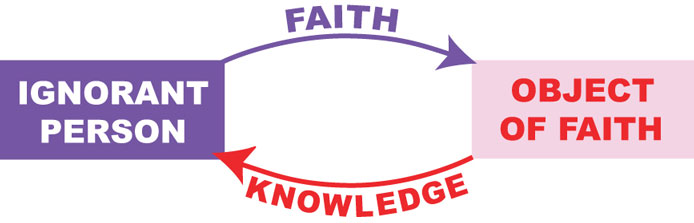
The graphic representation of the process of
knowing is a simple one.
The ignorant person
is faced with a person who has knowledge.
(The Object of Faith.)
To acquire that knowledge, the
ignorant person must place his faith, he must BELIEVE, what
the knower says to him about himself.
The ignorant person is now enriched with
knowledge that he did not have before. He
has acquired Knowledge, he has added information to his storehouse of
knowledge.
The
only way to know is to believe in the person who has offered him new data
that he was not aware of before they met.
Knowledge is
Information. It is not related to
belief in any way. It is not dependent on anyone’s belief, to exist as valid
data.
Belief is a voluntary mental act,
a trust, it is an expression of confidence in the
knowledge giver.
“Knowledge is Justified
true Belief” is NOT a valid definition of knowledge because it confuses
Knowledge with Belief. It tries to make knowledge a kind of belief, and
there is absolutely no justification for such an erroneous definition.
Justification of a
person’s belief is a different matter altogether.
Please visit The Nature of Knowledge
page for further clarification.


