CHAPTER V of
A Christian View of Men and Things*
by Dr. GORDON H. CLARK
SCIENCE
THAT theism gives coherence to history,
politics, and ethics, whereas naturalism does not, has been the positive
argument of the preceding chapters. Both the humanistic denial of God’s
existence and also that form of agnostic theism, if such a designation
be permitted, that fails to apply the concept of God in all phases of
knowledge, seem to have reduced history to a tale of human frustration,
politics to a system of brutality and torture, and ethics to the lustful
conflict of moral anarchy. On the other hand it has been shown that
Christian theism furnishes a basis for significance in history, orderly
freedom in government, and a life that is still called respectable west
of the iron curtain. Therefore, anyone who for some personal motive
desires this type of life would, if impressed by the argument, be
inclined to adopt a theistic worldview.
Science and Knowledge
This constructive argument can proceed no further without facing squarely
some very fundamental objections. The issues of history and politics, it
may be said, are so vague and general, or at least the methods employed
in those studies are so crude, that any plausibilities derived from them
would have to yield to the accurate result of the positive sciences. It
is unreasonable to attach much importance to the plausibilities of
philosophic speculation when the empirical methods of the laboratory can
discover the truth. Furthermore, an appeal to personal desires and
comfortable conclusions is a notorious source of self-deception. It may
be true that unyielding despair is not so pleasant as a belief in Divine
Providence; but if the facts prove the mechanical laws of physics, our
wishes cannot alter the matter. Science claims objectivity; no personal
or emotional bias contributes to its results; whereas grandiose theories
of history are largely, even if not altogether, the products of a
fertile imagination. It is only honest therefore, and in the long run it
is only wise, to face the facts.
Centuries ago it may have been possible to
ignore science‒ in fact centuries ago there was little science to
ignore‒ but today its successes are so phenomenal that it is usually
accorded the last word in all disputes. The younger generation can
hardly realize that so simple a thing as the incandescent electric bulb
came only yesterday. Today science receives its praise and respect by
reason of the atomic bomb, bacteriological warfare, and the possibility
of interplanetary travel. None of this may be desirable, but truth is
not a matter of desire; and the methods that have produced these
wonderful products of civilization are capable of answering every
question. As Auguste Comte explained the situation, man began to think
under a religious inspiration, and when the concepts of religion became
patently absurd, man turned to metaphysical properties; but as progress
in clarity is made, the concepts of positive science become a permanent
acquisition, so that never again will the method of learning and the
nature of knowledge change. Not only does positive science discover
facts, but also the classifications of facts are discovered in the
things themselves without the admixture of any apriori hypotheses or
subjective preferences. The idea of God, Comte concluded, depends on
atavistic mythologizing, and God as a matter of fact does not exist. Or
perhaps the objection will more modestly claim that even if God exists,
he cannot be known; or less modestly that he can be known to have no
direct interest in human affairs. The arguments of such an objection to
the conclusions of the previous chapters cannot be overlooked.
The compulsion to face these objections,
which is laid upon a theist who has stressed the problems of ethics, is
all the more stringent because the objectors themselves sometimes
contrast their own moral righteousness with the dishonesty of theism. T.
H. Huxley asserted that the foundation of morality is to renounce lying
and give up pretending to believe unintelligible propositions for which
there is no evidence and which go beyond the possibilities of knowledge.
In a similar vein W. K. Clifford said, “It is wrong always, everywhere,
and for anyone to believe anything upon insufficient evidence.”1 The
import and context of these statements is a general repudiation of
theism in favor of a scientific method that obtains indisputable truth.
Or, reference might have been made to more detailed scientific works,
such as The Mechanistic Conception of Life by Jacques Loeb, the volumes
on behaviorism by J. B. Watson, and more fundamentally the physics of La
Place, Haeckel, or even Ernst Mach, all of whom in one way or another
construct a scientific worldview that makes theism impossible.
To show the bearing of science on theism,
some quotations from distinguished contemporary scientists should be
made. Without doubt, Professor A. J. Carlson is a distinguished
scientist, as is attested by his writings and by his presidency over the
American Association for the Advancement of Science. Religious ideas and
their relation to science have attracted his attention, and his
conclusions are found in the twice published article, Science and the
Supernatural.2 One must note what he says on the nature of science as
well as what he says on its relation to religion. He writes,
“Probably the most
common meaning of science is a body of established, verifiable, and
organized data secured by controlled observation, experience, or
experiment[…].The element in science of even greater importance than the
verifying of facts, the approximation laws, the prediction of processes
is the method by means of which these data and laws are obtained and the
attitude of the people whose labor has secured them[…].
What is the method
of science? In essence it is this‒ the rejection in toto of all
non-observational and non-experimental authority in the field of
experience[…]. When no evidence is produced [in favor of a pronouncement]
other than personal dicta, past or present ‘revelations’ in dreams, or
the ‘voice of God,’ the scientist can pay no attention whatsoever,
except to ask: How do they get that way?”
Parenthetically it
may be remarked that this description of the nature of science somewhat
resembles Karl Pearson’s statements in his famous Grammar of Science to
the effect that
“The classification of facts and the
formation of absolute judgments upon the basis of this classification‒
judgments independent of the idiosyncrasies of the individual mind‒
essentially sum up the aim and method of modern science [ital. his][…].The
classification of facts, the recognition of their sequence and relative
significance is the function of science.”3
Not only does Carlson reject non-experimental
authority, but he also combines with his empirical scientific method a
disjunction between knowledge and belief that can be turned to his
embarrassment. In the article just quoted he continues,
“The scientist tries
to rid himself of all faiths and beliefs. He either knows or he does not
know. If he knows, there is no room for faith or belief. If he does not
know, he has no right to faith or belief.”
He then illustrates his point by listing
several Biblical miracles, some of the views of the Koran, the Vedas,
the Book of Mormon, and the writings of Mary Baker Eddy; and then
without fear of successful contradiction concludes, “a good deal of
‘revealed’ information about the nature of the world and the nature of
man has proved entirely erroneous.”
The extent to which science, according to
Professor Carlson’s experimentation, prohibits belief in the
supernatural is most clearly stated a page or two later.
“Many intelligent
people[…] retain a distillate of the supernatural in form of beliefs in a
‘moral purpose’ in the universe. And having injected human ethics into
an obviously a-moral universe, they endow man with personal
immortality[…]. Even this form of the supernatural has no sanction in
science or analyzed human needs, as I understand them.”4
In the late
nineteenth century a theological movement headed by Albrecht Ritschl
tried to harmonize science and religion by a radical bifurcation of
consciousness. Science was to deal with speculative truth, while
religion was to concern itself with practical value-judgments. Since
there was to be no truth in religion and no value in science, conflict
could not arise. If this remarkable solution ever satisfied the liberal
theologians, it never became the most popular view among scientists.
Karl Pearson presumably speaks for all science when he says,5
“The goal of science
is clear‒ it is nothing short of the complete interpretation of the
universe.” And, “Science does much more than demand that it
shall be left in undisturbed possession of what the theologian and
metaphysician please to term its ‘legitimate field.’ It claims that the
whole range of phenomena, mental as well as physical‒ the entire
universe‒ is its field. It asserts that the scientific method is the
sole gateway to the whole region of knowledge.”
Reflection on these
quotations raises a series of puzzling questions, some of which ought to
be answered by the serious theologian and scientist alike. Clifford and
Huxley, and anyone who opposes them, ought to make clear
what is sufficient evidence.
Is evidence sufficient only when it is logically demonstrative? Would
Clifford and Huxley be satisfied with something less than demonstration,
and if so how much less? More fundamental is the plain question, What is
evidence? Comte and Pearson assume that facts and classifications can be
empirically discovered. But can they? Comte was certain that the
positive character of knowledge, now that it has passed beyond the
theological and metaphysical stages, will never again change. But if
Comte is the father of sociology, it is one of his own sons, Sorokin,
who is sure that it will change again and again. Further, must we hold
with Karl Pearson that the judgments of science are absolute? Will a
judgment or fact, once for all discovered, never be abandoned in favor
of a more up-to-date fact or judgment? Do scientists never revise their
conclusions? And very much more to the point, is the scientific method the sole gateway to
the whole region of knowledge? What experiment or what evidence is
sufficient to prove that science is the sole gateway to all knowledge
that is yet to be obtained? If there
is a God, is it absolutely necessary that his existence be discovered by
some infinitely sensitive Geiger counters? If moral distinctions and
normative principles exist‒ in particular, Carlson’s principle that a
scientist has no right to believe anything‒ must such principles be discovered through a
microscope? And finally, and very
generally, what is scientific method? One must seriously question not
merely the desirability but the possibility of rejecting in toto
all non-observational and non-experimental authority in science. In
other words,
What is science?
Most of these questions, to be sure, do not
seem to be very religious, and one may fear that they are irrelevant to
a discussion of theism. Quite the contrary, the pertinence of scientific
objections to the supernatural depends entirely on the nature of science
and its limitations, if any.
Perhaps the easiest
way to commence the discussion of this extraordinarily complicated
subject is to dispose, first of all, of a popular notion that probably
no longer commands wide acceptance. It is essentially Pearson’s notion
that science gives absolute judgments. The conclusions of science have
often been regarded with an awe that takes them for final and infallible
truth‒ science simply cannot be wrong. The history of science, however, shows that
scientific method does not invariably arrive at the truth.
For example, science is indebted to Gilbert for his experiments on
magnetism. He used and had confidence in the scientific method. The
ancient Stoics (and should we add the modern personalists?), who declare
that the earth is a living being, he treats with scorn and derision;
whereas true science can arrive at conclusions “not with mere
probability, but with certainty.”6
Now, it were as foolish as false to deny that Gilbert was an important
scientist; yet his procedure did not prevent him from asserting that it
is the earth’s magnetism, its verticity, that holds it in its rotational
course. He also identified the earth’s poles with the magnetic poles and
dismissed the variation of the needle as due to some unknown obstacle.
And one may even wonder whether his own ascription of a soul to the
earth and his concept of an astral magnetic mind are so very far removed
from the Stoic superstition he derides. No doubt excuses can be made for
Gilbert, and his unfortunate remarks do not detract from his solid
accomplishments. He lived at an early date; scientific methodology had
not yet been adequately developed; and he was handicapped by the
absurdities of medieval confusion. But is it entirely certain that
scientific methodology is now adequate and that scientists are no longer
handicapped by post-medieval confusion? To forestall the neglect of this
consideration, a more recent example may be cited. Robert W. Woods began
his volume on Physical Optics by describing the theory of the
spectrum held before the time of Newton. It was thought at that time
that the prism somehow manufactured the colors of the spectrum. Then
Newton passed a beam of white light through a prism, produced the
colors, passed the colors through another prism and got his beam of
white light again. This experiment convinced him that the prism does not
manufacture colors that previously did not exist, but separates colors
that were actually merged in the white light. Wood writes,
“Curiously enough
this discovery, which we are taking as marking the beginning of our
definite knowledge about light, is one which we shall demolish in the
last chapter of this book, for our present idea regarding the action of
the prism more nearly resembles the idea held previous to Newton’s
experiments: we now believe that the prism actually manufactures the
colored light.”7
Scientific judgments therefore, far from
being absolute, are, as Plato long ago knew, essentially tentative and
stand in need of constant revision. Scientific procedure does not
invariably grasp the truth; on the contrary it has a long record of
accepting what is later thought to be false.
Facts, Laws, and Verification
But, it may be
asserted, although the laws of science are tentative and are modified
from time to time, becoming more accurate in the process, there are, as
a basis for these approximations, certain absolute facts. After all, a
fact is a fact, and no one can change it. The advantage science has over
theology is that it sticks to the facts. Still, one must not go too
fast. The practical mind that loves facts and distrusts theory should
acquire some patience and pause a while over the theory of facts. There
may at first be reluctance to face the question, What is fact?
Yet, if facts are unyielding absolutes, it ought not to prove too
difficult to show what a fact is. Let us try. Is it a fact that the
earth is round? In the Middle Ages the common people thought it was
flat. Since then, evidence has accumulated (considerable evidence was
known to astronomers during the Middle Ages) and has been disseminated,
until today everyone takes it as a fact that the earth is round. But
strictly, is it the earth’s roundness that is a fact, or is it the items
of evidence that are facts on which the conclusion of the earth’s
roundness rests? For example, the shadow of the earth on the moon during
a lunar eclipse has a round edge: perhaps this is a fact, and
the roundness of the earth is a theory. Of course, it is not a
fact that the earth is a sphere: it is flattened at the poles. But if it
is not a fact that the earth is perfectly round (spherical), what is the
fact? Is it a fact that the earth is an oblate spheroid? But this term
embraces a variety of forms and proportions; which form exactly is the
absolute unchangeable fact? Why not say simply that the earth has some
shape or other? Surely this is a fact‒ though science does not pride
itself on sticking to facts such as this.
Above, it was said that the shadow of the
earth in a lunar eclipse is a fact‒ on which the roundness of the earth
is erected as a theory. But is even the shadow a fact? Is it not rather
the fact that a certain darkness on the moon has a round edge, and is it
not a theory that this darkness is the shadow of the earth?
This type of analysis
seems to lead to the conclusion that all, or at least many, alleged
facts are theories developed out of simpler items of perception. The
problem naturally arises whether there is any fact that is not a theory.
Is there anything seen directly as what it is? No doubt many people at
Atlantic City on a fine summer’s day have seen an airplane high in the
air pursuing an even course; and as they have watched the plane so high
and so small, it has flapped its wings and dived to get a fish. Was it a
fact that it was an airplane, or was this a theory about a small object
in the sky?8
What is a fact?
There is one type of
fact that seems to be preeminently scientific: it is the length of a
line. When a scientist measures the
boiling point of water, he measures a line‒ the length of mercury in a
tube. When he measures the density of gold, he measures a line‒ the
distance on a piece of steel between a scratch called zero and another
scratch called, perhaps, nineteen. Similarly he measures another length
to determine the amperes of an electric circuit.
It may be that scientists never measure anything else than the lengths
of lines; at least it is quite safe to say that no significant
experiment can be completed without measuring a line.
Therefore if science is to be understood, careful thought must be given
to this exceedingly important step in experimentation.
It has been shown that science is not a body of fixed truths, and if the
length of a line turns out not to be a fact, the essential nature of
science will have to be sought, not in its results, but in its methods.
The experimental method, rather than
the particular laws or facts discovered, is the important thing. And to
understand the experimental method, an analysis of the process of
measuring a length is as instructive as it is for determining whether or
not science deals with facts.
Fact or not, the
length of a line, be it mercury in a tube or the distance between
scratches on a dial, is most difficult to ascertain.
To put a ruler against the line and say, “nineteen,” would be altogether
unscientific. The scientist does of course put a ruler of some sort to
the line and does read off nineteen spaces, or whatever it may happen to
be; but he never supposes that this is the fact he wants. After he
measures the distance between the two scratches on his bar of steel, he
measures it again. And strange as it may seem the length has changed.
The lump of gold that a moment before weighed about nineteen units of
the same volume of water now weighs less. When the scientist tries it a
third time, the gold seems to have gained weight, that is, the line has
become longer. The experiment is continued until the rigorous demands of
science are satisfied, or the patience of the scientist is exhausted,
and he finds himself with a list of numbers. Now it may be a fact (the
empirical evidence seems to favor it) that the lump of gold, weighed
these many times, is constantly changing; or the fact may be (not an
impossibility) that the scientist’s eyes blink so much that he cannot
see the same length twice; or both of these may be facts. But instead of
sticking to these facts, the scientist chooses to stick to the fact that
he has a list of numbers.
 These numbers he adds; the sum he divides by
the number of readings; and this gives him an arithmetical average, 19.3
for example. This new value, 19.3, does not occur, we may well suppose,
in the original list. That list contained 19.29, 19.28, 19.31, 19.32,
but never a 19.30. But if this is the case, could the arithmetic mean be
the ‘real’ length of the line, the fact itself? By what experimental
procedure does one determine that the average is the sought-for fact and
that none of the observed readings is? Or, further, would it not be
justifiable for the scientist to choose the mode, or the median, instead
of the arithmetic mean. Is it not a fact that the mode is the length‒ as
much a fact at least as that the average is? Really, is it not more the
fact, because the mode occurred several times in the list, while the
mean has not occurred at all? Or, should we say that in this essential
item of scientific procedure, science throws all the facts
(observations) out the window and sticks to what is not a fact (the
unobserved average)? Perhaps there is an aesthetic delight in averages
that is not found in modes. Unless therefore some balance, some vernier,
some scale shows our senses that averages are facts and that modes are
not, can the scientist do anything but trust his aesthetic taste?
These numbers he adds; the sum he divides by
the number of readings; and this gives him an arithmetical average, 19.3
for example. This new value, 19.3, does not occur, we may well suppose,
in the original list. That list contained 19.29, 19.28, 19.31, 19.32,
but never a 19.30. But if this is the case, could the arithmetic mean be
the ‘real’ length of the line, the fact itself? By what experimental
procedure does one determine that the average is the sought-for fact and
that none of the observed readings is? Or, further, would it not be
justifiable for the scientist to choose the mode, or the median, instead
of the arithmetic mean. Is it not a fact that the mode is the length‒ as
much a fact at least as that the average is? Really, is it not more the
fact, because the mode occurred several times in the list, while the
mean has not occurred at all? Or, should we say that in this essential
item of scientific procedure, science throws all the facts
(observations) out the window and sticks to what is not a fact (the
unobserved average)? Perhaps there is an aesthetic delight in averages
that is not found in modes. Unless therefore some balance, some vernier,
some scale shows our senses that averages are facts and that modes are
not, can the scientist do anything but trust his aesthetic taste?
 However, in any experiment that goes beyond a
student’s exercise, there is more to be considered. The scientist not
only calculates the average, but he also takes the difference between
each reading and the average, and calculates the average of these
differences to construct a figure denoting variable error. The result of
the previous example could be 19.3 ±.01. Suppose now that these
repetitions of one measurement are a part of a much more complicated
problem designed to determine a law of nature. The problem might be the
determination of the law of gravity. As is known, the attraction of
gravity, in the Newtonian theory, is directly proportional to the
product of two masses and inversely proportional to the square of the
distance between them. How could this law have been obtained by
experimental procedures? It was not and could not have been obtained by
measuring a series of lengths and (assuming unit masses) discovering
that the value of the force equaled a fraction whose denominator was
always the square of the distance. A length cannot be measured. If it
could, the experimenter might have discovered that the force between the
two masses, when they are a unit distance apart, was 100 units; he might
then have measured the force when the two masses were two units apart
and have discovered that it was 25 units; and a similar measurement at
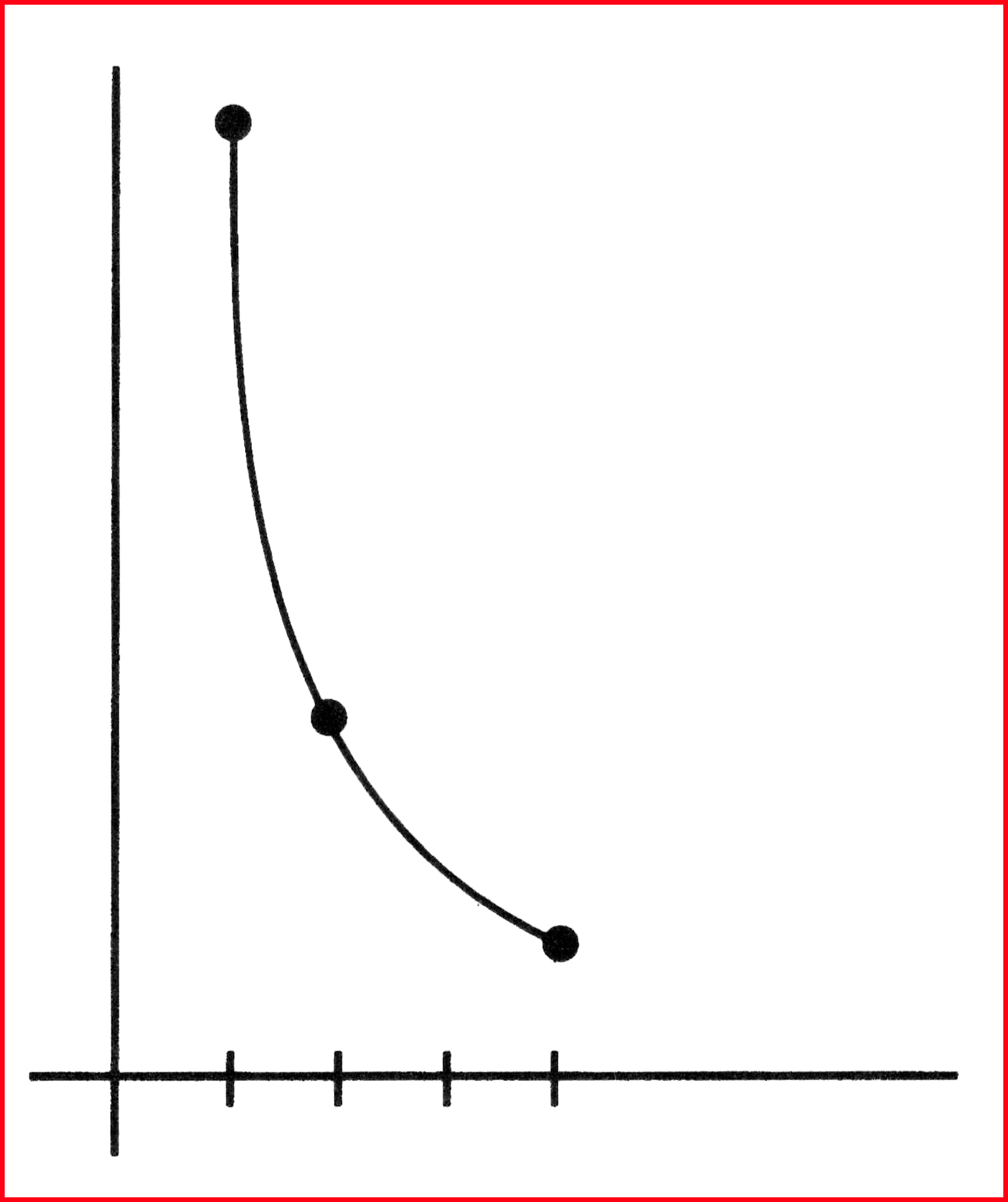
four units distance would have given the value of 6.25. The experimenter
presumably would then have made a graph and indicated the values so
obtained as points on the graph. Measuring four units on the x axis, he
would have put a dot 6.25 units above it; and at two units on the
x axis
he would have put a dot 25 units above it; and so on. By plotting a
curve through these points the experimenter would have discovered the
law of gravity. But as has been seen, the length of a line cannot be
measured. The values for the forces therefore will not be numbers like
6.25, but something like 6.25±.0043. And since the same difficulty
inheres in measuring the distances, the scientist will not have unit
distances but other values with variable errors. When these values are
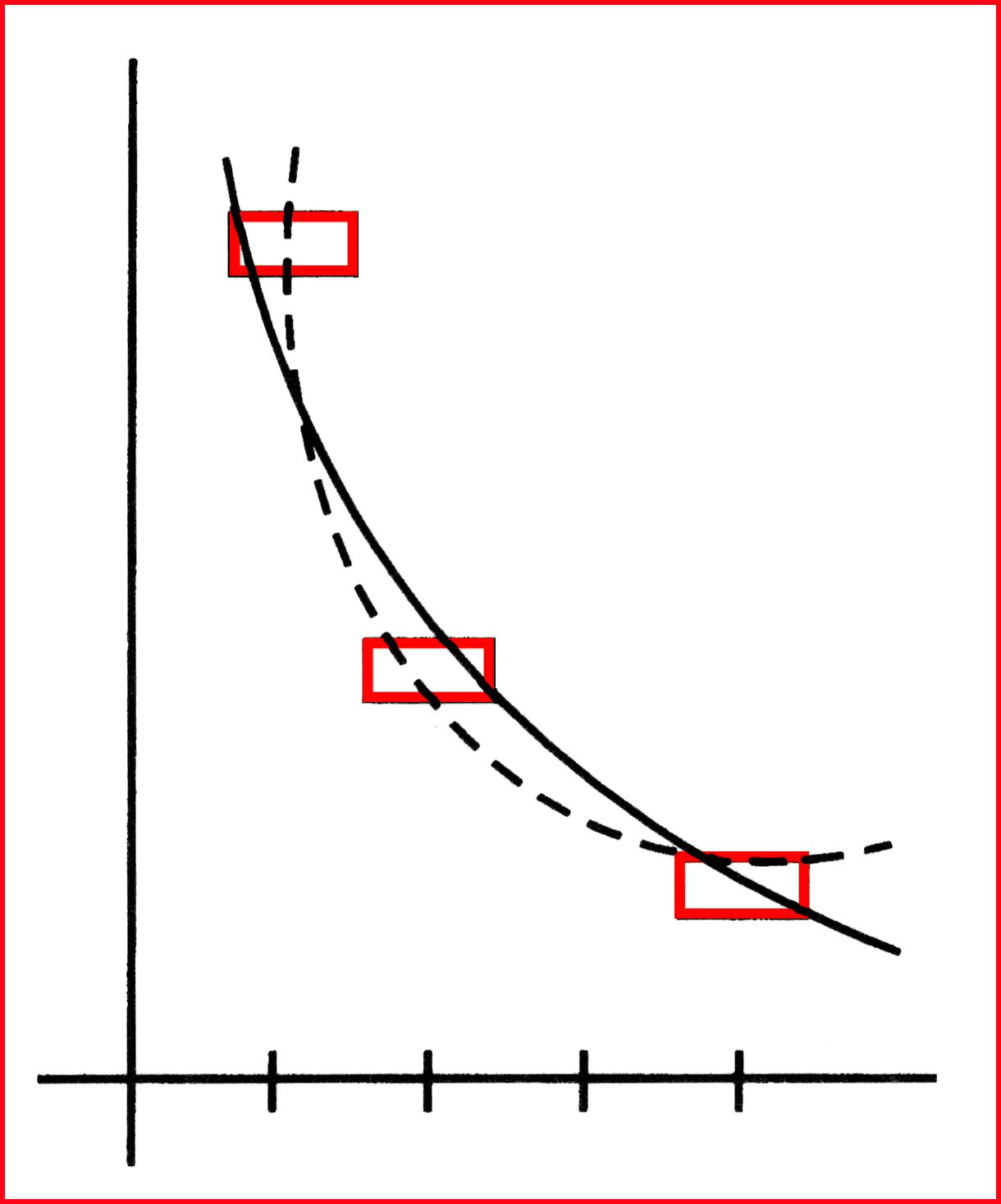
transferred to a graph, they cannot be represented by points. On the
x
axis the scientist will have to measure off two units more or less, and
on the y axis, 6.25 more or less.
It will be necessary to indicate these
measurements, not by points, but by rectangular areas. But, as an
elementary account of curves would show, through a series of areas, an
infinite number of curves may be passed. To be sure, there is also an
infinite number of curves that cannot be drawn through these particular
areas, and therefore the experimental material definitely rules out an
infinite number of equations; but this truth is irrelevant to the
present argument. The important thing is that areas allow the
possibility of an infinite number of curves; that is, measurements with
variable errors allow an infinite number of natural laws.
However, in any experiment that goes beyond a
student’s exercise, there is more to be considered. The scientist not
only calculates the average, but he also takes the difference between
each reading and the average, and calculates the average of these
differences to construct a figure denoting variable error. The result of
the previous example could be 19.3 ±.01. Suppose now that these
repetitions of one measurement are a part of a much more complicated
problem designed to determine a law of nature. The problem might be the
determination of the law of gravity. As is known, the attraction of
gravity, in the Newtonian theory, is directly proportional to the
product of two masses and inversely proportional to the square of the
distance between them. How could this law have been obtained by
experimental procedures? It was not and could not have been obtained by
measuring a series of lengths and (assuming unit masses) discovering
that the value of the force equaled a fraction whose denominator was
always the square of the distance. A length cannot be measured. If it
could, the experimenter might have discovered that the force between the
two masses, when they are a unit distance apart, was 100 units; he might
then have measured the force when the two masses were two units apart
and have discovered that it was 25 units; and a similar measurement at
four units distance would have given the value of 6.25. The experimenter
presumably would then have made a graph and indicated the values so
obtained as points on the graph. Measuring four units on the x axis, he
would have put a dot 6.25 units above it; and at two units on the
x axis
he would have put a dot 25 units above it; and so on. By plotting a
curve through these points the experimenter would have discovered the
law of gravity. But as has been seen, the length of a line cannot be
measured. The values for the forces therefore will not be numbers like
6.25, but something like 6.25±.0043. And since the same difficulty
inheres in measuring the distances, the scientist will not have unit
distances but other values with variable errors. When these values are
transferred to a graph, they cannot be represented by points. On the
x
axis the scientist will have to measure off two units more or less, and
on the y axis, 6.25 more or less.
It will be necessary to indicate these
measurements, not by points, but by rectangular areas. But, as an
elementary account of curves would show, through a series of areas, an
infinite number of curves may be passed. To be sure, there is also an
infinite number of curves that cannot be drawn through these particular
areas, and therefore the experimental material definitely rules out an
infinite number of equations; but this truth is irrelevant to the
present argument. The important thing is that areas allow the
possibility of an infinite number of curves; that is, measurements with
variable errors allow an infinite number of natural laws.
The particular law
that the scientist announces to the world is not a discovery
forced on him by so-called facts; it is rather a choice from among an
infinity of laws all of which enjoy the same experimental basis.
Thus it is seen that the falsity of science derives directly from its
ideal of accuracy. It may be a fact that gold is heavier than water, but
it is not a scientific fact; it may be a fact that the longer and the
farther a body falls, the faster it goes, but Galileo was not interested
in this type of fact. The scientist
wants mathematical accuracy; and when he cannot discover it, he makes
it. Since he chooses his law from
among an infinite number of equally possible laws, the probability that he has chosen the “true”
law is one over infinity, i.e. zero;
or, in plain English, the scientist has no chance of hitting upon the
“real” laws of nature.
No one doubts
that scientific laws are useful: by them the atomic bomb was invented.
The point of all this argument is merely this: however useful
scientific laws are, they cannot be true.9
Or, at the very least, the point of
all this argument is that scientific laws are not discovered
but are chosen.
Perhaps both points
should be maintained. Not only are scientific laws non-empirical, they
must indeed be false. Take for example the law of the pendulum. It
states that the period of the swing is proportional to the square root
of the pendulum’s length. But when the scientific presuppositions of
this law are examined, it will be found that the pendulum so described
must have its weight concentrated at a point, its string must be
tensionless, and there must be no friction on its axis. Since obviously
no such pendulum ever existed, it follows that the law of the pendulum
describes imaginary pendulums and that real pendulums do not obey the
law of physics. Note especially that the analysis does not separate
pendulums under laboratory conditions from pendulums in living-room
clocks, and does not conclude that in the laboratory, but not in the
living-room, the laws of physics hold. The analysis shows that no
physical pendulum, no matter how excellent the laboratory, satisfies the
scientist’s requirements. The
scientist’s world is (on pre-Heisenberg theory) perfectly mathematical,
but the sense world is not.
Naturally a great
many people, steeped in nineteenth century scientific traditions, react
violently to the idea that science is all false. Did we not make the
atom bomb, they say? Does not vaccination prevent smallpox? Cannot we
predict the position of Jupiter and an eclipse of the sun? Verified
prediction makes it forever ridiculous to attack science. This reaction
is of course understandable, however irrational it may be. The argument has not “attacked” science at
all; it has insisted that science is extremely useful‒ though by its own
requirements it must be false. The aim nowhere has been to attack
science; the aim is to show what science is.
How science can be
useful though false is illustrated in a delightful textbook on inductive
logic.10
Milk fever, the illustration goes, until late in the nineteenth century,
was a disease frequently fatal to cows. A veterinarian proposed the
theory that it was caused by bacteria in the cow’s udder. The cure
therefore was to disinfect the cow, which the veterinarian proceeded to
do by injecting Lugol solution in each teat. The mortality under this
treatment fell from a previous ninety percent to thirty. Does not this
successful treatment prove that the bacteria were killed and that Lugol
cured the disease? Unfortunately another veterinarian was caught without
the Lugol solution one day, and he injected plain boiled water. The cow
recovered. Had water killed the bacteria? What is worse, it was found
later that air could be pumped into the cows’ udders with equally
beneficial results. The original science was wrong, but it cured the
cows none the less.
A closer examination
of the logic of verification should be made. In the example above, the
first veterinarian probably argued: If bacteria cause milk fever, Lugol
solution will cure; the disinfectant does cure it; therefore I have
verified the hypothesis that bacteria cause milk fever. This argument,
as would be explained in a course of deductive logic, is a fallacy. Its
invalidity may perhaps be more clearly seen in an artificial example: if
a student doggedly works through Plato’s Republic in Greek, he will know
the Greek language; this student knows Greek; therefore he has read
Plato’s Republic. This is the fallacy
of asserting the consequent, and it is invalid whenever used. But it is
precisely this fallacy that is used in every case of verification.
If the law of gravitation is true, a
freely falling body will have a constant acceleration, and the eclipse
will begin at 2:58:03 p.m.: but freely falling bodies do have a constant
acceleration and the eclipse did begin at 2:58:03 p.m.; therefore the
law of gravitation is true. Or, if the periodic table of atomic weights
is true, a new element of such and such a weight must exist; this new
element has now been discovered; therefore the periodic table is
verified. And, if I eat roast turkey and plum pudding, I lose my
appetite; I have lost my appetite; therefore we had roast turkey for
dinner. All these arguments are equally invalid. But sometimes there is
an adverse reaction if it is claimed that verification never proves the
truth of a scientific law. Is it worse to “attack” science, or to
“murder” logic?
Formation of Concepts
With these
considerations in mind it is now time to outline the most serious
limitations of science. Up to this
point it has been assumed that the meaning of the word length
was known, even though no one could measure a length. Now it must be
asked,
What does length mean?
Does it have an unambiguous definition? Or, are several different things
indiscriminately called length? In general, how are the concepts of
physics to be formulated?11
The difficulty now being approached arises from a source not hitherto
mentioned. The impossibility of obtaining a fact in science, of
discovering the length of a line, depended psychologically on the
difference threshold. Because of the human inability to distinguish
between two items not widely separated, it was necessary to repeat
experiments, calculate averages and errors, and introduce a number of
non-empirical factors before coming to a result. In addition to the
difference threshold there are the upper and lower thresholds of
sensation. There are sounds, at least there are air vibrations, so high
that the human ear is not stimulated, although a dog may hear them. As
one goes down the scale, there finally are vibrations so low in
frequency that they are similarly inaudible. Or, one may cite lengths
too short to be seen and lengths in the celestial galaxies too large to
be seen. What is the scientific status of concepts that apply above and
below the limits of sensation? Is the submicroscopic length a length in
the same sense as a visible length is?
A serious examination
of these matters has been made, no doubt by several scholars, but
especially by the eminent physicist, P. W. Bridgman. It is worthwhile to
make an extended series of quotations.12
“All these experiments are concerned with
things so small as to be forever beyond the possibility of direct
experience[…]. Thus we observe an emission line in a spectroscope and may
infer an electron jumping from one energy level to another in an atom.
“The experimental facts are so utterly
different from those of our ordinary experience that not only do we
apparently have to give up generalizations from past experience as broad
as the field equations of electro-dynamics, for instance, but it is even
being questioned whether our ordinary forms of thought are applicable in
the new domain; it is often suggested, for example, that the concepts of
space and time break down.
“What do we mean by the length of an object?
We evidently know what we mean by length if we can tell what the length
of any and every object is, and for the physicist nothing more is
required. To find the length of an object, we have to perform certain
physical operations. The concept of length is therefore fixed when the
operations by which length is measured are fixed: that is, the concept
of length involves as much as and nothing more than the set of
operations by which length is determined. In general, we mean by any
concept nothing more than a set of operations; the concept is synonymous with the
corresponding set of operations.
“The concepts can be defined only in the
range of actual experiment, and are undefined and meaningless in regions
untouched by experiment. It follows that strictly we cannot make
statements at all about regions as yet untouched[…].
“What is the possible meaning of the
statement that the diameter of an electron is 10^-13
cm.? Again, the only answer is found by examining the operations by
which the number 10^-13 was obtained. This number came by solving
certain equations derived from the field equations of electrodynamics,
into which certain numerical data obtained by experiment had been
substituted. The concept of length has therefore now been so modified as
to include that theory of electricity embodied in the field equations,
and, most important, assumes the correctness of extending these
equations from the dimensions in which they may be verified
experimentally into a region in which their correctness is one of the
most important and problematical of present day questions in physics[…].
As a matter of fact, the concept of length disappears as an independent
thing and fuses in a complicated way with other concepts, all of which
are themselves altered thereby[…].
“It would doubtless conduce greatly to
clarity of thought if the operational mode of thinking were adopted in
all fields of inquiry as well as in the physical.
“Let anyone examine in operational terms any
popular present-day discussion of religious or moral questions to
realize the magnitude of the reformation awaiting us.
“Consider now another construct, one of the
most important of physics, that of the electric field. In the first
place, an examination of the operations by which we determine the
electric field at any point will show that it is a construct in that it
is not a direct datum of experience[…]. The field is, then, clearly a
construct. Next, from the formal point of view of mathematics, it is a
good construct, because there is a one to one correspondence between the
electric field and the electric charges in terms of which it is
defined[…]. Now, nearly every physicist takes the next step, and ascribes
physical reality to the electric field, in that he thinks that at every
point of the field there is some real physical phenomenon taking place[…].
At first this view most naturally involved as a corollary the existence
of a medium, but lately it has ‘become the fashion to say that the
medium does not exist, and that only the field is real. The reality of
the field is self-consciously inculcated in our elementary teaching […]
and is considered the most fundamental concept of all modern electrical
theory. Yet in spite of this, I believe13
that a critical examination will show that the ascription of physical
reality to the electric field is entirely without justification.”
This series of
quotations from Bridgman, set together instead of being distributed as
several points, concludes some of the previous argument and prepares for
the next particular. According to Bridgman’s operationalism a scientific
concept is defined by the experimental operations employed in obtaining
a list of readings; and therefore the microscopic and telescopic lengths
are conceptually different matters, with the result that it is only by
confusion that we apply the name length to both. If this is so, and
there are a respectable number of scientists who hold to this view of
things, a great deal that passes under the title of scientific
information is fundamentally misleading. To speak of the sun as ninety
million miles distant from the earth, or of the star as some billions of
miles distant, is to assume that lengths in inches, feet, and miles on
the earth’s surface are the same sort of distances that separate the
stars. But since the operations used in measuring these two sets of
“lengths” are different, it follows that there is no “distance” between
the earth and the sun. Similarly, any other concept that has been used
in connection with different operations is equally ambiguous and
misleading. To carry this thought one step further, it may be added that
the operations of science change from time to time, and when they change
all the old concepts are discarded. If a new instrument should be
invented for the measuring of stellar distances, the results would not
be the “length” of previous experimentation. A new method of measuring
means that something different is being measured, for “the concept is
synonymous with the corresponding operations.” And this substitution of
concepts, even more than the original troubles in measuring a line,
remove from science any absoluteness that Carlson and Clifford wish to
find.14
The operational
analysis of scientific procedure, while it effectively disposes of the
naive scientific philosophy of the nineteenth century, faces
difficulties of its own. Operationalism was formulated in an attempt to
be more consistently experimental. The motive is clear-cut, and enjoys
wide approval. But one result of this more consistent empiricism is, in
the quotation above, the disappearance of any electric field that is
physically real. And if Bridgman’s method should be applied to other
items, no doubt some of them would vanish too. The question comes,
whether anything would remain in existence. According to the thrust of
operationalism it would seem that only operations themselves could
survive the annihilating analysis. And if this is so, a curious result
ensues. Careful scientific procedure was originally invented for the
purpose of overcoming the grossness of ordinary sensation. The unaided
eye cannot make fine distinctions and therefore delicate instruments had
to be invented in order accurately to measure, say, a length. A length was supposed to be some sort of real
attribute of a physical thing. Now length turns out to be just the
operations themselves. And how can the
scientist observe and define the operations? Will he depend on his
unaided eyes to describe the instruments and the procedure, or will he
invent other more delicate instruments to measure the operations, ad
infinitum? There seems to be in all
this a thoroughgoing epistemological relativism that makes the obtaining
of truth impossible; and if scientific procedure cannot obtain truth, it
can offer no absolute arguments against theism nor can it say truthfully
that “the scientific method is the sole gateway to the whole region of
knowledge.”
Mechanical Model
The mention of theism, reminding us of our
main theme, calls attention to another item in the quotations from
Bridgman: In the history of the struggle between religion and science
one of the chief weapons used against religion has been the mechanical
image of nature. It has been held by irreligious philosophers and
scientists from Democritus through La Place to their contemporary
disciples that the world is composed of small, discrete particles,
called atoms or point centers of force, which move according to the laws
of mechanics; and that therefore there is no God. There could be no God
because the term God means some sort of spiritual being not composed of
atoms, and because a God would introduce purpose into what Carlson has
called “an obviously a-moral universe.”
Some replies to this materialistic or
mechanistic view have been based on the assumption that regularity and
machinery are better evidence of a divine machinist than the
irregularities of chance or miracles are. That is, the reply holds that
the mechanistic argument against God is a fallacy; the premises may be
admitted without necessitating the conclusions. More recently,
physicists, quite apart from any argument about theism, have adopted an
indeterministic view of nature. The Heisenberg ‘indeterminacy principle’
rejects mechanism and substitutes random motions and statistical laws.
Some theists have gladly accepted this as scientific proof, absolutely
true, that nature is not mechanical. And if nature is not mechanical,
there is room for God. But the whole matter is not very satisfactory. If
the mechanistic argument against God is invalid, the indeterminist
argument for God is not less so. If it is assumed that the universe can
be completely explained by atoms in mechanical motion, God has been
ruled out by assumption; on the other hand, if it is assumed that the
universe can be completely explained by point centers of force in random
motion, God is likewise ruled out by assumption. Presumably one could
assume that God fashioned the mechanism as easily as one could assume
that God can find a place in an indeterministic universe. The relation
of these theories to theism is not best described by this line of
argument.
A
more pertinent and penetrating analysis of this new development in
physics will lead to the conclusion that neither mechanism nor
indeterminism has been proved. They are both assumptions.
Applicable to the
mechanical image of nature and to any other image of nature as well are
the following restrictions by Bridgman.15
“Diametrically opposed to the views above,
there is another ideal of the explanatory process which is held by many
physicists […] namely, the endeavor to devise beyond the limits of present
experiment a structure built of elements like some of those of our
present experience, in the action of which we endeavor to find the
explanation of phenomena in the present range. Now a program such as
this, as a serious program for the final correlation of nature, is
entirely opposed to the spirit of the considerations expounded here[…].
Yet this has been the attitude of many eminent physicists, for example,
Faraday and Maxwell, in seeking to explain distant electrical action by
the propagation through a medium of a mechanical push or pull, or by
Hertz, who sought in all phenomena the effect of concealed masses with
ordinary mechanical inertia[…].
From a less serious point of view, however,
it may be quite justified to make such a working hypothesis as that in
the action of electrical forces may be discovered the same elements with
which we are familiar in the everyday experiences of mechanics. For such
a hypothesis often enables us to make partial correlations which suggest
new experimental tests, and thus gives the stimulus to an extension of
our experimental horizon. Many physicists recognize the tentative
character of such attempted explanations, but others apparently take
them more seriously, as for example Lord Kelvin in his continuous
life-long attempts to find a mechanical explanation of all physical
phenomena. This quotation from Kelvin is illuminating. ‘I never satisfy
myself until I can make a mechanical model of a thing. If I can make a
mechanical model, I can understand it. As long as I cannot make a
mechanical model all the way through, I cannot understand it’[…].
The instinctive
demand for a mechanism is fortified by observation of the many important
cases in which mechanisms have been discovered or invented. However, the
significance of such successful attempts must be subjected to the most
careful scrutiny. The matter has been discussed by Poincaré,16
who showed that not only is it always possible to find a mechanistic
explanation of any phenomenon (Hertz’s program was a perfectly possible
one), but there are always an infinite number of such explanations. This
is very unsatisfactory. We want to be able to find the real
mechanism. Now, an examination of specific proposed mechanisms will show
that most mechanisms are more complicated than the simple physical
phenomenon which they are invented to explain, in that they have more
independently variable attributes than the phenomenon has been yet
proved to have[…]. If, then, a mechanism is to be taken seriously as
actually corresponding to reality, we must demand that it have no more
degrees of freedom than the original phenomenon, and we must also be
sure that the phenomenon has no undiscovered features. Physical
experience shows that such conditions are most difficult to meet, and
indeed the probability is that they are impossible.”
Mechanical models,
however, have not been without their exponents, even in the face of
these criticisms. The point that a mechanical model usually has more
independently variable attributes than the phenomenon may be immediately
dismissed. Classical mechanism has always postulated that the model must
have as few variables as possible, and in Democritus these attributes
were shape, position, and motion. Contemporary mechanists, whatever they
substitute for these attributes, are willing to insist that they be
fewer or as few as are found in any phenomenon. The more serious problem
that mechanism must face is the new indeterminacy. Has it been proved
that nature is not mechanical? This question was carefully explored and
answered negatively by Chester T. Ruddick.17
And more recently C. West Churchman18
has built on Ruddick’s argument.
It would seem that
Ruddick’s excellent analysis shows well enough that physical
indeterminacy is not forced on one by any experimental data: Heisenberg
has not “proved” that the elements of nature are lawless. But on the
other hand the mechanical image of nature is likewise unproved. Whether
one wishes to accept a mechanical model or an indeterminism is a matter
of choice. Churchman chooses mechanism because he believes that it is
essential to the purpose of science. Not only does he discount
Bridgman’s skepticism as to natural images in general, but he labors to
overcome all scientific relativism. On one page he seems to make the
claim “adequately to refute the charge that relativism makes against any
absolute answer to problems of science.”19
Two chapters later, after considerable detailed analysis, he writes,
“We take this
analysis to be based on the assumption that whatever may be the meaning
of purpose [without which science cannot be understood], this meaning
must be consistent with the physicist’s aims, i.e., it must not conflict
with a physical interpretation of nature in accordance with
deterministic laws.”20
At this point one
naturally asks, why must a physicist’s aims be restricted to mechanical
models? While Heisenberg may not have “proved” indeterminism, does it
not remain a respectable scientific hypothesis? Could it not possibly be
true? To such questions Churchman’s answer seems to be that a scientist
must assume an image that will guarantee answers to his
problems.21
Presumably Heisenberg’s general views, even if they should turn out to
be correct descriptions of nature, will make at least some questions
unanswerable. And in this case, apparently, all scientific work might as
well be abandoned.
Physics, History, and Ethics
There is a prior and
much more important question: What is the purpose of science? Perhaps
Bridgman might be inclined to list this with his other “Meaningless
Questions,” but Churchman, going far beyond the narrower scope of
Bridgman’s work, does not shrink from integrating science with a general
view of society. A theory of science must explain the purpose of
science; and since this purpose is a part of a more general purpose, the
more restricted questions of physical experimentation must be answered
in the light of the history of society. Churchman indeed is willing to
wait for his answers until the general purposes common to all the
societies of the ages, if such exist, are discovered.22
But do such exist? It is no doubt a mark of scientific patience to await
the completion of the science of history, but until views of history are
accepted, is anyone in position to state the limitations or the absence
of limitations of scientific endeavor? If one person hopes that a future
science of history will justify the mechanical image of nature so that
answers to questions may be guaranteed, may not another person hope that
all images of nature are artificial constructs, corresponding to nothing
real, and that a science of history will not alter this analysis?
Churchman, however, is very thorough. He sees
that history requires ethical judgments. In constructing his science of
history, involving as it does certain definite proposals of a political
nature,
“we
wish to have no sympathy with a program aimed to simplify our desires,
or eliminate them.”
“To make a long story short and
oversimplified, we suppose that it is possible by an examination of the
histories of societies with respect to their aims and conflicts, to
determine predominant purposes expressive of the aims of man,
not as viewed from one age or social group, but as viewed throughout all
the changes of societies in their various historical aspects. Such
predominant purpose let us call ‘historical.’ Let us then define the
most general purpose, or ideal, to be the satisfaction of any given
historical purpose; or, in experimental terms, let us say that the
measure of progress is the measure of a random individual’s power
(probability of attainment) with respect to the set of historical
purposes. Examples of such historical purposes would evidently be
health, comfort, security, and similar aims.”23
This statement is modified a little later on.
He says,
“The moral obligation
of a community is not only to remove exploitation, but also to increase
without limit the probability that any random individual will satisfy
all his legitimate desires, i.e., all desires that are consistent with
the general aims of mankind.”24
It is in these last pages of the book that
Churchman tries to make good the word he spoke in his Preface.
“As the essay
will try to show, the presuppositions of inquiry become far more
complicated than early experimental science dreamed. This is emphasized
by the persistent claim of the essay that the simplest question of fact
in science requires for even an approximation, a judgment of value. This
is a far stronger claim than even the contemporary pragmatic writers are
willing to make for ethical theory. We are not merely claiming
that ethical judgments can be included within the scope of science; this
claim is by now well recognized by serious students of method. We are
rather making the much stronger claim that the science of ethics (like
all the principal branches of science) is basic25
to the meaning of any question the experimental scientist raises. All
the so-called ‘facts’ of science imply for their meaning a judgment of
value.”26
These sound like the
sentiments to which, by a radically different approach, the arguments of
the present volume have come. Many of the sentences of the two books
could be interchanged‒ but few of the paragraphs. Churchman and the
present writer agree, it seems, that if there are any scientific facts,
they are unattainable values with zero variable error; and that
experimental results therefore do not necessitate the particular laws
currently taught in physics texts. These laws are approximations,27
the result of choices, and can never be true. Further, it is agreed, in
opposition to the earlier empiricism, that physics requires some sort of
a priori. Presumably Churchman reflects his own views and is not merely
expounding Kant, when he writes,
“But space and time
are not enough to permit us to construct an understandable world; or,
rather, the conditions under which a space-time framework can be used by
the experimenter should be made clearer. We need only consider how the
experimenter differentiates objects in time. He does this by means of a
timepiece which must be so constructed that changes occur in it at
regular intervals; that is, the timepiece is constructed to obey some
‘mechanical’ law; without some such regularly operating mechanism to
rely on, the experimenter would have no way of calculating time.
Questions about time would still be meaningful, perhaps, if all clocks
stopped, but such questions would be meaningless if there were no
regularity in nature at all, for then there would be no way of
determining the passage of time except by a mystical intuition of
duration à la Bergson, an intuition that is meaningless for the
experimental scientist since it is inexpressible[…]. The Kantian position
is not easy to grasp; indeed it is all too often misinterpreted. Kant’s
demand or postulate that there exists a determinism in nature is not
scientific wishful thinking. He does not mean to assert that a
nondeterministic world would be a discouraging one for the scientist
interested in formulating a description of nature. His demand is not one
to be confirmed or refuted by examining the world of all possible
experiences. Rather, for Kant no investigations can be made,
no world of experience can exist, unless a regularity of nature
is presupposed. There would be no laws of nature, no facts of nature
(except the immediacies) unless we had already imposed on nature a
certain form. It is not that the mind, in a Humean sense,
‘unconsciously’ puts regularity into the world; it is rather that the
very possibility of mind and an observable world require as a necessary
condition a natural determinism.”28
That some presuppositions are necessary seems
to be a point of agreement, though it does not follow that there is
agreement on the particular presuppositions. That there must be some
sort of regularity in nature in order that even one question be
answerable is very plausible; but it does not follow that this must be
the regularity of a mechanical image. Churchman admits that “questions
about time would still be meaningful, perhaps, if all clocks stopped”;
and possibly he could be pressed to admit that no actual clock can be
constructed to obey mechanical law perfectly. In this case it is not
clear why a mechanical image of all nature must be presupposed.
Something less might be sufficient. If, for example, every particle of
matter or point center of force be presupposed to travel in an unbroken
space-time path, could not some questions be answered without requiring
the particles to obey the laws of mechanics?
Such thoughts lead to extremely interesting
speculations, but the issue of a mechanical image is not so important to
the acceptance or rejection of theism as many mechanists and many
theists think. Although it is a widely held opinion that mechanism and
theism are logically incompatible, this is so only if it is assumed that
no question about the universe can be answered except in mechanical
terms. But Churchman’s analysis shows one method of harmonizing
inviolable mechanism with significant teleology. No doubt Churchman’s
harmonization is unsatisfactory from a theistic point of view, but it
suggests the possibility that theistic teleology may also be logically
consistent with mechanism.
The major
difficulties with this most excellent analysis of experimental inference
lie in another direction. Since Churchman makes the laws of science
dependent on ethical principles, one must examine his method of
obtaining these principles. In general it may be said that Churchman
rejects the “rationalistic” method: perhaps he would not go so far as to
say that experiment is necessary to determine whether a
self-contradictory position is true or not,29
possibly logic is a non-experimental science, although the book is not
too clear on this point; but at any rate,
“To the empirical
temperament, however, the purely formal can never be said to have
meaning; for him, the questions asked must be translatable into a
definite experience or set of experiences before it can be said to be
meaningful. This is the fundamental viewpoint (though variant with the
meaning of experience) of the classical positivism of Comte, of the
modern logical positivists, and of the operationalists[…]
In general, the mind
that inquires into nature, and finds such inquiry the only meaningful
kind, seems forced to accept an experiential criterion of
meaningfulness, and to regard many of the classical problems of science,
of art, of ethics, and of religion, as meaningless, since apparently no
success could ever be made in showing how such questions can be put to
the test of experience. Few can doubt the healthy impact that the
positivist position has had upon modes of inquiry; it has sharply
distinguished the schools of thought, and has raised a standard under
which the proponents of experimental method can fight their battle
against a reactionary movement. To return to a pre-positivistic
viewpoint is to return to a pre-scientific viewpoint, to become as
reactionary as an advocate of the indisputable power of the sovereign in
the eyes of one with a democratic outlook.”30
Later he says.
“The proposed measure
of efficiency will not receive its validation through the fact that it
may ‘appeal’ to the rationally minded individual, or seem to some to
make the only possible sense out of the situation. Such appeals are
rationalistic in their method, and by implication attempt to set up a
non-experimental criterion for the science of ethics. It is important
therefore to indicate that the principles of the science of ethics which
we are about to propose must eventually be subjected to an historical
test to determine their validity.”31
And the only
difficulty he recognizes is the practical difficulty of accumulating
enough experience to arrive at a general science of history.32
To this type of
theory the preceding chapter on ethics attempted to reply. Basically it
was that observation can at best describe what is and cannot decide what
ought to be. The observation and description of what societies
predominantly think is value, gives no basis for concluding that the
items in question are values. If one reads between the lines, running
the risk of misrepresenting Churchman’s views, it would seem that the
bottom of his argument is something as follows: over the centuries men
have had many desires, and the more these desires are satisfied, the
better; only experimental science can satisfy desires; desires that
science cannot satisfy are illegitimate; therefore one is obliged to
accept the experimental philosophy. In effect this seems to mean that
even if God should exist and should be able to satisfy the desire for
personal immortality, it would still be morally wrong to have such a
desire because only God and not science could satisfy it; and it would
still be meaningless to speak of God because spiritual communion and not
scientific verification would prove his existence. Or, if Churchman
would not express himself just so with reference to these theistic
inferences, at least it can be maintained that his minor premise assumes
the point at issue. He holds that only science can satisfy desires, and
any desire that science cannot satisfy is illegitimate. But this is
circular. He wishes to justify the experimentalist philosophy; he does
so by asserting that only science can satisfy our desires; but when
certain desires are mentioned which science cannot satisfy, he replies
that such desires are illegitimate. And why are they illegitimate?
Because they conflict with the experimentalist philosophy. At least I
judge that this is what may be found between the lines. However that may
be, Churchman insists on the moral obligation of a community to remove
exploitation and on the need of man’s cooperation with man in the
conquest of nature. Many will agree with him; but what argument could he
use with a person who believes that cooperation is slave-morality and
that dictatorial irresponsibility is worth the price of less social
productivity? Or, to take other values that he has mentioned, health and
comfort, for example: what reason can he give for asserting these to be
values? Does no reason need to be given? Or, is it sufficient to say
that health is a necessary means to many other values? If this latter
reply is made, the question must be repeated‒ what is the argument to
justify these other values? To come to a very basic question, why should
it be assumed that life is worth living? Health is no doubt a value, if
the activities of life are values. But is life worth the trouble? It is
true that most people desire to live; but from the proposition that all
people except suicides desire to live, it does not follow that all
people ought to preserve their lives. Perhaps the suicides are the
wiser. Here are questions that the tenor of experimental philosophy does
not seem able to answer, for whatever Churchman might say in answer to
these objections, I fear that his answer would prove to be
rationalistic. Or else irrational.33
Conclusion
Since the discussion
of science has returned us to ethics, a phrase from the previous chapter
will serve to introduce a conclusion. One of the theories there
criticized depended on assuming a Reason spelled with a capital R. At
the beginning of the present chapter too, Science was assumed with a
capital S. It is this assumption that has been called in question.
There is no Science to which final
appeal can be made; there are only scientists and their various
theories. It was easy to show that the
Science of infallible law does not exist; it was not much more difficult
to show that absolute facts do not exist; it may have been a little
subtle to argue that the concepts of science change with the operations;
and when the methods, as opposed to the results, of science are taken as
the ultimately important matter, an attempt was made to show that
scientists do not agree on the methods. Furthermore, all these methods
depend on faith, choice, or, as Clifford would have to say,
“insufficient evidence.” No scientific
or observational proof can be given for the uniformity of nature, and
much less can experience demonstrate that “the scientific method is the
sole gateway to the whole region of knowledge.” On the contrary, a
plausible analysis showed that science was incapable of arriving at any
truth whatever. This may account for
the delightful remark of Spengler34
that
“it may be asserted that the downright faith
that Haeckel, for example, pins to the names atom, matter,
energy, is
not essentially different from the fetishism of Neanderthal Man.”
Nothing therefore
that comes out of observation, no matter with what scientific care the
observations are made, can discredit the arguments of the previous
chapters or motivate a choice against theism. Ethics and history do not depend on science,
but science depends on them. A
philosopher who was so thoroughly wrong that he was often right stated
the exact truth when he said,
“the moral (or
immoral) purpose in every philosophy has constituted the true vital germ
out of which the entire plant has always grown. Indeed, to understand
how the abstrusest metaphysical assertions of a philosopher have been
arrived at, it is always well (and wise) to first ask oneself, ‘What
morality do they (or does he) aim at?’”35
REFERENCES
1. Whether these authors have sufficient
evidence for their fundamental principles of morality has been directly
argued in the preceding chapter. The present discussion of science will
indirectly support the previous conclusion, and may result in Clifford’s
having condemned himself by his own assertion.
2. Science, 73:217-225. 1931; and The
Scientific Monthly 59:85-95, 1944. Cf. Man the Myth Maker, by Read Bain,
in the same periodical, 65:61ff., 1947.
3. Third edition, p. 6 (The Macmillan Co.,
1911). A contrary view is expressed by James B. Conant, On Understanding
Science, pp. 6, 10, 14.
4. This denial of a cosmic purpose and of
personal immortality, as an obvious conclusion of experimental science,
seems to involve the same dismal view of human life that was found in
Russell.
5.
Ibid. pp. 14, 24.
6. William Gilbert, On the Loadstone and
Magnetic Bodies (1600), tr. by P. F. Mottelay, 1892. pp. 178, 180, 327,
328, 329, 333 (Edwards Brothers).
7. Would Professor Carlson grant Wood the
right to believe?
8. This analysis of the datum of sensation
leads to most interesting and most delicate questions. Possibly nothing
is given in sensation. Cf. Brand Blanshard, The Nature of Thought, Vol.
I, pp.1-159, (Allen and Unwin, 1939).
9. Cf. Henri Poincaré, La Science et
l’Hypothèse, pp. 189-190: “le but de [la théorie de la lumiere] n’etait
pas de savoir s’il y a réelement un éther, s’il est ou non formé
d’atomes, si ces atomes se meuvent dans tel ou tel sens; c’etait de
prévoir les phenomenes optiques […] [mouvement et courant électrique sont]
appellations [qui] n’étaient que des images substituees aux objects
réels que la nature nous cachera éternellement[…]. Que tel phénomène
periodique […]soit réelement dû à la vibration de tel atome qui[…]se déplace
veritablement dans tel ou tel sens, voilá ce qui n’est ni certain ni
intéressant.”
10. Harold A. Larrabee, Reliable
Knowledge, p, 191. (Houghton Mifflin
Co., 1945).
11. An answer to this question from an historical point of view is given
in the extremely interesting and enlightening, but tantalizingly short
book, On Understanding Science by James B. Conant, (Yale University
Press, 1947).
12. P. W. Bridgman, The Logic of Modern Physics, pp. viii, ix, 5, 7,
21-22, 30, 32, 56-57, (The Macmillan Co., 1927).
13. Will Professor Carlson permit Bridgman to
believe?
14.
Cf. Carroll C. Pratt, The Logic of Modern Psychology, pp. 62, 63, 67,
68, (The Macmillan Company, 1939).
15. Op. cit. pp, 43 ff.
16. Henri Poincaré, La Science et
l’Hypothèse.
17. On the Contingency of Natural Law, in The Monist. July 1932.
18. Theory of Experimental Inference, (The
Macmillan Company, 1948).
19. Ibid. p, 173.
20. Ibid. p. 193.
21. Ibid. p. 203.
22. Ibid. p. 252.
23. Ibid. pp. 261, 262.
24. Ibid. p. 276.
25. Ibid. pp. vii-viii.
26. On pp. 226, 233 it is denied that any
science is basic: there is reciprocal influence and “spiral”
development.
27. Churchman has an elaborate theory of stochastic limits, but it is
doubtful that it affects the present argument.
28. Ibid. pp. 127, 129.
29. Bridgman, The Nature of Physical Theory
(Princeton University Press, 1936), pp. 36-38, seems to do exactly this.
He confuses the logical principal, x is either A or non-A with the
empirical question, is x A? His elementary troubles in applying
operational philosophy to logic should have led him to discard
operationalism instead of discarding logic.
30. Ibid, pp. 214-215. The connection between
science and democracy is interesting: does he imply that a sovereign
democracy does not claim indisputable power?
31. Ibid. p. 252.
32. Ibid. p. 262.
33. The Will to Believe, by William James,
can still be studied with profit. A. E. Taylor, Does God Exist? (The
Macmillan Company, 1947) pp. 16, 30, also argues that a belief in
science depends on nonscientific factors.
34. Op. cit. Vol. I, Chap. XI, p. 397, note 1.
35. Friedrich Nietzsche, Beyond Good and Evil, I, 6.
_______________________________________________
* This is chapter five of this influential book
by the Christian philosopher Dr. Gordon H. Clark.
Emphasis added.
The book is an introduction to several branches of philosophy.
It is
available at The Trinity Foundation, https://www.trinityfoundation.org/


