Chapter I
Basic Arguments
for a Universal Flood
In harmony with our conviction that the
Bible is the infallible Word of God, verbally inspired in the original
autographs, we begin our investigation of the geographical extent of the
Flood with seven Biblical arguments in favor of its universality. The first
six of these arguments are briefly stated, but the seventh is more complex
and requires a number of supporting arguments. The major objections to
these seven arguments will be considered in Chapter II and Chapter III.
THE DEPTH OF THE FLOOD
One of
the most important Biblical arguments for a universal Flood is the
statement of Genesis 7:19-20:
And the waters prevailed exceedingly upon the earth; and all the high
mountains that were under the whole heaven were covered. Fifteen cubits
upward did the waters prevail; and the mountains were covered.1
One need not be a professional scientist to realize the tremendous
implications of these Biblical statements. If only one (to say nothing of
all) of the high mountains
2
had been covered with water, the Flood would have been absolutely
universal; for water must seek its own level‒ and must do so quickly!
Herbert C. Leupold makes the following statement concerning the exegesis
and interpretation of this crucial text of Scripture:
A measure of the waters is now made by comparison with the only
available standard for such waters‒ the mountains. They are said to
have been “covered.” Not merely a few but “all the high mountains under
all the heavens.” One of these expressions alone would almost
necessitate the impression that the author intends to convey the idea
of the absolute universality of the Flood, e.g., “all the high
mountains.” Yet since “all” is known to be used in a relative sense,
the writer removes all possible ambiguity by adding the phrase “under
all the heavens.” A double “all” (kol) cannot allow for so relative a
sense. It almost constitutes a Hebrew superlative. So we believe that
the text disposes of the question of the universality of the Flood.
3
The phrase “fifteen cubits upward did the waters prevail” does not mean
that the Flood was only fifteen cubits (22 feet) deep, for the phrase is
qualified by the one which immediately follows: “and the mountains were
covered.” Nor does it necessarily mean that the mountains were covered to a
depth of only fifteen cubits, for this would require that all antediluvian
mountains be exactly the same altitude.
The true
meaning of the phrase is to be found in comparing it with Genesis 6:15,
where we are told that the height of the Ark was thirty cubits. Nearly all
commentators agree that the phrase “fifteen cubits” in 7:20 must therefore
refer to the draught of the Ark. In other words, the Ark sank into the
water to a depth of fifteen cubits (just one-half of its total height) when
fully-laden. Such information adds further support to this particular
argument for a universal Flood, because it tells us that the Flood
“prevailed” over the tops of the highest mountains to a depth of at least
fifteen cubits. If the Flood had not covered the mountains by at least such
a depth, the Ark could not have floated over them during the five months in
which the waters “prevailed’ upon the earth.
THE CHRONOLOGY OF THE FLOOD*
Duration of event in days
40 - There were forty days during which
the rain fell
110 - Throughout another 110 days the waters
continued to rise, making 150 days in all for their “prevailing”
(7:24)
74 - The waters occupied 74 days in their “going and
decreasing” (AV margin). This was from the 17th day of the seventh
month to the 1st day of the tenth month (8:5). There being 30 days
to a month, the figures in days are 13 plus 30 plus 30 plus 1
40 - Forty days elapsed before Noah sent out the raven (8:6-7)
7 - Seven days elapsed before Noah sent out the dove for the first
time (8:8). This period is necessary for reaching the total and is
given by implication from the phrase “other seven days” (8:10)
7 - Seven days passed before sending out the dove for the second
time (8:10)
7 - Seven days more passed before the third sending
of the dove (8:12)
29 - Up to this point 285 days are accounted
for, but the next episode is dated the 1st of the first month in
the 601st year. From the date in 7:11 to this point in 8:13 is a
period of 314 days; therefore an interval of 29 days elapses
57
- From the removal of the covering of the ark to the very end of the
experience was a further 57 days (8:14)
371 - TOTAL
* This table appears in E. F. Kevan’s
commentary on Genesis in The New Bible Commentary, ed. F.
Davidson (Grand Rapids: Wm. B. Eerdmans Pub. Co., 1953), pp. 84-85. As
is pointed out in our discussion below, the Flood probably reached its
maximum depth after the first forty days, instead of rising throughout
the 150 days as Kevan indicates.
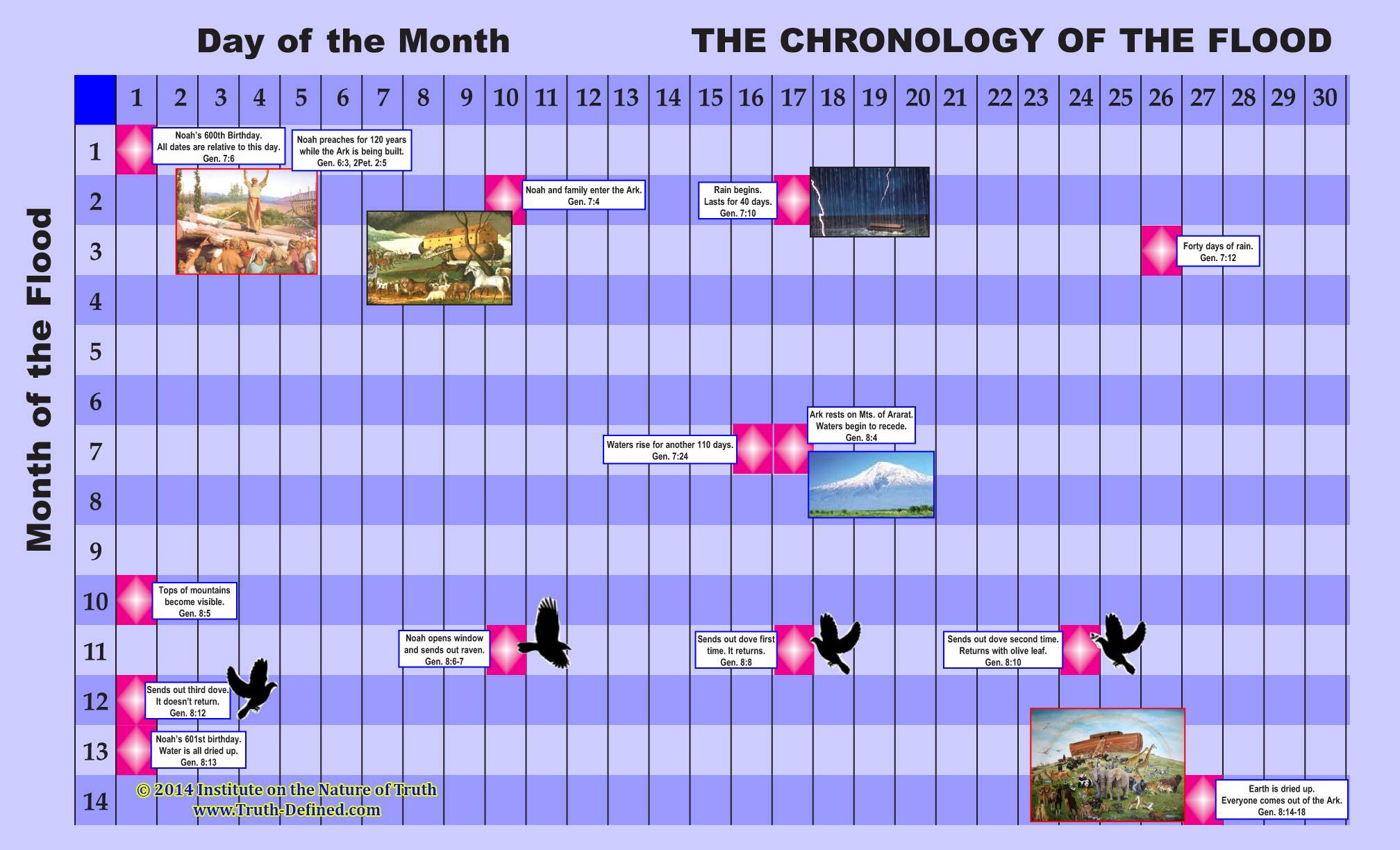
This graphic is not part of the original
text. It has been added by the editor to help the reader to visualize the
Flood chronology.
THE DURATION OF THE FLOOD
A careful study of the Biblical data
reveals the fact that the Flood lasted for 371 days, or a little over a
year. That the Flood
continued for more than a year is entirely in keeping with the doctrine of
its universality but cannot properly be reconciled with the local-Flood
theory. While there may be a difference of opinion among Christian scholars
as to the general depth of the Flood (depending upon the altitude of
antediluvian mountains), there can be no question as to its duration.
Twenty-one Weeks of “Prevailing”
Now some commentators have assumed that the
waters continued to rise during the 150 days that the waters “prevailed
upon the earth,” because “the windows of heaven were stopped, and the rain
from heaven was restrained” (8:2) only after the end of the 150-day period
(8:3). This is certainly a possible interpretation of the text, but it is
better to conclude with Leupold4
that the Flood attained its maximum depth after the first forty days and
continued to maintain this level for an additional 110 days before
beginning to assuage (7:24, 8:3). Our basis for assuming this is found in
7:4 and 7:12, where we read that the rains came “upon the earth forty days
and forty nights”; and 7:17 where we are told that “the flood was forty
days upon the earth.” Most of “the waters which were above the firmament”
(Gen. 1:7) must have fallen through “the windows of heaven” during the
first period of forty days; and although “the windows of heaven” were not
stopped for another 110 days (8:2), the rainfall during this second period
may have contributed only to the maintaining of the Flood at its maximum
height.
Thirty-one Weeks of “Assuaging”
One’s imagination is indeed staggered at the
thought of a Flood so gigantic as to overwhelm the high mountains of the
earth within a period of six weeks and then to continue prevailing over
those mountains for an additional sixteen weeks, during which time the sole
survivors of the human race drifted upon the face of a shoreless ocean! But
if the Biblical concept of a deluge covering the tops of mountains for
sixteen consecutive weeks is hard to reconcile with the local-Flood theory,
what are we to say of the fact that an additional thirty-one weeks were
required for the waters to subside sufficiently for Noah to disembark
safely in the mountains of Ararat?
Arthur C. Custance has recently
published a booklet in defense of the local-Flood theory, in which he
attempts to deal with this problem:
There are certain figures indicated in the
text which, if we are rightly interpreting them, provide some rather
surprising information about the rate at which the waters receded. In
Gen. 8:4 we are told that the Ark came to rest, i.e., grounded, on the
17th day of the 7th month . . . The record states then that the waters
receded (Gen. 8:5) until the first day of the 10th month, at which time
apparently it became possible to see dry land. Before this, the raven
released from the Ark had not found any resting place within easy
flying distance so that we must assume that the peak on which the Ark
was actually grounded had not appeared above the water up to this time.
Obviously, if land could be seen, the raven would have found a place to
alight instead of wandering to and fro as depicted in Gen. 8:7. In this
interval, therefore, from the 17th day of the 7th month to the 1st day
of the 10th month the water level had fallen perhaps 25 or 30 feet. It
is clear that as soon as the level had fallen by the amount equal to
the draught of the vessel dry land would appear . . . and 25 feet in 74
days is the equivalent of a drop in level of about 4 inches per day.5
Custance then proceeds to demonstrate that a drop in water level of only a
few inches a day would be more appropriate for a limited flood than a
universal one.
When we turn to the text of Genesis,
however, we discover that this could not have been the case. For 8:4-7
indicates that “the tops of the mountains” were seen as much as forty days
before the raven was sent forth. Custance assumes that the raven was
released forty days after the Ark was grounded and that the 74-day period
described in 8:5 overlapped the 40-day period mentioned in 8:6. But if this
were true, the entire bird episode, including the plucking of the fresh
olive leaf, would have been completed two weeks before the tops of the
mountains were seen!6 Noah did not send forth the raven to determine whether any mountain peaks had emerged as yet, as Custance assumes, but to
gain information about the nature of these exposed areas. Alexander Heidel
explains:
Forty days after the tops of the other
mountains had become visible, Noah opened the window of the ark and
sent forth a raven (8:5-7). The wild, omnivorous bird went flying back
and forth, sometimes away from the ark and sometimes back to it again,
until the waters had dried off the earth, but he did not again go into
the ark. He presumably found some carrion meat floating in the water or
deposited on the mountaintops, or some aquatic creatures trapped on the
mountain peaks as the water receded, and this provided sufficient
sustenance for the unclean raven with his carrion-eating propensities.
The raven’s failure to return into the ark does not show that he proved
himself useless for the intended purpose and that the experiment was
unsuccessful. To the contrary, it was a good sign; for it proved that
the waters had declined considerably and that even though the outside
world was still very unfriendly or inhospitable, it was no longer too
inhospitable for so sturdy and unfastidious a bird as the raven.7
Furthermore, it can hardly be emphasized too strongly that it was not
merely the top of the high mountain on which the Ark rested that was seen
on the first day of the tenth month. The Scriptures inform us that on that
day “were the tops of the mountains seen.” In other words, the Flood waters
must have subsided hundreds of feet in order for various mountain peaks of
different altitudes to be seen by then.
Nor does
the Bible teach that the tops of the mountains were still submerged on the
last day of the ninth month and then suddenly emerged on the first day of
the tenth month. With equal justification, one might argue that the ground
was still soaked on the twenty-sixth day of the second month because we are
told that the ground was dry on the twenty-seventh day of the second month.
It is obvious that the Scriptures speak of definite stages of drying in
verses 11, 13, and 14, with the implication of a uniform process between
the stages. In like manner, from the day that the Ark grounded on the
highest peak in the mountains of Ararat, more and more of the lower peaks
emerged from the waters as they gradually subsided. Doubtless during much
of the ninth month the tops of various mountains were seen. But it is also
true that on the first day of the tenth month “were the tops of the
mountains seen.” It just so happens that God chose this date, rather than a
slightly earlier one, to mark a stage in the abating of the waters.
The order
of events as set forth in the first part of the eighth chapter of Genesis
would seem, then, to be as follows: (1) After the waters had “prevailed
upon the earth” 150 days, the waters began to assuage. (2) The Ark rested
upon the mountains of Ararat the same day that the waters began to assuage,
for the 17th day of the 7th month was exactly 150 days after the Flood
began. (3) The waters continued to subside, so that by the 1st day of the
10th month (74 days later), the tops of various lower mountains could be
seen. This would suggest a drop of perhaps fifteen or twenty feet a day, at
least during the initial phase of this assuaging period. (4) The Flood
level continued to fall for forty more days, so that Noah, no longer
fearing that the Flood would return, sent forth a raven to investigate the
conditions outside the Ark. These events are sketched in Figure
2.
Instead of constituting an objection to
the universal Flood concept, the rate of decline of the water level thus
becomes a strong argument in its favor. For if nothing could be seen but
the tops of mountains after the waters had subsided for 74 days, we are
left with no other alternative than to conclude that the Flood covered the
whole earth. The duration of the Flood in its assuaging, as well as in its
prevailing, compels us to think of it as a global, not merely a local,
catastrophe.
THE GEOLOGY
OF THE FLOOD
Since so
many arguments against the universality of the Flood have been based upon
supposed geological objections, it is very important to realize that the
Scriptures have something to say about the geological factor too. In fact,
the first recorded event of the Flood is that “on the same day were all the
fountains of the great deep broken up” (7:11). According to Brown, Driver,
and Briggs, the word tehom (translated “deep” in this verse) has the
primary meanings of (1) “deep, of subterranean waters,” (2) “sea,” and (3)
“primeval ocean, deep.”8
There can be little question, then, that the phrase tehom rabbah (“great
deep”) points back to the tehom of Genesis 1:2 and refers to the oceanic
depths and underground reservoirs of the antediluvian world. Presumably,
then, the ocean basins were fractured and uplifted sufficiently to pour
waters over the continents, in conjunction with those waters which were
above the “firmament” (expanse) and which poured down through the “windows
of heaven.”
The close
connection that exists between Genesis 7:11 and 1:2-10 must be evident to
all who have studied the text with care. For example, Franz Delitzsch calls
our attention to the fact that “it was by a cooperation of subterranean and
celestial forces, which broke through the restraints placed upon the waters
on the second and third days of creation, that the Deluge was brought to
pass.”9
But the most significant fact to be observed is that these geological
phenomena were not confined to a single day. In fact, the Scriptures state
that this breaking up of “the fountains of the great deep” continued for a
period of five months, for it was not until after the 150 days had passed
that “the fountains of the deep… were stopped” (8:2). Such vast and
prolonged geologic upheavals in the oceanic depths cannot be reconciled
with the theory that the Flood was merely a local inundation in some part
of the Near East. Instead, this Biblical information gives substantial
support to the concept of a geographically universal Deluge.10
THE SIZE OF
THE ARK
According to Genesis 6:15, Noah was commanded to make “the length of the
ark three hundred cubits, the breadth of it fifty cubits, and the height of
it thirty cubits.” The first question to be considered, of course, is the
length of the cubit as used in this passage. The Babylonians had a “royal”
cubit of about 19.8 inches, the Egyptians had a longer and a shorter cubit
of about 20.65 inches and 17.6 inches respectively, while the Hebrews
apparently had a long cubit of 20.4 inches (Ezek. 40:5) and a common cubit
of about 17.5 inches.11
While it is certainly possible that the
cubit referred to in Genesis 6 was longer than 17.5 inches, we shall take
this shorter cubit as the basis for our calculations. According to this
standard, the Ark was 437.5 feet long, 72.92 feet wide, and 43.75 feet
high. Since it had three decks (Gen. 6:16), it had a total deck area of
approximately 95,700 square feet (equivalent to slightly more than the area
of twenty standard college basketball courts), and its total volume was
1,396,000 cubic feet. The gross tonnage12
of the Ark (which is a measurement of cubic space rather than weight, one
ton in this case being equivalent to 100 cubic feet of usable storage
space) was about 13,960 tons, which would place it well within the category
of large metal ocean-going vessels today.13
Arthur Custance questions whether the
Ark could really have been this huge and suggests, without evidence, that
the cubit of those days may have been much shorter than eighteen inches.
Then he goes on to say:
I think anyone who tries to visualize
the construction of a vessel 450 feet long by four men will realize
that the size of the timbers alone for a “building” 45 feet high
(analogous to a four story apartment building) would seem by their
sheer massiveness to be beyond the powers of four men to handle. With
all the means later at their disposal, subsequent builders for 4000
years constructed seaworthy vessels that seldom seem to have exceeded
150 to 200 feet at the most. The Queen Mary has a total length of 1018
feet which is not very much more than twice the length of the Ark. It
was not until 1884 apparently that a vessel, the Eturia, a Cunard
liner, was built with a length exceeding that of the Ark.14
The
Scriptures, however, do not suggest that Noah and his three sons had to
construct the Ark without the help of hired men. Nevertheless, we agree
that the sheer massiveness of the Ark staggers the imagination. In fact,
this is the very point of our argument: for Noah to have built a vessel of
such magnitude simply for the purpose of escaping a local flood is
inconceivable. The very size of the Ark should effectively eliminate the
local-Flood view from serious consideration among those who take the Book
of Genesis at face value.
THE NEED
FOR AN ARK
Not only
would an ark of such gigantic proportions have been unnecessary for a local
flood, but there would have been no need for an ark at all! The whole
procedure of constructing such a vessel, involving over a century of
planning and toiling, simply to escape a local flood, can hardly be
described as anything but utterly foolish and unnecessary. How much more
sensible it would have been for God merely to have warned Noah of the
coming destruction, so that he could move to an area that would not have
been affected by the Flood, even as Lot was taken out of Sodom before the
fire fell from heaven. Not only so, but also the great numbers of animals
of all kinds, and certainly the birds, could easily have moved out also,
without having to be stored and tended for a year in the Ark! The entire
story borders on the ridiculous if the Flood was confined to some section
of the Near East.
The writers have had a difficult time
finding local-Flood advocates that are willing to face the implications of
this particular argument. Arthur Custance, however, has recently suggested
that the Ark was simply an object-lesson to the antediluvians:
It would require real energy and faith
to follow Noah’s example and build other Arks, but it would have
required neither of these to pack up a few things. and migrate. There
is nothing that Noah could have done to stop them except by
disappearing very secretly. Such a departure could hardly act as the
kind of warning that the deliberate construction of the Ark could have
done. And the inspiration for this undertaking was given to Noah by
leaving him in ignorance of the exact limits of the Flood. He was
assured that all mankind would be destroyed, and probably supposed that
the Flood would therefore be universal. This supposition may have been
quite essential for him.15
But how
can one read the Flood account of Genesis 6-9 with close attention and then
arrive at the conclusion that the Ark was built merely to warn the ungodly,
and not mainly to save the occupants of the Ark from death by drowning? And
how can we exonerate God Himself from the charge of deception, if we say
that He led Noah to believe that the Flood would be universal, in order to
encourage him to work on the Ark, when He knew all the time that it would
not be universal?
With respect to the animals in the Ark,
Custance takes the view that they were only domesticated varieties that
would prove to be useful to man:
To begin with, there is plenty of
evidence to show that the domestication of animals was first undertaken
somewhere in this general area. Assuming that such species as had been
domesticated in the centuries between Adam and Noah were confined to
the areas settled by man and had not spread beyond this, any Flood
which destroyed man would also wipe out these animals. The process of
domestication would then have to be begun all over again, and probably
under far less ideal conditions … It is almost certain that
domesticated animals could not have migrated alone … For this reason,
if for no other, some animals at least would have to be taken on board
… but these were probably of the domesticated varieties.16
But
where does the Book of Genesis suggest that Noah was to take only
domesticated animals into the Ark? The purpose of the Flood was to destroy
“both man, and beast, and creeping things, and birds of the heavens” (6:7),
and “to destroy all flesh, wherein is the breath of life, from under
heaven” (6:17, cf. 6:12-13, 19-21, 7:2-4, 8, 14-16; 8:1, 17-19; 9:8-17).
And this was accomplished when “all flesh died that moved upon the earth,
both birds, and cattle, and beasts, and every creeping thing that creepeth
upon the earth, and every man: all in whose nostrils was the breath of the
spirit of life, of all that was on the dry ground, died. And every living
thing was destroyed that was upon the face of the ground, both man, and
cattle, and creeping things, and birds of the heavens; and they were
destroyed from the earth” (7:21-23). These are exactly the same terms used
in the first chapter of Genesis to describe the various kinds of land
animals which God created. If only domesticated animals were to be taken
into the Ark, are we to assume that only domesticated animals were created
by God in the first chapter of Genesis? The fact of the matter is that no
clearer terms could have been employed by the author than those which he
did employ to express the idea of the totality of air-breathing animals in
the world. Once this point is conceded, all controversy as to the
geographical extent of the Deluge must end; for no one would care to
maintain that all land animals were confined to the Mesopotamian Valley in
the days of Noah! Joseph P. Free, Professor of Archaeology at Wheaton
College, concludes:
The fact that every living creature was
to be destroyed would indicate that the whole earth was subject to the
flood (Gen. 7:4). Probably the animals had scattered over much of the
earth; a universal flood would have been needed to destroy them …
Certainly all the main groups of animals were represented on the ark.
The variations which we observe today within the main groups of animals
could have developed in the few thousand years (more or less) since the
flood.17
The fact
that Noah was commanded to build an ark “to the saving of his house” (Heb.
11:7) and was commanded to bring in two of every kind of animal “to keep
seed alive upon the face of the earth” (7:3) proves conclusively that the
Flood was universal in scope.
THE TESTIMONY OF THE APOSTLE PETER
One of
the most important Biblical passages relating to the magnitude of the
Deluge is to be found in II Peter 3:3-7:
… knowing this first, that in the last
days mockers shall come with mockery, walking after their own lusts,
and saying, Where is the promise of his coming? for, from the day that
the fathers fell asleep, all things continue as they were from the
beginning of the creation. For this they willingly forget, that there
were heavens from of old, and an earth compacted out of the water and
amidst water, by the word of God; by which means the world that then
was, being overflowed with water, perished; but the heavens that now
are, and the earth, by the same word have been stored up for fire,
being reserved against the day of judgment and destruction of ungodly
men.
In this
passage of Scripture, Peter speaks of a day, yet future from his
standpoint, when men would no longer think seriously of Christ’s Second
Coming as a cataclysmic, universal intervention by God into the course of
world affairs. And the reason for this skeptical attitude would be none
other than a blind adherence to the doctrine of uniformitarianism ‒ a
doctrine which maintains that natural laws and processes have never yet
been interrupted (or newer and higher laws introduced) so as to bring about
a total destruction of human civilization through the direct intervention
of God. And since this has never been the case in past history, there
should be no cause to fear that it will ever occur in the future!
In
answering these skeptics of the end-time, the Apostle Peter points to two
events in the past which cannot be explained on the basis of
uniformitarianism. The first of these events is the creation of the world:
“there were heavens from of old, and an earth … by the word of God”; and
the second event is the Flood: “the world [kosmos] that then was, being
overflowed with water, perished [apoleto].”
But it is
the second of these two events, the Flood, which serves as the basis of
Peter’s comparison with the Second Coming and the final destruction of the
world. For even as “the world that then was” perished by water, so “the
heavens that now are, and the earth,” protected as they are, by God’s
eternal promise, from another aqueous cataclysm (Gen. 9:11-19), have,
nevertheless, “been stored up for fire, being reserved against the day of
judgment and destruction of ungodly men.”
Let us now
consider the implications of this passage with respect to the geographical
extent of the Flood. In speaking of the events of the second and third days
of creation, Peter uses the terms “heavens from of old, and an earth” in a
sense that is obviously universal. By the same token, no one can deny that
Peter also uses the terms “heavens that now are, and the earth” in the
strictly universal sense. Otherwise, Peter would be speaking of the
creation and final destruction of only a part of the earth!
Now the one
event which Peter sets forth as having brought about a transformation, not
of the earth only but also of the very heavens, is the Flood! It was the
Flood that constituted the line of demarcation between “the heavens from of
old” and “the heavens that now are” in the thinking of the Apostle Peter.
It was the Flood that utilized the vast oceans of water out of which and
amidst which the ancient earth was “compacted,” unto the utter destruction
of the kosmos “that then was.”18
It was the Flood to which Peter appealed as his final and incontrovertible
answer to those who chose to remain in willful ignorance of the fact that
God had at one time in the past demonstrated His holy wrath and omnipotence
by subjecting “all things” to an overwhelming, cosmic catastrophe that was
on an absolute par with the final day of judgment, in which God will yet
consume the earth with fire and will cause the very elements to dissolve
with fervent heat (II Peter
3:10).
If the Flood was limited to the region of Mesopotamia, it is difficult
to see how Peter’s appeal to the Flood would have any value as a
contradiction to the doctrine of uniformitarianism, which assumes that “all
things” have never yet been upset by a universal cataclysm. Nor is it easy
to excuse Peter of gross inaccuracy when he depicts the Flood in such
cosmic terms and in such an absolutely universal context, if the Flood was
only a local inundation after all.
Merrill F. Unger, Professor of Old
Testament at Dallas Theological Seminary, emphasizes the crucial
significance of Peter’s statements in determining the magnitude and effects
of the Deluge:
That the antediluvian era, described by
Peter as “the world that then was,” was obviously different
climatically and geologically from the “heavens” and “the earth … that
now are” (II Peter 3:7), is clearly implied in the Apostle’s stern
warning to naturalistic skeptics, who mock at the idea of Christ’s
supernatural Second Advent on the ground that “all things continue as
they were from the beginning of the creation” (II Peter 3:4). Against
the false naturalistic theory of uniformity, the Apostle urges the
truth of supernatural catastrophism as evidenced by the Noahic Flood.19
Thus,
the third chapter of Second Peter provides powerful New Testament support
for the geographical universality of the Flood. Anything less than a
catastrophe of such proportions would upset the entire force of Peter’s
argument and would give much encouragement to those whom he so solemnly
warned.
THE TOTAL DESTRUCTION OF A WIDELY-DISTRIBUTED HUMAN RACE
Our seventh and
final basic argument for a universal Flood is founded upon the Biblical
testimony of a total destruction of the human race outside of the Ark. Such
an argument, to be conclusive in demonstrating a geographically universal
Flood, must include two sub-arguments: (1) the Bible teaches that all
mankind perished in the Flood and (2) the human race had spread far beyond
the Near East, if not around the earth, by the time of the Flood. In the
development of this argument, we shall set forth four major reasons for
believing that the Bible teaches a total destruction of the race and two
major reasons for believing that the antediluvians had become widely
distributed by the time of the Flood.
The Total Destruction of Humanity
From the very beginning of the Flood
controversy, there has been little question among conservative Christian
scholars as to the total destruction of the human race by the Flood. In the
year 1845, Charles Burton could say, without fear of contradiction:
Among the Christian philosophers who
dispute on this arena, there is a perfect agreement on the most
important point, viz., that by the Flood, the whole population of the
world was destroyed. With the Mosaic narrative before them, no other
opinion could be entertained.20
The same
situation prevails today, more than a century later, with only very rare
exceptions.21
The reasons for this remarkable unanimity of opinion among evangelical
scholars must now be presented.
The moral
purpose of the Flood. The Flood must have destroyed the entire human race
outside of the Ark, because the Scriptures clearly state that the purpose
of the Flood was to wipe out a sinful and degenerate humanity; and this
purpose could not have been accomplished by destroying only a portion of
the race. Turning our attention now to the most important passages of
Scripture that shed light on this question, we read in the sixth chapter of
Genesis:
And Jehovah saw that the wickedness of
man was great in the earth, and that every imagination of the thoughts of
his heart was only evil continually. And it repented Jehovah that he had
made man on the earth, and it grieved him at his heart. And Jehovah said, I
will destroy man whom I have created from the face of the ground; both man,
and beast, and creeping things, and birds of the heavens; for it repenteth
me that I have made them (6:5-7) … And the earth was corrupt before God,
and the earth was filled with violence. And God saw the earth, and, behold,
it was corrupt; for all flesh had corrupted their way upon the earth. And
God said unto Noah, The end of all flesh is come before me; for the earth
is filled with violence through them; and, behold, I will destroy them with
the earth (6:11-13).
The constant, almost monotonous
repetition of phrases depicting the utter depravity of antediluvian
humanity has filled the minds of believers with a sense of awe and
astonishment. Every statement seems calculated to impress upon its readers
the idea of universal sin; not just the exceptional sins of this group or
of that region, nor even of specific times or occasions, but rather the sin
of an entire age and an entire race that had utterly corrupted its way upon
the earth and was now ripe for the judgment of a holy God. W. Graham
Scroggie has skillfully and graphically sketched the Biblical picture of
antediluvian humanity:
The appalling condition of things is
summed up in a few terrible words, words which bellow and burn:
wickedness, evil imagination, corruption, and violence; and these sins
were great, widespread, “in the earth,” continuous, “only evil
continually,” open and daring, “before God,” replete, “filled,” and
universal, “all flesh.”
………………………….
This is an astounding event! After over
1,600 years of human history the race was so utterly corrupt morally
that it was not fit to live; and of all mankind only four men and four
women were spared, because they did not go with the great sin drift.22
In the light of these facts, the conclusion seems to be self-evident
that God’s stated purpose of destroying “man whom I have created,” because
of his hopeless depravity and in order to start afresh with Noah, could not
have been accomplished by destroying only a part of the race and allowing
the rest of Adam’s descendants to continue in their sinful ways.
The
exceptional case of Noah. The fact that all mankind, rather than just a
part of the race, was destroyed in the Flood is emphasized in the
Scriptures by repeated statements to the effect that Noah and his family
were the only ones who escaped the judgment waters. The pertinent passages
in Genesis read as follows:
But Noah found favor in the eyes of
Jehovah … Noah was a righteous man and perfect in his generations: Noah
walked with God (6:8-9) … everything that is in the earth shall die.
But I will establish my covenant with thee; and thou shalt come into
the ark, thou, and thy sons, and thy wife, and thy sons’ wives with
thee (6:17-18) … And Jehovah said unto Noah, Come thou and all thy
house into the ark; for thee have I seen righteous before me in this
generation (7:1) … and they were destroyed from the earth: and Noah
only was left, and they that were with him in the ark. And the waters
prevailed upon the earth a hundred and fifty days. And God remembered
Noah … (7:23,24; 8:1).
And
lest there might remain some lingering doubt in the minds of Bible students
as to whether or not Noah’s family constituted the sole survivors of the
Flood, we have two emphatic statements by the Apostle Peter on this matter:
… the longsuffering of God waited in the
days of Noah, while the ark was a preparing, wherein few, that is,
eight souls, were saved through water (I Pet. 3:20).
God spared
not the ancient world [kosmos] , but preserved Noah with seven others,
a preacher of righteousness, when he brought a flood upon the world
[kosmos] of the ungodly (II Pet. 2:5).
Now it
would seem to be perfectly evident from studying these passages that Noah
was spared because of his righteous character. By the same token, the Flood
came to destroy others because they were unrighteous. Now if it should
actually turn out to have been the case that only a portion of the human
race outside of the Ark was destroyed by the Flood, then we must conclude
one of two things: (1) there were people outside of the Ark who were as
righteous as Noah and thus were permitted by God to escape the Flood waters
also; or (2) having a righteous character was not the only factor that
determined who was to escape the Flood.
As we
consider these two alternatives, we must admit that the first one is quite
inconceivable, for the exceptional and unique righteousness of Noah is
emphasized over and over again throughout the entire Bible (Gen. 5:29;
6:8,9,18; 7:1; 9:1; Ezek. 14:14,20; Heb. 11:7 and II Pet. 2:5). Also, the
abysmal and universal wickedness of the antediluvians has been affirmed by
an astonishing array of Scriptural testimony (Gen. 6:1-6,11-13; Luke
17:26-27; I Pet. 3:20; II Pet. 2:5 and Jude 14-15). To deny this is simply
to deny the Word of God.
But the second alternative is equally
untenable, for the Scriptures give no hint anywhere that men were destroyed
for any other reason than for their ungodliness. Now if any ungodly people
actually did escape the Flood, they must have done so by virtue of the fact
that they didn’t happen to live in that particular area where the Flood
came (assuming that the Flood was local); or else they were stronger or
more ingenious than other sinners and thus, in one way or another, managed
to escape the onrushing Flood waters. But if this had been the case, then
those who died in the waters did so only because they were unfortunate
enough to be living in the wrong place or because they were not
sufficiently strong or clever, and not simply because they were ungodly!
We
pause at this point to ask the question: can sane and sensible hermeneutics
tolerate for one moment such an interpretation of the Biblical doctrine of
the Flood? We may disagree on various methods of interpretation or even on
whether the Biblical record is to be accepted as authentic and trustworthy
and credible. But when mature and trained scholars can examine the
Scriptural account of the Flood, in both Old and New Testaments, and
conclude that the Bible does not really intend to teach that the Flood was
sent to destroy all ungodly men, then Biblical hermeneutics, in our
opinion, ceases to be a scientific and scholarly discipline.
Consequently, both of the above-mentioned alternatives must be rejected
without hesitation. The Scriptures do teach that the Flood destroyed all
mankind outside of the Ark, because none outside of the Ark were godly and
the Flood was sent by God to destroy the ungodly.23
The
testimony of the Lord Jesus Christ. It almost seems that our Lord made a
special point of choosing His illustrations and warnings from those
portions of the Old Testament that would become objects of unbelieving
scorn and ridicule throughout the coming centuries. For example, in Matthew
19:4 He referred to the creation of Adam and Eve in the Garden of Eden; in
Luke 17:29 to the destruction of Sodom by fire and brimstone from heaven;
in Luke 17:32 to the transformation of Lot’s wife into a pillar of salt; in
Matthew 12:40 to the experience of Jonah in the belly of the great fish; in
Luke 11:32 to the repentance of the Ninevites at the preaching of Jonah.
And in addition to all of these, our Lord made special reference to Noah
and the Flood in the seventeenth chapter of Luke. For the sake of our
subsequent discussion, we must include part of the context in our quotation
of this passage:
And as it came to pass in the days of
Noah, even so shall it be also in the days of the Son of man. They ate,
they drank, they married, they were given in marriage, until the day
that Noah entered into the ark, and the flood came, and destroyed them
all. Likewise even as it came to pass in the days of Lot; they ate,
they drank, they bought, they sold, they planted, they builded; but in
the day that Lot went out from Sodom it rained fire and brimstone from
heaven, and destroyed them all: after the same manner shall it be in
the day that the Son of man is revealed (Luke 17:26-30. Cf. Matt.
24:39).
Now it
is very important that we observe the context into which our Lord places
the Flood-destruction. It is placed alongside the destruction of Sodom and
the destruction of the ungodly at the time of Christ’s Second Coming. This
fact is of tremendous significance in helping us to determine the sense in
which the word “all” is used in reference to those who were destroyed by
the Flood.
Our argument proceeds in the following
manner: the force of Christ’s warning to the ungodly concerning the doom
which awaits them at the time of His Second Coming, by reminding them of
the destruction of the Sodomites, would be immeasurably weakened if we knew
that some of the Sodomites, after all, had escaped. This would allow hope
for the ungodly that some of them might escape the wrath of God in that
coming day of judgment. But we have, indeed, no reason for thinking that
any Sodomite did escape destruction when the fire fell from heaven.
In exactly
the same manner, Christ’s warning to future generations, on the basis of
what happened to the ungodly in the days of Noah, would have been pointless
if part of the human race had escaped the judgment waters. In fact, the
only characterization which our Lord made of those who perished in the
Flood was that they ate and drank and married and were given in marriage.
Thus, if it should be argued that people living in other parts of the world
might not have been as wicked as those who lived in the area that was
flooded, it would be sufficient reply to point out that our Lord’s
characterization did not have to do with degrees of ungodliness, but rather
with the utter absence of that positive godliness which was essential to
salvation.
Therefore, we are persuaded that
Christ’s use of the word “all” in Luke 17:27 must be understood in the
absolute sense; otherwise the analogies would collapse and the warnings
would lose their force. A heavy burden of proof rests upon those who would
maintain that only a part of the human race was destroyed in the Flood, in
view of the clear statements of the Lord Jesus Christ.
God’s
Covenant with Noah After the Flood. One of the most difficult problems to
be faced by those who deny that the Flood was anthropologically universal
is the covenant which God made with Noah after the Flood had ended. For if
the Flood destroyed only a part of the human race, then those who escaped
the Flood waters were not included in the Covenant of the Rainbow.24
Only toward the descendants of Noah would the birds, beasts, and fishes
show fear and dread (Gen. 9:2); they only would be prohibited from eating
flesh with the blood (9:3-4); and they only would have the authority to
take life (9:5-6).
If God’s covenant with Noah means
anything at all, it must be a covenant with the entire human race. But the
Scriptures repeatedly state that God made this covenant with Noah and his
sons (Gen. 9:1-17). Therefore the whole of humanity has descended from
Noah’s family and the Flood destroyed the entire antediluvian race. Samuel
J. Schultz of Wheaton College has reached a similar conclusion on this
crucial question:
Had any part of the human race survived
the flood outside of Noah and his family they would not have been
included in the covenant God made here. The implication seems to be
that all mankind descended from Noah so that the covenant with its bow
in the cloud as a reminder would be for all mankind.25
The
Extensive Distribution of the Antediluvian Race
Those who acknowledge the tremendous weight
of Biblical testimony concerning the total destruction of the human race
outside of the Ark, and yet who are still unwilling to admit that the Flood
was geographically universal, usually maintain that the race had not spread
beyond the region of Mesopotamia during the period from Adam to Noah.26
But it is our conviction that such a position cannot be successfully
defended and that for at least two reasons which must now be considered.
Longevity.
In the first place, the vast possibilities for population growth due to
longevity among the antediluvians must be recognized. Even a rather cursory
examination of Genesis 5 brings to light some rather startling statistics
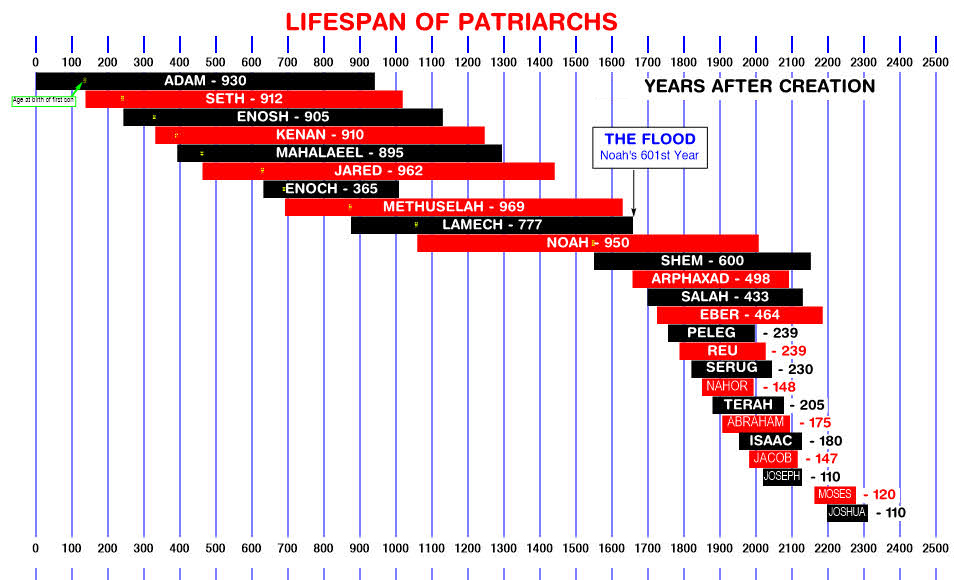
in this respect. In that chapter we read that Adam lived 930 years, Seth
912, Enosh 905, Kenan 910, Mahalalel 895, Jared 962, Enoch 365 (who did not
die, but was translated to God’s presence without dying), Methuselah 969,
Lamech 777, and Noah 950. The average of these ages, omitting Enoch, is
912.27
William R. Vis has prepared a graph to indicate the contrast between
the ages of patriarchs before and after the Flood (see Fig. 3). He
explains:
A study of this chart shows in a
striking way that something extremely significant happened to the earth
and to man at the time of the flood. It would seem that whatever this
was, it probably removed the dominant factor for the long life of the
patriarchs. The spiritual message of the Bible is clear: the length of
life decreased because of the entrance of sin into the human family.
However, the scientific explanation is not evident. Could some
antediluvian climatic or other condition have been extremely favorable
for long life in man? Perhaps future scientific research will cast some
light on this.28
That
there is nothing inherently impossible about such long ages is believed by
many modern students of the phenomenon of biologic aging and maturity. One
of the researchers on these problems is Dr. Hans Selye, Director of the
Institute of Experimental Surgery at the University of Montreal. Dr. Selye
has recently said:
Medicine has assembled a fund of
knowledge that will now serve, I believe, as a point of departure for
studying the causes of old age. If the causes of aging can be found,
there is no good medical reason to believe that it will not be possible
for science to find some practical way of slowing the process down or
even bringing it to a standstill.29
Possible
physical explanations of antediluvian longevity, and its decline after the
Flood, will be discussed later.30
We merely accept the fact at this point and note the important consequences
of this fact with respect to the world population before the Flood.
The record in Genesis 5 clearly implies
that men had large families in those days. Although in most cases only one
son is named in each family (apparently for the purpose of tracing the line
of descent from Adam to Noah), it is also said that each “begat sons and
daughters,” so that each family must have had at least four children, and
probably many more. Furthermore, the age of the fathers at the birth of
each of the named sons ranged from 65 years (in the case of Mahalalel and
Enoch) to 500 years (in Noah’s case). Consequently the Bible implies that:
(1) men typically lived for hundreds of years, (2) their procreative powers
persisted over hundreds of years also, and (3) through the combined effects
of long lives and large families, mankind was rapidly “filling the earth”
(Gen. 1:28; 6:1,11).
All things considered, it is certainly
very conservative to estimate that each family had, say, six children, and
that each new generation required ninety years on the average. That is,
assume the first family (Adam and Eve) had six children; the three families
that could be established from these had six children each; and the nine
families resulting from these each had six children, and so on. Actually,
each probably had far more than six children, but this figure will allow
for those who did not marry, who died prematurely, etc. At an average
figure of ninety years per generation, which seems far higher than was
probably actually the case, one can calculate that there were some eighteen
generations in the 1,656 years from Adam to the Flood.
The total
number of people in the nth generation can be calculated on this basis as
equal to 2(3)n. Thus, at the end of the first generation (n equals one),
the number in the family was 2(3), or 6. At the end of two generations, it
was 2(3)2, or 18. Finally, at the end of 17 generations, the number was 258
million and, at the end of 18 generations, it was 774 million! If, at this
time, only one previous generation was still living, the total population
of the earth would have been over 1,030 million! And we believe that anyone
would agree that these calculations are extremely conservative, assuming
only that the Biblical statements are true.
Lest anyone
regard such rates of population increase as unreasonable, listen to the
following:
During the first half of the nineteenth
century, world population reached 1 billion; in 1930 the figure was
about 2 billion. In 1957 and 1958 alone, the earth’s population
increased by 90 million, a figure twice the population of France, and
the world is expected to have 3 billion inhabitants by 1962. The
acceleration of population growth in underdeveloped countries is
especially spectacular. Annual increases of 2 percent or more are usual
in most of these countries, and in some there is a growth of 3 percent
….31
The
present rate of world population increase is thus approximately 2 per cent
per year. But the rate of population growth we have supposed for the
antediluvian period is less than 1.5 per cent per year!
Of course,
the modern population “explosion,” as it is sometimes called, is not
believed to be typical of increase rates during earlier periods of history.
Theorists usually say that earlier population increases were lower due to
the effects of war, disease and starvation. But as Fairfield Osborn points
out:
It must be remembered that the numerical
loss of human life in the last two great wars was relatively
inconsequential when measured against the total populations of the
countries at war. In fact, the wars of the last century have had
virtually no influence in restraining population increase in the
countries engaged.32
Similarly, there is little real evidence to support the opinion that either
disease or starvation, although they have occasionally taken great toll of
human life, have had any very significant influence in restraining
population increase, on a percentage basis. And especially is this true
with respect to the antediluvian period, when the very fact that men lived
to such great ages would indicate that famine and disease were not serious
problems.
We are confident, therefore, that our
estimate of a population of one billion people on the earth at the time of
the Deluge is very conservative; it could well have been far more than
this. A population of this order of magnitude would certainly have spread
far beyond the Mesopotamian plains ‒ in fact, for all practical purposes,
would have “filled the earth,” as the Scripture says. In fact, this very
figure is the estimated population of the earth in 1850,33
the earliest date for which there is any really accurate estimate of world
population, and the entire earth was certainly “filled” at that time.
In the
early days of the controversy over the geographical extent of the Deluge
(1840-1860), the most common arguments for a limited antediluvian
population, as set forth, for example, by John Pye Smith,34
Edward Hitchcock,35
and Hugh Miller,36
were that the extreme sinfulness of the race made rapid population growth
impossible and that the patriarchs did not beget children until late in
life, with only a few children being mentioned even then.
With regard to the first of these
arguments, it needs only to be pointed out that while the Scriptures do say
that the earth was filled with “violence” (Gen. 6:11,13), they say, at the
same time, that “the earth” was “filled” with violence!37
In other words, the very proof text which these men put forward in support
of the limited-population view, turns out upon closer examination to be an
even more effective argument for the universal distribution of antediluvian
populations. Furthermore, if analogies with postdiluvian history are at all
valid in such a study, they certainly prove beyond any question that
extreme sinfulness and a tendency to strife and violence in human society
are factors that have favored the scattering, rather than the centralizing,
of populations. The history of Indian tribes in the Americas and of the
Gothic and Germanic tribes in Europe illustrates this fact clearly. And
finally, the nations which boast the highest birth rates in the world today
(India, China, and Russia) are not necessarily the most righteous!
The second
objection commonly urged against a large antediluvian population was that
children were not born until the patriarchs were well advanced in years and
that even then few children are named in the genealogies of Genesis. For
example, it was observed that Noah lived 500 years before he begat any
sons, and then only three are named.
But such an argument is refuted by the
following considerations: (1) Noah must have been the exception to the
rule, because in the case of every other patriarch the phrase “begat sons
and daughters” is used; (2) if Noah did not have any children until he was
500 years old (which cannot be proved), then he was also exceptional in
this regard; for all the other patriarchs had children when they were less
than 200 years old, and most of them (if we include Adam) when less than
130 years of age; (3) the fact that Noah was 500 years old when he begat
three sons is important, for it proves that the patriarchs were capable of
begetting children for hundreds of years; (4) it is possible that the sons
who are named in Genesis 5 were not the first-born sons in each case,
because we know that Adam had sons and daughters (Cain, Abel, and Cain’s
wife, at the very least) long before we read the formula of Genesis 5:3,
“And Adam lived a hundred and thirty years, and begat a son in his own
likeness, after his image; and called his name Seth”;38
(5) God’s command to Adam and his descendants was to “be fruitful and
multiply, and replenish [fill] the earth” (1:28), and this command was
obeyed: “men began to multiply on the face of the ground” (6:1).
A
well-known German writer of the present day has expressed the matter as
follows:
Already in the time of Cain, apparently
in his advanced age, a city could be built (probably at first simply an
established colony), Gen. 4:17. This is the less astonishing, since the
life-energy of the youthful race must at the beginning have been very
powerful. Also, with the long lives of the parents, the number of
children must have been much greater than later on; and, for the same
reason, many generations must have lived alongside of each other at the
same time. With an average of only six children per family, by the time
Cain was only 400 years old he would have had far more than 100,000
descendants.39
C. F. Keil agreed with Franz Delitzsch that one explanation for the
amazing longevity of these patriarchs was “that the after-effects of the
condition of man in paradise would not be immediately exhausted”; to which
Keil added these words: “This longevity, moreover, necessarily contributed
greatly to the increase of the human race.”40
A contemporary Catholic scholar comes to the following conclusion as to what the Bible teaches
concerning the geographical distribution of antediluvian humanity:
In view of the insistence shown by the
sacred writer on the multiplication of the race by the repeated
declaration that each of the patriarchs begat “sons and daughters,” and
that he allows so much time between Adam and the flood (MT 1656 years,
Samaritan text 1307, LXX 2256), it is hardly to be assumed that he
thought all men could still be living in one region. In fact, the text
indicates to the contrary, for God not only gave the command to
increase and multiply, but also to “fill the earth,” 1:28.41
Robert
Jamieson, prominent nineteenth century defender of the local-Flood theory,
must have realized the inherent weakness of Pye Smith’s arguments for a
limited distribution of humanity in the days of Noah, for he did not use
them in his lengthy defense of the local-Flood theory in the Jamieson,
Fausset, and Brown Commentary (1870). In fact, his only remark on the
subject was this: “The human race as yet occupied a small tract of western
Asia, their members being comparatively few, as is evident from the single
fact that the preaching of Noah was within the hearing of all that
generation.”42
Since this argument is still being echoed today,43
we do well to examine it more closely.
We must first of all recognize that
nowhere in Scripture are we told that “the preaching of Noah was within the
hearing of all that generation.” Peter says that Noah was “a preacher of
righteousness” (II Peter 2:5), and the author of Hebrews tells us that Noah
by faith “prepared an ark to the saving of his house; through which he
condemned the world” (Heb. 11:7). But this is not equivalent to saying that
Noah preached directly to all the people of his generation!
While it is
true that multitudes of people may have heard Noah’s impassioned warnings
directly, Noah’s condemnation of the world probably consisted mainly in the
very contrast of his godly and believing life with the lives of all others
in his time. To him only God could say: “Come thou and all thy house into
the ark; for thee have I seen righteous before me in this generation” (Gen.
7:1). The fact that no other human beings of that time had Noah’s faith and
righteousness was the condemnation of the world. The kind of faith that
produced obedience (Gen. 6:22), even unto the building of the Ark, was the
only kind of faith that could bring deliverance from judgment. No one else
had the kind of faith that produced obedience; therefore the world was
condemned. In like manner, only a relatively few persons of the world ever
saw the Lord Jesus Christ during his earthly ministry; but it is true,
nevertheless, that “the world knew him not” (John 1:10) and “this is the
judgment, that the light is come into the world, and men loved darkness
rather than the light; for their works were evil” (John 3:19).
But even if
the fact that Noah’s ark-building faith “condemned the world” should mean
that everyone in the world heard the warnings of Noah, it would by no means
follow that the human race had to be confined to one small region of the
earth. During that 120-year period of grace “when the long-suffering of God
waited in the days of Noah, while the ark was a preparing” (Gen. 6:3, I
Pet. 3:20), the news of Noah’s remarkable activities and alarming warnings
could easily have spread throughout the entire earth.44
To
summarize briefly, it is easier to understand how the earth could have been
filled with people by the time of the flood if we realize the greatness of
antediluvian longevity, fecundity, and strife and the command of God to
“fill the earth” (Gen. 1:28). The sinfulness of the antediluvians and the
characteristics of patriarchal family life are objections that can easily
be turned into supporting arguments, and the fact that Noah was a preacher
who condemned the world can be made to harmonize perfectly with the concept
of a widely scattered antediluvian race.45
Paleontology. Our second reason for believing that man had travelled far
beyond the confines of the Near East by the time of the Flood is based upon
evidence from paleontology. It is not our purpose here to enter into a
discussion of the absolute age of the various “fossil men.” Nor are we
attempting to settle here the difficult question of which, if any, of these
human remains are antediluvian. Our purpose in appealing to such evidence
in this chapter is simply to show how devastating to the
limited-distribution theory would be the discovery that even one human
fossil from Africa, Europe, Asia, or America antedated the Flood.
Now the
important fact to be observed with regard to these ancient fossils is that
practically all of them have been found hundreds, and even thousands, of
miles from the Mesopotamian Valley! In view of this fact, the advocates of
the limited-distribution theory are forced to maintain one of two possible
positions: (1) no human fossils that ever have or ever will be discovered
outside of the Mesopotamian Valley can be considered antediluvian, or (2)
if men actually did migrate to distant regions before the Flood, they must
have been driven back into Mesopotamia by some universally compelling
force, whether natural or supernatural, in order to be drowned in a limited
Flood.
George Frederick Wright, a geologist of two generations ago, seeing the
futility of defending the first of these two alternatives, wrote as
follows:
An insuperable objection to this theory
is that the later discoveries have brought to light remains of
prehistoric man from all over the northern hemisphere, showing that
long before the time of the flood, he had been widely scattered.46
He then proceeded to defend the second alternative, by suggesting that:
in connection with the enormous physical
changes in the earth’s surface during the closing scenes of the glacial
epoch, man had perished from off the face of the earth except in the
valley of the Euphrates, and that the Noachian Deluge is the final
catastrophe in that series of destructive events.47
But this second alternative is also faced with insuperable objections: (1)
if we are to follow the modern scientific theory of Pleistocene ice ages,
then we must also follow the scientists when they tell us that the ice
sheets never covered the major part of the earth at any time;48 (2) even if
an ice age could have succeeded in confining mankind to the Mesopotamian
Valley, it would not help the limited-distribution theory, because the
Flood must have come at a later time when temperatures had risen
sufficiently to cause a sudden melting of the ice sheets (as Wright himself
suggests), and (3) the Scriptures give no hint whatever of any natural or
supernatural gathering of humanity back into Mesopotamia to be drowned by
melting ice sheets!
Wright’s hypothesis has received little
support in the twentieth century, and we must concur with Byron C. Nelson’s
verdict that “it was a fruitless effort to combine the theory of the Flood
with the theories of modern geology.”49
In
conclusion, it must be admitted that evidence from paleontology presents
some very embarrassing problems for those who believe that the entire human
race was confined to the region of Mesopotamia at the time of the Flood. If
it should ever be proved that any of the ancient human fossils discovered
in Java, China, South Africa, or Western Europe were antediluvian, then the
universality of the Flood could be proven by paleontology alone.50 For it
would be quite futile to defend the theory that a mountain-covering,
year-long deluge extended from Mesopotamia to Western Europe, South Africa,
China, or Java, without at the same time covering the entire earth.
SUMMARY AND CONCLUSION
In this chapter we have attempted to
establish the geographical universality of the Flood on the basis of seven
major Biblical arguments: (1) the Bible says that the waters of the Flood
covered the highest mountains to a depth sufficient for the Ark to float
over them; (2) the Bible also informs us that this situation prevailed for
a period of five months and that an additional seven months were required
for the waters to subside sufficiently for Noah to disembark in the
mountains of Ararat; (3) the expression “fountains of the great deep were
broken up” points unmistakably to vast geological disturbances that are
incompatible with the local-Flood concept, especially when these
disturbances are said to have continued for five months; (4) the
construction of the Ark with a capacity of at least 1,400,000 cubic feet,
merely for the purpose of carrying eight people and a few animals through a
local inundation is utterly inconceivable; (5) if the Flood had been
limited in extent, there would have been no need for an ark at all, for
there would have been plenty of time for Noah’s family to escape from the
danger-area, to say nothing of the birds and beasts; (6) Peter’s use of the
Flood as a basis for refuting uniformitarian skeptics in the last days
would have been pointless if the Flood had been merely a local one,
especially when we consider the cosmic setting into which he placed that
cataclysm (II Pet. 3:3-7), and (7) a widely distributed human race could
not have been destroyed by a local Flood.
In support of our seventh argument, we presented four Biblical reasons for the
necessity of a total destruction of humanity in the days of Noah: (1) since
the stated purpose of the Flood was the punishment of a sinful race, such a
purpose could not have been accomplished if only a part of humanity had
been affected; (2) the fact that the Flood destroyed the rest of mankind is
greatly strengthened by repeated statements in Genesis, I Peter, and II
Peter, to the effect that only Noah and his family were spared; (3) the
Lord Jesus Christ clearly stated that all men were destroyed by the Flood
(Luke 17:26-30), and (4) the covenant which God made with Noah after the
Flood becomes meaningless if only a part of the human race had been
involved.
In addition to these arguments for a
total destruction of the human race except for Noah’s family, we gave two
reasons for believing that the human race could not have been confined to
the Mesopotamian Valley at the time of the Flood: (1) the longevity and
fecundity of the antediluvians would allow for a very rapid increase in
population even if only 1656 years elapsed between Adam and the Flood; and
the prevalence of strife and violence would have encouraged wide
distribution rather than confinement to a single locality; (2) evidence of
human fossils in widely-scattered parts of the world makes it very
difficult to assume that men did not migrate beyond the Near East before
the time of the Flood.
The writers are firmly convinced that
these basic arguments, if carefully weighed by Christian thinkers, would
prove to be sufficiently powerful and compelling to settle once and for all
the long-debated question of the geographical extent of the Flood. This is
not to say, of course, that a universal Flood presents no serious
scientific problems; for the remaining chapters of this volume are devoted
largely to an examination of such problems. But we do believe that no
problem, be it scientific or philosophical, can be of sufficient magnitude
to offset the combined force of these seven Biblical arguments for a
geographically universal Flood in the days of Noah.
REFERENCES
1- Unless otherwise noted, all Scripture
quotations are taken from the American Standard Version of 1901.
2- The present
Mt. Ararat, on or near which the Ark was said to have grounded, is some
17,000 feet in elevation! Of course, unless uniformitarianism be
presupposed, it is not necessary to assume that antediluvian mountains were
this high. See below pp. 266-270.
3- H. C. Leupold,
Exposition of Genesis
(Columbus: The Wartburg Press, 1942), p. 301.
4- Leupold,
op.
cit., pp. 300, 306. Cf. Alexander Heidel, The Gilgamesh Epic and Old
Testament Parallels (2nd Ed.; Chicago: University of Chicago
Press, 1949), p. 246.
5- Arthur C. Custance,
The Extent of the
Flood: Doorway Papers #41 (Ottawa: Published by the author, 1958), pp. 8-9.
Earlier in the century, George Frederick Wright wrote in a similar fashion:
“The duration of the Deluge, according to Genesis, affords opportunity for
a gradual progress of events which best accords with scientific conceptions
of geological movements. If, as the most probable interpretation would
imply, the water began to recede after 150 days from the beginning of the
Flood and fell 15 cubits in 74 days, that would only be 3% inches per day‒
a rate which would be imperceptible to an ordinary observer.” International
Standard Bible Encyclopedia, ed. James Orr (Grand Rapids: Wm. B. Eerdmans
Pub. Co., reprint, 1946), II, 824.
6- Even if one were to adopt E. F. Kevan’s
theory that the tops of the mountains “were not then just beginning to
emerge, but had been hidden by the mists which such a downpour of rain must
have created” (The New Bible Commentary, p. 84) it would still not be
permissible to overlap the 74 days and the 40 days, for this would call for
an interval of 103 days instead of 29 days between 8:12 and 8:13 (see
Figure 1). But Kevan’s theory (which is similar to the “phenomenal” theory
of Ramm discussed on pp. 58-59) is contradicted by the fact that the
Scriptures do not speak of mists fading away until the tops of the
mountains were seen, but rather of the waters decreasing continually until
the tops of the mountains were seen (8:5). It should be noted that Custance
is not appealing to any “mists” to confuse the picture, as others have
done, but is claiming that not even the mountain peak on which the Ark
rested emerged from the waters until the first day of the tenth month.
7-
Heidel, op. cit., pp. 251-252. Similarly, Robert Jamieson commented that
the raven “went forth going and returning; i.e., roving on the heights that
bad emerged from the waters, or-perched on the external covering of the
ark, so that he was at no loss for a resting-place, and his voracious
appetite would find plenty of carrion floating on the slimy hillsides on
which, after so long an abstinence, he would greedily prey.” Critical and
Experimental Commentary (Grand Rapids: Wm. B. Eerdmans Pub. Co., reprinted,
1948), I, 102. The dove, on the other hand, would not be satisfied until it
found a clean and dry resting-place. For a discussion of the significance
of the olive leaf, see pp. 104-106.
8- Francis Brown, S. R. Driver, and Charles
A. Briggs, A Hebrew and English Lexicon of the Old Testament (Boston, New
York, and Chicago: Houghton, Mifflin, & Co., 1906), p. 1062. Ludwig Koehler
and Walter Baumgartner, Lexicon in Veteris Testamenti Libros (Grand Rapids:
Wm. B. Eerdmans Pub. Co., 1953), II, 1019, give the first two meanings of
tehom as (1) the primeval ocean, and (2) the subterranean water.
9- Franz
Delitzsch, A New Commentary on Genesis, trans. Sophia Taylor (New York:
Scribner & Welford, 1899), p. 267. J. P. Lange was much impressed by the
geological argument: “the flood itself may, perhaps, have been partial, but
the earth-crisis, on which it was conditioned, must have been universal.
With the opening of the fountains of the deep stands the opening of the
windows of heaven in polar contrast … As an earth-crisis, the flood was
probably universal.” A Commentary on the Holy Scriptures: Genesis, ed. J.
P. Lange (Grand Rapids: Zondervan Publishing House, n.d.), p. 296.
10- See below,
pp. 122, 127, for further discussion of this point.
11- R. B. Y.
Scott, “Weights and Measures of the Bible,” The Biblical Archaeologist,
Vol. XXII, No.2 (May, 1959), pp. 22-27.
12- The displacement tonnage of the Ark
(defined as the weight of sea water displaced by the structure when
submerged to its design draught, assumed at 15 cubits), is:
[(300)(50)(15)(17.5/12)3(64)]/2240 = 19,940 tons
13- The U.S.S.
Mariposa is 14,512 tons, the U.S.S. Constitution is 23,719 tons, and the
U.S.S. United States (the largest American ocean liner) is 53,329 tons.
(New York, 1960 World Almanac, N. Y. World Telegram Co., p. 680). See
below, p. 103, for a discussion of the structure and stability of the Ark.
14-
Custance, op. cit., p. 20.
15- Custance,
op. cit., p. 18. Custance
feels that the Ark was not overly large (see above, p. 10) and that it did
not take over a century to build. The 120 years of Gen. 6:3, in his
opinion, refers to man’s future life-span. But where is the evidence that
man’s life span after the Flood was to be 120 years? Many men lived much
longer than this (11:11, 13, 15, 17, 19, 21, 23, 25; 25:7; 35:28; 47:9).
See Heidel, op. cit., p. 230, and Leupold, op. cit., pp. 256-257.
16- Custance,
op. cit., p. 19. For further discussion on the problem of animals in the
Ark, see below, pp. 63 ff.
17- Joseph P. Free,
Archaeology and Bible
History (5th ed. rev.; Wheaton, Ill.: Scripture Press. 1956), p. 42. Some
defenders of the local-Flood theory claim to have found in Genesis 9:10
support for their view that only a few land animals were affected by the
Flood. They claim that a literal reading of this verse calls for two groups
of animals: “from all going out of the ark to every beast of the earth.” It
is highly questionable, however, whether this is the correct translation.
Brown, Driver, and Briggs cite this verse as an example of the special
usage of lekol at the close of a description or enumeration, and translate
it as follows: “all that go out of the ark as regards (=namely, even) all
the beasts of the earth.” A Hebrew and English Lexicon of the Old
Testament, p. 514. See also Franz Delitzsch and August Dillmann in loco.
The ASV thus improves over the AV by translating: “of all that go out of
the ark, even every beast of the earth.” Thomas Whitelaw, who believed that
the Flood was local, admitted that this verse is “not necessarily implying
…, though in all probability it was the case, that there were animals which
had never been in the ark; but simply an idiomatic phrase expressive of the
totality of the animal creation (Alford).” The Pulpit Commentary, ed. H. D.
M. Spence (Grand Rapids: Wm. B. Eerdmans Pub. Co., reprinted 1950), p. 143.
18-
Henry Alford’s comments on the use of kosmos in this passage are important:
“… kosmos, as an indefinite common term, takes in the ouranoi kai ge
[heavens and earth], which were then instrumental in, and purified by, the
destruction, if not altogether swept away by it.” (The Greek Testament, 5th
ed.; London: Longmans, Green, & Co., 1895, IV, 414).
Of special
significance also is this comment by Joseph B. Mayor: “It is evident from
[II Peter 3:7, 10, 12] that the writer looked forward to a fundamental
metamorphosis of the existing universe through the final conflagration, and
this naturally leads him to take an exaggerated [sic!] view of the deluge,
which he regards as a parallel destruction. Hence the present heavens and
earth are distinguished from the antediluvian in the next verse [v. 7]”
(The Epistle of St. Jude and the Second Epistle of St. Peter, London,
Macmillan & Co., 1907, p. 153). It would be appropriate for a
uniformitarian to describe Peter’s reference to the Flood as “exaggerated.”
True Biblical exegesis simply cannot be harmonized with this philosophy of
earth-history.
19- Merrill F. Unger,
Archaeology and the
Old Testament (3rd. Ed., Grand Rapids: Zondervan Publishing House, 1956),
p. 62. There are some writers who have applied II Peter 3:6 (“the world
that then was, being overflowed with water, perished”) to Genesis 1:2
instead of to Genesis 6-9. See J. Sidlow Baxter, Explore the Book (London:
Marshall, Morgan, & Scott, Ltd., 1951), I, 42; and Kenneth S. Wuest,
In
These Last Days (Grand Rapids: Wm. B. Eerdmans Pub. Co., 1954), p. 67.
But such
an application is impossible for three reasons: (1) Genesis 1:2 does not
speak of a world perishing by being overflowed with water, whereas four
entire chapters of Genesis are devoted to a description of the great Noahic
Deluge which fits Peter’s description perfectly; (2) II Peter 3:5 describes
the earth’s condition during the second and third days of the creation week
(Gen. 1:6-10), and the catastrophe of II Peter 3:6 obviously follows this;
(3) Peter has already referred to the Noahic Deluge twice before (I Pet.
3:20, II Pet. 2:5), and therefore the context would demand that II Peter
3:6 refer to the same Deluge. Neither Baxter nor Wuest offers proof for his
interpretation, and the vast majority of commentators agree that Peter is
referring to the Flood.
20- Charles Burton,
Lectures on the Deluge
and the World After the Flood (London: Hamilton, Adams, & Co., 1845), p.
21.
21-
Bernard Ramm (The Christian View of Science and Scripture, Grand Rapids:
Wm. B. Eerdmans Pub. Co., 1954) is one modern evangelical writer who
believes that only a part of the human race was destroyed by the Flood.
Because of the important implications of this view, we shall devote most of
Chapter II to an examination of his arguments.
22- W. Graham
Scroggie, The Unfolding Drama of Redemption (London: Pickering & Inglis,
Ltd., 1953), I, 74, 77. Italics are his.
23- William
Sanford LaSor claims that the Flood was sent as a judgment upon the godly
Sethite line for intermarrying with the ungodly Cainite line. Thus, the
Flood needed to be only as extensive as the Sethite line (“Does the Bible
Teach a Universal Flood?” Eternity, Vol. XI, No. 10 [December, 1960]). But
how could the Flood have destroyed the Sethites only, if they were living
with Cainites? Even more important, the Scriptures emphasize everywhere
that God brought the Flood not to destroy sinning saints, but rather to
destroy “the world of the ungodly” (II Pet. 2:5).
24- God’s thrice-repeated promise never to
wipe out “everything living” and “all flesh” again by a Flood (Gen. 8:21;
9:11,15) makes it quite impossible to accept the view that only a part of
the human race was destroyed by the Flood. And if it be insisted that these
terms are to be understood in a limited sense, then we must say that God
has broken His promise repeatedly; for millions have perished in vast and
destructive local floods in many parts of the earth. The same argument is
decisive against the view that the Flood was geographically local though
anthropologically universal, for God promised not only to spare the human
race (to say nothing of “every thing living”) from another Flood but also
the earth itself (Gen. 8:21; 9:11, Isa. 54:9).
25- Samuel J.
Schultz, “The Unity of the Race: Genesis 1-11,” Journal of the American
Scientific Affiliation, VII (September, 1955), p. 52. LaSor loc. cit.)
argues that the Flood did not destroy all men outside the Ark because the
New Testament consistently traces the human race to Adam rather than to
Noah! It hardly seems necessary to point out, however, that Noah could not
have been the federal head of postdiluvian humanity because neither his
wife nor his three daughters-in-law owed their physical existence to him in
the same sense that Eve owed hers to Adam.
26- Another
possibility would be that antediluvians in other parts of the earth died or
were driven back into Mesopotamia just in time to drown in a local Flood.
See below, pp. 32-33.
27- C. F. Keil says concerning Genesis 5:
“Every attack upon the historical character of its numerical statements has
entirely failed, and no tenable argument can be adduced against their
correctness.” Biblical Commentary on the Old Testament, trans. James Martin
(Grand Rapids: Wm. B. Eerdmans Pub. Co., reprinted 1951), I, 123.
28- William R.
Vis, “Medical Science and the Bible,” Modern Science and Christian Faith
(2d ed.; Wheaton: Van Kampen Press, 1950), p. 242. Italics are ours.
29- Hans Selye:
“Is Aging Curable?” Science Digest, Vol. 46, December 1959, p. 1.
30- See pages
399-405.
31- “Population Growth,” News item in
Science, Vol. 129, April 3, 1959, p.
882. referring to a recent report The Future Growth of World Population,
published by the United Nations’ Bureau of Social Affairs.
32- Fairfield
Osborn: “Our Reproductive Potential,” Science, Vol. 125, March 22, 1957, p.
531.
33-
V. E. McKelvey: “Resources, Population Growth, and Level of Living,”
Science, Vol. 129, April 3, 1959, p. 878. See also our discussion on
post-diluvian populations, pages 396-398.
34- John Pye
Smith, The Relation Between The Holy Scriptures and Some Parts of
Geological Science (5th ed.; London: Henry G. Bohn, 1854), pp. 269-270.
35-
Edward Hitchcock, The Religion of Geology and Its Connected Sciences
(Boston: Phillips, Sampson & Co., 1852), p. 132.
36- Hugh
Miller, The Testimony of the Rocks (New York: Robert Carter and Brothers,
1875), pp. 316-319.
37- The Hebrew word for “earth” (‘ares) can
sometimes be translated “land.” Except in rare instances, the context
clearly indicates which translation is preferable. ‘ares appears 79 times
in the first nine chapters of Genesis, but in only four cases can it be
legitimately translated “land” (Gen. 2:11,12,13; 4:16). For a discussion of
the limited usage of universal terms, see below, pp. 55-62.
38- For further
discussion of this point, see below, pp. 479-480.
39- Erich
Sauer, The Dawn of World Redemption, trans. G. H. Lang (Grand Rapids: Wm.
B. Eerdmans Pub. Co., 1952), p. 67.
40- C. F. Keil,
op. cit., pp. 123-124.
41-
Edmund F. Sutcliffe, 8.1., “Genesis,” A Catholic Commentary on Holy
Scripture (New York; Thomas Nelson & Sons, 1953), p. 190.
42- Jamieson,
op.cit., p. 99.
43- Custance,
op.cit., p. 18: “The very
method by which God forewarned men implies a situation in which the
population of the world was still fairly well congregated.” Ramm, op.cit.,
p. 239, uses the same argument to prove that the Flood was
anthropologically local, affecting only a small part of the human race!
44-
Civilization may very well have reached great heights before the Flood, and
thus communication systems may have been efficient. “Vast strides must have
been made in knowledge and civilization in such a lapse of time. Arts and
sciences may have reached a ripeness of which the record, from its
scantiness, conveys no adequate conception. The destruction caused by the
Flood must have obliterated a thousand discoveries, and left men to recover
again by slow and patient steps the ground they had lost” (J. J. Stewart
Perowne, “Noah,” Dr. William Smith’s Dictionary of the Bible, ed., H. B.
Hackett and Ezra Abbot. Boston: Houghton, Mifflin, & Co., 1896, III, p.
2178). See also below pp. 40-41.
If, in addition, we allow for a possible
uniformity of language before the Flood, more than a hundred years during
which the report of Noah’s words could have been spread abroad, and the
sensational nature of his ark-building enterprise, we have more than enough
reasons for assuming that everyone in the world had an opportunity to hear
directly or indirectly the warnings of this mighty “preacher of
righteousness.”
45- Many Old Testament scholars believe that
the period from Adam to the Flood lasted much more than 1656 years, because
of gaps in the genealogy of Genesis 5. If this be true, how much more
impossible it would be to insist that the human race did not spread out
beyond Mesopotamia by the time of the Flood! See pp. 474-477.
46- George F.
Wright, “The Deluge of Noah,” International Standard Bible Encyclopedia,
II, 824. Cf. Ramm, op. cit., p. 239.
47- Wright,
loc. cit.
48- Richard F. Flint of Yale University
claimed that “glaciers have covered nearly one-third of the land area of
the world.” Glacial Geology and the Pleistocene Epoch (New York: John Wiley
& Sons, Inc., 1947), p. 10.
49- Byron C. Nelson,
The Deluge Story in
Stone (Minneapolis: Augsburg Publishing House, 1931), p. 134. As late as
1950, however, Dr. R. C. Stone defended this view: “The Biblical account
does not preclude mass migration to S. America, Java, Northern Europe, and
the Far Eastern Asia mainland before Noah’s day, providing such men had
become extinct before the Flood or were killed by the flooding of these
areas.” (Exegesis of the Biblical Account of the Flood,” Unpublished Paper,
Wheaton College, Nov. 11, 1950).
50- This argument seriously undermines the
popular local-Flood view. Wright’s bizarre theory would not be affected by
it, of course; nor would Ramm’s theory of an anthropologically local Flood.
In fact, Ramm uses this same argument to defend his own view: “Some assert
that man never spread beyond the Mesopotamian Valley. This is impossible to
defend in that it is so well proven that men were to be found outside of
the Mesopotamian area long before the Flood.” op. cit., p. 239. Then, in a
footnote, he adds: “Rehwinkel admits this. op. cit., pp. 32-40.”
But this is a
strange way to express it, since Rehwinkel, a defender of the universal
flood view, cited those numerous instances of human fossils in various
parts of the world for the very reason that they constitute supporting
evidence for the universal Flood view!