
| |
The Great Ideas - Truth |
 This page contains all of the references on the topic of Truth in Volume 3 of The Great Books collection.
 The literature of
some authors extend beyond one volume. The introduction in the Syntopicon
explains the numbering system of the citations.
The literature of
some authors extend beyond one volume. The introduction in the Syntopicon
explains the numbering system of the citations.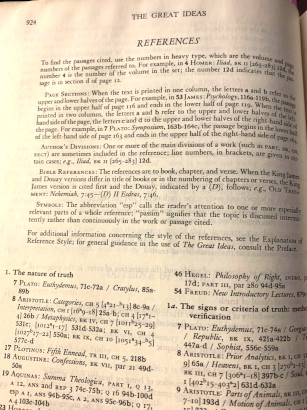 The blue text in each cell
designates my comments after reading the given reference. A date is given
after each comment.
The blue text in each cell
designates my comments after reading the given reference. A date is given
after each comment.  The topic of Truth has been divided into
several sub-topics. These sub-topics are given as the last line in each
cell.
The topic of Truth has been divided into
several sub-topics. These sub-topics are given as the last line in each
cell.| AP | APOCRYPHA |
Wisdom of Solomon, 7:24‑26 (D) OT, Book of Wisdom, 7:24‑26 Ecclesiasticus, 24:9 (D) OT, Ecclesiasticus, 24:14 5. The eternal verities and the mutability of truth |
| AP | APOCRYPHA |
Wisdom of Solomon, 1:11 (D) OT, Book of Wisdom, 1:11 Ecclesiasticus, 1:28‑30; 4:25; 7:12‑13; 15:8; 19:26‑28; 20:18,24‑26; 25:2; 27:9; 34:4; 41‑17; 51:1‑3 (D) OT, Ecclesiasticus, 1:37‑40; 4:30; 7:13‑14; 15:8; 19:23‑26; 20:20,26‑28; 25:3‑4; 27:10; 34:4; 41:21; 51:1‑5 Susanna (D) OT, Daniel, 13 8a. Prevarication and perjury: the injustice of lying or bearing false witness |
| AP | APOCRYPHA |
II Machabees, 6:18‑7:42 8e. The love of truth and the duty to seek it: the moral distinction between the sophist and the philosopher; martyrdom to the truth |
| NT | NEW TESTAMENT |
John 3:33; 7:14‑18; 8:12‑59; 14:6,16‑17; 15:26; 16:13‑14; 17:17; 18:37‑38
Romans 1:18‑25; 2:2, 8‑9, 20 ICorinthians 1:17‑2:16 IICorinthians 13:8 Ephesians 4:21‑24 IIThessalonians 2:10‑14 ITimothy 2:3‑4; 3:15 IITimothy 2:25‑26 Hebrews 6:18; 10:26 James 5:19‑20 I John 1:5‑10; 2:4, 21‑22; 3:18‑19; 5:5‑12 esp. 5:6 IIJohn 2‑4 IIIJohn, 3‑4,8 2d. The comparison of human and divine truth: finite truths and the infinite truth |
| NT | NEW TESTAMENT |
II John, 2 5. The eternal verities and the mutability of truth |
| NT | NEW TESTAMENT |
Matthew, 5:33‑37; 19:17‑18; 26:55‑75; 28:11‑15 Mark, 14:48‑72 Luke, 3:14; 22:54‑62 John, 8:44; 18:15‑27 Acts, 5:1‑10; 6:11‑15 Romans, 9:1 IICorinthians, 4:2 Ephesians, 4:14‑15,25 Colossians, 3:8‑10 ITimothy, 2:7; 4:1‑3 Titus, 2:3 James, 3:14‑17 IPeter, 2:1 Revelation, 21:6‑8,27; 22:13‑15 8a. Prevarication and perjury: the injustice of lying or bearing false witness |
| NT | NEW TESTAMENT |
ICorinthians, 13:6 Galatians, 4:16 8c. Truth in relation to love and friendship: the pleasant and the unpleasant truth |
| NT | NEW TESTAMENT |
Matthew, 28:19‑20 Mark, 16:14‑20 Luke, 24:46‑48 John, 8:31‑32; 14:6; 16:13; 18:37 Acts, 6:8‑7:60 (D) Acts, 6:8‑7:59 IICorinthians, 13:7‑8 Ephesians, 6:14 James, 3:13‑18 IPeter, 2:1‑2 8e. The love of truth and the duty to seek it: the moral distinction between the sophist and the philosopher; martyrdom to the truth |
| OT | OLD TESTAMENT |
Exodus 34:6
Numbers 23:19 Psalms 31:5; 86:15; 96:13; 100:5; 117:2; 119:142,160; 146:6 (D) Psalms 30:6; 85:15; 95:13; 99:5; 116:2; 118:142,160; 145:6‑7 Proverbs 30:5‑6 2d. The comparison of human and divine truth: finite truths and the infinite truth |
| OT | OLD TESTAMENT |
Psalms, 100:5; 117:2; 119:160; 146:6
(D) Psalms, 99:5; 116:2; 118:160; 145:6‑7 Proverbs, 8:22‑30 5. The eternal verities and the mutability of truth |
| OT | OLD TESTAMENT |
Genesis, 4:8‑10; 27; 39:7‑20 Exodus, 20:16; 23:1,7 Leviticus, 6:2‑7; 19:11‑12 I Deuteronomy, 5:20; 19:15‑21 IIChronicles, 18 (D) IIParalipomenon, 18 Job, 8:11‑18; 27:3‑4,8‑10 Psalms, 5:6; 15:1‑2; 24:3‑4; 31:18; 34:11‑13; 43:1; 50:16‑21; 52:1‑5; 55:23; 101:7; 119:29‑30; 120:1‑3 (D) Psalms, 5:7; 14:1‑3; 23:3‑4; 30:19; 33:12‑14; 42:1; 49:16‑21; 51:1‑7; 54:24; 100:7; 118:29‑30; 119:1‑3 Proverbs, 3:3; 6:16‑19; 8:7‑9; 10:18; 11:1,9; 12:17‑22; 13:5; 14:5,25; 17:4,7; 19:5,9,22; 20:17,23; 21:6,28; 24:24,26; 25:18; 26:18‑28; 30:5‑9 Isaiah, 9:13‑17; 28:14‑18; 59 passim (D) Isaias, 9:13‑17; 28:14‑18; 59 passim Jeremiah, 5:1‑5; 9:1‑9; 14:10‑16; 23:16‑40 (D) Jeremias, 5:1‑5; 9:1‑9; 14:10‑16; 23:16‑40 Nahum, 3:1 Zechariah, 8:16‑19 (D) Zacharias, 8:16‑19 Malachi, 2:1‑9; 3:5‑18 (D) Malachias, 2:1‑9; 3:5‑18 8a. Prevarication and perjury: the injustice of lying or bearing false witness |
| OT | OLD TESTAMENT |
Proverbs, 11:9‑13
8c. Truth in relation to love and friendship: the pleasant and the unpleasant truth |
| OT | OLD TESTAMENT |
Psalms, 15:1‑2; 25:4‑5; 43:3; 51:6; 119:30 (D) Psalms, 14:1‑3; 24:4‑5; 42:3; 50:8; 118:30 Proverbs, 23:23 8e. The love of truth and the duty to seek it: the moral distinction between the sophist and the philosopher; martyrdom to the truth |
|
VOL. # |
AUTHOR | REFERENCES AND COMMENTS |
| 4 | HOMER 800 BC |
Iliad, BKxiv [301‑360] 101b‑d
Odyssey, BKxiii [250‑310] 257d‑258b 8b. The expediency of the political lie |
| 5 |
ARISTO- PHANES 446-386 BC |
Clouds [889‑901] 499b‑c
4d. Truth and probability in rhetoric and dialectic |
| 5 | EURIPIDES 480-406 BC |
Phoenician Maidens [469‑472] 382a
4d. Truth and probability in rhetoric and dialectic |
| 5 | EURIPIDES |
Phoenician Maidens [861‑961] 385d‑386d
8a. Prevarication and perjury: the injustice of lying or bearing false witness |
| 5 | SOPHOCLES 497-406 BC |
Oedipus the King [216‑462] 101a‑103c
Philoctetes 182a‑195a,c esp. [50‑134] 182d‑183c, [895‑962] 190a‑d 8a. Prevarication and perjury: the injustice of lying or bearing false witness |
| 5 | SOPHOCLES |
Trachiniae [335 496] 173a‑174c 8b. The expediency of the political lie |
| 5 | SOPHOCLES |
Oedipus the King 99a‑113a,c
8c. Truth in relation to love and friendship: the pleasant and the unpleasant truth |
| 5 | SOPHOCLES |
Antigone [499‑511] 135b‑c; [683‑739]
137a‑c
8d. Civil liberty as a condition for discovering the truth: freedom of thought and discussion |
| 6 |
HERODOTUS 484-425 BC |
History, BKii, 71a‑73b
esp. 72a‑b;
BKiv, 127a‑b 4b. Truth in science and poetry: the truth of fact and the truth of fiction |
| 6 | HERODOTUS | History, BKiii, 105c‑d; BKvi,
201d‑202c; BKvii, 217d 8a. Prevarication and perjury: the injustice of lying or bearing false witness |
| 6 | HERODOTUS | History, BKvi, 186b‑c; BKviii, 264a‑c 8b. The expediency of the political lie |
| 6 | HERODOTUS | History, BKvii, 216d‑217a 8d. Civil liberty as a condition for discovering the truth: freedom of thought and discussion |
| 6 | HERODOTUS | History, BKvii, 239a‑c; 242c‑d 8e. The love of truth and the duty to seek it: the moral distinction between the sophist and the philosopher; martyrdom to the truth |
| 6 |
THUCYDIDES 460-400 BC |
Peloponnesian War, BKi, 354b 4b. Truth in science and poetry: the truth of fact and the truth of fiction |
| 6 | THUCYDIDES | Peloponnesian War, BKiii, 425c‑d 4d. Truth and probability in rhetoric and dialectic |
| 6 | THUCYDIDES | Peloponnesian War, BKiii, 427b‑c 8b. The expediency of the political lie |
| 6 | THUCYDIDES | Peloponnesian War, BKii, 397b‑c;
BKiii, 427a‑c 8d. Civil liberty as a condition for discovering the truth: freedom of thought and discussion |
| 6 | THUCYDIDES | Peloponnesian War, BKii, 397b‑c 8e. The love of truth and the duty to seek it: the moral distinction between the sophist and the philosopher; martyrdom to the truth |
| 7 |
PLATO 428-348 BC |
Euthydemus, 71c‑72a
>>> a poor attempt
to try and show that lies do not exist because lies are about things
that are opposite to the truth. True things exist, but lies do not ∴
lying does not exist. [7/04] Cratylus, 85a‑89b >>> do names given to things actually contain some truth about the named object, or are they just conventional or arbitrary words that can be changed without ill effect? Props have two possible states, true or false. Names are conventions, because different languages give different names for the same object. Protagoras: man is the measure of all things. The truth is that things are as they appear to anyone- how can some of us be wise & some foolish? [such a low and contradictory definition of truth, it is easily dismissed.] Socrates then argues against Protagoras’s relativism. That the same essence of someone is independent of what others believe about him. Socrates: When we name, we distinguish things according to their natures. He then settles on the idea that there are men, namely legislators, who are the ones who give names to things! He then goes on to compare the use & naming of tools to the use & naming of people. Since we give specific names to tools, we should give specific names to people that “fits” them best. Our legislators should know how to put the natural (fitting, most meaningful) names of each thing into sounds & syllables, to give each its “ideal” name!! Who decides whether an awl is well made, the user of the awl & not just the maker. Then the thing being named should have a say in what he is being named! He concludes that names have a truth by nature & are not conventional things. [not convincing.] [7/2/04] 1. The nature of truth |
| 7 | PLATO |
Euthydemus, 71c‑74a Telling a falsehood is impossible. [This could be valid if we consider that false is the denial of a truth, & if truth is not known, then its denial is impossible!] [7/04] Gorgias, 266b Republic, BKix, 421a‑422b Timaeus, 447a‑d The father and maker of all this universe is past finding out. [He admits that he cannot find out who is God.] As being is to becoming, so is truth to belief. [7/04] Sophist, 556c‑559a Ignorance is the aberration of a mind which is bent on truth. [7/04] 1a. The signs or criteria of truth: methods of verification |
| 7 | PLATO | Euthydemus, 71c‑74a Cratylus, 85a‑89b Phaedrus, 124c‑126c Republic, BKv, 368c‑373c; BKvi, 383d‑388a esp. 387a; BKix, 423b‑424a Timaeus, 447a‑d Parmenides, 507c‑509a Theaetetus, 534d‑536a; 537a‑c Sophist, 561d‑577b Philebus, 625a 1b. The relation between truth and being or reality |
| 7 | PLATO | Phaedrus, 124c‑129d Symposium, 167a‑d Republic, BKvi, 383d‑388a Theaetetus, 525c‑526a Sophist, 556c‑559a; 561b‑d Philebus, 630d‑631d; 637c‑638a Laws, BKii, 654a‑662a 1c. The relation of truth, goodness, and beauty |
| 7 | PLATO | Republic, BKv, 370d‑373c
esp. 373b‑c;
BKvi, 386d‑388a Timaeus, 447b‑d Theaetetus, 517b‑d; 527b‑d; 531b‑532a Philebus, 633a‑635b 2e. The distinction between truth and probability: its relation to the distinction between knowledge and opinion |
| 7 | PLATO | Phaedo, 224a‑b Republic, BKvi, 386d‑388a; BKvii, 392b‑393b; BKx, 431b‑c Theaetetus, 538d‑541a Sophist, 575d‑577b esp. 577a‑b Philebus, 622d‑626a 3a(1) The truth of sensations: judgments of perception |
| 7 | PLATO | Theaetetus, 538d‑541a Philebus, 623d‑624c 3a(2) Truth in the memory and imagination |
| 7 | PLATO | Republic, BKvi, 386d‑388a Theaetetus, 536c‑544a 3b. Truth in the acts of the mind |
| 7 | PLATO | Cratylus 85a‑114a,c passim,
esp.
85a‑89a, 104b‑114a,c Republic, BKii, 323c‑324c; BKvi, 386d‑388a Seventh Letter, 809c‑810d 3b(1) The truth of ideas: concepts and definitions |
| 7 | PLATO | Euthydemus, 71c‑74a Cratylus, 85a‑86b; 109a‑b Sophist, 561d‑577b esp. 575a577b 3b(2) The truth of propositions: the special problem of judgments about future contingencies |
| 7 | PLATO | Euthydemus 65a‑84a,c
esp. 67b‑68d,
71b‑72c Phaedo, 236c‑238a 3b(3) Truth in reasoning: the truth of premises in relation to the truth of conclusions; logical validity and truth about reality |
| 7 | PLATO | Protagoras, 53a Euthydemus, 72d‑73b Republic, BKiv, 350d‑351b Theaetetus, 527a‑528a Sophist, 558b‑d 3c. The principle of contradiction as the foundation of truth in judgment and in reasoning |
| 7 | PLATO | Phaedo, 224a‑c Theaetetus, 539a‑540a 3d(1) The infallibility of the senses and the mind: the respects in which they are incapable of error |
| 7 | PLATO | Meno, 180b‑182a esp. 181d‑182a Phaedo, 224a‑225a Republic, BKii, 323c‑324c; BKiii, 339b‑340a Theaetetus, 520c‑522b; 536c‑544a Sophist, 557b‑558d; 575d‑577b Philebus, 622d‑626a 3d(2) The nature and sources of error in human perception and thought: the distinction between error and ignorance |
| 7 | PLATO | Sophist, 557b‑558d Statesman, 582d‑584a Philebus, 610d‑613a 3d(3) Rules for the correction or prevention of error in thought |
| 7 | PLATO | Protagoras, 52d‑57c Gorgias, 281d‑282a Republic, BKii, 320d‑324c; BKx, 427c‑431b Sophist, 561b‑d; 577d‑579d Laws, BKii, 660b‑662a 4b. Truth in science and poetry: the truth of fact and the truth of fiction |
| 7 | PLATO |
Republic, BKvi, 383d‑388a; BKvii,
391b‑398c Timaeus, 447b‑d Philebus, 633a‑635a 4c. Truth in metaphysics, mathematics, and the empirical sciences: the truth of principles, hypotheses, and conclusions in the several speculative disciplines |
| 7 | PLATO | Protagoras, 39d‑42c Euthydemus 65a‑84a,c Phaedrus, 131b‑141a,c Apology, 200a‑c Gorgias 252a‑294d esp. 258b‑d Republic, BKvi, 386d‑388a Sophist, 578d‑579d Philebus, 634b‑635a Seventh Letter, 809c‑810d 4d. Truth and probability in rhetoric and dialectic |
| 7 | PLATO | Cratylus, 113c‑114a,c Phaedrus, 125a‑b Meno, 184d Theaetetus, 528b‑c 5. The eternal verities and the mutability of truth |
| 7 | PLATO | Euthydemus, 72d‑73a Cratylus, 86a‑d; 107d‑109a Phaedo, 236c‑238a Theaetetus, 517b‑532c passim, esp. 517b‑c, 522b, 525a‑526c, 531b‑532a 7a. The impossibility of knowing the truth: the restriction of all human judgments to degrees of probability; the denial of axioms and of the possibility of demonstration |
| 7 | PLATO | Cratylus, 86b‑d; 113c‑114a,c Meno, 179b‑183b esp. 179d‑180b, 182c‑183b Theaetetus, 517b‑532c esp. 527b‑528c 7b. The defense of truth against the skeptic |
| 7 | PLATO | Euthyphro, 192a‑193b Apology, 208c‑210d esp. 209a‑b Laws, BKxi, 783c‑784b 8a. Prevarication and perjury: the injustice of lying or bearing false witness |
| 7 | PLATO | Republic, BKii, 323c‑324a; BKiii,
326b‑c; 340b‑341a Laws, BKii, 658a‑c 8b. The expediency of the political lie |
| 7 | PLATO |
Symposium, 161b‑d Apology, 201d‑203c Phaedo, 234c‑235a Republic, BKi, 297b‑c; BKv, 356d‑357b; BKx, 427c Philebus, 622d‑631d 8c. Truth in relation to love and friendship: the pleasant and the unpleasant truth |
| 7 | PLATO |
Apology, 200a‑210b passim Statesman, 601c‑602c 8d. Civil liberty as a condition for discovering the truth: freedom of thought and discussion |
| 7 | PLATO |
Lysis, 22b‑c Protagoras, 54c‑55a Euthydemus 65a‑84a,c Phaedrus, 124c‑127c Meno, 179d‑180b; 182c‑183b Euthyphro, 198d‑199a,c Apology 200a‑212a,c esp. 201d‑203a, 206b‑d, 207d‑208a, 210a‑b Phaedo, 223b‑225a; 234c‑235a; 251b‑d Gorgias, 271a‑b Republic, BKii, 319c‑320c; 323c‑324a; BKv, 370b‑373c; BKvi, 377a‑379c; BKx, 427c Theaetetus, 518d‑519a; 524b; 525a; 528c‑531a Sophist 551a‑579d esp. 571b‑c Philebus, 610c‑d Seventh Letter, 808c‑809a 8e. The love of truth and the duty to seek it: the moral distinction between the sophist and the philosopher; martyrdom to the truth |
| 8 |
ARISTOTLE 384-322 BC |
Categories, CH5 [4a21‑b13]
8c‑9a I think he is saying that even though a person, who is being described by a statement, is changing, the statement itself cannot change and since it was true of him at a certain time, it must be considered a true statement always. This is very much how Nash and Robbins approach the noT i.e. > Props. are carriers of truth > A prop, that describes an event is true for that instance. These I disagree with. An “instance” cannot be defined or even named. The foolish idea that “I am writing on 7:18:04” is an endless prop. that these men seem to be blind to. They think that if they say “I am writing at 7:15 pm on 7:16:04” that they have a closed prop., but they do not. 1- The instant a date or time is introduced, it is an arbitrary number because dates & times are totally relative and arbitrary designations. 2- The date and time itself would have to be infinitely well defined, an impossibility. 3- We can never say that this is the True date & time of an event. 4- The “I”, the subject of the prop. is NOT the same person for any length of time. Since they would probably admit this, they want to say that he is unchangeable for an Instant of time. But this instant or moment would have to be an infinitely small moment. Thus the need to define an infinitely small period of time, which is an impossibility. [7/04] Interpretation, CH1 [16a9‑18] 25a‑b; CH4 [17a1‑4] 26b Only props. can be true or false. Sentences are nTnF according to Aristotle, even though they are meaningful. He wants to dismiss all sentences [7/04] Metaphysics, BKiv, CH7 [1011b25‑29] 531c; Now he says that props. can be either true or false, which is how he defined them before. He does not want to admit that there are “indeterminacies” between T&F. This is his famous “definition” of truth passage, which is really not a definition, but a condition, which almost everyone is confusing with each other. In fact he says so plainly that he has assumed what truth & falsity mean, and all his arguments are based on these assumptions. Later (1012:25) he makes a very important observation, though his conclusion from it is incorrect. “If all things are in motion, nothing will be true”, but “everything therefore will be false.” Is NOT correct. [7/04] [1012a1‑17] 531d‑532a; BKvi, CH4 [1027b17‑22] 550a; Falsity & truth are not in things[…] they are in thought. This can be understood in more than one way: 1- the ideas of T&F is only in minds, which is what he probably means. 2- there is no T & F in things, which he probably does not mean, but which I believe is correct. A consequence of this is that as Christians we do have to admit that Truth is IN Christ. In fact, there is No T outside of Him. “I am the truth” means just that, pure and simple. [7/04] BKix, CH10 [1051a34‑b5J 577c‑d 1. The nature of truth |
| 8 | ARISTOTLE |
Prior Analytics, BKi, CH32 [47a4‑9]
65a Everything that is true must in every respect agree with itself. [Coherence theory in brief.] [7/04] Heavens, BKi, CH[270b1‑13] 361c‑d; The senses convince us that there is a god above fire, earth, air & water called Aithea which ‘runs always.’ [7/04] BKiii, CH7 [306a1‑18] 397b‑c Deductions can be wrong if assumptions are incorrect. [7/04] Soul, BKi, CHi [402b15‑403a2] 631d‑632a 1a. The signs or criteria of truth: methods of verification |
| 8 | ARISTOTLE |
Categories, CH12 [14b
10‑21] 20b Interpretation, CH3 [16b19‑26] 25d‑26a; CH9 [18b1‑4] 28b‑c Prior Analytics, BKi, CH36 [48a40‑b9] 66d; BKii, CH2 [53b11‑26] 72d‑73a Metaphysics, BKii, CHi [993b 19‑31] 512a‑b; BKv, CH7 [1017a31‑34] 538a; BKvi, CH4 550a,c; BKix, CH10 577c‑578a,c 1b. The relation between truth and being or reality |
| 8 | ARISTOTLE |
Metaphysics, BKv, CHi [1013a20‑24]
533 b; BKxii, CH7 [1072a25‑b4]
602 b‑c Soul, BKiii, CH7 663c‑664b esp. [431a 13‑19] 663d 1c. The relation of truth, goodness, and beauty |
| 8 | ARISTOTLE |
Metaphysics, BKv, CH29 [1024b18‑26]
546c‑d 2a. The distinction between truth and falsity in the mind and in things: logical and ontological truth |
| 8 | ARISTOTLE |
Metaphysics, BKiv, CH4 [1006a12‑29]
525b‑c; BKxi, CH5 [1062a5‑19]
590b‑c 2b. The distinction between truth of statement and truth of signification: the distinction between real and verbal truth |
| 8 | ARISTOTLE |
Metaphysics, BKii, CHi [993b19‑31]
512a‑b 2c. The distinction between theoretical and practical truth: conformity to existence and conformity to right desire |
| 8 | ARISTOTLE | Interpretation, CH9 28a‑29d Posterior Analytics, BKi, CH2 97d‑99a; CH6 102b‑103c; CH8 104a‑b; CH30 119d; CH33 121b‑122a,c Topics, BKi, CH1 [100a25‑b26] 143a‑b Metaphysics, BKiv, CH4‑6 525a‑531c; BKvii, CH15 [1039b31 ‑1040a8] 563d‑564a; BKix, CH10 [1051b13‑18] 577d; BKxi, CH6 590d‑592b 2e. The distinction between truth and probability: its relation to the distinction between knowledge and opinion |
| 8 | ARISTOTLE | Metaphysics, BKiv, CH5 [1010b1‑29]
530a‑c; BKxi, CH6 [1062b33‑1063a9]
591a‑b Soul, BKii, CH6 [418a6‑18] 648d‑649a; BKiii, CH3 [427b6‑15] 659d‑660a; [428a11‑18] 660b; CH6 [430b26‑30] 663b‑c Sense and the Sensible, CH4 [442b4‑9] 680a b 3a(1) The truth of sensations: judgments of perception |
| 8 | ARISTOTLE | Metaphysics, BKiv, CH5 [1010b1‑12]
530a‑b; BKv, CH29 [1024b17‑27]
546c‑d Soul, BKiii, CH3 [428a11‑18] 660b Memory and Reminiscence, CHi [451a8‑12] 692a 3a(2) Truth in the memory and imagination |
| 8 | ARISTOTLE |
Soul, BKiii, CH6 662d‑663c; CH10 [433a21‑28] 665d‑666a
Soul, BKiii, CH6 662d‑663c; CH10 [433a
21‑28]
665d‑666a
3b. Truth in the acts of the mind |
| 8 | ARISTOTLE | Categories, CH4 [2a4‑10]
6a Interpretation, CHi [16a9‑18] 25a‑b Here even Aristotle admits that there are words, which when not used in props., have to be described as nTnF. [7/04] Topics, BKvi, CHi [139a24‑b2] 192a‑b; BKvi, CH4‑ BKvii, CH5 194c‑211a,c passim Metaphysics, BKv, CH29 1024b27‑38] 546d‑547a; BKvi, CH4 [1027b27‑28] 550a; BKix, CH10 [1051b18‑33] 577d‑578a Soul, BKiii, CH6 [430a26 ‑b5] 662d‑663a; [430b26‑30] 663b‑c 3b(1) The truth of ideas: concepts and definitions |
| 8 | ARISTOTLE | Categories, CH4 [2a4‑10]
6a; CH5 [4a10‑b19]
8b‑9a Interpretation, CHi [16a9‑18] 25a‑b; CH4‑14 26a‑36d passim, esp. CH4 [17a1‑4] 26b, CH7 26d‑27d, CH9 28a‑29d, CH14 35c‑36d Metaphysics, BKiv, CH7 1011b25‑29] 531c; [1012a1‑17] 531d‑ 532a; CH8 [1012a29‑b22] 532b‑d; BKvi, CH4 550a,c; BKix, CH10 1051a34‑b18] 577c‑d Soul, BKiii, CH3 [427b16‑25] 660a; CH6 [430a26‑b5] 662d‑663a; [430b26‑31] 663b‑c 3b(2) The truth of propositions: the special problem of judgments about future contingencies |
| 8 | ARISTOTLE | Prior Analytics, BKii, CH2‑4 72d‑77a Posterior Analytics, BKi, CH2 [71b16‑26] 98a‑b; [72a6‑9] 98c; [72a14‑19] 98c‑d; CH10 104d‑105d; CH12 [77b16‑34] 106d‑107a Physics, BKi, CH2 [185a5‑12] 259d; CH3 [186a4‑9] 260d‑261a; BKviii, CHi [252a19‑b7] 335d‑336b 3b(3) Truth in reasoning: the truth of premises in relation to the truth of conclusions; logical validity and truth about reality |
| 8 | ARISTOTLE | Categories, CH10 [13b1‑35]
19a‑c Prior Analytics, BKii, CH17 86b‑87a Posterior Analytics, BKi, CH11 105d‑106b Metaphysics, BKiii, CH2 [996b26‑30] 515b; BKiv, CH3‑6 524b‑531c: CH8 [1012a29‑b22] 532b‑d; BKxi, CH5‑6 590a‑592b 3c. The principle of contradiction as the foundation of truth in judgment and in reasoning |
| 8 | ARISTOTLE | Metaphysics, BKiv, CH5 [1010b
15‑29] 530 b‑c; BKix, CH10 [1051b
25‑33] 578a Soul, BKii, CH6 [418a6‑18] 648d‑649a; BKiii, CH3 [427b6‑15] 659d‑660a; [428a5‑429a2] 660b‑661a; CH6 [430a26‑b5J 662d‑663a; [430b26‑30] 663b‑c; CH10 [433a 21‑28] 665d‑666a Sense and the Sensible, CH4 [442b4‑9] 680a‑b 3d(1) The infallibility of the senses and the mind: the respects in which they are incapable of error |
| 8 | ARISTOTLE | Prior Analytics, BKi, CH34‑35 66b‑d;
BKii, CH16‑21 85c‑89b Posterior Analytics, BKi, CH5 101b‑102b; CH12 [77b16‑34] 106d‑107a; CH16‑18 109b‑111c Topics, BKi, CHi [101a5‑17] 143c‑d; BKv, CH3 [131b19‑36] 182b‑c; BKvi, CH9 [148a2‑9] 202a; BKviii, CH12‑13 220c‑221d Sophistical Refutations 227a‑253d Physics, BKi, CH2 [185a5‑12] 259d Heavens, BKi, CH5 [271b1‑18] 362c‑d Metaphysics, BKiv, CH5 [1009a 15‑1010a14] 528c‑529d; CH6 [1011a3‑13] 530d; CH7 [1012a18‑22] 532a; BKix, CH10 1051b 18‑1052a4] 577d‑578a,c; BKxi, CH6 [1062b 12‑24] 590d‑591a Soul, BKiii, CHi [425a30‑b4] 657c; CH3 [427a16‑b6] 659c‑d; CH6 [430a26‑b5] 662d‑663a; CH10 [433a21‑28] 665d‑666a Sense and the Sensible, CH4 [442b4‑9] 680a‑b Memory and Reminiscence, CHi [451a8‑12] 692a Dreams 702a‑706d 3d(2) The nature and sources of error in human perception and thought: the distinction between error and ignorance |
| 8 | ARISTOTLE | Topics 143a‑223a,c Sophistical Refutations 227a‑253d 3d(3) Rules for the correction or prevention of error in thought |
| 8 | ARISTOTLE | Posterior Analytics, BKi, CH32
120c‑121b Metaphysics, BKix, CH9 [1051a 22‑34] 577b‑c; BKxiii, CH2 [1077bii]‑CH3 [1078a31] 609a‑d 4c. Truth in metaphysics, mathematics, and the empirical sciences: the truth of principles, hypotheses, and conclusions in the several speculative disciplines |
| 8 | ARISTOTLE | Topics, BKi, CHi [100a18‑b31]
143a‑c; CH2 [101a34‑b4]
144a Metaphysics, BKiv, CH2 [1004b15‑27J 523d 4d. Truth and probability in rhetoric and dialectic |
| 8 | ARISTOTLE | Categories, CH5 [4a10‑b12]
8b‑9a Posterior Analytics, BKi, CH8 104a‑b Metaphysics, BKii, CHi [993b19‑31] 512a‑b; BKix, CH10 [1051b33‑1052a12] 578a,c 5. The eternal verities and the mutability of truth |
| 8 | ARISTOTLE | Sophistical Refutations, CH34 [183b16‑184b8]
253a‑d Heavens, BKi, CH10 [279b4‑12] 370d; BKiv, CHi [307b28‑308a8] 399a‑b Metaphysics, BKi, CH3 [983a33‑b6] 501c‑d; CH7 506b‑d; CH10 511c‑d; BKii, CHi 511b,d‑512b; BKiii, CHi [995a23‑b4] 513b,d; BKxii, CH10 [1075a25‑1076a4J 606a‑d; BKxiii, CHi [1076a8‑17] 607a Soul, BKi CH2 [403b20‑23] 633a 6. The accumulation or accretion of truth, and the correction of error, in the progress of human learning |
| 8 | ARISTOTLE | Posterior Analytics, BKi, CH3 [72b5‑33]
99b‑c Metaphysics, BKiv, CH3‑8 524b‑532d; BKx, CHi [1053a31‑b3] 580a; CH6 [1057a7‑11] 584b; BKxi, CH5‑6 590a‑592b 7a. The impossibility of knowing the truth: the restriction of all human judgments to degrees of probability; the denial of axioms and of the possibility of demonstration |
| 8 | ARISTOTLE | Metaphysics, BKiv, CH4‑8 525a‑532d;
BKxi, CH6 590d‑592b 7b. The defense of truth against the skeptic |
| 8 | ARISTOTLE | Physics, BKviii, CHi [251a28‑b1]
334d‑335a Metaphysics, BKv, CH29 [1025a1‑12] 547a 8a. Prevarication and perjury: the injustice of lying or bearing false witness |
| 8 | ARISTOTLE | Metaphysics, BKiv, CH2 [1004b17‑27]
523d 8e. The love of truth and the duty to seek it: the moral distinction between the sophist and the philosopher; martyrdom to the truth |
| 9 | ARISTOTLE | Parts of Animals, BKiii, CH4 [666a
7‑10]193d That the heart is the source of blood has been verified thru dissection & demonstration. The heart is also at the center & thus the source of pain & pleasure. [7/04] Motion of Animals, CHi [698a10‑15] 233a The prime mover must be immovable because he is the prime mover. [7/04] Generation of Animals, BKiii, ch 10 [760b27‑35] 301d‑302a Theories are considered confirmed if they agree with the facts. [All other references support the Correspondence theory of truth.] [7/04] Ethics, BKi, ch 7 [1098a35]‑ch 8 [1098b12] 343d‑344a; BKii, CH7 [1107a27‑32] 352d‑353a; BKx, CH1 [1172a34‑b7] 426b; CH8 [1179a17‑22] 433d‑434a Politics, BKvii, ch 1 [1323a33‑b7] 527b 1a. The signs or criteria of truth: methods of verification |
| 9 | ARISTOTLE | Ethics, BKi, CH3 339d‑340b; CH7 [1098a25‑35]
343d; BKii, CH2 [1103b26‑1104a9]
349b‑c; BKvi, CH2 387d‑388b; BKx, Chi [1172a34‑b8]426b‑c 2c. The distinction between theoretical and practical truth: conformity to existence and conformity to right desire |
| 9 | ARISTOTLE | Ethics, BKi, CH3 [1094b11‑28]
339d‑340a; CH7 [1098a25‑35]
343d; BKii, CH2 [1104a1‑9]
349b‑c; BKvi, CH9 [1142b5‑15]
391d Rhetoric, BKi, CHi [1355a4‑18] 594b; CH2 [1357a23‑b21] 596d‑597c; BKii, CH25 [1402b13‑1403a17] 652b‑653a 2e. The distinction between truth and probability: its relation to the distinction between knowledge and opinion |
| 9 | ARISTOTLE | Parts of Animals, BKii, CH2 [648b15‑20]
173a 3a(1) The truth of sensations: judgments of perception |
| 9 | ARISTOTLE | Ethics, BKvi, CH2 [1139a27‑30]
387d‑388a; CH3 [1139b14‑18]
388b 3b. Truth in the acts of the mind |
| 9 | ARISTOTLE | Ethics, BKii, CH7 [1107a27‑32]
352d‑353a; BKvi, CH2 [1139a21‑31]
387d‑388a 3b(2) The truth of propositions: the special problem of judgments about future contingencies |
| 9 | ARISTOTLE | Ethics, BKi, CH3 [1094b11‑28]
339d‑340a; CH8 [1098b9‑12]
344a; BKvi, CH9 [1142b8‑15]
391d; [1142b22‑26]
392a; BKvii, CH2 [1146a23‑30]
396b Poetics, CH24 [1460a19‑25] 696b‑c 3b(3) Truth in reasoning: the truth of premises in relation to the truth of conclusions; logical validity and truth about reality |
| 9 | ARISTOTLE | Ethics, BKiii, CHi [1110b17‑1111a20]
356b‑357a; CH4 359a‑c; BKvi, CH9 391c‑392b Rhetoric, BKiii, CH7 [1408a20‑25] 659b 3d(2) The nature and sources of error in human perception and thought: the distinction between error and ignorance |
| 9 | ARISTOTLE | Poetics, CH25 696d‑698c 4b. Truth in science and poetry: the truth of fact and the truth of fiction |
| 9 | ARISTOTLE | Generation of Animals, BKii, CH6 [742b18‑35]
283d‑284a Ethics, BKi, CH3 [1094b23‑28] 339d‑340a; CH7 [1098a25‑35] 343d 4c. Truth in metaphysics, mathematics, and the empirical sciences: the truth of principles, hypotheses, and conclusions in the several speculative disciplines |
| 9 | ARISTOTLE | Ethics, BKi, CH3 [1094b18‑28]
339d‑340a Rhetoric, BKi, CHi [1355a4‑40] 594b‑d; CH2 [1356a36‑1357b21] 596a‑597c; BKii, CH23 [1397b12‑27] 645d‑646a; [1400a5‑14] 648d; CH25 [1402b13‑1403a17] 652b‑653a; BKiii, CH7 [1408a20‑23] 659b 4d. Truth and probability in rhetoric and dialectic |
| 9 | ARISTOTLE | History of Animals, BKiii, CH3 [513a7‑14]
36c‑d Parts of Animals, BKi, CHi [642a25‑30] 165b‑c Ethics, BKi, CH6 [1096a11‑16] 341b Rhetoric, BKi, CHi [1355a34‑39] 594d 6. The accumulation or accretion of truth, and the correction of error, in the progress of human learning |
| 9 | ARISTOTLE | Ethics, BKiv, CH7 374b‑375a Rhetoric, BKi, CH14 [1375a8‑13] 619c; CH15 [1377a8‑b12] 621d‑622d 8a. Prevarication and perjury: the injustice of lying or bearing false witness |
| 9 | ARISTOTLE | Ethics, BKi, CH6 [1096a11‑16]
341b; BKiv, CH3 [1124b26‑30]
371 d; CH7 374b‑375a 8c. Truth in relation to love and friendship: the pleasant and the unpleasant truth |
| 9 | ARISTOTLE | Parts of Animals, BKi, CH5 [644b21‑645a25]
168c‑169a Ethics, BKi, CH6 [1096a11‑16] 341b; BKiv, CH7 [1127a33‑b8] 374c‑d; BKvii, CH2 [1146a23‑27] 396b 8e. The love of truth and the duty to seek it: the moral distinction between the sophist and the philosopher; martyrdom to the truth |
| 10 | GALEN 129-216 AD |
Natural Faculties, BKi, CH13, 173d 1a. The signs or criteria of truth: methods of verification |
| 10 | GALEN |
Natural Faculties, BKi, CH14, 178c‑d
Natural Faculties, BKi, CH14, 178c‑d
3b(3) Truth in reasoning: the truth of premises in relation to the truth of conclusions; logical validity and truth about reality |
| 10 | GALEN |
Natural Faculties, BKi, CH14, 178d‑179a; CH16 180c‑182b; BKii,
CH8, 192a‑b; CH9, 199a,c; BKiii, CH10 207b‑d
6. The accumulation or accretion of truth, and the correction of error, in the progress of human learning |
| 10 | HIPPOCRATES 460-370 BC |
Ancient Medicine, par i, 1b There is nothing which can be referred to in order to discover the truth. [7/04] 1a. The signs or criteria of truth: methods of verification |
| 10 | HIPPOCRATES | Regimen in Acute Diseases, par i 26a‑c 6. The accumulation or accretion of truth, and the correction of error, in the progress of human learning |
| 12 | AURELIUS 121-180 AD |
Meditations, BKiv, SECT20 265a‑b
1c. The relation of truth, goodness, and beauty |
| 12 | AURELIUS |
Meditations, BKix, SECTi, 291a‑b 8a. Prevarication and perjury: the injustice of lying or bearing false witness |
| 12 | AURELIUS |
Meditations, BKvi, SECT21 276a 8c. Truth in relation to love and friendship: the pleasant and the unpleasant truth |
| 12 | AURELIUS |
Meditations, BKi, SECT14 254b‑c; BKiii, SECT6 261a‑c; SECT12
262b‑c; BKv, SECT9 270b‑c; BKvi, SECT12 274c; SECT21 276a
8e. The love of truth and the duty to seek it: the moral distinction between the sophist and the philosopher; martyrdom to the truth |
| 12 | EPICTETUS 50-135 AD |
Discourses, BKii, CH20 164c‑166c
7b. The defense of truth against the skeptic |
| 12 | EPICTETUS |
Discourses, BKii CH2, 141a; BKiv, CHii, 241a‑b
1c. The relation of truth, goodness, and beauty |
| 12 | EPICTETUS |
Discourses, BKi, CH7 112b‑113d
Discourses, BKi, CH7 112b‑113d 3b(3) Truth in reasoning: the truth of premises in relation to the truth of conclusions; logical validity and truth about reality |
| 12 | EPICTETUS |
Discourses, BKi, CH7 112b‑113d
Discourses, BKi, CH7 112b‑113d
3d(2) The nature and sources of error in human perception and thought: the distinction between error and ignorance |
| 12 | EPICTETUS |
Discourses, BKi, CH7 112b 113d
3d(3) Rules for the correction or prevention of error in thought |
| 12 | EPICTETUS |
Discourses, BKii, CH20 164c‑166c
7a. The impossibility of knowing the truth: the restriction of all human judgments to degrees of probability; the denial of axioms and of the possibility of demonstration |
| 12 | EPICTETUS |
Discourses, BKiv, CHi 213a‑223d passim
8c. Truth in relation to love and friendship: the pleasant and the unpleasant truth |
| 12 | EPICTETUS |
Discourses, BKi, CH2, 107d‑108b; CH8 113d‑114c; CH9, 115c‑116a;
BKii, CH6, 144d‑145b; CH17, 160a‑161a; CH22, 169d‑170a; BKiii,
CH2 177c‑178d; CH10, 186b‑187a; CH15, 190c‑d; CH21‑22,
193d‑198b; CH24, 207d‑210a; BKiv, CHi 213a‑223d passim, esp.
215c‑217b, 220b‑223d; CH5, 228a‑b; CH8 235b‑237d
8e. The love of truth and the duty to seek it: the moral distinction between the sophist and the philosopher; martyrdom to the truth |
| 12 | LUCRETIUS 99-55 BC |
Nature of Things, BKi [690‑700] 9c; What surer test can we have than the senses, whereby to note truth and falsehood? [7/04] BKiv [469‑499] 50b‑d Any one sense cannot confute another. [i.e. each sense has its own realm, and one cannot refute the other.] [There is nothing of higher certainty than sense?][7/04] 1a. The signs or criteria of truth: methods of verification |
| 12 | LUCRETIUS |
Nature of Things, BKi [693‑700] 9c; BKiv [379‑521] 49a‑51a
3a(1) The truth of sensations: judgments of perception |
| 12 | LUCRETIUS |
Nature of Things, BKi [693‑700] 9c; BKiv [379‑521] 49a‑51a
Nature of Things, BKi [693‑700] 9c; BKiv [379‑521] 49a‑51a
3d(1) The infallibility of the senses and the mind: the respects in which they are incapable of error |
| 12 | LUCRETIUS |
Nature of Things, BKiv [379‑521] 49a‑51a; [1141‑1191] 59a‑d
Nature of Things, BKiv [379‑521] 49a‑51a; [1141‑1191] 59a‑d
3d(2) The nature and sources of error in human perception and thought: the distinction between error and ignorance |
| 12 | LUCRETIUS |
Nature of Things, BKiv [469 477] 50b
7a. The impossibility of knowing the truth: the restriction of all human judgments to degrees of probability; the denial of axioms and of the possibility of demonstration |
| 12 | LUCRETIUS |
Nature of Things, BKiv [469‑521] 50b‑51a
7b. The defense of truth against the skeptic |
| 13 | VIRGIL 70-19 BC |
Aeneid, BKii [1‑246] 124a‑131a
8b. The expediency of the political lie |
| 14 | PLUTARCH 50-120 AD |
Marcus Brutus, 816d‑817c
3d(2) The nature and sources of error in human perception and thought: the distinction between error and ignorance |
| 14 | PLUTARCH |
Cimon, 390b‑d
4b. Truth in science and poetry: the truth of fact and the truth of fiction |
| 14 | PLUTARCH |
Alcibiades, 160b‑161b Lysander, 357a‑b; 365a‑366a Alcibiades, 160b‑161b Lysander, 357a‑b; 365a‑366a 8b. The expediency of the political lie |
| 14 | PLUTARCH |
Cimon, 390 b‑d
8c. Truth in relation to love and friendship: the pleasant and the unpleasant truth |
| 15 | TACITUS 56-120 AD |
Annals, BKiii, 49c 6. The accumulation or accretion of truth, and the correction of error, in the progress of human learning |
| 15 | TACITUS |
Histories, BKiii, 256a‑b 8b. The expediency of the political lie |
| 15 | TACITUS |
Annals, BKii, 26b
8c. Truth in relation to love and friendship: the pleasant and the unpleasant truth |
| 15 | TACITUS |
Histories, BKi, 189a
-b
8d. Civil liberty as a condition for discovering the truth: freedom of thought and discussion |
| 16 | COPERNICUS 1473-1543 |
Revolutions of the Heavenly Spheres, 505a‑506a
2e. The distinction between truth and probability: its relation to the distinction between knowledge and opinion |
| 16 | COPERNICUS |
Revolutions of the Heavenly Spheres, 505a‑506a
4c. Truth in metaphysics, mathematics, and the empirical sciences: the truth of principles, hypotheses, and conclusions in the several speculative disciplines |
| 16 | KEPLER 1571-1630 |
Epitome, BKiv, 888b‑890a
4c. Truth in metaphysics, mathematics, and the empirical sciences: the truth of principles, hypotheses, and conclusions in the several speculative disciplines |
| 16 | KEPLER |
Epitome, BKiv, 846a‑850a Harmonies of the World, 1009b‑1010a 6. The accumulation or accretion of truth, and the correction of error, in the progress of human learning |
| 16 | KEPLER |
Harmonics of the World, 1009b‑1010b
8e. The love of truth and the duty to seek it: the moral distinction between the sophist and the philosopher; martyrdom to the truth |
| 16 | PTOLEMY 100-170 AD |
Almagest, BKxiii, 429a‑b
4c. Truth in metaphysics, mathematics, and the empirical sciences: the truth of principles, hypotheses, and conclusions in the several speculative disciplines |
| 16 | PTOLEMY |
Almagest, BKi, 6b
6. The accumulation or accretion of truth, and the correction of error, in the progress of human learning |
| 17 | PLOTINUS 205-270 AD |
Fifth Ennead, TR iii, CH5, 218b The object known must be identical with the knowing act. If this identity does not exist, neither does truth. This leads directly to the conclusion that there is no truth in created matter. Our ”knowing” them is NEVER identical with the matter itself. This truth has to be a knowing of a spiritual being. The truth then can be identical with the knowing, since both are spiritual or mental. [7/04] 1. The nature of truth |
| 17 | PLOTINUS |
Fifth Ennead, TR iii, CH5, 218b 1b. The relation between truth and being or reality |
| 17 | PLOTINUS |
First Ennead, TR iii, CH1‑2 10a‑d; TR vi, CH3‑9 22b‑26a
esp. CH4,
23a Sixth Ennead, TR vii, CH31‑33 336d‑338b 1c. The relation of truth, goodness, and beauty |
| 17 | PLOTINUS |
First Ennead, TR iii 10a‑12b 4c. Truth in metaphysics, mathematics, and the empirical sciences: the truth of principles, hypotheses, and conclusions in the several speculative disciplines |
| 18 | AUGUSTINE 354-430 AD |
Confessions, BKvii, par 21 49d‑50a Only God is eternal. Truth, to be truth, must be eternal, ∴ Truth & God must be identical. But he also seems to be saying is that truth is in things because God created them & they are from God’s mind, where only truth abides. (T = Truth) (t = truth used colloquially) This is also the argument by Robbins & others. Truth is what God “thinks” is true. False is what God “thinks” is false. Therefore, since “I am writing on 7/16/04” is true because that is what I am doing now, ∴ It must also be in God’s mind that “I am writing now” (even though it can’t be the identical prop. in God’s mind, it has to be “Berj M is writing now.”) ∴ It must be true that “I am writing now.” [7/04] 1. The nature of truth |
| 18 | AUGUSTINE |
Confessions, BKx, par 17‑20 75c‑76c; BKxi, par 5 90b‑c City of God, BKxi, CH2 323a‑c No one can come to a knowledge of God except thru Christ Jesus. [He also refers to God as truth, and also God’s son as truth.][7/04] 1a. The signs or criteria of truth: methods of verification |
| 18 | AUGUSTINE |
Confessions, BKiii, par 10 15b‑d; BKv, par 5 28b‑c; BKvii, par 16‑23 48c‑50c City of God, BKxi, CH10, 328c‑d Christian Doctrine, BKi CH34 634b‑c 1b. The relation between truth and being or reality |
| 18 | AUGUSTINE |
Confessions, BKvii, par 23 50b‑c 1c. The relation of truth, goodness, and beauty |
| 18 | AUGUSTINE |
Confessions, BKiii, par 10 15b‑d; BKv, par 5 28b‑c; BKxi, par 5
90b‑c City of God, BKxi, CH10, 328c‑d Christian Doctrine, BKi, CH9‑10 627a‑b; CH34 634b‑c 2d. The comparison of human and divine truth: finite truths and the infinite truth |
| 18 | AUGUSTINE |
City
of God, BKxix,CH18 523a‑b
3a(1) The truth of sensations: judgments of perception |
| 18 | AUGUSTINE |
Confessions, BKx, par 19 76a‑b City of God, BKviii, CH6, 269b‑c Christian Doctrine, BKi, CH9 627a 3b. Truth in the acts of the mind |
| 18 | AUGUSTINE |
Confessions, BKx, par19 76a‑b Christian Doctrine, BKii, CH35 653b‑c 3b(1) The truth of ideas: concepts and definitions |
| 18 | AUGUSTINE |
Christian Doctrine, BKii, CH31‑34 651d‑653b
3b(3) Truth in reasoning: the truth of premises in relation to the truth of conclusions; logical validity and truth about reality |
| 18 | AUGUSTINE |
City
of God, BKxix, CH18 523a‑b
3d(1) The infallibility of the senses and the mind: the respects in which they are incapable of error |
| 18 | AUGUSTINE |
City
of God, BKxi, CH2, 323c; BKxix, CH6 514b‑515a; CH18 523a‑b Christian Doctrine, BKi, CH9 627a 3d(2) The nature and sources of error in human perception and thought: the distinction between error and ignorance |
| 18 | AUGUSTINE |
City
of God, BKxi, CH2 323a‑c; BKxix, CH18 523a‑b 4a. Truth in science and religion: the truth of reason and the truth of faith |
| 18 | AUGUSTINE |
Confessions, BKiv, par2 19d; BKv, par10 29b‑d Christian Doctrine, BKii, CH36 653d; BKiv, CH5 677a‑d; CH12 683d‑684c 4d. Truth and probability in rhetoric and dialectic |
| 18 | AUGUSTINE |
Confessions, BKi, par 6 2b‑c; par 9 3a‑b; BKxi, par 9‑11 91c‑92b City of God, BKviii, CH7 269c‑d Christian Doctrine, BKi, CH8‑10 626c‑627b; BKii, CH38 654b‑c 5. The eternal verities and the mutability of truth |
| 18 | AUGUSTINE |
Confessions, BKvii, par 13‑15 47c‑48c City of God, BKviii, CH5 267d‑268d; CH10‑11 271a‑272c Christian Doctrine, BKii, CH40 655b‑656a 6. The accumulation or accretion of truth, and the correction of error, in the progress of human learning |
| 18 | AUGUSTINE |
Confessions, BKv, par 19 32b‑c City of God, BKxix, CH18 523a‑b 7a. The impossibility of knowing the truth: the restriction of all human judgments to degrees of probability; the denial of axioms and of the possibility of demonstration |
| 18 | AUGUSTINE |
City
of God, BKxix, CH18 523a‑b 7b. The defense of truth against the skeptic |
| 18 | AUGUSTINE |
Christian Doctrine, BKi, CH36 634d‑635b 8a. Prevarication and perjury: the injustice of lying or bearing false witness |
| 18 | AUGUSTINE |
Confessions, BKi, par i 1a‑b; BKiii, par 6‑10 14b‑15d; BKv, par
12‑13 30a‑c; par 23‑25 33c‑34c; BKvi, par 7‑8 36d‑37c; BKvii,
par 24 50d‑51a; BKviii, par 29‑30 60d‑61c; BKx, par 33‑34
79d‑80c City of God, BKviii, CH27 284d‑285d 8e. The love of truth and the duty to seek it: the moral distinction between the sophist and the philosopher; martyrdom to the truth |
| 19 | AQUINAS 1225-1274 |
Summa Theologica, PART1, Q13, A12, ANS and REP3 74c‑75b; What is of faith cannot be false. I don’t know exactly how he means this, but if I take it in the sense that Faith is God’s gift, and this faith leads to knowing Christ who is Truth itself, then the faith cannot be false. It is God’s given gift and not something generated by man himself thru his own efforts. [7/04] Q16 94b‑100d This is one of the longest discussions by Aquinas on what is truth. Some very interesting ideas are brought out. Some of them seem very naïve & irrelevant, almost a play on words. Some are worthy of underlining to arouse curiosity. But most unfortunately is tainted with his correspondence theory (CT) which he thinks is a definition of truth. He mentions other’s “definitions” of truth, but all of them are cited to defend his CT. Nowhere here do I see St Aug’s definition of TiG and treated in any respectful manner as it is a bit in his TRUTH, vol 1. He is just not going to let go of 2-valued logic & that there are truth in things, even though sometimes when he is backed into a corner, his justification for this is that all these props. are also in God’s mind, an indefensible position in the light of ICor 2:11. [7/04] esp. A I, ANS 94b‑95c, A2, ANS 95c‑96b; Q17, A4 103c‑104b Whether true & false are contraries. True & false are contraries & not just affirmations & negations, both of which would be considered valid propositions. His definition of False is also lacking because his definition of Truth is so fluid & weak & broad. [7/04] 1. The nature of truth |
| 19 | AQUINAS |
Summa Theologica PARTi, Q32, A1, REP2 175d‑178a The knowledge of the divine persons. [Aquinas mentions Aristotle as referring to God as a 3-part being, but the quote given by him is not correct. See On the Heavens, Bk1, Ch1.] [7/04] 1a. The signs or criteria of truth: methods of verification |
| 19 | AQUINAS |
Summa Theologica, PARTi, Q1, A1, REP2 3b‑4a; Q3, A4, REP2
16d‑17c; Q14, A8, REP3 82c‑83b; Q16, A1, REP3 94b‑95c; A3 96b‑d;
A8, REP2 99d‑100d; Q18, A4, REP3 107d‑108c; Q44, A1, ANS
238b‑239a; Q87, A3, REP1 467b‑468a; Q119, A1, ANS 604c‑607b;
PART1‑11, Q2, A3, ANS 617b‑618a; Q3, A7, ANS 628a‑d; Q22, A2,
ANS 721c‑722c; Q29, A5, ANS 747c‑748b 1b. The relation between truth and being or reality |
| 19 | AQUINAS |
Summa Theologica, PARTi, Q5, A4, REPi 25d‑26c; Q16, A1, ANS
94b‑95c; A3, ANS 96b‑d; A4 97a‑c; Q17, A4, REP2 103c‑104b; Q54,
A2, ANS 285d‑286c; Q79, A11, REP2 424d‑425b; Q82, A3, REP1
433c‑434c; A4, REP1 434c‑435c; PARTi‑ii, Q3, A5, REP2 626b‑627a;
Q9, A1, ANS and REP2‑3 657d‑658d; Q19, A1 703b‑d; A3, REP1
704c‑705a; Q22, A2, ANS 721c‑722c; Q27, A1, REP3 737b‑d; A2, ANS
737d‑738c; Q29, A5 747c‑748b 1c. The relation of truth, goodness, and beauty |
| 19 | AQUINAS |
Summa Theologica, PARTi, Q16, A1 94b‑95c; A7, REP4 99a‑d; Q17,
A1 100d‑101d; Q21, A2, ANS 125c‑d
2a. The distinction between truth and falsity in the mind and in things: logical and ontological truth |
| 19 | AQUINAS |
Summa Theologica, PARTi, Q16, A8, REP3 99d‑100d
2b. The distinction between truth of statement and truth of signification: the distinction between real and verbal truth |
| 19 | AQUINAS |
Summa Theologica, PARTi, Q85, A6, REPi 458d‑459c
2c. The distinction between theoretical and practical truth: conformity to existence and conformity to right desire |
| 19 | AQUINAS |
Summa Theologica, PARTi, Q2, A1, REP3 10d‑11d; Q16, AA 5‑8
97c‑100d; Q21, A2, ANS 125c‑d; Q106, A1, REP3 545d‑546d; Q107,
AA 2‑3 550b‑551c; PARTi‑ii, Q3, A7, ANS 628a‑d
2d. The comparison of human and divine truth: finite truths and the infinite truth |
| 19 | AQUINAS |
Summa Theologica, PARTi, Q12, A7, ANS 56a‑57b; Q16, A8 99d‑100d;
Q32, A1, REP2 175d‑178a; Q79, A9, REP3‑4 422b‑423d
2e. The distinction between truth and probability: its relation to the distinction between knowledge and opinion |
| 19 | AQUINAS |
Summa Theologica, PARTi, Q17, A2 102a‑d; Q85, A6, ANS 458d‑459c
3a(1) The truth of sensations: judgments of perception |
| 19 | AQUINAS |
Summa Theologica, PARTi, Q17, A2, REP2 102a‑d; Q54, A5, ANS
288a‑d
3a(2) Truth in the memory and imagination |
| 19 | AQUINAS |
Summa Theologica, PARTi, Q16, AA 1‑2 94b‑96b; Q17, A3 102d‑103c;
Q58, A5 303c‑304c; Q85, A6 458d‑459c; Q94, A4 505a‑506a; Q106,
Ai, ANS 545d‑546d; Q107, A2, ANS 550b‑551a; PARTi‑ii, Q17, A6,
ANS 690b‑d
3b. Truth in the acts of the mind |
| 19 | AQUINAS |
Summa Theologica, PARTi, Q2, Ai, REP2 10d‑11d; Q16, A2 95c‑96b;
Q17, A3 102d‑103c; Q58, A5 303c‑304c; Q85, Ai, REPi 451c‑453c;
A6 458d‑459c; Q94, A4, ANS 505a‑506a
3b(1) The truth of ideas: concepts and definitions |
| 19 | AQUINAS |
Summa Theologica, PARTi, Q3, A4, REP2 16d‑17c; Q13, A12, ANS and
REP3 74c‑75b; Q14, A13 esp. REP3 86d‑88c; A15, REP3 89b‑90b; Q16,
A2 95c‑96b; AA 7‑8 99a‑100d; Q17, AA 3‑4 102d‑104b; Q57, A3
297b‑298a; Q58, A4, REP2 302d‑303c; Q85, Ai, REPi 451c‑453c; A5,
REP3 457d‑458d; A6 458d‑459c; Q86, A4 463d‑464d; Q94, A4, ANS
and REP5 505a‑506a
3b(2) The truth of propositions: the special problem of judgments about future contingencies |
| 19 | AQUINAS |
Summa Theologica, PARTi, Q84, A3, REP3 443d‑444d; Q85, A6, ANS
458d‑459c
3b(3) Truth in reasoning: the truth of premises in relation to the truth of conclusions; logical validity and truth about reality |
| 19 | AQUINAS |
Summa Theologica, PARTi, Q58, A4, REP2 302d‑303c
3c. The principle of contradiction as the foundation of truth in judgment and in reasoning |
| 19 | AQUINAS |
Summa Theologica, PARTi, Q17, AA 2‑3 102a‑103c; Q85, Ai, REPi
451c‑453c; A6 458d‑459c; Q94, A4 505a‑506a
3d(1) The infallibility of the senses and the mind: the respects in which they are incapable of error |
| 19 | AQUINAS |
Summa Theologica, PARTi, Q17 100d‑104b; Q84, A8 450b‑451b; Q85,
Ai, REPi 451c‑453c; A6 458d‑459c; Q89, A5, ANS 477a‑478b; Q94,
A4 505a‑506a; PARTi‑ii, Q5, A8, REP3 642d‑643d
3d(2) The nature and sources of error in human perception and thought: the distinction between error and ignorance |
| 19 | AQUINAS |
Summa Theologica, PARTi, Qi, AA 1‑2 3b‑4c 4a. Truth in science and religion: the truth of reason and the truth of faith |
| 19 | AQUINAS |
Summa Theologica, PARTi, Q10, A3, REP3 42c‑43b; Q14, A15, REP3
89b‑90b; Q16, AA 7‑8 99a‑100d; Q84, Ai, REP3 440d‑442a 5. The eternal verities and the mutability of truth |
| 19 | AQUINAS |
Summa Theologica, PARTi, Q16, Ai, REP2 94b‑95c; Q84, Ai, ANS
440d‑442a; Q85, A2, ANS 453d‑455b 7a. The impossibility of knowing the truth: the restriction of all human judgments to degrees of probability; the denial of axioms and of the possibility of demonstration |
| 19 | AQUINAS |
Summa Theologica, PARTi, Q2, Ai, REP3 10d‑11d; Q16, Ai, REP2
94b‑95c; Q85, A2, ANS 453d‑455b 7b. The defense of truth against the skeptic |
| 19 | AQUINAS |
Summa Theologica, PARTi, Q21, A2, REP2 125c‑d 8a. Prevarication and perjury: the injustice of lying or bearing false witness |
| 19 | AQUINAS |
Summa Theologica, PARTi‑ii, Q38, A4 788d‑789b 8c. Truth in relation to love and friendship: the pleasant and the unpleasant truth |
| 19 | AQUINAS |
Summa Theologica, PARTi, Q82, A3, REPi 433c‑434c; PARTi‑ii, Q29,
A5 747c‑748b 8e. The love of truth and the duty to seek it: the moral distinction between the sophist and the philosopher; martyrdom to the truth |
| 20 | AQUINAS |
Summa Theologica, PARTii‑ii, Q180, A2, REP3 608c‑609c 1c. The relation of truth, goodness, and beauty |
| 20 | AQUINAS |
Summa Theologica, PARTi‑ii, Q57, A5, REP3 39a‑40a; Q94, A4, ANS
223d‑224d
2c. The distinction between theoretical and practical truth: conformity to existence and conformity to right desire |
| 20 | AQUINAS |
Summa Theologica, PARTi‑ii, Q93, A2, ANS 216c‑217b
2d. The comparison of human and divine truth: finite truths and the infinite truth |
| 20 | AQUINAS |
Summa Theologica, PARTi‑ii, Q57, A2, REP3 36a‑37b; Q94, A4, ANS
223d‑224d
2e. The distinction between truth and probability: its relation to the distinction between knowledge and opinion |
| 20 | AQUINAS |
Summa Theologica, PARTi‑ii, Q57, A5, REP3 39a‑40a
3b(2) The truth of propositions: the special problem of judgments about future contingencies |
| 20 | AQUINAS |
Summa Theologica, PARTi‑ii, Q94, A2, ANS 221d‑223a
3c. The principle of contradiction as the foundation of truth in judgment and in reasoning |
| 20 | AQUINAS |
Summa Theologica, PARTi‑ii, Q94, A4, ANS 223d‑224d
3d(1) The infallibility of the senses and the mind: the respects in which they are incapable of error |
| 20 | AQUINAS |
Summa Theologica, PARTi‑ii, Q53, Ai 19d‑21a; Q72, A5, ANS
115a‑116b; Q88, Ai, ANS 193a‑194b; PARTiii SUPPL, Q82, A3, ANS
971a‑972d 3d(2) The nature and sources of error in human perception and thought: the distinction between error and ignorance |
| 20 | AQUINAS |
Summa Theologica, PARTi‑ii, Q109, Ai 338b‑339c; PARTii‑ii, Qi,
Ai 380b‑381a; AA 3‑5 381d‑384b; Q2, AA 3‑4 392d‑394b; A10
399b‑400b; Q4, Ai 402a‑403d; A8 409a‑d 4a. Truth in science and religion: the truth of reason and the truth of faith |
| 20 | AQUINAS |
Summa Theologica, PARTi‑ii, Q94, A4, ANS 223d‑224d 4c. Truth in metaphysics, mathematics, and the empirical sciences: the truth of principles, hypotheses, and conclusions in the several speculative disciplines |
| 20 | AQUINAS |
Summa Theologica, PARTi‑ii, Q93, A2 216c‑217b; PARTii‑ii, Qi,
Ai, CONTRARY 380b‑381a 5. The eternal verities and the mutability of truth |
| 20 | AQUINAS |
Summa Theologica, PARTi‑ii, Q97, Ai, ANS 236a‑d; PARTii‑ii, Qi,
A7 385c‑387a 6. The accumulation or accretion of truth, and the correction of error, in the progress of human learning |
| 20 | AQUINAS |
Summa Theologica, PARTi‑ii, Q100, A5, ANS and REP5 255a‑257c;
A6, ANS 257c‑258c 8a. Prevarication and perjury: the injustice of lying or bearing false witness |
| 20 | AQUINAS |
Summa Theologica, PARTi‑ii, Q100, A5, REP5 255a‑257c 8c. Truth in relation to love and friendship: the pleasant and the unpleasant truth |
| 20 | AQUINAS |
Summa Theologica, PARTi‑ii, Q100, A5, REP 5 255a‑257c; PARTiii
SUPPL, Q96, A6, REP10 1058a‑1061b; A7 1061b‑1062a; Aii, ANS
1063d‑1064d 8e. The love of truth and the duty to seek it: the moral distinction between the sophist and the philosopher; martyrdom to the truth |
| 21 | DANTE 1265-1321 |
Divine Comedy, PARADISE, iv [124‑126] 112a; xxxiii [49‑54] 156d 1b. The relation between truth and being or reality |
| 21 | DANTE |
Divine Comedy, PARADISE, ii [19‑148] 108a‑109b passim; iv
[115]‑v [12] 111d‑112b; xix [22‑66] 135b‑d; xxi [73‑105] 139a‑b
2d. The comparison of human and divine truth: finite truths and the infinite truth |
| 21 | DANTE |
Divine Comedy, PARADISE, xiii [112‑120] 126c
3d(2) The nature and sources of error in human perception and thought: the distinction between error and ignorance |
| 21 | DANTE |
Divine Comedy, PURGATORY, iii [16‑45] 56a‑b; PARADISE, ii
[25‑148] 108a‑109b passim 4a. Truth in science and religion: the truth of reason and the truth of faith |
| 21 | DANTE |
Divine Comedy, HELL, xvi [106‑136] 23c‑d; xxv [34‑48] 36d xxviii
[112‑126] 42c‑d
4b. Truth in science and poetry: the truth of fact and the truth of fiction |
| 21 | DANTE |
Divine Comedy, HELL, xi [16‑66] 15b‑d; xvii [1‑33] 23d‑24a;
xxiii [58‑148] 33c‑34c esp. [142‑144] 34c; xxix [37]‑xxx [148]
43c‑46a; PARADISE, xxix [82‑126] 151a‑c 8a. Prevarication and perjury: the injustice of lying or bearing false witness |
| 21 | DANTE |
Divine Comedy, HELL, xxvi‑xxvii 38a‑41b 8b. The expediency of the political lie |
| 21 | DANTE |
Divine Comedy, HELL, xi [16‑66] 15b‑d passim; xviii 25b‑26d;
xxiii [58‑148] 33c‑34c; xxvi‑xxvii 38a‑41b; xxix [37]‑xxx [148]
43c‑46a; PARADISE, xvii [103‑142] 133b‑c 8c. Truth in relation to love and friendship: the pleasant and the unpleasant truth |
| 22 | CHAUCER 1343-1400 |
Troilus and Cressida, BKiv, STANZA 147‑154 107b‑108b
3b(2) The truth of propositions: the special problem of judgments about future contingencies |
| 22 | CHAUCER |
Troilus and Cressida, BKii, STANZA I47‑149 40b‑41a Prologue [715‑746] 171b‑172a Miller’s Prologue [3167‑3186] 212a‑b Prologue to Melibeus 400b‑401a 4b. Truth in science and poetry: the truth of fact and the truth of fiction |
| 22 | CHAUCER |
Nun’s Priest’s Tale [15,288‑452] 457b‑460b 8c. Truth in relation to love and friendship: the pleasant and the unpleasant truth |
| 22 | CHAUCER |
Prologue [285‑308] 164a‑b Second Nun’s Tale 463b‑471b 8e. The love of truth and the duty to seek it: the moral distinction between the sophist and the philosopher; martyrdom to the truth |
| 23 | HOBBES 1588-1679 |
Leviathan, PART1, 56b Truth is Correspondence. Geometry is the only science that God has bestowed on mankind. Correct definitions lead to truth. We must give the right name to all things so that we can be sure we are true. [7/04] 1. The nature of truth |
| 23 | HOBBES |
Leviathan, PARTi, 56b; PARTiii, 165a; Equates “our natural reason” with the “undoubted word of God.” [7/04] CONCLUSION, 282c “Truth of doctrine dependeth either upon reason or upon Scripture.” [Already our reason is of equal value to scriptural revelation, a fatal flaw.] [7/04] 1a. The signs or criteria of truth: methods of verification |
| 23 | HOBBES |
Leviathan, PARTi, 56b 1b. The relation between truth and being or reality |
| 23 | HOBBES |
Leviathan, PARTi, 56b
2b. The distinction between truth of statement and truth of signification: the distinction between real and verbal truth |
| 23 | HOBBES |
Leviathan, PARTi, 78b‑c
2c. The distinction between theoretical and practical truth: conformity to existence and conformity to right desire |
| 23 | HOBBES |
Leviathan, PARTi, 60c‑61a
2e. The distinction between truth and probability: its relation to the distinction between knowledge and opinion |
| 23 | HOBBES |
Leviathan, PARTi, 56b‑d
3b(1) The truth of ideas: concepts and definitions |
| 23 | HOBBES |
Leviathan, PARTi, 56b; 57c
3b(2) The truth of propositions: the special problem of judgments about future contingencies |
| 23 | HOBBES |
Leviathan, PARTi, 56b‑d; 58d‑59a; 65c‑d; PARTiv, 267b‑c
3b(3) Truth in reasoning: the truth of premises in relation to the truth of conclusions; logical validity and truth about reality |
| 23 | HOBBES |
Leviathan, PARTi, 56d
3d(1) The infallibility of the senses and the mind: the respects in which they are incapable of error |
| 23 | HOBBES |
Leviathan, PARTi, 51b‑52b; 56b‑d; 57c‑d; 58d‑60a; 78a‑79b;
PART11, 139c; PARTiii, 172b‑d; PARTiv, 258b‑d 3d(2) The nature and sources of error in human perception and thought: the distinction between error and ignorance |
| 23 | HOBBES |
Leviathan, PARTi, 56b‑d; 58d‑60c 3d(3) Rules for the correction or prevention of error in thought |
| 23 | HOBBES |
Leviathan, PARTi, 83b; PARTiv, 274c‑d; CONCLUSION, 282c 4a. Truth in science and religion: the truth of reason and the truth of faith |
| 23 | HOBBES |
Leviathan, PARTi, 67b‑c 4b. Truth in science and poetry: the truth of fact and the truth of fiction |
| 23 | HOBBES |
Leviathan, PARTi, 59b‑c; PARTiv, 269b 4c. Truth in metaphysics, mathematics, and the empirical sciences: the truth of principles, hypotheses, and conclusions in the several speculative disciplines |
| 23 | HOBBES |
Leviathan, PARTi, 67c 4d. Truth and probability in rhetoric and dialectic |
| 23 | HOBBES |
Leviathan, PARTiv, 267b 5. The eternal verities and the mutability of truth |
| 23 | HOBBES |
Leviathan, PARTi, 56b‑d; PARTii, 114d‑115a; 164a,c; PARTiv,
267c‑269b passim; CONCLUSION, 282b‑d 6. The accumulation or accretion of truth, and the correction of error, in the progress of human learning |
| 23 | HOBBES |
Leviathan, PARTii, 101c 8a. Prevarication and perjury: the injustice of lying or bearing false witness |
| 23 | HOBBES |
Leviathan, PARTii, 102d‑103a 8d. Civil liberty as a condition for discovering the truth: freedom of thought and discussion |
| 23 |
MACHIAVELLI 1469-1527 |
Prince, CHxviii 25a‑26a 8b. The expediency of the political lie |
| 25 |
MONTAIGNE
1533-1592 |
Essays, 260c‑261c; 285c‑288a; >>> We lack faculties, such as the ability to sense magnetism, are we not then also lacking in other senses and thus we are unable to know the true essence of things? [Very important insight.] [7/04] 292c‑d >>> [Many very good quotes.] - Our senses are unreliable. - There is no present time. - All things are in constant flux. - Nothing certain can be stated about any created thing. [7/04] 1a. The signs or criteria of truth: methods of verification |
| 25 | MONTAIGNE |
Essays, 80b‑82b; 208d‑209c; 213c‑d; 267c‑268a; 272d‑273b
2d. The comparison of human and divine truth: finite truths and the infinite truth |
| 25 | MONTAIGNE |
Essays, 271b‑273b
2e. The distinction between truth and probability: its relation to the distinction between knowledge and opinion |
| 25 | MONTAIGNE |
Essays, 285c‑286a
3a(1) The truth of sensations: judgments of perception |
| 25 | MONTAIGNE |
Essays, 269d‑294b esp. 270c 276a, 285c‑292d; 497c‑d; 517d‑518b 3d(2) The nature and sources of error in human perception and thought: the distinction between error and ignorance |
| 25 | MONTAIGNE |
Essays, 80b‑82b; 208c‑209c; 212a‑215a; 238c‑239d; 267c‑268a;
272d‑273b; 291b‑294b 4a. Truth in science and religion: the truth of reason and the truth of faith |
| 25 | MONTAIGNE |
Essays, 41b‑42a; 199a‑200d; 258c‑259a 4b. Truth in science and poetry: the truth of fact and the truth of fiction |
| 25 | MONTAIGNE |
Essays, 271a‑c; 276b‑278a 6. The accumulation or accretion of truth, and the correction of error, in the progress of human learning |
| 25 | MONTAIGNE |
Essays, 80b‑82b; 208a‑294b esp. 240c‑246a, 257d‑264a, 270a‑279c,
285c‑294b; 308c‑d; 318a‑319b; 439c‑440a; 497d‑502c; 517b‑519a 7a. The impossibility of knowing the truth: the restriction of all human judgments to degrees of probability; the denial of axioms and of the possibility of demonstration |
| 25 | MONTAIGNE |
Essays, 16a‑17c; 314d‑316a; 323c‑324b; 381d‑382b; 383b‑384b 8a. Prevarication and perjury: the injustice of lying or bearing false witness |
| 25 | MONTAIGNE |
Essays, 11b‑13c;16a‑17c; 306a‑d; 314d‑316a; 381a‑388c; 487d‑488a 8b. The expediency of the political lie |
| 25 | MONTAIGNE |
Essays, 307a; 320c‑321a; 323c‑324b; 522b‑d 8c. Truth in relation to love and friendship: the pleasant and the unpleasant truth |
| 25 | MONTAIGNE |
Essays, 446d‑450a 8e. The love of truth and the duty to seek it: the moral distinction between the sophist and the philosopher; martyrdom to the truth |
| 26 |
SHAKE- SPEARE 1564-1616 |
Midsummer‑Night’s Dream, ACT v, SCi [1‑27] 370d‑371a 4b. Truth in science and poetry: the truth of fact and the truth of fiction |
| 26 |
SHAKE- SPEARE |
2nd
Henry IV, ACT i, sc i [60‑135] 468d‑469c 8c. Truth in relation to love and friendship: the pleasant and the unpleasant truth |
| 27 |
SHAKE- SPEARE |
Sonnets, CXLVIII 608d‑609a 3d(2) The nature and sources of error in human perception and thought: the distinction between error and ignorance |
| 27 |
SHAKE- SPEARE |
Hamlet, ACT iii, SCii [18‑42] 49a‑b 4b. Truth in science and poetry: the truth of fact and the truth of fiction |
| 27 |
SHAKE- SPEARE |
Coriolanus, ACTii, SCiii [119‑128] 367b 6. The accumulation or accretion of truth, and the correction of error, in the progress of human learning |
| 27 |
SHAKE- SPEARE |
Troilus and Cressida, ACT iii, sc ii [165‑212] 121d‑122b Antony and Cleopatra, ACT i, sc ii [99‑115] 313b‑c Timon of Athens 393a‑420d esp. ACT i, sc ii [220‑234] 399c‑d, ACT iv, sc iii [197‑218] 413a Sonnets, CXXXVII‑CLII 607a‑609c 8c. Truth in relation to love and friendship: the pleasant and the unpleasant truth |
| 28 |
GALILEO 1564-1642 |
Motion of the Heart, 268d; 286b‑c; 295d‑296a Circulation of the Blood, 322d 323d; 324c‑d On Animal Generation, 331b 332a; 357b Empiricist- no relevant value to the real noT. [7/04] 1a. The signs or criteria of truth: methods of verification |
| 28 | GALILEO |
Two New Sciences, THIRD DAY, 200a‑b
3b(1) The truth of ideas: concepts and definitions |
| 28 |
GILBERT 1544-1603 |
Loadstone, BKv, 105c 3d(2) The nature and sources of error in human perception and thought: the distinction between error and ignorance |
| 28 | GILBERT |
Loadstone, PREP, 2b‑d 6. The accumulation or accretion of truth, and the correction of error, in the progress of human learning |
| 28 |
HARVEY 1578-1657 |
Motion of the Heart, 268d; 286b‑c; 295d‑296a Circulation of the Blood, 322d 323d; 324c‑d On Animal Generation, 331b 332a; 357b Empiricist- not relevant value to the real noT. [7/04] 1a. The signs or criteria of truth: methods of verification |
| 28 | HARVEY |
Circulation of the Blood, 320b On Animal Generation, 333c 3a(1) The truth of sensations: judgments of perception |
| 28 | HARVEY |
On
Animal Generation, 333b‑d
3b(1) The truth of ideas: concepts and definitions |
| 28 | HARVEY |
Motion of the Heart, 268a‑c On Animal Generation, 333b‑d; 335a‑c; 364a‑365a esp. 365a; 411c‑d 3d(2) The nature and sources of error in human perception and thought: the distinction between error and ignorance |
| 28 | HARVEY |
Motion of the Heart, 268a‑c On Animal Generation, 331b‑332a; 333b‑d; 335a‑c 3d(3) Rules for the correction or prevention of error in thought |
| 28 | HARVEY |
Motion of the Heart, 268a‑b 4b. Truth in science and poetry: the truth of fact and the truth of fiction |
| 28 | HARVEY |
Motion of the Heart, 267b,d‑269a; 274a‑b; 279d‑280c; 293b‑d Circulation of the Blood, 306a‑c On Animal Generation, 331a‑332a; 336d‑337a,c; 364a‑365a; 377a‑c; 433c; 457b 6. The accumulation or accretion of truth, and the correction of error, in the progress of human learning |
| 28 | HARVEY |
On
Animal Generation, 331c‑332a 8c. Truth in relation to love and friendship: the pleasant and the unpleasant truth |
| 28 | HARVEY |
Motion of the Heart, 268a‑d Circulation of the Blood, 313a‑b On Animal Generation, 331c‑332a; 457b 8e. The love of truth and the duty to seek it: the moral distinction between the sophist and the philosopher; martyrdom to the truth |
| 29 |
CERVANTES
1547-1616 |
Don
Quixote esp. PARTi, 1d‑2b, 4b‑c, 18d‑22a, 44b, 50b‑52d
3a(2) Truth in the memory and imagination |
| 29 | CERVANTES |
Don Quixote, PARTi, 183d‑193a esp. 184b‑d, 186b‑d; PARTii,
212a‑215b esp. 213b‑c, 214c‑d 4b. Truth in science and poetry: the truth of fact and the truth of fiction |
| 30 |
BACON 1561-1626 |
Advancement of Learning, 16a; Begin with certainties- end with doubts. Begin with doubts- end in certainties. [His philosophy of science.] [7/04] 43d‑44c; 57d‑58b Novum Organum, BKi, APH 14‑17 107d‑108a; Some useful quotes on the inability to know nature. [7/04] APH 50 111b; APH 70 116b‑117a; APH 73 117d‑118a; APH 81 120b‑c; APH 106 128c; BKii 137a‑195d passim [Did not read, does not seem relevant to the noT- Describes how to experiment & study nature. Stresses carefulness, systematic, organized study.] [7/04] 1a. The signs or criteria of truth: methods of verification |
| 30 | BACON |
Advancement of Learning, 26c‑27a 1c. The relation of truth, goodness, and beauty |
| 30 | BACON |
Advancement of Learning, 51c‑d; 58b Novum Organum, BKi, APH 16 108a; APH 41 109c‑d; APH 50 111b New Atlantis, 213d 3a(1) The truth of sensations: judgments of perception |
| 30 | BACON |
Advancement of learning, 57d‑58b
3b(1) The truth of ideas: concepts and definitions |
| 30 | BACON |
Advancement of Learning, 54c‑55a; 57d‑58b
3b(2) The truth of propositions: the special problem of judgments about future contingencies |
| 30 | BACON |
Advancement of Learning, 57b‑58a; 59c‑60b Novum Organum, BKi, APH 14 107d‑108a 3b(3) Truth in reasoning: the truth of premises in relation to the truth of conclusions; logical validity and truth about reality |
| 30 | BACON |
Advancement of Learning, 59c‑60a
3c. The principle of contradiction as the foundation of truth in judgment and in reasoning |
| 30 | BACON |
Novum Organum, BKi, APH 16 108a
3d(1) The infallibility of the senses and the mind: the respects in which they are incapable of error |
| 30 | BACON |
Advancement of Learning, 13c‑15a; 16a; 43d‑44c; 51b‑d; 60b‑61c
esp. 61b‑c; 66c‑d; 98c Novum Organum, BKi, APH 12 107d; APH 14‑17 107d‑108a; APH 20 108b; APH 30 109a; APH 38‑70 109c‑117a; APH 78‑92 119b‑125d; APH 104‑106 128a‑c New Atlantis, 213d 3d(2) The nature and sources of error in human perception and thought: the distinction between error and ignorance |
| 30 | BACON |
Advancement of Learning, 11a‑17b esp. 13a‑c, 14c‑15a, 16b‑c;
33d‑34b; 43d‑44c; 47d‑49b; 51b‑d; 60a‑61d; 64a‑66a esp. 64d‑65a Novum Organum 105a‑195d esp. BKi, APH 11‑26 107d‑108d, APH 39‑69 109c‑116b, APH 103‑106 127d‑128c, APH 124 133c‑d New Atlantis, 213d 3d(3) Rules for the correction or prevention of error in thought |
| 30 | BACON |
Advancement of learning, 33c‑d; 55b‑d; 95d‑101c 4a. Truth in science and religion: the truth of reason and the truth of faith |
| 30 | BACON |
Advancement of Learning, 38d‑39b 4b. Truth in science and poetry: the truth of fact and the truth of fiction |
| 30 | BACON |
Advancement of Learning, 48b‑49a 4c. Truth in metaphysics, mathematics, and the empirical sciences: the truth of principles, hypotheses, and conclusions in the several speculative disciplines |
| 30 | BACON |
Advancement of Learning, 12a‑c 4d. Truth and probability in rhetoric and dialectic |
| 30 | BACON |
Advancement of Learning, 27d‑28c Novum Organum, BKi, APH 56 112a 5. The eternal verities and the mutability of truth |
| 30 | BACON |
Advancement of Learning, 14c‑l5d; 16c; 32a; 47d‑48d; 64a‑b Novum Organum, BKi, APH 56 112a; APH 84 121b‑d; APH 92‑115 125b‑130d passim 6. The accumulation or accretion of truth, and the correction of error, in the progress of human learning |
| 30 | BACON |
Advancement of Learning, 57d‑58b Novum Organum, BKi, APH 67 115d‑116a 7a. The impossibility of knowing the truth: the restriction of all human judgments to degrees of probability; the denial of axioms and of the possibility of demonstration |
| 30 | BACON |
Advancement of Learning, 13a‑c; 57d‑58b Novum Organum, BKi, APH 67 115d‑116a 7b. The defense of truth against the skeptic |
| 30 | BACON |
Novum Organum, BKi, APH 71 117a‑c 8e. The love of truth and the duty to seek it: the moral distinction between the sophist and the philosopher; martyrdom to the truth |
| 31 |
DESCARTES 1596-1650 |
Meditations, iii, 83a; Again he is sure that what his senses are telling him cannot be called false. He has confidence that the ideas he has are real & conformable to the world. [7/04] iv 89a‑93a passim A very optimistic portrayal of his mental faculties & how he is able to separate his mind from his senses and thus contemplating his dependence, come upon the idea that an independent being, i.e. God, exists. This knowledge is the most certain thing that a human may know. Now that he knows that this God exists in whom are contained (not hidden) all the treasures of wisdom and knowledge, he is to go on to the knowledge of other objects of the universe. One of this man’s unbelievably naïve statements is that it is impossible for God to ever deceive anyone. Now this sounds very pious & even obvious, but then he takes off on this and assigns truth to his ability to perceive. Since God has given him the ability to judge, he cannot be in error, if he uses it right!!! Further down he admits that he is not infallible and does fall into error. He keeps referring to creation as perfect. Is he forgetting the Fall and its effects? Here he introduces the ideas of understanding & will that is so prominently discussed by Malebranche, i.e. the image of God in man is understanding & will. For him error comes from a free-wheeling will & not from the understanding, since it is perfect & given by a perfect God. He examined the world & saw that be being able to question, he is convinced that he exists, and this belief is so clearly true!! [7/04] Objections and Replies, 229c‑d Really unbelievably optimistic about his powers of perception & understanding, really “blaming” God for his wonderful inerrant abilities. Descartes: “It would be irrational to doubt that which we correctly understand.”!!! [7/04] 1. The nature of truth |
| 31 | DESCARTES |
Rules, ii 2a‑3b There are two ways to arrive at the knowledge of facts- by experience & by deduction. Arithmetic & Geometry offer us the greatest certitude, because we start with no assumptions. [!!]. [It is interesting to note that Descartes has very few cited references to earlier authors.] [7/04] Discourse, PARTi, 43d‑44b; PARTii, 47a‑48a; PARTiv 51b‑54b; >>> To think it is necessary to be. [7/04] PARTvi, 61d‑62c; 65d‑66b Meditations, 72b,d; 73d‑74a; 1‑11 75a‑81d; iii, 82a‑d; He trusts his mind, ∴ he exists. God cannot be a deceiver [!!!] ∴ his senses are reliable ∴ 2+3=5, etc. [7/04] 85b‑86d; iv 89a‑93a passim; v, 93a‑94a; 95d‑96a; vi, 99a‑c Objections and Replies, 123d‑125b; POSTULATE vii 131c; 153a‑c;157b‑158a;168b‑c; 206c‑207a; 210b‑c; 226d; 237b‑238b 1a. The signs or criteria of truth: methods of verification |
| 31 | DESCARTES |
Meditations, i, 76c Objections and Replies, 226d‑227a; 229c‑d; 261a 1b. The relation between truth and being or reality |
| 31 | DESCARTES |
Objections and Replies, 126b‑127c
2a. The distinction between truth and falsity in the mind and in things: logical and ontological truth |
| 31 | DESCARTES |
Objections and Replies, 126a‑b; 206c‑207a; 237b‑c
2c. The distinction between theoretical and practical truth: conformity to existence and conformity to right desire |
| 31 | DESCARTES |
Rules ii 2a‑3b; iii, 3d‑4a Discourse, PARTi, 43d; 44a‑b; PARTiv, 51b‑d Meditations, I‑II, 75a‑78b; v, 95b‑96a Objections and Replies, 124b‑125b 2e. The distinction between truth and probability: its relation to the distinction between knowledge and opinion |
| 31 | DESCARTES |
Rules, viii, 13a‑b; xii, 18c; 22c‑23a Discourse, PARTiv, 53b Meditations, i 75a‑77c; iii, 83d‑84a; vi, 101d‑103d Objections and Replies, 124d; POSTULATE i 130d; 206c‑207a; 229d‑230d 3a(1) The truth of sensations: judgments of perception |
| 31 | DESCARTES |
Rules, xii, 22c‑23a Discourse, PARTiv, 53b Meditations, i, 75c‑77c 3a(2) Truth in the memory and imagination |
| 31 | DESCARTES |
Rules, viii, 13a‑b; xii, 18c; 22c‑23c Meditations, iii, 82a‑86d esp. 85c; iv 89a‑93a esp. 90b‑91b Objections and Replies, 123d‑125b; 141a; 229d‑230d 3b. Truth in the acts of the mind |
| 31 | DESCARTES |
Rules, xii, 21d‑22a Meditations, iii, 82a‑86d esp. 83a, 85c; iv, 90b‑c Objections and Replies, DEF iii 130b; AXIOM iv‑v 131d‑132a; 156d‑158a 3b(1) The truth of ideas: concepts and definitions |
| 31 | DESCARTES |
Rules, xii, 22c‑23b Discourse, PARTiv, 52a Meditations, iii, 83a; 85c; iv, 90b‑91b Objections and Replies, 123d‑125c; DEF ix 130d; 156d‑157c; 215d‑216c; 229d‑230d 3b(2) The truth of propositions: the special problem of judgments about future contingencies |
| 31 | DESCARTES |
Rules, iii, 4a‑d; x, 16d‑17a; xii, 23b Objections and Replies, 126b‑127c 3b(3) Truth in reasoning: the truth of premises in relation to the truth of conclusions; logical validity and truth about reality |
| 31 | DESCARTES |
Meditations, iii, 82b‑d
3c. The principle of contradiction as the foundation of truth in judgment and in reasoning |
| 31 | DESCARTES |
Rules, xii, 22c‑23b Meditations, ii, 77d‑78b; iii, 83a; iv 89a‑93a Objections and Replies, 124b‑d; 215b‑216c; 229d‑230d 3d(1) The infallibility of the senses and the mind: the respects in which they are incapable of error |
| 31 | DESCARTES |
Rules, ii, 2d‑3a; xii, 22c‑23b Meditations, i‑ii 75a‑81d passim; iii, 83a; iv 89a‑93a esp. 91b; vi, 100a‑103d Objections and Replies, 123d‑126a; 141a; 142c; 215b‑216c; 229d‑230d 3d(2) The nature and sources of error in human perception and thought: the distinction between error and ignorance |
| 31 | DESCARTES |
Rules, ii‑xii 2a‑25a Discourse 41a‑67a,c esp. PARTii, 47a‑48a, PARTiv, 51b‑52a, PARTvi, 64d Meditations, i 75a‑77c; vi, 103a‑d Objections and Replies, 206a‑c 3d(3) Rules for the correction or prevention of error in thought |
| 31 | DESCARTES |
Discourse, PARTi, 43c Objections and Replies, 125c‑126a; 284d 4a. Truth in science and religion: the truth of reason and the truth of faith |
| 31 | DESCARTES |
Discourse, PARTi, 43a‑b 4b. Truth in science and poetry: the truth of fact and the truth of fiction |
| 31 | DESCARTES |
Rules, ii, 2d‑3b Discourse, PARTii, 47b‑48a; PARTvi, 66a‑b Meditations, i, 76c Objections and Replies, 218b 4c. Truth in metaphysics, mathematics, and the empirical sciences: the truth of principles, hypotheses, and conclusions in the several speculative disciplines |
| 31 | DESCARTES |
Rules, x, 16d‑17a Discourse, PARTvi, 63c‑d 4d. Truth and probability in rhetoric and dialectic |
| 31 | DESCARTES |
Meditations, v, 93b‑94c Objections and Replies, 216d‑217b; 229c‑d 5. The eternal verities and the mutability of truth |
| 31 | DESCARTES |
Discourse 41a‑67a,c esp. PARTi, 42b‑44c, PARTii, 46c‑48a,
PARTiii, 49d‑50b, PARTvi 60d‑67a,c 6. The accumulation or accretion of truth, and the correction of error, in the progress of human learning |
| 31 | DESCARTES |
Objections and Replies, 272a‑273a 7a. The impossibility of knowing the truth: the restriction of all human judgments to degrees of probability; the denial of axioms and of the possibility of demonstration |
| 31 | DESCARTES |
Meditations, v, 95d‑96a Objections and Replies, 206c‑207a; 272a‑273a 7b. The defense of truth against the skeptic |
| 31 | DESCARTES |
Rules, i, 1d 8c. Truth in relation to love and friendship: the pleasant and the unpleasant truth |
| 31 | DESCARTES |
Objections and Replies, 283c‑d 8d. Civil liberty as a condition for discovering the truth: freedom of thought and discussion |
| 31 | DESCARTES |
Rules, viii, 13d‑14a Discourse, PARTi, 41d‑42a; PARTiii, 51b 8e. The love of truth and the duty to seek it: the moral distinction between the sophist and the philosopher; martyrdom to the truth |
| 31 |
SPINOZA 1632-1677 |
Ethics, PART1, AXIOM 6 355d; A true idea must agree with that of which it is the idea. If you have an idea & are certain of it, then you have a true idea. >>> Just as light reveals both itself & the darkness, so truth is the standard of itself & of the false. (i.e. we must define truth to be able to define false!) >>> [7/04] PARTii, DEF 4 373b; PROP 32 385c; PROP 43, SCHOL 388d‑389b 1. The nature of truth |
| 31 | SPINOZA |
Ethics, PARTi, AXIOM 6 355d; PARTii, DEF 4 373b; PROP 32‑34 385c‑d; PROP 38‑43 386c‑389b; Falsehood is the privation of knowledge. Truth is its own standard. If you have it, you know it (!!!) Our mind is part of God’s mind, therefore we are inerrant (!!!) [7/04] [Overly optimistic notions about the capabilities of minds to learn truth. A few valuable quotes.] [7/04] PARTiv, PROP 1 424c‑425a; PARTv, PROP 4, SCHOL 453b‑d 1a. The signs or criteria of truth: methods of verification |
| 31 | SPINOZA |
Ethics, PARTi, AXIOM 6 355d; PARTii, DEF 4 373b; PROP 7 375a‑c;
PROP 10, SCHOL 376d‑377a; PROP 24‑34 383c‑385d; PROP 43, SCHOL
388d‑389b; PROP 44, DEMONST 389b‑c; COROL 2, DEMONST 390a 1b. The relation between truth and being or reality |
| 31 | SPINOZA |
Ethics, PARTii, PROP 47, SCHOL 390c‑391a
2b. The distinction between truth of statement and truth of signification: the distinction between real and verbal truth |
| 31 | SPINOZA |
Ethics, PARTii, PROP 32‑34 385c‑d
2d. The comparison of human and divine truth: finite truths and the infinite truth |
| 31 | SPINOZA |
Ethics, PARTii, PROP 35, DEMONST 385d‑386a; PROP 40, SCHOL 2
388a‑b; PROP 41‑44 388c‑390a; PROP 49, SCHOL, 391d‑392a
2e. The distinction between truth and probability: its relation to the distinction between knowledge and opinion |
| 31 | SPINOZA |
Ethics, PARTii, PROP 24‑28 383c‑384c; PROP40, SCHOL 2‑PROP 41
388a‑c
3a(1) The truth of sensations: judgments of perception |
| 31 | SPINOZA |
Ethics, PARTii, PROP 17, SCHOL 381b‑d; PROP 35, SCHOL 386a‑b;
PROP 40, SCHOL I‑PROP 41 387b‑388c; PROP 44, COROL i and SCHOL
389c‑390a
3a(2) Truth in the memory and imagination |
| 31 | SPINOZA |
Ethics, PARTii, PROP 44, DEMONST 389b‑c; COROL 2, DEMONST 390a;
PROP 48 391a‑c; PROP 49, SCHOL 391d‑394d
3b. Truth in the acts of the mind |
| 31 | SPINOZA |
Ethics, PARTi, AXIOM 6 355d; PROP 8, SCHOL 2, 357b‑d; PARTii,
DEF4 373b; PROP 32‑43 385c‑389b
3b(1) The truth of ideas: concepts and definitions |
| 31 | SPINOZA |
Ethics, PARTii, PROP 49, SCHOL, 392a‑394a
3b(2) The truth of propositions: the special problem of judgments about future contingencies |
| 31 | SPINOZA |
Ethics, PARTii, PROP 40, DEMONST 387a
3b(3) Truth in reasoning: the truth of premises in relation to the truth of conclusions; logical validity and truth about reality |
| 31 | SPINOZA |
Ethics, PARTii, PROP 49, SCHOL, 393c‑d
3c. The principle of contradiction as the foundation of truth in judgment and in reasoning |
| 31 | SPINOZA |
Ethics, PARTii, PROP 43‑47 388c‑391a; PROP 49, SCHOL 391d‑394d
passim
3d(1) The infallibility of the senses and the mind: the respects in which they are incapable of error |
| 31 | SPINOZA |
Ethics, PARTii, PROP 17, SCHOL 381b‑d; PROP 33 385c‑d; PROP 35
385d‑386b; PROP 40‑41 387a‑388c; PROP 47, SCHOL 390c‑391a; PROP
49, SCHOL 391d‑394d passim; PARTiv, PROP i 424c‑425a 3d(2) The nature and sources of error in human perception and thought: the distinction between error and ignorance |
| 31 | SPINOZA |
Ethics, PARTii, PROP 37‑39 386b‑387a 4c. Truth in metaphysics, mathematics, and the empirical sciences: the truth of principles, hypotheses, and conclusions in the several speculative disciplines |
| 31 | SPINOZA |
Ethics, PARTi, DEF 8 355c; PROP 8, SCHOL 2 356d‑357d; PROP 17,
SCHOL, 363a‑b; PROP 19, SCHOL 363d; PROP 20, COROL i 364a 5. The eternal verities and the mutability of truth |
| 32 |
MILTON 1608-1674 |
Paradise Lost, BKvii [109‑130] 219b‑220a
2d. The comparison of human and divine truth: finite truths and the infinite truth |
| 32 | MILTON |
Areopagitica, 406a‑b
2e. The distinction between truth and probability: its relation to the distinction between knowledge and opinion |
| 32 | MILTON |
Areopagitica, 389b‑390a 3d(3) Rules for the correction or prevention of error in thought |
| 32 | MILTON |
Paradise Lost, BKxii [552‑587] 331a‑332a 4a. Truth in science and religion: the truth of reason and the truth of faith |
| 32 | MILTON |
Paradise Lost, BKii [108‑118] 113b Areopagitica, 382a‑383a 4d. Truth and probability in rhetoric and dialectic |
| 32 | MILTON |
Areopagitica 381a‑412b esp. 384b‑389a, 398a‑b, 404a‑b 6. The accumulation or accretion of truth, and the correction of error, in the progress of human learning |
| 32 | MILTON |
Paradise Lost, BKiv [114‑125] 155a 8a. Prevarication and perjury: the injustice of lying or bearing false witness |
| 32 | MILTON |
Areopagitica 381a‑412b esp.
383b‑384a,392a‑393a,401b‑402a,404a‑b,409b‑410a 8d. Civil liberty as a condition for discovering the truth: freedom of thought and discussion |
| 32 | MILTON |
Paradise Lost, BKvi [29‑43] 197a; BKxii [552‑573] 331a‑b 8e. The love of truth and the duty to seek it: the moral distinction between the sophist and the philosopher; martyrdom to the truth |
| 33 |
PASCAL 1623-1662 |
Vacuum, 365b‑366a Geometrical Demonstration, 435b‑436b Very good insight. [7/04] 1a. The signs or criteria of truth: methods of verification |
| 33 | PASCAL |
Pensees, 184‑241 205a‑217b passim, esp. 233‑241 213b‑217b
2e. The distinction between truth and probability: its relation to the distinction between knowledge and opinion |
| 33 | PASCAL |
Pensees, 9 173b
3a(1) The truth of sensations: judgments of perception |
| 33 | PASCAL |
Pensees, 82‑88 186b‑189b
3a(2) Truth in the memory and imagination |
| 33 | PASCAL |
Vacuum, 373a‑b Geometrical Demonstration, 430b‑431b 3b(1) The truth of ideas: concepts and definitions |
| 33 | PASCAL |
Pensees, 9 173b
3d(1) The infallibility of the senses and the mind: the respects in which they are incapable of error |
| 33 | PASCAL |
Pensees, 82‑88 186b‑189b Geometrical Demonstration, 441a‑b 3d(2) The nature and sources of error in human perception and thought: the distinction between error and ignorance |
| 33 | PASCAL |
Vacuum, 365b‑366a Geometrical Demonstration, 430a‑434a 3d(3) Rules for the correction or prevention of error in thought |
| 33 | PASCAL |
Provincial Letters, 147b‑148b; 163a‑166a Pensees, 434 248a‑250a; 846 339a‑b; 857‑858 342a; 862‑865 342b‑343b Vacuum, 355b‑356b; 365b‑366a Geometrical Demonstration, 440a‑b 4a. Truth in science and religion: the truth of reason and the truth of faith |
| 33 | PASCAL |
Vacuum, 358b 5. The eternal verities and the mutability of truth |
| 33 | PASCAL |
Vacuum, 357a‑358a 6. The accumulation or accretion of truth, and the correction of error, in the progress of human learning |
| 33 | PASCAL |
Pensees, 72 181a‑184b esp. 182b; 381‑385 238b‑239a 7a. The impossibility of knowing the truth: the restriction of all human judgments to degrees of probability; the denial of axioms and of the possibility of demonstration |
| 33 | PASCAL |
Pensees, 378 238a; 912‑922 349b‑351b 7b. The defense of truth against the skeptic |
| 33 | PASCAL |
Provincial Letters, 67b‑69a; 117b‑127a 8a. Prevarication and perjury: the injustice of lying or bearing false witness |
| 33 | PASCAL |
Pensees, 100‑101 191a‑192b Geometrical Demonstration, 440a‑b 8c. Truth in relation to love and friendship: the pleasant and the unpleasant truth |
| 33 | PASCAL |
Pensees, 261 221a; 582‑583 276b; 864 343b 8e. The love of truth and the duty to seek it: the moral distinction between the sophist and the philosopher; martyrdom to the truth |
| 33 |
NEWTON 1642-1727 |
Principles, BKiii, RULE iv 271b 1a. The signs or criteria of truth: methods of verification |
| 33 | NEWTON |
Optics, BKi, 384b‑385b 3d(2) The nature and sources of error in human perception and thought: the distinction between error and ignorance |
| 33 | NEWTON |
Optics, BKiii, 543a‑b 4c. Truth in metaphysics, mathematics, and the empirical sciences: the truth of principles, hypotheses, and conclusions in the several speculative disciplines |
| 35 |
BERKELEY 1685-1753 |
Human Knowledge, SECT129 438d‑439a Thinks infinite divisibility of lines is not a good idea. [7/04] 1a. The signs or criteria of truth: methods of verification |
| 35 | BERKELEY |
Human Knowledge, INTRO, SECTi 405a‑b; SECT14‑15 415c‑416a;
SECT40 420b; SECT86‑88 429c‑430b
3a(1) The truth of sensations: judgments of perception |
| 35 | BERKELEY |
Human Knowledge, SECT40 420b; SECT88 430a‑b
3d(1) The infallibility of the senses and the mind: the respects in which they are incapable of error |
| 35 | BERKELEY |
Human Knowledge, INTRO 405a‑412a,c passim, esp. SECT1‑4 405a‑d,
SECT17‑25 409d‑412a,c; SECT86‑88 429c‑430b 3d(2) The nature and sources of error in human perception and thought: the distinction between error and ignorance |
| 35 | BERKELEY |
Human Knowledge, INTRO 405a‑412a,c passim, esp. SECT1‑4 405a‑d,
SECT21‑25 411b‑412a,c 3d(3) Rules for the correction or prevention of error in thought |
| 35 | BERKELEY |
Human Knowledge, INTRO, SECT1‑2 405a‑b; SECT86‑88 429c‑430b;
SECT101‑102 432c‑433a 7a. The impossibility of knowing the truth: the restriction of all human judgments to degrees of probability; the denial of axioms and of the possibility of demonstration |
| 35 | BERKELEY | Human Knowledge, PREF, 404a; INTRO, SECT1‑5 405a‑d; SECT40 420b;
SECT85‑91 429c‑431a; SECT101‑102 432c‑433a; SECT133 439c‑440a 7b. The defense of truth against the skeptic |
| 35 |
HUME
1711-1776 |
Human Understanding, SECTix, DIV 82 487b‑c; SECTx, DIV 86‑91
488d‑491c A miracle is a violation of the laws of nature. [7/04] 1a. The signs or criteria of truth: methods of verification |
| 35 | HUME |
Human Understanding, SECTxii, DIV 117‑123 504a‑506a
3a(1) The truth of sensations: judgments of perception |
| 35 | HUME |
Human Understanding, SECTii, DIVii, 455b‑c
3a(2) Truth in the memory and imagination |
| 35 | HUME |
Human Understanding, SECTiv, DIV 21 458b‑c
3b(2) The truth of propositions: the special problem of judgments about future contingencies |
| 35 | HUME |
Human Understanding, SECTvii, DIV 52, 473a
3d(1) The infallibility of the senses and the mind: the respects in which they are incapable of error |
| 35 | HUME |
Human Understanding, SECT1, DIV 6‑7, 453c‑454a; SECTv, DIV 45
469c; SECTvii, DIV 48 470d‑471c 3d(2) The nature and sources of error in human perception and thought: the distinction between error and ignorance |
| 35 | HUME |
Human Understanding, SECTi, DIV 7 453c‑454a; DIV 10, 455b;
SECTxii, DIV 116, 503d‑504a 3d(3) Rules for the correction or prevention of error in thought |
| 35 | HUME |
Human Understanding, SECTxi, DIV 102 497b‑d 4a. Truth in science and religion: the truth of reason and the truth of faith |
| 35 | HUME |
Human Understanding, SECTiv, DIV 26 460b‑c; SECTiv, DIV
28‑SECTv, DIV 38 460d‑466c esp. SECTv, DIV 34 463d‑464b; SECTvii,
DIV 60 477a‑c; SECTxii 503c‑509d 7a. The impossibility of knowing the truth: the restriction of all human judgments to degrees of probability; the denial of axioms and of the possibility of demonstration |
| 35 | HUME |
Human Understanding, SECTi, DIV8‑9, 454b‑455a; SECTxii, DIV
126‑128 507a‑508a 7b. The defense of truth against the skeptic |
| 35 | HUME |
Human Understanding, SECTxi, DIV 102 497b‑d; DIV 114 503a‑b 8d. Civil liberty as a condition for discovering the truth: freedom of thought and discussion |
| 35 |
LOCKE
1632-1704 |
Human Understanding, BKII, CHxxxii, SECT1‑3 243c‑244a; Truth & falsehood belong to propositions, not to ideas. Ideas, being bare appearances are nTnF. >>> The name of anything cannot be T or F. >>> It is interesting to note that he feels compelled to use 2 “definitions” or designations for truth here. 1- Metaphysical truth- i.e. truth which he assigns to props. 2- Ordinary use of the word truth- but he assigns these “truths” to be nTnF ideas or names. The reason ideas & names are nTnF is because we have not yet passed judgment on them. But when the idea refers to something external to it, then it is capable of being designated T or F. [7/04] SECT19 247a‑b; Similar to above. BKiv, CHv 329a‑331b What is Truth? 1- A right joining or separating of signs. 2- Truth only in props. 3- Mental >> ideas or words 4- Moral truth [7/04] esp. SECT2 329a, SECT9 330d‑331a Truth is agreement of ideas, put into words, of things as they are. He is a correspondence truth-ist. Does not seem to critique his thoughts or consider any other “theory.” He does not want to assign the value of truth to the simpler ideas of objects. But realizes that if we really want to know something as it is in real essence, that is very difficult & he waxes skeptical here. [7/04] 1. The nature of truth |
| 35 | LOCKE |
Human Understanding, INTRO, SECT2‑3 93b‑94a; BKii, CHxxx, SECT2
238b‑c; BKiii, CHXI, SECT24 305b‑d, BKIV, CHIV, SECT1‑12
323d‑326d >>> Propositions can be true even if they are referring to things that do not exist. Even moral ideas. [7/04] esp. SECT3‑4 324b‑c; CHxii, SECT13 362c‑d 1a. The signs or criteria of truth: methods of verification |
| 35 | LOCKE |
Human Understanding, BKiv, CHv, SECT7‑8 330b‑d 1b. The relation between truth and being or reality |
| 35 | LOCKE |
Human Understanding, BKiv, CHiii, SECT20 319b‑c 1c. The relation of truth, goodness, and beauty |
| 35 | LOCKE |
Human Understanding, BKii, CHxxxii, SECT2 243d; BKiv, CHv,
SECTii 331b
2a. The distinction between truth and falsity in the mind and in things: logical and ontological truth |
| 35 | LOCKE |
Human Understanding, BKii, CHxxxii, SECT4‑25 244a‑248a passim,
esp. SECT5 244a‑b; BKiv, CHiv, SECT1‑12 323d‑326d passim, esp.
SECTi 323d‑324a; SECT18 328d‑329a; CHv, SECT6‑8, 330b‑d
2b. The distinction between truth of statement and truth of signification: the distinction between real and verbal truth |
| 35 | LOCKE |
Human Understanding, BKiv, CHv, SECTii 331b
2c. The distinction between theoretical and practical truth: conformity to existence and conformity to right desire |
| 35 | LOCKE |
Human Understanding, BKiv, CHiii, SECT14 316b‑d; SECT29
322c‑323a; CHiv, SECT6‑8 325a‑c; SECT18 328d‑329a; CHvi
331b‑336d esp. SECT13 335c‑d, SECT16 336d; CHxv 365a‑366c;
CHxvii, SECT 2 371d‑372b; SECT14‑17 378c‑379c; CHxix, SECT1
384c‑d
2e. The distinction between truth and probability: its relation to the distinction between knowledge and opinion |
| 35 | LOCKE |
Human Understanding, BKii, CHxxx, SECT2 238b‑c; CHxxxi, SECT2
239b‑d; CHxxxii, SECT 14‑16 245c‑246b; BKiv, CHiv, SECT4 324c;
CHxi, SECT3 355a b; SECTii 357b‑c
3a(1) The truth of sensations: judgments of perception |
| 35 | LOCKE |
Human Understanding, BKiv, CHxi, SECT11 357b‑c
3a(2) Truth in the memory and imagination |
| 35 | LOCKE |
Human Understanding, BKii, CHxxx‑xxxii 238a‑248b passim,
esp.
CHxxxii 243c‑248b; BKiii, CHvi, SECT43‑47 280c‑282b passim
3b(1) The truth of ideas: concepts and definitions |
| 35 | LOCKE |
Human Understanding, BKii, CHxxxii, SECT1‑3 243c‑244a; SECT
19‑26 247a‑248b; BKiii, CHvii, SECTi 283a‑b; BKiv, CHv
329a‑331b; CHvi, SECT3 331c‑d; SECT16 336d
3b(2) The truth of propositions: the special problem of judgments about future contingencies |
| 35 | LOCKE |
Human Understanding, BKii, CHxi, SECT13 146b‑c
3b(3) Truth in reasoning: the truth of premises in relation to the truth of conclusions; logical validity and truth about reality |
| 35 | LOCKE |
Human Understanding, BKi, CH i, SECT16 99b‑c; SECT19‑20 100b‑d;
CHiii, SECT3 113a‑b; BKiv, CHii, SECTi 309b‑d; CHvii, SECT4 337b‑338b; SECT8‑11 338d‑342d passim 3c. The principle of contradiction as the foundation of truth in judgment and in reasoning |
| 35 | LOCKE |
Human Understanding, BKii, CHxi, SECT3 144c‑d; CHxxx, SECT2
238b‑c; CHxxxi, SECT2 239b‑d; CHxxxii, SECT14‑17 245c‑246c
3d(1) The infallibility of the senses and the mind: the respects in which they are incapable of error |
| 35 | LOCKE |
Human Understanding, BKii, CHxxi, SECT58‑70 193d‑197b; CHxxxii,
SECT19 247a‑b; CHxxxiii 248b‑251d esp. SECT18 251a‑c; BKiii,
CHix, SECT21‑23 290c‑291c; CHx 291d‑300a passim, esp. SECT9
293d‑294a, SECT16 295d, SECT34 299d‑300a; CHxi, SECT1‑7
300a‑301c; BKiv, CHv, SECT 9 330d‑331a; CHvi, SECT16 336d;
CHvii, SECT12‑20 342d‑344d passim; CHxvii, SECT12‑13 378b‑c;
CHxx 388d‑394c 3d(2) The nature and sources of error in human perception and thought: the distinction between error and ignorance |
| 35 | LOCKE |
Human Understanding, BKiii, CHxi 300a‑306d 3d(3) Rules for the correction or prevention of error in thought |
| 35 | LOCKE |
Human Understanding, BKiv, CHvii, SECTii, 340b‑c; CHxvii,
SECT23‑24 380b‑d; CHxviii 380d‑384b passim, esp. SECT2 381a‑b,
SECT8‑9 383b‑d; CHxix, SECT4 385b 4a. Truth in science and religion: the truth of reason and the truth of faith |
| 35 | LOCKE |
Human Understanding, BKiv, CHiii, SECT9‑30 315c‑323c passim 4c. Truth in metaphysics, mathematics, and the empirical sciences: the truth of principles, hypotheses, and conclusions in the several speculative disciplines |
| 35 | LOCKE |
Human Understanding, BKiii, CHx, SECT34 299d‑300a 4d. Truth and probability in rhetoric and dialectic |
| 35 | LOCKE |
Human Understanding, BKiv, CHi, SECT9 308c‑309b; CHiii, SECT31
323c‑d; CHxi, SECT14 358b‑c 5. The eternal verities and the mutability of truth |
| 35 | LOCKE |
Human Understanding, 85a‑c; 89a‑b 6. The accumulation or accretion of truth, and the correction of error, in the progress of human learning |
| 35 | LOCKE |
Human Understanding, INTRO, SECT 4‑7 94a‑95c esp. SECT7 95a‑c 7b. The defense of truth against the skeptic |
| 35 | LOCKE |
Toleration, 14a 8a. Prevarication and perjury: the injustice of lying or bearing false witness |
| 35 | LOCKE |
Human Understanding, 87a‑b 8c. Truth in relation to love and friendship: the pleasant and the unpleasant truth |
| 35 | LOCKE |
Toleration 1a‑22d esp. 4a, 9a‑10a, 15c Human Understanding, BKiv, CHiii, SECT20 319b‑c 8d. Civil liberty as a condition for discovering the truth: freedom of thought and discussion |
| 35 | LOCKE |
Human Understanding, 87a‑b; BKii, CHxxi, SECT74, 199c‑d; BKiii,
CHx, SECT34, 300a; BKiv, CHxix, SECTi 384c‑d 8e. The love of truth and the duty to seek it: the moral distinction between the sophist and the philosopher; martyrdom to the truth |
| 36 |
STERNE
1713-1768 |
Tristram Shandy, 234b‑236b
3b(1) The truth of ideas: concepts and definitions |
| 36 | STERNE |
Tristram Shandy, 234b‑236b 3d(2) The nature and sources of error in human perception and thought: the distinction between error and ignorance |
| 36 | STERNE |
Tristram Shandy, 224b‑225a 6. The accumulation or accretion of truth, and the correction of error, in the progress of human learning |
| 36 |
SWIFT
1667-1745 |
Gulliver, PARTiii, 118a‑119a 6. The accumulation or accretion of truth, and the correction of error, in the progress of human learning |
| 36 | SWIFT |
Gulliver, PARTiv, 146b 8a. Prevarication and perjury: the injustice of lying or bearing false witness |
| 37 |
FIELDING
1707-1754 |
Tom
Jones, 13b 1a. The signs or criteria of truth: methods of verification |
| 37 | FIELDING |
Tom
Jones, 19a‑20a; 49b‑50c 4b. Truth in science and poetry: the truth of fact and the truth of fiction |
| 37 | FIELDING |
Tom
Jones, 40b‑41a; 66c‑d; 130d‑131a; 295b; 318d‑319a; 382b 8a. Prevarication and perjury: the injustice of lying or bearing false witness |
| 38 |
MONTES- QUIEU 1689-1755 |
Spirit of Laws, BKxii, 94c 8b. The expediency of the political lie |
| 38 |
MONTES- QUIEU |
Spirit of Laws, BKxix, 146c 8d. Civil liberty as a condition for discovering the truth: freedom of thought and discussion |
| 38 |
ROUSSEAU
1712-1778 |
Inequality, 348a,c 1a. The signs or criteria of truth: methods of verification |
| 38 | ROUSSEAU |
Inequality, 333d‑334a 4a. Truth in science and religion: the truth of reason and the truth of faith |
| 38 | ROUSSEAU |
Inequality, 348a,c 4c. Truth in metaphysics, mathematics, and the empirical sciences: the truth of principles, hypotheses, and conclusions in the several speculative disciplines |
| 38 | ROUSSEAU |
Inequality, 330a‑d; 346d‑347a 6. The accumulation or accretion of truth, and the correction of error, in the progress of human learning |
| 38 | ROUSSEAU |
Social Contract, BKii, 395d‑396a 8e. The love of truth and the duty to seek it: the moral distinction between the sophist and the philosopher; martyrdom to the truth |
| 40 |
GIBBON
1737-1794 |
Decline and Fall, 88c‑d
3a(2) Truth in the memory and imagination |
| 40 | GIBBON |
Decline and Fall, 190c‑d 4a. Truth in science and religion: the truth of reason and the truth of faith |
| 40 | GIBBON |
Decline and Fall, 88a‑d; 186c‑d; 345c; 471c‑d 4b. Truth in science and poetry: the truth of fact and the truth of fiction |
| 40 | GIBBON |
Decline and Fall, 23d‑24a 6. The accumulation or accretion of truth, and the correction of error, in the progress of human learning |
| 40 | GIBBON |
Decline and Fall, 215b‑216a; 296b‑c 8a. Prevarication and perjury: the injustice of lying or bearing false witness |
| 40 | GIBBON |
Decline and Fall, 48a 8b. The expediency of the political lie |
| 40 | GIBBON |
Decline and Fall, 669a‑671b passim 8d. Civil liberty as a condition for discovering the truth: freedom of thought and discussion |
| 40 | GIBBON |
Decline and Fall, 217a‑220d esp. 219c‑220d;327d‑328b 8e. The love of truth and the duty to seek it: the moral distinction between the sophist and the philosopher; martyrdom to the truth |
| 41 | GIBBON |
Decline and Fall, 299b 3d(3) Rules for the correction or prevention of error in thought |
| 41 | GIBBON |
Decline and Fall, 40d‑41a; 337c 4b. Truth in science and poetry: the truth of fact and the truth of fiction |
| 41 | GIBBON |
Decline and Fall, 274a‑d; 298a‑300b 6. The accumulation or accretion of truth, and the correction of error, in the progress of human learning |
| 41 | GIBBON |
Decline and Fall, 300a‑b; 523a 8d. Civil liberty as a condition for discovering the truth: freedom of thought and discussion |
| 41 | GIBBON |
Decline and Fall, 499c; 526c‑d 8e. The love of truth and the duty to seek it: the moral distinction between the sophist and the philosopher; martyrdom to the truth |
| 42 |
KANT
1724-1804 |
Pure Reason, 36a‑37b; |
| 42 | KANT |
Pure
Reason, 36b‑37b; 64d‑65c; 77b‑d; 85b‑87c esp. 86b‑87c; 91d‑93b;
114d‑115a; 146a‑149d esp. 146d; 153a‑c; 157d; 193a‑b; 211c‑218d;
231b‑c 1a. The signs or criteria of truth: methods of verification |
| 42 | KANT |
Pure
Reason, 36a‑37b esp. 36b‑c; 91d‑93b; 102c‑103a; 114d‑115a 1b. The relation between truth and being or reality |
| 42 | KANT |
Pure
Reason, 114d‑115a; 190c‑191a Fund. Prin. Metaphysic of Morals, 253b‑c; 264b‑d; 271a‑c; 283d‑287d esp. 283d‑284d Practical Reason, 291a‑297c; 310a‑b; 319c‑321b; 329a‑337a,c esp. 329b‑d Intro. Metaphysic of Morals, 388a‑d Judgement, 596c‑598b 2c. The distinction between theoretical and practical truth: conformity to existence and conformity to right desire |
| 42 | KANT |
Pure
Reason, 1a‑4a,c; 108a; 228c‑d; 240b‑243c Judgement, 600d‑604b esp. 601d, 603a‑b, 603d‑604b 2e. The distinction between truth and probability: its relation to the distinction between knowledge and opinion |
| 42 | KANT |
Pure
Reason, 108a‑109c esp. 108a‑d
3a(1) The truth of sensations: judgments of perception |
| 42 | KANT |
Pure
Reason, 173b‑174a
3a(2) Truth in the memory and imagination |
| 42 | KANT |
Pure
Reason, 36b‑37d; 108a‑109c; 110d‑112d; 115d‑119a esp. 118a‑c;
174b‑d; 193a‑b; 233d‑234b
3b. Truth in the acts of the mind |
| 42 | KANT |
Pure
Reason, 36b‑c; 77b‑d; 85b‑87c esp. 86b‑87c; 91d‑93b; 179d‑182b;
193a‑c; 215d‑217a; 233d‑234b Pref. Metaphysical Elements of Ethics, 367d‑368a Judgement, 570b‑572d 3b(1) The truth of ideas: concepts and definitions |
| 42 | KANT |
Pure
Reason, 99a‑100a; 108a‑d; 193a‑c
3b(2) The truth of propositions: the special problem of judgments about future contingencies |
| 42 | KANT |
Pure
Reason, 36a‑37d; 64d‑65c; 109b‑c; 110d‑111c; 180c‑182b; 193a‑b;
211c‑218d
3b(3) Truth in reasoning: the truth of premises in relation to the truth of conclusions; logical validity and truth about reality |
| 42 | KANT |
Pure
Reason, 17d‑18d; 36b‑37b; 64d‑65c; 97a‑b; 174b‑d
3c. The principle of contradiction as the foundation of truth in judgment and in reasoning |
| 42 | KANT |
Pure
Reason, 108a‑d; 193a‑b; 233d‑234b
3d(1) The infallibility of the senses and the mind: the respects in which they are incapable of error |
| 42 | KANT |
Pure
Reason, 1a‑4a,c; 109b‑c; 133c‑134d; 193a‑b; 200c‑209d;
219a‑220b; 224a‑227a esp. 224a‑c, 226b‑d; 229b‑c Fund. Prin. Metaphysic of Morals, 260d‑261b Practical Reason, 294c‑295d; 302a‑d; 348d‑349a Judgement, 575b‑c 3d(2) The nature and sources of error in human perception and thought: the distinction between error and ignorance |
| 42 | KANT |
Pure
Reason, 5a‑13d; 101b‑d; 129c‑130a; 209b‑211c; 218d‑227a;
248d‑250a,c esp. 250a,c Practical Reason, 293c‑294b esp. 293d [fn 3]; 335b‑c; 336d‑337a,c Judgement, 575b‑c; 600d‑603d 3d(3) Rules for the correction or prevention of error in thought |
| 42 | KANT |
Judgement, 601d‑607c esp. 601d‑602a, 603a‑b, 604d‑606d 4a. Truth in science and religion: the truth of reason and the truth of faith |
| 42 | KANT |
Pure
Reason, 173b‑174a 4b. Truth in science and poetry: the truth of fact and the truth of fiction |
| 42 | KANT |
Pure
Reason, 15c‑16c; 17d‑19a; 194b‑c; 217a‑c; 245c‑248d Fund. Prin. Metaphysic of Morals, 264d Practical Reason, 311d‑3l3d; 330d‑331a; 351b‑352c Intro. Metaphysic of Morals, 388a‑c Science of Right, 398c‑399c 4c. Truth in metaphysics, mathematics, and the empirical sciences: the truth of principles, hypotheses, and conclusions in the several speculative disciplines |
| 42 | KANT |
Pure
Reason, 108a‑109d 4d. Truth and probability in rhetoric and dialectic |
| 42 | KANT |
Pure
Reason, 1d‑2b [fn 2]; 5d‑6c; 220b‑221b; 248d‑250a,c Practical Reason, 336d‑337a,c judgement, 513d‑514b 6. The accumulation or accretion of truth, and the correction of error, in the progress of human learning |
| 42 | KANT |
Pure
Reason, 129c‑130a; 218d‑222b; 224a‑227a Practical Reason, 294c‑295d; 311d‑313d 7a. The impossibility of knowing the truth: the restriction of all human judgments to degrees of probability; the denial of axioms and of the possibility of demonstration |
| 42 | KANT |
Pure
Reason, 129c‑130a; 200c; 218d‑222b; 224a‑227a Practical Reason, 294c‑295d; 311d‑313d 7b. The defense of truth against the skeptic |
| 42 | KANT |
Fund. Prin. Metaphysic of Morals, 260a‑c; 267d‑268a; 269a‑c;
272c‑d Science of Right, 432c‑433c 8a. Prevarication and perjury: the injustice of lying or bearing false witness |
| 42 | KANT |
Pure
Reason, 220b‑221b; 223a‑c 8d. Civil liberty as a condition for discovering the truth: freedom of thought and discussion |
| 42 | KANT |
Pure
Reason, 187c‑188b; 221c‑222b Practical Reason, 299d; 335b‑c; 337c‑338b Pref. Metaphysical Elements of Ethics, 365b [fn i] Judgement, 551d‑552a 8e. The love of truth and the duty to seek it: the moral distinction between the sophist and the philosopher; martyrdom to the truth |
| 43 |
CONSTI- TUTION OF THE U.S. |
AMENDMENTS, i 17a 8d. Civil liberty as a condition for discovering the truth: freedom of thought and discussion |
| 43 | FEDERALIST |
NUMBER 20, 78a‑b
1a. The signs or criteria of truth: methods of verification |
| 43 | FEDERALIST |
NUMBER 1, 29d‑30a; NUMBER 31, 103c‑104a; NUMBER 38, 122a‑b 3d(2) The nature and sources of error in human perception and thought: the distinction between error and ignorance |
| 43 | FEDERALIST |
NUMBER 31, 103c‑104a 4c. Truth in metaphysics, mathematics, and the empirical sciences: the truth of principles, hypotheses, and conclusions in the several speculative disciplines |
| 43 |
MILL
1806-1873 |
Utilitarianism, 446d‑447a; 461c‑d; 463c‑d 1a. The signs or criteria of truth: methods of verification |
| 43 | MILL |
Utilitarianism, 461c‑d
2c. The distinction between theoretical and practical truth: conformity to existence and conformity to right desire |
| 43 | MILL |
Liberty, 274b‑293b passim
2e. The distinction between truth and probability: its relation to the distinction between knowledge and opinion |
| 43 | MILL |
Utilitarianism, 461c‑d
3a(1) The truth of sensations: judgments of perception |
| 43 | MILL |
Liberty, 274b‑293b passim 3d(2) The nature and sources of error in human perception and thought: the distinction between error and ignorance |
| 43 | MILL |
Liberty, 276b‑277a; 283a‑288c passim 3d(3) Rules for the correction or prevention of error in thought |
| 43 | MILL |
Utilitarianism, 455a‑c 4a. Truth in science and religion: the truth of reason and the truth of faith |
| 43 | MILL |
Liberty, 283d‑284b Utilitarianism, 445b‑c 4c. Truth in metaphysics, mathematics, and the empirical sciences: the truth of principles, hypotheses, and conclusions in the several speculative disciplines |
| 43 | MILL |
Liberty, 292b‑293b 4d. Truth and probability in rhetoric and dialectic |
| 43 | MILL |
Liberty, 274b‑293b passim 5. The eternal verities and the mutability of truth |
| 43 | MILL |
Liberty, 274b‑293b passim, esp. 280a c, 288d‑290a 6. The accumulation or accretion of truth, and the correction of error, in the progress of human learning |
| 43 | MILL |
Liberty, 280d‑281c Utilitarianism, 455c‑456a 8a. Prevarication and perjury: the injustice of lying or bearing false witness |
| 43 | MILL |
Liberty, 277b‑278a Utilitarianism, 455c‑456a 8b. The expediency of the political lie |
| 43 | MILL |
Liberty, 274b‑293b passim; 293d; 297b‑298b 8d. Civil liberty as a condition for discovering the truth: freedom of thought and discussion |
| 43 | MILL |
Liberty, 278c‑283c 8e. The love of truth and the duty to seek it: the moral distinction between the sophist and the philosopher; martyrdom to the truth |
| 44 |
BOSWELL
1740-1795 |
Johnson, 129a 1a. The signs or criteria of truth: methods of verification |
| 44 | BOSWELL |
Johnson, 134c‑d
3b(3) Truth in reasoning: the truth of premises in relation to the truth of conclusions; logical validity and truth about reality |
| 44 | BOSWELL |
Johnson, 106d; 126b 3d(2) The nature and sources of error in human perception and thought: the distinction between error and ignorance |
| 44 | BOSWELL |
Johnson, 98d‑99a; 282c‑d 4b. Truth in science and poetry: the truth of fact and the truth of fiction |
| 44 | BOSWELL |
Johnson, 129a; 222a 6. The accumulation or accretion of truth, and the correction of error, in the progress of human learning |
| 44 | BOSWELL |
Johnson, 121c‑d; 126b 7b. The defense of truth against the skeptic |
| 44 | BOSWELL |
Johnson, 2d‑3a; 99a; 124a; 157c‑d; 372c‑373a; 377b; 542a‑c 8a. Prevarication and perjury: the injustice of lying or bearing false witness |
| 44 | BOSWELL |
Johnson, 212a‑d 8b. The expediency of the political lie |
| 44 | BOSWELL |
Johnson, 94b; 106d; 299b‑d; 393c; 402 a‑c; 542a‑c 8c. Truth in relation to love and friendship: the pleasant and the unpleasant truth |
| 44 | BOSWELL |
Johnson, 221d‑224a; 300c‑301a; 512c‑d 8d. Civil liberty as a condition for discovering the truth: freedom of thought and discussion |
| 44 | BOSWELL |
Johnson, 4b‑c; 151b‑c; 221d‑224a 8e. The love of truth and the duty to seek it: the moral distinction between the sophist and the philosopher; martyrdom to the truth |
| 45 |
FARADAY
1791-1867 |
Researches in Electricity, 467a‑b; 774d‑775a 1a. The signs or criteria of truth: methods of verification |
| 45 | FARADAY |
Researches in Electricity, 391 b‑c
2e. The distinction between truth and probability: its relation to the distinction between knowledge and opinion |
| 45 | FARADAY |
Researches in Electricity, 774d‑775a 3d(3) Rules for the correction or prevention of error in thought |
| 45 | FARADAY |
Researches in Electricity, 332a‑b; 391b‑c 6. The accumulation or accretion of truth, and the correction of error, in the progress of human learning |
| 45 |
LAVOISIER 1743-1794 |
Elements of Chemistry, PREF, 1b‑c
1a. The signs or criteria of truth: methods of verification |
| 46 |
HEGEL 1770-1831 |
Philosophy of Right, INTRO, par 23 17d; PARTiii par 280 94d‑95a
Nothing relevant to truth. [7/04] 1. The nature of truth |
| 46 | HEGEL |
Philosophy of Right, PREF, 2b; PARTiii, par 227 74b‑d Philosophy of History, PARTiv, 350a‑b 1a. The signs or criteria of truth: methods of verification |
| 46 | HEGEL |
Philosophy of Right, PARTiii, par 360 113d‑114a,c Philosophy of History, INTRO, 156d‑157b; PARTi, 237d‑238a; PARTiv, 349b‑350b 1b. The relation between truth and being or reality |
| 46 | HEGEL |
Philosophy of Right, PARTii, par 132, 46b Philosophy of History, PARTii, 278a‑c; PARTiv, 346d‑347a 1c. The relation of truth, goodness, and beauty |
| 46 | HEGEL |
Philosophy of Right, PREF, 2d‑3b Philosophy of History, PARTiv, 360d‑361a 2c. The distinction between theoretical and practical truth: conformity to existence and conformity to right desire |
| 46 | HEGEL |
Philosophy of History, PARTiii,308a‑b; PARTiv, 349b‑350a
2d. The comparison of human and divine truth: finite truths and the infinite truth |
| 46 | HEGEL |
Philosophy of Right, PARTii, par 132, 46b‑c; par 140 49b‑54a;
PARTiii, par 268 84c‑d; ADDITIONS, 91 131a‑d
2e. The distinction between truth and probability: its relation to the distinction between knowledge and opinion |
| 46 | HEGEL |
Philosophy of Right, INTRO, par 1‑2 9a‑10a
3b(1) The truth of ideas: concepts and definitions |
| 46 | HEGEL |
Philosophy of Right, PARTiii, par 360 113d‑114a,c Philosophy of History, INTRO, 158c‑160b; PARTiv, 349b‑350b 4a. Truth in science and religion: the truth of reason and the truth of faith |
| 46 | HEGEL |
Philosophy of History, PARTiii, 285d‑286a 4b. Truth in science and poetry: the truth of fact and the truth of fiction |
| 46 | HEGEL |
Philosophy of Right, ADDITIONS, i 115a‑d 4c. Truth in metaphysics, mathematics, and the empirical sciences: the truth of principles, hypotheses, and conclusions in the several speculative disciplines |
| 46 | HEGEL |
Philosophy of Right, PREP, 1d‑2a; 6a‑7c; PARTiii, par270, 85c;
ADDITIONS, i 115a‑d Philosophy of History, INTRO, 156d‑157b; 176b‑c; PART iv, 349b‑350a 5. The eternal verities and the mutability of truth |
| 46 | HEGEL |
Philosophy of Right, PREF, 2b‑c; 3b‑5c; 7a; PARTi, par 44 23c;
PARTiii, par 270, 86b‑c Philosophy of History, INTRO, 159b‑c 7a. The impossibility of knowing the truth: the restriction of all human judgments to degrees of probability; the denial of axioms and of the possibility of demonstration |
| 46 | HEGEL |
Philosophy of Right, PREF, 3b‑5c; 7a; PARTiii, par 272, 90a 7b. The defense of truth against the skeptic |
| 46 | HEGEL |
Philosophy of Right, PARTii, par 140 49b‑54a 8a. Prevarication and perjury: the injustice of lying or bearing false witness |
| 46 | HEGEL |
Philosophy of Right, PARTiii, par 314‑315 104b‑c 8d. Civil liberty as a condition for discovering the truth: freedom of thought and discussion |
| 46 | HEGEL |
Philosophy of Right, PREF, 1d‑2a; 4b‑5c Philosophy of History, INTRO, 158c‑160b; PARTii, 276a‑d; 279d‑281a; PARTiii, 308b‑c 8e. The love of truth and the duty to seek it: the moral distinction between the sophist and the philosopher; martyrdom to the truth |
| 47 |
GOETHE 1749-1832 |
Faust, PARTii [7428‑7433] 181b‑182a 4b. Truth in science and poetry: the truth of fact and the truth of fiction |
| 47 | GOETHE |
Faust, PRELUDE [73‑74] 3a 5. The eternal verities and the mutability of truth |
| 47 | GOETHE |
Faust, PARTi [354‑429] 11a‑12b; [656‑675] 17b‑18a; [1064‑1067]
26b; [1908‑1945] 45b‑46a 7a. The impossibility of knowing the truth: the restriction of all human judgments to degrees of probability; the denial of axioms and of the possibility of demonstration |
| 47 | GOETHE |
Faust, PARTi [586‑593] 16a‑b 8e. The love of truth and the duty to seek it: the moral distinction between the sophist and the philosopher; martyrdom to the truth |
| 48 |
MELVILLE
1819-1891 |
Moby
Dick, 313a‑b 3d(2) The nature and sources of error in human perception and thought: the distinction between error and ignorance |
| 48 | MELVILLE |
Moby
Dick, 276a‑b; 360b‑361a 4a. Truth in science and religion: the truth of reason and the truth of faith |
| 48 | MELVILLE |
Moby
Dick, 35b‑36a; 78a‑b 8e. The love of truth and the duty to seek it: the moral distinction between the sophist and the philosopher; martyrdom to the truth |
| 49 |
DARWIN
1809-1882 |
Origin of Species, 239c Descent of Man, 590a 4c. Truth in metaphysics, mathematics, and the empirical sciences: the truth of principles, hypotheses, and conclusions in the several speculative disciplines |
| 49 | DARWIN |
Descent of Man, 590a 6. The accumulation or accretion of truth, and the correction of error, in the progress of human learning |
| 49 | DARWIN |
Descent of Man, 315a‑b 8b. The expediency of the political lie |
| 49 | DARWIN |
Descent of Man, 315b 8c. Truth in relation to love and friendship: the pleasant and the unpleasant truth |
| 50 |
MARX- ENGELS 1818-1883 1820-1895 |
Communist Manifesto, 428b‑d 5. The eternal verities and the mutability of truth |
| 50 |
MARX- ENGELS |
Communist Manifesto, 427a‑b; 428b‑d 7a. The impossibility of knowing the truth: the restriction of all human judgments to degrees of probability; the denial of axioms and of the possibility of demonstration |
| 51 |
TOLSTOY
1828-1910 |
War
and Peace, EPILOGUE ii, 684a 1a. The signs or criteria of truth: methods of verification |
| 51 | TOLSTOY |
War
and Peace, BKv, 217c 1b. The relation between truth and being or reality |
| 51 | TOLSTOY |
War
and Peace, BKv, 216d‑218b esp. 217c‑d
2d. The comparison of human and divine truth: finite truths and the infinite truth |
| 51 | TOLSTOY |
War
and Peace, BKvii, 294b‑295a
3a(2) Truth in the memory and imagination |
| 51 | TOLSTOY |
War
and Peace, EPILOGUE ii, 683d‑684a
3b(3) Truth in reasoning: the truth of premises in relation to the truth of conclusions; logical validity and truth about reality |
| 51 | TOLSTOY |
War
and Peace, BKxiii, 585b 3d(2) The nature and sources of error in human perception and thought: the distinction between error and ignorance |
| 51 | TOLSTOY |
War
and Peace, BKv, 196a‑197c; EPILOGUE ii, 695d‑696d 4a. Truth in science and religion: the truth of reason and the truth of faith |
| 51 | TOLSTOY |
War
and Peace, BKiii, 134a‑c; BKix, 366d‑367b; BKx, 405b‑406c 4b. Truth in science and poetry: the truth of fact and the truth of fiction |
| 51 | TOLSTOY |
War
and Peace, EPILOGUE ii, 690a‑b 4c. Truth in metaphysics, mathematics, and the empirical sciences: the truth of principles, hypotheses, and conclusions in the several speculative disciplines |
| 51 | TOLSTOY |
War
and Peace, BKv, 216d‑218b esp. 217c 5. The eternal verities and the mutability of truth |
| 51 | TOLSTOY |
War
and Peace, BKv, 196a‑b; BKix, 342b‑343a 6. The accumulation or accretion of truth, and the correction of error, in the progress of human learning |
| 51 | TOLSTOY |
War
and Peace, BKv, 194b‑195a 7a. The impossibility of knowing the truth: the restriction of all human judgments to degrees of probability; the denial of axioms and of the possibility of demonstration |
| 51 | TOLSTOY |
War
and Peace, BKiii, 134a‑c; BKviii, 304c‑305a; BKix, 366d‑367b;
BKx, 441a‑b 8a. Prevarication and perjury: the injustice of lying or bearing false witness |
| 51 | TOLSTOY |
War
and Peace, BKvi, 247d‑248a; BKviii, 310c‑d; 319c‑d; 333b‑334c 8c. Truth in relation to love and friendship: the pleasant and the unpleasant truth |
| 52 |
DOSTO- EVSKY 1821-1881 |
Brothers Karamazov, BKvi, 153b‑d 1c. The relation of truth, goodness, and beauty |
| 52 |
DOSTO- EVSKY |
Brothers Karamazov, BKii, 20a‑b 8c. Truth in relation to love and friendship: the pleasant and the unpleasant truth |
| 53 |
JAMES
1842-1910 |
Psychology, 141a‑142a; 176a‑b; 456a; 636a‑660b esp. 636a‑b,
638b‑640a, 643a, 645a‑b, 646b‑648b, 654a‑655a; 863a; 864a‑865a;
881a‑b 1a. The signs or criteria of truth: methods of verification |
| 53 | JAMES |
Psychology, 636a; 638a‑643a esp. 641a 643a; 852a; 880b 882a 1b. The relation between truth and being or reality |
| 53 | JAMES |
Psychology, 880b‑882a
2b. The distinction between truth of statement and truth of signification: the distinction between real and verbal truth |
| 53 | JAMES |
Psychology, 643a‑645b; 655a‑659a; 865b; 886a‑888a
2c. The distinction between theoretical and practical truth: conformity to existence and conformity to right desire |
| 53 | JAMES |
Psychology, 671b [fn 1]
2d. The comparison of human and divine truth: finite truths and the infinite truth |
| 53 | JAMES |
Psychology, 460a‑471a esp. 468b‑469a; 475a‑478b; 508a‑520a esp.
508a, 519b; 521a‑522a; 565a‑b; 593a‑626a esp. 593a‑595a,
601a‑602a, 606b‑625a; 648b [fn i]; 780a‑785a; 851b‑852a
3a(1) The truth of sensations: judgments of perception |
| 53 | JAMES |
Psychology, 240a‑241b; 480a‑484a esp. 483b; 498a‑499a; 527a‑538b;
662a‑663a [fn i]
3a(2) Truth in the memory and imagination |
| 53 | JAMES |
Psychology, 867a‑868b
3b. Truth in the acts of the mind |
| 53 | JAMES |
Psychology, 299a‑302a esp. 299b, 302b [fn i]; 305a‑312a esp.
307a‑308a; 669a‑671a esp. 671b [fn i]
3b(1) The truth of ideas: concepts and definitions |
| 53 | JAMES |
Psychology, 638b; 640b; 671a‑672a; 884b‑885a; 889b‑890a
3b(2) The truth of propositions: the special problem of judgments about future contingencies |
| 53 | JAMES |
Psychology, 295a‑b; 526b [fn i]; 867a ‑882a esp. 869a‑870a,
871b‑872b, 878b‑880b
3b(3) Truth in reasoning: the truth of premises in relation to the truth of conclusions; logical validity and truth about reality |
| 53 | JAMES |
Psychology, 639a‑641a
3c. The principle of contradiction as the foundation of truth in judgment and in reasoning |
| 53 | JAMES |
Psychology, 125a‑126a; 361a‑b
3d(1) The infallibility of the senses and the mind: the respects in which they are incapable of error |
| 53 | JAMES |
Psychology, 240a‑241b; 264b‑268a; 460a‑469a esp. 462b‑464a,
468b‑469a; 506a‑520a passim, esp. 508a; 533a‑538b; 610b‑625a
passim, esp. 618b‑621a, 625a 3d(2) The nature and sources of error in human perception and thought: the distinction between error and ignorance |
| 53 | JAMES |
Psychology, 864a 4a. Truth in science and religion: the truth of reason and the truth of faith |
| 53 | JAMES |
Psychology, 641a‑643a 4b. Truth in science and poetry: the truth of fact and the truth of fiction |
| 53 | JAMES |
Psychology, 862a‑866a esp. 863a‑865a, 866a; 870a‑878a; 882a‑886a
esp. 883a, 884a‑b 4c. Truth in metaphysics, mathematics, and the empirical sciences: the truth of principles, hypotheses, and conclusions in the several speculative disciplines |
| 53 | JAMES |
Psychology, 879b‑882a; 889a‑890a 5. The eternal verities and the mutability of truth |
| 53 | JAMES |
Psychology, 37b; 125b‑126a 6. The accumulation or accretion of truth, and the correction of error, in the progress of human learning |
| 53 | JAMES |
Psychology, 884b‑886a 7a. The impossibility of knowing the truth: the restriction of all human judgments to degrees of probability; the denial of axioms and of the possibility of demonstration |
| 53 | JAMES |
Psychology, 671a‑672a 7b. The defense of truth against the skeptic |
| 54 |
FREUD
1856-1939 |
New Introductory Lectures, 879c Scientific thought aims to arrive at correspondence with reality. This correspondence with the real external world we call truth. Religion should not claim to have truth. That is an encroachment on science’s truth. [!!!] [7/04] 1. The nature of truth |
| 54 | FREUD |
New
Introductory Lectures, 819d‑820a; 879c 1a. The signs or criteria of truth: methods of verification |
| 54 | FREUD |
New
Introductory Lectures, 880b 1c. The relation of truth, goodness, and beauty |
| 54 | FREUD |
Beyond the Pleasure Principle, 661c‑662a
2e. The distinction between truth and probability: its relation to the distinction between knowledge and opinion |
| 54 | FREUD |
Interpretation of Dreams, 148d‑149a; 337a‑c Unconscious, 430b‑c 3a(1) The truth of sensations: judgments of perception |
| 54 | FREUD |
Interpretation of Dreams, 341b‑343c esp. 342d‑343b General Introduction, 597b‑599b Ego and Id, 700c; 701d 3a(2) Truth in the memory and imagination |
| 54 | FREUD |
Interpretation of Dreams, 148d‑149a; 210c‑d; 337a‑d; 353d‑355b
esp. 354c‑355a; 379b‑d General Introduction, 472a‑c Ego and Id, 700c; 701d War and Death, 760d‑761a New Introductory Lectures, 819b‑c 3d(2) The nature and sources of error in human perception and thought: the distinction between error and ignorance |
| 54 | FREUD |
New
Introductory Lectures, 874a‑881c esp. 874d‑875a, 878b‑880d, 881c 4a. Truth in science and religion: the truth of reason and the truth of faith |
| 54 | FREUD |
Group Psychology, 692c‑693a 4b. Truth in science and poetry: the truth of fact and the truth of fiction |
| 54 | FREUD |
Beyond the Pleasure Principle, 661c‑662 b Inhibitions, Symptoms, and Anxiety, 722a‑b New Introductory lectures, 873d‑875b 4c. Truth in metaphysics, mathematics, and the empirical sciences: the truth of principles, hypotheses, and conclusions in the several speculative disciplines |
| 54 | FREUD |
Psycho-Analytic Therapy, 125d‑126a General Introduction, 550d‑551a New Introductory Lectures, 880d‑881c 6. The accumulation or accretion of truth, and the correction of error, in the progress of human learning |
| 54 | FREUD |
New
Introductory Lectures, 881d‑882a 7a. The impossibility of knowing the truth: the restriction of all human judgments to degrees of probability; the denial of axioms and of the possibility of demonstration |
| 54 | FREUD |
New
Introductory Lectures, 881d‑882b 7b. The defense of truth against the skeptic |
| 54 | FREUD |
Interpretation of Dreams, 197c‑d War and Death, 757b 8b. The expediency of the political lie |
| 54 | FREUD |
General Introduction, 453a 8c. Truth in relation to love and friendship: the pleasant and the unpleasant truth |
| 54 | FREUD |
New
Introductory Lectures, 879b‑880b 8d. Civil liberty as a condition for discovering the truth: freedom of thought and discussion |
| 54 | FREUD |
Psycho-Analytic Therapy, 125d‑127a,c esp. 127a,c New Introductory Lectures, 874d‑875a 8e. The love of truth and the duty to seek it: the moral distinction between the sophist and the philosopher; martyrdom to the truth |


|
Continue the conversation |


