Definition and
Meaning
are two different facets of a term.
THEORY OF DEFINITION*
ARTHUR PAP
Definitions can be classified from (at least)
two different points of view. We can ask what sort of statements definitions
are, how they are to be justified, and what purpose they serve in the
process of acquiring scientific knowledge. For lack of a simpler word, let
us call a classification of definitions from this point of view
epistemological.
We can also distinguish different forms of definition; and a classification from this point of view is naturally called
formal.
Epistemological classification.
The question is often
raised and discussed whether a definition can be true or false, or whether
it is just an arbitrary stipulation to use a word in a certain way. The
obvious answer is that some of the statements that are, in everyday life,
and in science, called “definitions” are merely stipulative and others are
not. By just looking at the sequence of words, however, one cannot tell
whether one is confronted with a stipulation or with a
proposition, i.e., something that
can be called true or false. For example: “A spinster is an unmarried woman
older than 25.” This would be a
stipulative definition if it amounted to the proposal, “Let us use the
word ‘spinster’ as an abbreviation for ‘unmarried woman older than 25’.” One
can accept or reject a proposal; but since to make a proposal is not to
assert anything, the question of truth or falsehood is
inappropriate. But the same statement may be meant as a report of the actual
usage of the word “spinster”: English-speaking people apply the word
“spinster” to women of the described sort and to no other objects. In that
case the definition is a proposition, and then it is appropriate to ask
whether it is true or false.
The first distinction, then, is that between
(linguistic) proposals and propositions. Propositional definitions, in turn,
can be classified from two important points of view: they may be empirical
propositions, or they may be analytic propositions. And they may be about
words (verbal usage) or about objects referred to by words, or they may
analyze concepts expressed by words. An empirical proposition is a
proposition whose truth or falsehood can only be determined by experience
(in the broadest sense of “experience”). And even if there are good reasons
for accepting it as true, it remains logically conceivable (i.e., does not
involve self-contradiction to suppose) that it be false. An analytic
proposition, on the other hand, is arrived at by analysis of what one means
by the words used. Thus we would not allow that “All mothers are women”
could ever be refuted; one may, of course, change the ordinary meanings of
the words, but that would be different from finding the proposition now
expressed by these words to be false.
Following Copi,1
we call a definition which is an empirical proposition about verbal usage
lexical. But we split Copi’s
category of “theoretical” definitions into
theoretical in the sense of
empirical propositions about scientific objects, and
analyses of concepts. To see the
difference, compare “Water is a substance composed of molecules consisting
of two hydrogen atoms and one oxygen atom (H2O)” with “A circle
is a closed line any two points on which have the same distance from a given
point.” The former statement must be justified by reference to experimental
results interpreted by a scientific theory (atomic theory of matter). The
latter statement, however, expresses a precise analysis of the property
connoted by the word “circle.” I can get a person who has learnt the use of
the word “circle” by ostensive definition, i.e., by being conditioned to
apply the word “circle” to closed lines of a certain shape and only such
lines, to formulate that analysis by just inviting him to reflect on what
distinguishes a circle from an ellipse, a square, and other closed lines of
regular character. But the cited definition of water could not be arrived at
in this way; it expresses the empirical generalization that anything which
has the qualitative properties connoted by “water” as the term is used in
daily life also has that chemical structure, and conversely.
It is easy to confuse
a lexical definition with an analysis because one tends to confuse the
use of a word with its
mention. When I say, “John is a
tall boy,” I use the name “John” to talk about a boy; it is therefore
inconsistent to write “John is a tall boy” and also “John is a name,” for
the same thing cannot be both a boy and a name. The correct way of writing
would be: “‘John’ is a name,” the inner quotes serving to name a name. Now,
consider the definition “An uncle is a man who has the same parents as some
other person who is a parent.” If it is a lexical definition, then it is a
statement about the English word “uncle”; it then asserts that what
English-speaking people intend to say about a person x when they say “x is
an uncle” is that x is a man who has the same parents as some other person
who is a parent. But if it is an analysis, then it is a statement about the
property connoted by the word
“uncle”: it says that the property of being an uncle is the property of
being a man having the same parents as some other person who is a parent. If
the relevant rules of the English language changed, say, if “uncle” came to
be used in the sense in which “cousin” is now used, the dictionary
definition would have to be changed, but the analysis would still be correct
if it ever was, for the kinship relation of unclehood does not change when
its English name changes. Further, a Frenchman who asserts that
“Un oncle est un homme qui a les meme
parents que quelque autre personne qui est un parent” makes (provided
your instructor’s French translation is correct) precisely the same
assertion as the American makes by the words “An uncle is a man who has the
same parents as some other person who is a parent;” the American and the
Frenchman, in other words, assert the same proposition by means of different
sentences. But if the American had made an assertion about the way people in
America and Britain use the word “uncle,” and the Frenchman about the way
people in France use the word “oncle,” they obviously would have asserted
different propositions (in fact, it would be conceivable that one were true
and the other false, since it is conceivable that “oncle” might not be the
French synonym for “uncle”).
The line between
propositional and stipulative definitions is not always perfectly sharp.
What Copi calls a
precising definition
of a vague term cuts across the line, for it is partly propositional and
partly stipulative. Suppose, for example, you were to define “wealthy
American” as meaning “American whose annual income exceeds $15,000.” This
definition can claim to be true in
the sense that a great many Americans who are commonly referred to as
wealthy do satisfy the proposed definition (i.e., have an annual income
exceeding $15,000), and a great many who are commonly referred to as “not
wealthy” do not satisfy the definiens.
But to say that the defined term is, prior to the precising definition,
vague, just means that there are borderline cases with respect to it, i.e.,
persons who would not uniformly be called “wealthy” and would not uniformly
be called “not wealthy” either. The precising definition then amounts to the
decision to allot these borderline cases to the extension of “wealthy” or to
the extension of “not wealthy.”
Analytic definitions
of concepts can give rise to
analytic
statements. Thus the analytic definition of “uncle” above gives rise to
the analytic statement “All uncles are men”; the latter statement may be
said to be true by definition but
it is not itself a definition. An analytic statement is true by definition
in the sense that with the help of a correct definition, i.e., one
expressing the meaning with which the defined term is actually used, it is
transformable into a logically true statement; and a logically true
statement is one which can be seen to be true just by virtue of its form,
i.e., the meanings of logical constants, such particles as “all,” “some,”
“which,” “or.” To say that all uncles are men, is to say that all men who
have the same parents as some other person who is a parent, are men. This
statement has the form “All A which are B, are A,” and anybody who
understands the logical constants “all,” “which,” “are,” can see that such a
statement is true no matter what terms be substituted for the schematic
letters “A” and “B
” (provided, of course, that terms are used univocally).
Formal classification.
Copi distinguishes definition by example (including
ostensive definition as a special case) from connotative definition, i.e., definition specifying the conventional connotation (criterion of
application) of a term. But the latter kind of definition can have several forms; it is not restricted to what Copi calls “synonymous” definition and
definition “by genus and difference.” One important formal distinction is that between explicit and contextual definition. An explicit definition equates the definiendum
with the definiens in such a way that one may be replaced by the other in any context without changing the
remainder of the sentence. Thus “A father is a male parent” is an explicit definition, by virtue of which the sentence “My father is poor” may be
transformed into the synonymous sentence “My male parent is poor.” Similarly, “A brother is a male sibling” is an explicit definition. These
definitions also happen to have genus-difference form, but it will be shown presently that an explicit definition need not have that form.
Now, suppose you were
asked to define “brother” in terms of “male” and “parent” (and whatever
logical constants may be needed). You could not construct a synonym which
could replace “brother” in the sentence “Bill is John’s brother” or “John
has no brother.” It is true that “brother” might be equated with “human male
who has the same parents as some other human,” but if you were to substitute
this expression for “brother” in the sentence “Bill is John’s brother” you
would obtain a pretty unintelligible sentence: “Bill is John’s human male
who has the same parent as some other human”!
A contextual
definition is so called because it is a definition of a term in the context
of a sentence (more exactly, statement-form) that contains it. Thus a
contextual definition of “brother of”2
in terms of “male” and “parent of” looks as follows:
x is brother of
y = x is a human male distinct
from y and the parents of
x are the parents of
y. In order to apply this
definition to the above sentences we must translate the sentences in their
entirety; we cannot simply lift the term “brother” out of them and replace
it by a synonym: “Bill is John’s brother” (i.e., “Bill is brother of John”)
becomes “Bill is a human male distinct from John and the parents of Bill are
the parents of John”; similarly “John has no brothers” becomes “There is no
human male distinct from John whose parents are the parents of John.”
As our example
suggests, contextual definition is appropriate especially for terms
connoting a relationship. In general, terms that have no meaning whatever in
isolation but only in the context of entire statements (“syncategorematic”
terms) can be defined only contextually. To explain what “all” means is to
explain what a statement of the form “All
A are B” means, to explain what “or” means is to explain what a statement of
the form “p or q” (where the letters “p” and “q” represent statements)
means, to unfold the ambiguity of “is”
is to explain how such statements as “This man is the criminal we were
looking for” (identity), “That man is
strong” (predication), “There is a cat
on the couch” (existence) differ in
meaning. Contextual definition of “all”: all A are B = there are no A that
are not B. Contextual definition of the exclusive sense of “or”: p or q = not-(not-p and not-q) and not-(p and q).
The following kinds of
explicit definition should be distinguished:
genus-difference,
disjunctive, and
quantitative. The word “sibling” may be disjunctively defined as
“brother or sister” (provided you don’t define “brother” as “male sibling”
and “sister” as “female sibling”!),3
“spouse” as “husband or wife.” This procedure amounts to explaining the
connotation of a generic term by enumerating the species that make up the
genus. It is a legitimate way of explaining the meaning of an unfamiliar
word by means of familiar words, but should not be confused with analysis.
Thus one would hardly be giving an analysis of the concept “animal” if one
were to enumerate the different species of animals: an animal is either a
lion or a mouse or a dog etc. etc. An example of a quantitative explicit
definition: the momentum of a body is the product of its mass times its
velocity. What is defined here is a term designating a magnitude (measurable
property), not a class of objects; therefore the terminology of genus,
species, difference, and of extension and intension, is not applicable here.
Momentum is not a species of velocity, the way lions are a species of
animals. Similarly, the definitions “x3 = x•x•x”, “2 = 1 + 1”, “i = √-1” are explicit, but not of genus-difference nor of
disjunctive form. On the other hand, some definitions of mathematical
concepts properly have genus-difference form. Example: a prime number is a
number which is divisible only by unity and by itself.
A species of contextual definition which is
very important in empirical science is the
operational definition. The
definiens of such a definition has
the form of an implication: if a
specified test is performed, then
a specified result will be observed. Examples:
x is soluble in water = if x
is immersed in water then x
dissolves; x is magnetic = if a
small iron body is placed near x,
then it will move towards x;
x is revengeful = if
x has been hurt, then
x thirsts for revenge;
x is forgiving = if
x has been hurt, then x
does not hate the person who hurt him (at least not more than before he got
hurt). Concepts which are operationally defined as illustrated are often
called disposition concepts. To
ascribe a disposition to an object is to predict how it would react to a
specific kind of stimulation under specific circumstances.
One more form of definition, which is used especially in mathematics and
formal logic, should be mentioned:
recursive definition. Thus arithmetical addition can be recursively
defined as follows:
(x+y´) = (x+y)´ and (x+0) =
x. Here “y´” means “the number which is the immediate successor of y”; the
notions of successor and zero are undefined but are used to define
(recursively) “plus.” By applying this definition to an expression of
the form (x+y),
one can eliminate the symbol of addition in a finite number of steps.
Thus “2 + 3” can be brought into that form by replacing “3” by its
definiens “2´.” The step by step elimination of “plus” then proceeds as
follows:
2 + 2´ = (2 + 2)´ = (2 + 1´)´ = (2 + 1)´´= (2 + 0´)´´= (2 + 0)´´´ = 2´´´.
The latter expression may, looking up the explicit
definition of “5”, be replaced by “5” (hence it is incidentally evident
that we have just formally proved “2 + 3 = 5”– though such a formal
proof does not tell us what we might do with the equation in practical
life).
——————————
*
Several years before Arthur Pap died, he wrote the present paper for use
with his classes in introductory logic. It was not originally intended for
publication, but the ideas in it have a theoretic interest which, in our
opinion, merits wider circulation. The manuscript appears here as Professor
Pap wrote it except for minor changes in form and an alteration of the
wording in the third paragraph under “Formal classification”; it was
prepared for publication by John T. Wilcox, Assistant Professor of
Philosophy, Emory University.
1
The reference is to I. M. COPI, Introduction to Logic, 1st ed. (New York, Macmillan, 1953). -JTW.
2
Don’t confuse the
property-term “brother” with the relation-term “brother of.” The former is,
as shown above, explicitly definable on the basis of “human male” and
“parent” but not the latter. It should be noted that once “brother of” has
been defined, it is perfectly legitimate to define “brother” in terms of
“brother of”: a brother is a person who is brother of some other person.
3
It is true that in a
dictionary you are likely to find “sibling” defined in terms of “brother”
and “sister,” and also the latter words in terms of the former. When such
circular definitions are
condemned, it is because “definition” is understood as an explanation of the
meaning of a word by means of words whose meaning is already known by the
person who requests the explanation. But the dictionary maker cannot easily
predict which are the words already understood and which are the words that
prospective users of the dictionary will “look up.” To play it safe, he may
define “sibling” in terms of “brother” and “sister” for the benefit of those
who don’t know the meaning of “sibling” but know the meanings of the latter
words, and also define the latter words in terms of “sibling” for the
benefit of those who may happen to know the meanings of “sibling,” “male”
and “female” but not the meanings of “brother” and “sister.”
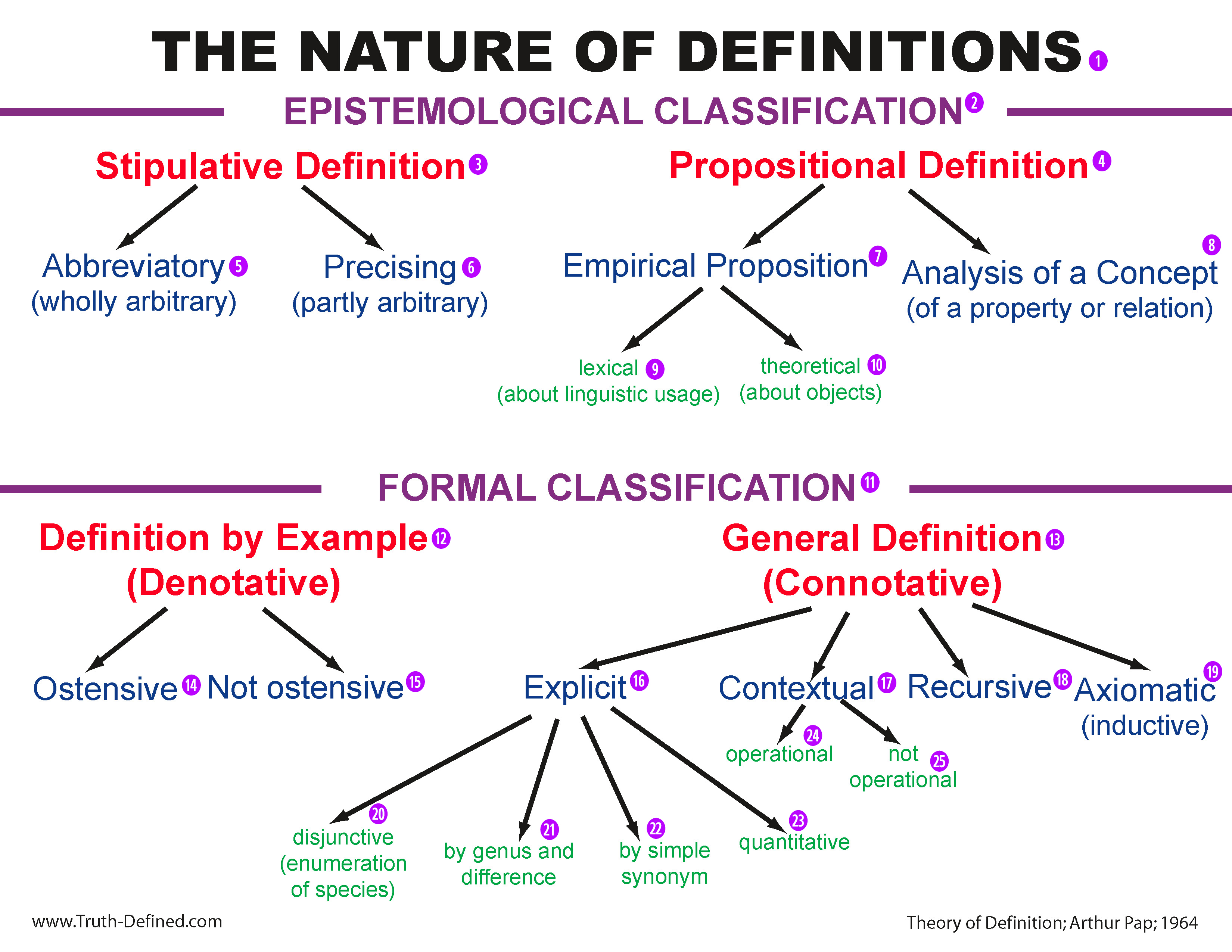
1
The Nature of Definitions
2
Epistemological Classification:
3
Stipulative Definition:
e.g. A spinster is an unmarried woman older than 25.
5
Abbreviatory: (wholly arbitrary): Not an assertion; nTnF.
6
Precising: (partly arbitrary): Linguistic
4
Propositional Definition:
Propositional; T or F; An Assertion.
English speaking people apply the word “spinster” to women of the described
sort and to no other objects.
7
Empirical Proposition: T or F, can only be known by experience.
9
Lexical: (about linguistic usage):
(real)
Use of a word.
10
Theoretical: (about objects):
8
Analysis of a Concept: (of a property or relation):
Mention of a Word.
11
Formal Classification:
12
Definition by Example: (Denotative):
Extension - All members of the Class.
14
Ostensive:
Non-verbal: Car owner: all those who own cars.
15
Not Ostensive: Verbal or Nominal - Naming members of the
extension.
13
General Definition: (Connotative): Intension:
Characteristics of owning a car. Description of the qualifications for
membership of the class. The qualities and attributes of the object.
16
Explicit:
Father is a male parent.
20
Disjunctive: (enumeration of species):
sibling=brother or sister.
21
By Genus and Difference:
a prime number is a number which is divisible only by unity and by itself.
22
By Simple Synonym
23
Quantitative:
Designates a magnitude, measurable properties, the momentum of a body is the
product of its mass times the velocity.
17
Contextual
24
Operational: Disposition: “if … then”
25
Not Operational
18
Recursive
19
Axiomatic: (inductive):
2
WORDS
We have seen that for thoughts to be communicated they must usually be put
into words, and that words almost always help us to think more clearly and
effectively.
Words are obviously of very great importance to mankind, but they must be
kept in their place; they must be always the servants of our thinking and
not its masters. We must remember that it is we, men and women, who
constructed the words in the first place and who collectively decide, under
the guidance to some extent of schoolmasters, linguists and so forth, how
they shall be used. We must beware always of thinking that because a word
exists the ‘thing’ for which that word is supposed to stand necessarily
exists too.
As John Stuart Mill said:
The tendency has always been strong to believe that whatever receives a name
must be an entity or being, having an independent existence of its own: and
if no real entity answering to the name could be found, men did not for that
reason suppose that none existed, but imagined that it was something
peculiarly abstruse and mysterious, too high to be an object of sense.
To take a simple case, it is not
necessarily true that because the words ‘unicorn’, ‘centaur’ exist, that
there are in nature animals for which the words stand. This seems obvious to
us now, but it was not always so.
[…]
Primitive men used to think of words as instruments for the control of
objects and they often attributed supernatural power to them. As Ogden and
Richards tell us in
The Meaning of Meaning:
Every ancient Egyptian had two names– one for the world, and another by
which he was known to the supernatural powers. The Abyssinian Christian’s
second name, given at baptism, is never to be divulged. The guardian deity
of Rome had an incommunicable name, and in parts of ancient Greece the holy
names of the gods, to ensure against profanation, were engraved on lead
tablets and sunk in the sea.
These are examples of what we
should regard as superstitious importance being attached to the names given
to people; they are cases therefore where there is a danger of words
assuming a mastery that should not be theirs. In modern times the danger is
more subtle– the danger that abstract nouns like Communism or Democracy may
be venerated or abused for themselves without reference to the ideas for
which they are supposed to stand, and may unduly influence man’s thinking.
We must be aware the whole time of the danger of allowing our methods of
thinking to be dictated too much (it is bound to happen to some extent) by
the language we have inherited and the ways in which it has been used in the
past.
Words, therefore, must, in one
way, not be regarded as too important: they are merely tools. But just
because they are tools they are in another sense very important indeed.
A carpenter will be unable to do
his work efficiently unless he has at his disposal tools which are exactly
the right ones for the job he has in hand. The important thing is that they
should be appropriate– accurate, well-sharpened, precise, or heavy and blunt
according to what is required. And the carpenter must know how to use them.
Although these tools are of the
greatest importance to him, if he is a good carpenter they are his servants.
In the short run it may be true that the work he can do will be dictated to
him by the nature and variety of the tools he has at his disposal and the
condition they are in. But in the long run he will not allow his work to be
impeded in this way: he will get new and better tools, devising original
ones if necessary, and he will see to it that those he has are kept in
first-rate condition for the jobs for which he is going to use them.
The analogy between a carpenter
and his tools and a thinker and his words is a useful one. We must have
words which we know how to use and which aptly express the thoughts we have
in mind. But in what sense can words be described, even metaphorically, as
accurate and well-sharpened?
Suppose that I say or write:
‘Tables are usually made of wood.’ There would be little doubt that this
sentence would successfully convey the meaning I have in mind. We all know
pretty well what we mean by ‘table’: we all know more exactly what we mean
by ‘wood’: and though ‘usually’ is a rather vague word, there would probably
be agreement if I said I intended ‘at least more often than not’. If you
were setting out to pick holes in what I say you might question the truth of
this statement by asserting that in some primitive countries rocks are used
as tables and that if all those were to be included, the number made of wood
would be only a minority. You might say ‘what
exactly do you mean by table? Is
it defined by its size, its shape, the number of its legs or the purpose for
which it is used?’
But although it would be possible
to ask troublesome questions about this statement, they would for the most
part be questions asked by someone who was not trying to be troublesome. On the
whole the words used are sufficiently ‘accurate’ and ‘well-sharpened’ to do
the job for which I am using them: that is they communicate to my listeners
or readers the thought which I have in my mind.
Suppose now that I say, ‘Democracy
is a good thing.’ The meaning that is communicated and the reaction that
results will of course depend very much on the context and occasion. A word
like ‘democracy’ today is so charged with emotional associations that many
people would find it difficult to write down a clear, coherent account of
what they suppose is meant by anyone who uses the word. And if one did get,
say, a dozen different people to write down what they would mean, their
accounts would be likely to differ considerably. One would also get widely
different accounts about what was meant by ‘being a good thing’ in this
context.
The words ‘Democracy’ and ‘good’
in this sentence are not ‘accurate’ or ‘well-sharpened’. I might say that
they do not enable me to perform the task of communicating my thoughts
clearly. But it must be admitted that the thought that inspired such a
sentence is likely to have been vague, hazy and altogether slovenly; in
which case it might perhaps be more accurate to say that these words do not
enable me, or at any rate do not help me, to think accurately and clearly.
If asked what exactly I meant by the sentence I should have to do some hard
thinking, and I should have to find and to use words which were capable of
conveying a more precise meaning.
If a word, then, is to be
described as accurate, it must be the sort of word to which different people
will attach the same meaning and that meaning must be a reasonably clear-cut
and precise one. That is true of the words ‘table’ and ‘wood’, but it is not
true of the words ‘democracy’ and ‘good’.
In order to get a clearer idea of
the difficulties involved here– how it is that some words can be described
as accurate while others cannot– it will be well to examine more closely how
we decide or discover what a word is going to be used to mean.
OSTENSIVE DEFINITION
An example of the simplest use of
a word or symbol is when we point to a succession of similar animals and say
‘cat’, ‘cat’, ‘cat’…
This is a way of announcing that
we intend to use the word or symbol ‘cat’ to refer to animals of this type.
It would not be sufficient to point to one animal, for ‘cat’ might then be
its name or might stand for any four-legged animal. The word in a sense
‘stands for’ the animal, but it is important to notice that the word is
nothing unless someone uses it, i.e. writes it or says it.
We use the word to refer to the
object. It might be said loosely that the word ‘cat’
means an animal of this type but
strictly speaking it is we who
mean. It will be an aid to clear thinking about this if, instead of asking
ourselves what various words mean, we ask what the people who use them mean.
And if a word is to be used for effective communication, there must be
general agreement that different people will mean the same thing.
To explain how a word is going to
be used and what we are going to make it stand for, is to
define it, and if this explanation takes place by pointing or its
equivalent, the process is called
ostensive definition. We explain how we intend to use the word ‘cat’ by
pointing to or displaying a number of those animals.
There are clearly very many words
that can be defined ostensively in this way… nouns like ‘chair’, ‘animal’,
‘house’, ‘waistcoat’; adjectives like ‘red’, ‘hard’, ‘square’; verbs like
‘to walk’, ‘to dance’, ‘to swallow’, ‘to hit’; prepositions like ‘under’,
‘in’, ‘from’, ‘through’. In some cases if one wants to define the word very
precisely– if for example a biologist is drawing a distinction between
animal and plant life– the production of a sufficient number of examples to
make it clear ostensively where the line is to be drawn might be difficult
and tedious and it would be convenient to supplement the ostensive
definition with a verbal one.
But in the beginnings of language,
definition must clearly be ostensive, just as a Frenchman and a German who
have no language in common can only communicate with each other by first
making signs and then by teaching each other their language by ostensive
definition.
VERBAL DEFINITION
The other method we have of
explaining what we mean by a word, or defining it, is to do so in terms of
other words–verbal definition. If
I am trying to explain to someone what a cat is and there is not one
available to which I can point I might say: ‘It’s a four-legged animal with
fur, usually about two feet long …
The answer might be, from A, ‘Oh,
yes. I know what you mean: I’ve seen lots of those about, but I didn’t know
they were called cats.’
Or from B, ‘I don’t think I’ve
ever seen any of those, but I can imagine what it’s like. I suppose it’s
about the size of a small dog. And I know what fur is, my aunt’s got a fur
coat.’
From C, ‘I don’t understand what
you’re talking about. What’s an animal? How can anything have four legs?
What’s fur?’
A has already been shown the
object that is being defined but he hasn’t had it linked for him to the word
which is going to be used to stand for it. The verbal definition works
because it succeeds in linking the word ‘cat’ with the object, cat, which
has been experienced.
B, however, has no experience of
cats but he has seen four-legged animals and fur and he is capable of
linking these ideas together. The verbal definition works, at least to some
extent, because it succeeds in linking the word ‘cat’ with separate
experiences of the different characteristics of the object, cat, which are
then brought together in the mind.
But it is almost certain that the
idea of cat for B will be much less clear than for A. B might now be able to
recognize a cat as such, but if he were asked to draw a picture of one it
would probably not be very convincing.
But for C the verbal definition is
a complete failure. He has not experienced any of the things referred to,
his mind has got nothing to work on. I might try again to explain what an
animal is and what fur is and I should clearly have to search for ideas that
he has experienced. If I can find none, my task is hopeless.
Inevitably, verbal definition is
circular and by itself it is useless: we define cat as an animal with fur,
and we define fur as what a cat has. The definition, the explanation, can
only succeed in communicating our meaning if it is composed of words whose
meanings have already been understood: and in the last resort, or rather in
the first resort, these meanings must have been made clear by ostensive
definition.
It is impossible, for example, to
explain what red looks like to someone who has been blind from birth, for
there is nothing in his experience to which any of the words can be made to
refer.
In practice, when we are defining
words, we generally use both kinds of definition: we may start with a verbal
definition but if we are sensible we use ostensive definition whenever
possible to supplement and clarify our meaning.
DENOTATION AND CONNOTATION
It is worth drawing attention here
to a distinction made by logicians which is very similar to that between
ostensive and verbal definition. We have seen that if we are asked what is
meant by a ‘rose’ there are two methods of answering. The first method is to
take the enquirer out into the garden, if it is the right time of year, and
point to a variety of roses; in other words to define ‘rose’ ostensively.
Ideally, in order to complete this ostensive definition we should be able to
point to all the roses there are. The whole class of ‘roses’ is said to be
what the word ‘rose’ ‘denotes’, or is the ‘denotation’
of ‘rose’.
Our other method of answering
would be to explain what it is to be a ‘rose’, that is to explain the
characteristics and attributes of the flower. In order to do this properly,
we should have to be expert botanists and to know the technical vocabulary.
To do this would be to define verbally what it is to be a rose; the
qualities and attributes of a rose are called the ‘connotation’ of ‘rose’.
The ‘denotation’
of a class is thus simply all members of the class: the ‘connotation’ of a class is a description of the qualifications for
membership of the class. The denotation of ‘car-owner’ is all those people
who own cars, the connotation is simply the characteristic of owning a car.
ACCURACY OF DEFINITION
It is not hard to see how the
meaning of words which are capable of ostensive definition is built up.
Sometimes and for some purposes it is convenient to make the meaning very
precise, at other times it may not very much matter how precise it is. For
example, in England there is no clear-cut dividing line in ordinary
conversation between a town and a village. Usually it does not matter and an
argument between two people to decide which it is would generally speaking
be a foolish one. But for certain purposes– for example those of local
government– it may be desirable to construct a dividing line, to say that if
the population is above 3,000, it shall rank as a town, below that, as a
village. To insist, because of this, that for purposes of ordinary
conversation we should first discover the exact population of a place before
referring to it as a town or village would be pedantic and silly.
We want
our words to be suitable for the purpose for which we are using them: if our
purpose is accurate, precise thought, we must have accurate, precise words,
but it is important to remember that we do not always want our thoughts to
be accurate and precise and it is not, therefore, always necessary: to have
the denotation or connotation of our term accurately defined. In most of our
ordinary conversations we are using words the whole time of which the
denotation and connotation are vague. And for most of our ordinary
conversations it does not matter at all that that is so. We have seen
already that we should find it difficult to agree upon a precise connotation
for ‘table’, but as for most purposes, we use the word for particular tables
… (‘Put the fish on that table, dear, not on the chair’) our thinking and
our communication are not in the least hindered by that fact. But it is
important to realize that if we start enquiring whether a slab of wood with
four legs attached to it, which people mostly use for sitting on, is or is
not a table, we are not propounding a deep metaphysical question, but merely
discussing how we shall use a word. And this particular word is one which we
are on the whole perfectly happy to leave with a vague connotation. Accuracy
and precision are not here necessary for the purposes for which we want the
word. We do not need a surgeon’s delicate instruments to extract a thorn
from our fingers, nor do we need scales which register milligrammes to
discover whether we have put on weight in the last ten years.
The words we have considered so
far have for the most part been capable of ostensive definition– they stand
for simple things like roses, or waistcoats, for simple activities like
dancing or eating, or for simple qualities like red or square. We can be
reasonably certain that for the most part people mean approximately the same
thing when they use these words. If they don’t, if what I call a waistcoat
you call a pullover our disagreements will very soon and very easily be
brought to light and will probably be adjusted; perhaps after consulting a
third person one of us will agree that his use of the word was not in
accordance with common practice and will consent to change it. There will
often be border-line disagreements– what is the difference between capering
and dancing?– but because the definition is in the first place ostensive,
these disagreements will usually easily be resolved if it happens to be
important for any particular purpose that they should be. The essential
thing is to be able to realize whether the disagreement is one about how a
certain word is to be used or whether it is a real argument about real
things.
This sort of difficulty is much
more likely to arise with words that cannot be defined ostensively but it
may be worth illustrating the point with a simple example.
Suppose that on my return from the
beach I am asked whether there were many people bathing this morning. I
reply: ‘Yes, a good many.’ X, who was with me, says, ‘Oh, no, there weren’
very many.’ We then have a discussion as to whether or not there were many
people bathing. It is possible that there might be a serious disagreement
about the actual number. I might have seen about 150, whereas X, who is an
unobservant type, might only have noticed about a dozen. But it is more
likely that we are in rough agreement about the number but disagree about
whether to call it ‘many’.
I hadn’t been down there for a
week and there were certainly many more than when last I went, but X who was
there yesterday, found there were fewer there today. In a sense it might be
argued that we are using the word many to mean the same thing, namely, ‘as
many as or more than we expected’ but that it is our expectations which
differ. And though we can compare notes about our expectations and about the
way in which we use ‘many’, once we have realized what the discussion is
about, it is virtually over. It is interesting to notice that we use ‘many’
according to the context to mean any number from 2 upwards. (‘Has X got many
wives?’) In some ways this flexibility or adaptability may be useful, though
there is a danger that it may make a conversation so vague as to be nearly
meaningless, and in any talking or writing about mathematical or scientific
matters that lays claim to accuracy the word ‘many’ is almost useless.
ABSTRACT WORDS
Words which cannot be defined
ostensively, words such as ‘justice’, ‘value’, ‘purpose’, ‘imagining’,
‘thinking’, ‘good’, ‘beautiful’, for which there is no concrete thing, or
activity or quality, to which we can point by way of definition, are called
abstract words.
It is much more difficult in using
them to be certain that we mean the same thing, and it is therefore much
more likely that arguments in which such words occur will be stultified
because words are being used to mean different things by different people.
If someone interrupts an argument
of this kind by saying: ‘It all depends what you mean by…’ he is often
regarded as being pedantic and tiresome, but in fact it is an essential
point about which agreement must be reached before any useful discussion can
start.
Almost inevitably, the process by
which we become acquainted with the meanings that are to be attached to
abstract words is a gradual one. By reading about ‘justice’ in several
different contexts, we come to have a vague idea of what the word is being
used to mean. And as we grow older we accumulate more and more references
and cross-references to it until we have a whole association of ideas linked
with that word.
It is clearly very difficult to
discover how closely, the complex of ideas aroused in my mind by the word
‘justice’, resembles that aroused in yours. It is doubly difficult because
in the first place I should not find it easy to express those ideas in
words– that is, my conception of what I mean by ‘justice’ is itself vague–
and in the second place if I did succeed in putting those ideas into words,
many of them would inevitably be of the kind which are not capable of
ostensive definition, which are therefore themselves linked with a further
complex of ideas. The double difficulty therefore repeats itself.
It may not matter that the meaning
which a word like ‘justice’ has, is inevitably vague and shifting: what is
important again is that we should recognize that this is so and that we
should be able to distinguish between an argument in which we really are
discussing whether a particular act is just (having clearly defined for our
local limited purpose what it is to be just), and one in which we are
debating, perhaps unconsciously, how we are to use the word ‘just’.
Suppose, for example, that a
schoolmaster is asked whether it was just that Jones Major should have been
punished for eating sweets in the class-room while, in the same period,
Smith Minimus was let off with a warning. The schoolmaster might point out
that Jones had been warned before, that he had been eating persistently,
provocatively and noisily: Smith on the other hand, was very minimus, it was
his first day at school and it was only small sweet.
Having had the circumstances
explained to him, the interrogator might then agree– ‘Yes-it was just.’ But
if he did not agree, if they were both in possession of the same set of
facts, and one thought the action was just and the other did not, then it
must be that they are using the word ‘just’ in different senses, or that
they are applying different criteria in deciding what it is to be just. Any
further argument about the justice of the action, that failed to recognize
that it was the meaning of the word that was under discussion, would be a
futile one. The disputants might of course agree about a verbal definition
of ‘just’: they might both say that by being ‘just’ they mean ‘giving
everyone his due,’ but obviously this merely shifts the question to what is
meant by ‘due’. If two people, with exactly the same information about at
event, disagree as to whether a certain word should properly be used to
describe it, then either they are expressing the fact that their attitudes
towards the event are different, that one, perhaps, approves and the other
disapproves, or it is the use of the word about which they are disagreeing.
There might of course, in the
example given, be further argument as to whether it was
desirable that Smith should remain
unpunished: it might be maintained that to punish him now will have the
effect of saving a lot of trouble and sweets in the future, and any
discussion about this– the possible effects of a certain the action– would
be a real discussion and not a verbal one.
It is in abstract thinking that
the danger arises most often of allowing words, as it were, ‘to take
charge’. There is the tendency, to which we have referred earlier, to
suppose that there are neat parcels of things in the world of reality
corresponding to abstract nouns such as Justice, Faith, Perfection. There is
also the tendency in some cases to suppose that words have a single, real, I
was proper meaning if only we could discover what it is. ‘Yes,’ it might be
said, ‘I see how you are using the word, but what does it
really mean?’ ‘What is the
real meaning of just or good?’
To think in this way is to be like
the person who, when a new planet was discovered and given the name Uranus,
asked how the astronomer could be sure that it
really was Uranus.
The corrective for this tendency–
and nearly everybody makes this sort of mistake sometimes– is to remind
ourselves the whole time, that we
make the words; the meanings we attach to them are built up, sometimes
gradually, by the general agreement of mankind and these meanings are in
many cases various and are subject to alteration if people on the whole
decide to use them differently.
An example of a word which now
conveys a meaning which has significantly changed is ‘precarious’. This word
is derived from the Latin: precari=to
pray, and was originally used to mean ‘obtained by entreaty’ or ‘held at
someone else’s pleasure’. People use it now almost exclusively to mean
‘uncertain’, ‘liable to be upset’ as in ‘precariously poised’, ‘a precarious
livelihood’.
It is very easy to see how this
change of use has come about. The tenure of anything that is obtained by
entreaty or is held at someone’s else’s pleasure will quite likely, but not
necessarily, be uncertain or ‘precarious’ (in the modern sense of the word).
A tenure or position therefore comes to be described as ‘precarious’ just
because it is uncertain, without
any reference to whether or not it has been obtained by entreaty: and the
fact that this was its original meaning may then very quickly be forgotten.
There is a tendency to say of a
word like this that the original meaning is its
real meaning or what it ought to
mean and that people who use it to mean merely ‘uncertain’ are just making a
mistake. It is true of course that the new use of the word must have arisen
from ignorance in the past and there may have been misunderstandings and
failures of communication owing to the fact that different people were using
it to mean different things. But now that the change has taken place,
however much we may regret it, there is nothing that we can do about it. By
using the word in its new sense, people successfully convey their meaning,
and if as a defiant gesture directed against the processes of change we use
the word in its old sense, we shall simply fail to make our meaning clear.
It is of course the classical
scholar who, because he instinctively notes the derivation of the word, is
most likely to regret and resist the change in meaning. And it is worth
noticing that it is almost impossible now for there to be any change in the
meanings attached to ancient Greek and Latin words: this is simply because
they are dead languages and are hardly used at all today for purposes of
communication either in speech or in writing. The meanings are firmly under
the control of schoolmasters and university dons and are fixed in a way in
which the meanings of the words of a living, growing language can never be.
A living language is changed by
the adaptation of old words to new uses: it is also added to by the
construction of new words. This happens most often in science, especially a
science that is exploring new ground. The development of electricity, for
example, was accompanied by a whole crop of new words– ohms, amperes,
electrons, volts, etc. Such new words may refer to entities which had not
previously been known to exist, they may reflect a new way of classifying or
looking at reality, or they may be short ways of expressing what could
easily be said at greater length with old words.
‘Psycho-kinesis’ for example is a
word that has recently been coined to describe the movement of matter
outside a man’s body by the exercise of his mind, without using physical
means. There was no need for this word earlier because it is only recently
that the possibility of such a thing happening has been seriously
investigated. But now, for those who are interested, the use of the word
saves time and trouble.
Such new words must obviously be
carefully defined and if they are going to be employed only in technical
contexts it is likely that they will be carefully used, and that there will
not be very much danger of the meaning attached to them shifting or
changing. Sometimes a new word may be coined for one of the many meanings
attaching to a word that is already in existence, for in the pursuit of an
accurate train of thought it will be a hindrance both to thinking and
communication if the word which normally conveys the meaning one wants to
express is also used to convey other meanings, especially if they differ
only subtly and slightly from the one that is wanted. This is most likely to
happen in subjects such as Psychology, Economics or Philosophy in which the
ideas being studied are matters of everyday conversation. For example, Sir
Dennis Robertson, the eminent economist, uses the word ‘Ecfare’ to describe
the particular aspect of welfare which is economic.
There are many examples in English
of the same word being used to mean a variety of things. ‘Pound’ can be of
weight or of money (meanings that are quite different now, though they are
connected historically), or an enclosure for cattle, or it can be used as a
verb, ‘to thump or pummel’, or ‘to make one’s way heavily’, meanings which
have no very close connection with its use as a noun. It is much less likely
to matter if the meanings differ widely for it is usually clear from the
context which one is intended and an ambiguity that is obvious is less
likely to impede clear thinking and communication than one that is subtle
and concealed. If a schoolmaster, for example, has told his mathematical set
to bring up log tables and a boy comes staggering into the class-room with a
wooden piece of furniture, the incident would probably be regarded as a
failure of discipline rather than of communication.
It is natural and right that the
creation of new words should be taking place the whole time in a living
language. Those that satisfy a popular need will be absorbed into the
language and it will soon be forgotten how new they are; others will remain
technical words to be used only by scientists; and others will perhaps be
used only by the person who invented them and after one appearance in some
scientific or philosophical journal will be heard and seen no more.
It is often said that a language
is debased when old words change their meanings and new, hybrid words are
invented. It is certainly a matter for regret when through carelessness or
ignorance or slipshod thinking words are used in such a way that they no
longer convey the precise, accurate meaning for which they were originally
designed. We can make up our minds to help to resist such debasement by
thinking clearly and using words carefully. But we must remember that in a
progressive dynamic society in which ideas are changing and in which men are
developing new ways of looking at things, it is inevitable and proper that
the tools of thinking should be undergoing development, too.
EMOTIONAL ASSOCIATIONS OF WORDS
We have seen that the complex
associations of ideas evoked by its certain words are not easy to
communicate and are likely to differ from person to person.
When language is being used partly
or entirely to evoke emotion, as it is often in poetry and in some kinds of
prose, this complex of associations is of great importance. Such writing
will clearly depend for its effectiveness on the similarity of the
associations for different people, or the extent to which the word, the
phrase, the sentence, or just the sound, evokes in the reader or the
listener emotions similar to those with which it was associated by the
writer.
Such associations are continually
changing with the passage of time. If a writer today were to use the phrase
‘verdant pastures,’ he would be likely to be accused of being trite or
hackneyed, whereas at some time, for some people, that phrase would no doubt
have had the most pleasant associations of peace and comfort and beauty. It
is very easy to say what ‘verdant pastures’
mean: I could explain it to you
ostensively as I write by pointing out of the window, but as an instrument
in the evoking of emotion, in the conjuring up of a picture of beauty, it is
probably for most people, no longer efficacious.
The importance of the emotional
associations of words for our present purposes lies in the fact that they
are likely to be serious hindrances to straight, clear thinking. This is
especially true in argument, or when the thinking is expressed in a chain of
reasoning which is designed to persuade. It is perhaps almost inevitable
that this should happen to some extent: the essential thing is that we
should be able to recognize it and allow for it.
[…]
There are of course many words or
phrases which may be used in such a way as not merely to state a fact but
also to express an attitude, and such words and phrases have a useful
purpose to fulfill. But when they are being used in what purports to be a
rational discussion, we must be careful to ensure that they are not used in
such a way as to prejudge the issue or beg the question.
It would obviously be foolish to
discuss whether it was a good thing to be pig-headed: for ‘pig-headed’ is
normally used to describe someone who in the opinion of the speaker is
excessively or unreasonably disinclined to change his mind, and an excess of
anything must by definition be a bad thing. If Smith and Jones are
discussing Robinson, and Smith says that he has the spirit of eternal youth
while Jones says that he is suffering from arrested development, they are
agreeing about the fact that Robinson is young for his years but their
attitudes towards the fact are different. It may be interesting for them to
continue to produce phrase of approval and disapproval, but they must not
delude themselves into thinking that they are having a rational argument.
The use of such emotionally
coloured words or phrases in argument may often be unconscious, but they may
also be used with dishonest intent. The person who applies the word
‘blackmail’ to any threat which he dislikes, or ‘sabotage’ to any action
which obstructs the execution of his purposes, is not merely expressing and
inviting disapproval, but is also, probably deliberately, misrepresenting
facts. ‘Blackmail’ is still mainly used in its original sense of the threat
of revealing some discreditable secret, in other words it is what most
people would regard as a particularly base kind of threat; and ‘sabotage’ is
still mainly used to mean the malicious, deliberate destruction of plant,
factories, etc. It is possible, of course, that people may use these words
so often to make actions which they dislike sound worse than they are that
their original meanings may become lost. If this happens it will be
interesting to see how long they retain their evil associations and how
long, therefore, they are effective for the purpose for which they are used.
This use of words to express an
attitude instead of, or perhaps as well as, stating a fact is called the ‘emotive’
use of words. Examples abound in ordinary conversation and writing, and they
may, of course, be perfectly harmless and legitimate. They are frequently
found in the utterances of politicians who are taking part in a controversy,
and it is perhaps here, where emotions and loyalties are so easily aroused,
that they are most likely to obscure clear thinking. It is here, therefore,
that it is particularly important to be on the lookout for them, and to be
prepared to analyse them.
SUMMARY
In order to think and communicate
clearly we must study words carefully. We must beware of thinking that words
have ‘real’ meanings which are in some mysterious way attached to them. We
must think what we use them to mean and we must examine the ways in which
they are used by other people.
We must be sure that we are not
allowing our thoughts to be blurred and slipshod because we are using words
which are defined vaguely when precision is necessary and possible, or using
words in a question-begging and emotionally coloured way. It is inevitable
and right that we should have our attitudes of approval or disapproval, but
we must recognise them for what they are and not confuse them with rational
thinking, though they may be part, and a very necessary and important part,
of the data in a logical argument.
Our choice of words and the way in
which we use them should be related the whole time to the purpose we have in
view. If we are using words for communication, this purpose may be to
inform, to describe, to request, to persuade, to command, to question, to
explain, to prove, or some combination of these.
Which words we use and how we use
them will obviously depend not only on which of these things we are trying
to do, but also on what we know of the intelligence and background of our
audience.
E. R. Emmet; Handbook of Logic; 1981; ch2
* * * * * * * * * * * * * * * * * * * * * * * *
DEFINITION
CIRCULAR
- The definiendum occurs in the definiens, or a part of the definiens is
defined in terms of the definiendum.
COORDINATIVE
- As used by Reichenbach,
interpretation of the terms of a formal deductive system by means of
expressions denoting observable objects or processes (e.g. definition of
“length” in terms of a standard rod).
ELIMINATIVE
- Enables elimination of
definiendum from any sentence in which it occurs (“to define a term is to
show how one can get along without it”).
EXPLICATIVE
-
Analysis of the meaning of the definiendum.
EXPLICIT
-
Definiendum can simply be replaced by definiens in any sentence without
changing the remainder of the sentence (e.g. father = male parent).
IMPLICIT
- A set of postulates (axioms) is said to implicitly define the primitive
terms in it, i.e. it delimits their denotations to objects and relations
that satisfy it.
IN USE
(CONTEXTUAL)
- Rule for translating sentences containing definiendum into synonymous
sentences that do not contain it; but while being eliminative, it is not
explicit (e.g. x is brother of y=x is male and has the
same parents as y).
OSTENSIVE
- Explaining the meaning of a term by pointing at, or inducing experience
of, instances denoted by it.
RECURSIVE
- Rule for eliminating definiendum in a finite number of symbolic
transformations from expressions in which it occurs together with constant
arguments (e.g. “+” from “3+2”).
Arthur
Pap; Semantics and Necessary Truth; 1958; p425ff
A definition is a declaration that a certain newly-introduced symbol or
combination of symbols is to mean the same as a certain other combination of
symbols of which the meaning is already known.
It is to be observed that
a definition is, strictly speaking, no part of the subject in which it
occurs. For a definition is concerned wholly with symbols, not with what
they symbolize. Moreover, it is not true or false, being an expression of a volition, not a proposition.
Whitehead and
Russell; Principia Mathematica; 1927
Words have not got
—
by natural design as it were— senses of which they are the owners. They are
instruments by which men give direction to thoughts, nothing more.
I. A. Richards;
Multiple Definition; v34; 1934
Are definitions true or false?
When a proposition which is true or false, […] consists of a definition
(definiens) and a definiendum, its parts […] are not, therefore,
necessarily true or false. […] definitions (being only parts of such
propositions) are not true or false.
In general, we do not speak of
names as true or false. Brentano says of definitions that they are composite
names:
“A name which is composed of several names and which names all
logical parts of a logical whole from the highest genus of its range to its
lowest species, is called a definition.”
Accordingly definitions are
not propositions. But in so far as only propositions may be called true or
false, we cannot speak of true or false definitions.
Paul Weingartner; Basic Questions on Truth; 2000; ch5
In any discussion or interpretation of symbols we need a means of
identifying referents. The reply to the question what any word or symbol
refers to consists in the substitution of a symbol which can be better
understood.
Such substitution is Definition.
Definition-
An explicit definition defines one expression (the definiendum) by means of another (the definiens) which can replace the first wherever it occurs.
A contextual definition supplies a replacement for certain longer expressions in which the
definiendum occurs but not an equivalent for that expression itself. (If Xs can be contextually defined in terms of
Ys, Xs are sometimes said to be logical constructions out of Ys, and ‘X’ to be an incomplete symbol [=contextually defined expression].)
A recursive definition gives a rule for eliminating the
definiendum in a finite number of steps. A set of axioms is sometimes said to give an
implicit definition of its primitive [=undefined term] terms.
See ch. 3 §1 for the interdefinability of
connectives; ch. 4 §3 for Russell’s contextual definition of definite
descriptions; ch. 7 §5 for Tarski’s recursive definition of satisfaction;
pp, 103-4 for formal conditions on definitions.
Susan Haack; Philosophy of Logics; 2000; p245
It is the object of Definition to determine the nature or meaning or
signification of a thing (taking “thing” in its widest application, i.e. as
including, not only outward material objects, but also names, notions,
mental states, etc.): in other words, definition is the formal attempt to
answer the question, “What is it?”
[…] knowledge of a thing is in
great measure knowledge of what the thing is not.
William Leslie Davidson; The Logic of Definition; 1885
A concept introduced through NOMINAL DEFINITION
is chosen relatively arbitrarily, and can easily be replaced by another. In
a REAL DEFINITION, however, it is the essence of a concept that is
analysed, and this procedure cannot be arbitrary.
Dieter
Wunderlich; Foundations of Linguistics; 1979; p167
30. DEFINITIONS
A word is a large class of physical things or events such as ink marks,
graphite marks, or sound waves. A particular word is used many times; it has
many occurrences. The word “language,” for example, occurs frequently in the
preceding section. It is the same word in each of these occurrences, and
each occurrence is a physical thing. The word is the class of all such
occurrences– oral or written– past, present, or future. Words are not,
however, merely collections of physical things or events, for words have
meaning. Words are symbols.
The meaning of a word is not a natural attribute which man discovers;
meaning is given to a word by people who agree to let it have that meaning.
For example, there is no intrinsic characteristic of the word “cat” which
makes it refer to feline animals; it does so because English-speaking people
have adopted a convention to that effect. This is not intended to suggest
that people once sat down at a conference table and formally decided the
meanings of words. For the most part, these conventions, like many other
conventions, have grown gradually and informally over a long period of time.
As language continues to grow and develop, these conventions are still
subject to change. The important fact is that other conventions could have
been adopted without being false or incorrect. Indeed, there are many
different languages– English, German, Russian, etc.– all with different
conventions. None of these languages is false and none is “the true
language.”
A word has meaning if there is a convention establishing its meaning.
Definitions express these conventions in the metalanguage. The convention
may have been laid down formally by means of a definition, or it may have
grown up informally by way of customary usage. In either case, the
definition, as a formulation of a convention, is neither true nor false.
Offering a definition is like making a proposal. One may accept it or reject
it, but the proposal, itself, is not true or false. If a young man’s
proposal, “Let’s get married,” met the response, “That’s false,” it would be
a nonsensical reply. Likewise, there may be good reasons for rejecting a
proposal to use a certain word in a certain way, but falsity is not one of
them. Nor is truth a reason for accepting such a proposal.
Moreover, when the convention governing the meaning of a word has developed
informally, a definition may be offered as an explicit formulation of that
convention. Again, the definition is neither true nor false; it is more like
a rule than like a statement of fact. Rules, like proposals, can be accepted
or rejected, complied with or violated. For example, certain conventions of
etiquette have developed informally in our culture. These conventions are
formulated in rules such as, “Do not eat peas with your knife.” This rule is
neither true nor false, but statements which are true or false can be made
about the rule. For instance, it is true to say that the foregoing rule
expresses a currently accepted convention of etiquette. Similarly, although
a particular definition is neither true nor false, the statement that this
definition expresses an accepted convention is either true or false. It is
important to realize that the statement about the definition is different
from the definition itself.
In most cases, the meaning of a word has two aspects. Consider the word
“logician.” In the first place, this word refers to various men such as
Aristotle, George Boole, Gottlob Frege, Bertrand Russell, Kurt Godel, W. V.
Quine, and many others. These people– that is, all people who are logicians–
constitute the extension of the word “logician.” The extension of a word
consists of the class of all objects to which that word correctly applies.
Extension is one aspect of the meaning of a word. In the second place, there
are certain properties which distinguish logicians from all other people and
things. A logician is a person who is skilled in logic. In order to qualify
as a logician, an object must have the properties of being human and being
skillful in logic. The intension of the word “logician” consists of these
two properties. The intension of a word consists of the properties a thing
must have in order to be in the extension of that word. The extension of a
word is the class of things to which the word applies; the intension of a
word is the collection of properties which determine the things to which the
word applies.
There are many ways of specifying the meanings of words; consequently, there
are many different types of definitions. To begin with, we may specify the
meaning of a word through its extension, or we may specify its meaning
through its intension. There is thus a basic distinction between extensional
definitions and intensional definitions.
There are two fundamentally different ways of indicating the extensions of
words. First, we may simply point to objects in the extension of the word.
To give the meaning of the word “dog,” we can point to a variety of dogs.
This method of indicating the extension of the word is called “ostensive
definition.” Another method of indicating the extension of a word is to name
some of the objects in its extension (if the objects in the extension have
proper names). Thus, one can mention examples of the extension of the word
“dog” by naming various dogs: Fido, Rover, Spot, Rex, Beauregard, etc. An
ostensive definition is a nonverbal extensional definition, for the meaning
of the word is given not by using other words to explain its meaning, but by
pointing to the actual objects. Naming members of the extension, on the
other hand, is verbal extensional definition, for the meaning of the word is
explained by the use of other words, the names of the members of the
extension.
Whether one gives the extension of a word verbally or nonverbally, it is
usually impractical or impossible to indicate every member of the extension.
It would be impossible to point out each member of the extension of the word
“dog,” because this word applies to dogs as yet unborn. Furthermore, it
would be impractical to point out every living dog to show the meaning of
the word, because there are so many dogs and they are so widely scattered.
Very often, then, extensional definitions consist of indicating, either
verbally or nonverbally, some members of the extension, assuming that other
members of the extension can be recognized on the basis of their similarity
to the examples. This process of definition suffers some imprecision, yet
the meanings of many words are effectively conveyed by extensional
definitions.
A moment’s reflection should be sufficient to realize that some words must
be defined nonverbally. If the meaning of a word could be given only by
using other words, then it would be impossible to convey the meaning of any
word. Unless some words had their meanings given nonverbally, there would be
no words with meanings that could be used to explain the meanings of other
words. Imagine finding a Sanskrit dictionary in which every Sanskrit word is
defined in terms of other Sanskrit words. You could memorize every
definition in that dictionary, but you would not know what any of the words
mean, for you would not know to what things these words refer. Something
like ostensive definition is necessary to relate some of the words to
things; it is not sufficient merely to relate all of the words to each
other.
Intensional definitions are verbal. One important type of intensional
definition is the explicit definition. An explicit definition consists of
giving a word or phrase which means the same as the word being defined. For
example,
a] “Mendacious” means “deceitful.”
“Pentagon”
means “five-sided plane figure.”
“Bachelor” means “unmarried adult male.”
In each case, the word being defined appears on the left; it is called the
“definiendum.” The word or phrase on the right does the defining; it is
called the “definiens.” The definition itself occurs in the metalanguage as
a proposal or rule about the use of words in the object language.
A definition is circular if the definiendum occurs in the definiens. For instance,
b] “Pentagon” means “plane figure having the shape of a pentagon.”
is circular because the word to be defined is used in giving the definition.
Such definitions are useless. Definitions can also be circular in a less direct
manner. For example, the following three definitions taken together are
circular:
c] “Mendacity” means “lack of veracity.”
“Veracity” means “absence of prevarication.”
“Prevarication” means “mendacity.”
Three words are defined, but each is defined in terms of the other two. Unless
a meaning is independently given for one of the three, none of them achieve
meaning from this series of definitions.
Many words, like “dog,” “run,” and “red,” refer to objects, events, or
properties. Such words have extensions and intensions. Other words have meaning
only as they function in a linguistic context. Words like “if” “unless,” “the,”
“only,” “is,” “not,” and “or” do not refer to anything. For instance, there is
no such thing as an “unless,” there is no such event as “unlessing,” and there
is no such property as being “unless.” Words of this sort have neither
intension nor extension; in fact, they have no meaning in isolation. They have
purely grammatical functions, and their meanings come from their function in
providing structure for the statements in which they occur. We give the
meanings or these words by showing how they function in a context. This method
of specifying meanings is called “contextual definition.”
Since logic is primarily concerned with form or structure, many of the most
important logical words are defined contextually. We have already encountered
many such definitions. For example, in discussing categorical statements we had
occasion to note that statements of type A, “All F are G,” were equivalent in
meaning to statements or the form “Only G are F. “ This is a contextual
definition or the word “only.” There is no single word or phrase that is
equated in meaning to the word “only”; instead, the context in which the word
“only” occurs has the same meaning as a statement that does not contain the
word “only” The truth tables, for another example, provide contextual
definitions of the truth-functional connectives.
Contextual definitions may be contrasted with explicit definitions on the
following grounds. If a word that is explicitly defined occurs in a statement,
then we may replace the defined word by its definiens without changing the
meaning of the statement.
d] In the statement “Fred Smith is a bachelor,” we may replace the word
“bachelor” by the phrase “unmarried adult male,” with the result that the
statement “Fred Smith is an unmarried adult male” means the same as the
original statement.
By contrast,
e] In the statement “Only mammals are whales,” our contextual definition does
not provide any word or phrase with which to replace the word “only.” Our
definition does permit us to replace the whole statement in which the word
“only” occurs with another statement, “All whales are mammals,” which has the
same meaning as the original statement. The meaning of the word “only” is
specified by the definition, because the definition enables us to express,
without using the word “only,” what was originally expressed with the help of
the word “only.”
We have described some of the different types of definitions; now we must
discuss some of the purposes definitions are designed to fulfill. Although
definitions are not true or false, their adequacy can be judged in terms of
their ability to fulfill certain functions.
1. Some definitions are designed to characterize the customary usage of a word.
These definitions attempt to make explicit the conventions followed by people
who speak the language, or perhaps those who speak it correctly. Definitions
given in dictionaries have this function.
When we look up a word in the dictionary to find out what it means, it might be
tempting to say that we find the true definition. A dictionary gives a large
number of definitions, and these definitions purport to be conventions to which
speakers of the language conform. A previous point applies here. For purposes
of logical clarity, it is essential to distinguish carefully between
definitions and statements about definitions. A definition itself has the force
of a proposal to use a certain word with a certain meaning; as such, it is
neither true nor false. The statement that a particular definition is the
accepted one is a statement about the definition, not the definition itself.
This statement is either true or false.
2. Sometimes we define a new word because there is no established way of
briefly expressing an important meaning. For example, we might wish to make
repeated reference to those months of the year which have fewer than thirty-one
days. As a convenient abbreviation, we might coin the word “monette” and define
it as “month having fewer than thirty-one days.”
3. A word is vague if there are objects that are neither definitely included in
nor definitely excluded from its extension. Definitions often have the purpose
of making vague words more precise. For example, the word “rich” is vague. Some
people have very little money; they are definitely not rich. Others have
millions; they are definitely rich. Some people have quite a lot of money, but
they are not fabulously wealthy. Even if we know how much money such a person
has, we cannot say whether he is rich or not because of the vagueness of the
word “rich.” We might wish to make this word more precise by a definition such
as the following: “rich” means “has a fortune of at least half a million
dollars.”
4. Sometimes we seek an intensional definition for a word whose extension is
quite well known. For instance, we have very little trouble in applying the
word “human”; when we encounter an object we can almost always say definitely
whether or not it is human. Still, we might have considerable difficulty in
saying what properties distinguish humans from nonhumans. The problem is to
find an intensional definition which will provide the extension we already
accept for the word.
Although we use the word “human” quite adequately in most contexts, its
extension is not precisely determined. The case is typical. There are many
objects which definitely belong to the extension of the word; there are many
other objects which definitely fall outside its extension; and there are some
objects which are borderline cases– neither definitely within the extension nor
definitely outside the extension. To find an adequate intensional definition of
“human” requires that we find a set of properties which are shared by all the
objects definitely within the extension of the word but not shared by any of
the objects definitely outside its extension. The borderline cases can be dealt
with as we see fit.
If an intensional definition is proposed, it must not be too broad or too
narrow. The definition will be too broad if it admits into the extension some
objects which were definitely outside the extension. The definition will be too
narrow if it excludes from the extension objects which were definitely within
the extension. Notice that a definition could be both too broad and too narrow.
For example, the definition ‘‘‘human’ means ‘rational animal’“ has been
proposed. There is reason to suppose that this definition is too broad in some
respects and too narrow in others. We would normally regard tiny infants,
Mongolian idiots, and insane persons as humans. However, it is doubtful that
such beings are rational, so the proposed definition would seem to exclude them
from the extension of “human.” Thus, the definition is too narrow. At the same
time, certain apes seem to be quite intelligent and capable of elementary
reasoning. Such creatures, which are clearly excluded from the extension of
“human” as we understand the word, would be included under the proposed
definition. In this respect the intensional definition is too broad.
When we have succeeded in framing an intensional definition which is neither
too broad nor too narrow, we must still consider how it disposes of the
borderline cases. To pursue our previous example, we shall find borderline
cases if we ask when an organism becomes human. Does a person first qualify as
a human being at the moment of birth? Is an unborn baby a human being? Does a
foetus become a human when the mother first “feels life”? Is the fertilized egg
a human being from the moment of fertilization? These are not purely academic
questions. Questions of the following sorts are involved. Does an unborn child
have any legal rights? Can an unborn child inherit money or be the beneficiary
of a life insurance policy? Is abortion murder? (By definition, it is
impossible to murder anything that is not human.)
Even if we have succeeded in framing an intensional definition which deals
satisfactorily with the borderline cases we have already encountered, we may
still wish to consider certain additional borderline cases we have not yet
encountered, and may never encounter. For example, suppose a space ship landed
on earth carrying beings from another planet who were obviously intelligent and
similar to earth people in many other respects. Suppose further that someone
killed one of these beings without any provocation. Would this be murder? It
would depend upon our definition of “human.”
Until the word “human” is clearly defined, it does not make sense to ask
whether such visitors from space are really human, for the answer depends upon
the definition of “human.” Whether a given definition is reasonable and useful
is, nevertheless, a very important question. There are numerous legal, ethical,
biological, sociological, anthropological, and psychological considerations
which are relevant to this question. They do not tell us whether a given
definition is true, but they do help us to appraise the adequacy of
definitions.
5. Some definitions are designed to introduce a word which will have
theoretical importance and utility. Such definitions are common in science.
Words like “work” and “energy” are given precise definitions in physics, not so
much to remove the vagueness of their everyday meanings, but to provide words
that can be used to state important physical generalizations. Indeed, the
ordinary meanings are deliberately changed to provide useful physical concepts.
In philosophy, too, we seek definitions which will provide theoretically useful
concepts. For example, philosophers have tried to define the word “free” (as it
occurs in the phrase “free will”) so that it will mark a significant
distinction between free and unfree acts. The resulting concept should enable
us to state the connection between freedom and responsibility. It should help
us to explain what it means to say that a person could have acted differently,
and it should help us to clarify the relation, if any, between freedom and
causal determination.
6. In addition to intensions, extensions, and grammatical functions, words have
emotive force. A book which goes into great detail might be described by one
person as thorough and scholarly, but by another person as tiresome and
pedantic. It is not so much that the two people are making different statements
of fact about the book as that they are expressing different attitudes toward
it.
Definitions are often designed to transfer emotive force. This can be done in
either of two ways.
First, we may take a word which has a great deal of emotive
force and define it so that it will apply to something we wish to applaud or
condemn. For instance, one might define “socialistic” as “tending to equalize
wealth by government action.” Since the graduated income tax has the effect of
equalizing wealth, the word “socialistic” applies to it. Among people for whom
the word “socialistic” has negative connotations, this tends to transfer the
negative attitudes to the graduated income tax itself. Among people for whom
the word “socialistic” has positive connotations, the effect would be just
opposite. Definitions of this kind transfer emotive force from the definiendum
to the definiens. The definiens clearly applies to the graduated income tax, so
the emotive force of the definiendum–”socialistic” – is transferred to the
graduated income tax via the definiens.
Second, the process may be reversed. Suppose a certain drama is admittedly
naturalistic. Someone might define “naturalistic” as “glorifying the meanness
of human nature and the sordidness of human existence.” This definition
transfers negative emotive force from the definiens to the word “naturalistic”–
the definiendum– and thence to the play itself. Definitions whose main function
is the transfer of emotive force are called “persuasive definitions.”
The foregoing examples could easily give the impression that all persuasive
definitions are illegitimate. This is not true. We need words with emotive
force to express our feelings, emotions, and attitudes; persuasive definitions
help to provide the necessary vocabulary. However, persuasive definitions can
lead to difficulty if, in the process of transferring emotive force, we also
modify the established descriptive meanings of our words. If the modification
of descriptive meaning goes unnoticed, confusion can result.
The preceding list of purposes of definitions is not intended to be exhaustive,
nor are these purposes mutually exclusive. In discussing the definition of
“human,” we were concerned with characterizing customary usage to some extent
(purpose 1), making a somewhat vague word more precise (purpose 3), providing
an intensional definition for a word whose extension is fairly clear (purpose
4), and providing a word with theoretical importance and utility (purpose 5).
Some of the most important philosophical problems are basically problems of
definition. Philosophers ask: What is justice? What is art? What is religion?
What is knowledge? What is truth? In each of these cases, the question could be
rephrased: How should we define the word “justice”? How should we define the
word “art”? etc. Notice that this transformation takes what appears to be a
question in the object language and reformulates it as a question in the
metalanguage. It will not do to answer that definitions are conventions, so one
definition is as good as another. Definitions are conventions, but some
conventions achieve their purposes better than others. Finding an adequate
definition is often a delicate matter.
Wesley C. Salmon; Logic; 1973; s30
EXPLICATION OF WORDS
There is no greater impediment to the advancement of knowledge than the
ambiguity of words.
[…] definitions and axioms are the foundations of all science.
[…] A definition is nothing else but an explication of the
meaning of a word, by words whose meaning is already known. Hence it is
evident, that every word cannot be defined; for the definition must consist
of words; and there could be no definition, if there were not words
previously understood without definition.
[…] It may further be observed,
that there are many words which, though they may need explication, cannot be
logically defined. A logical definition, that is, a strict and proper
definition, must express the kind (genus) of the thing defined, and the
specific difference by which the species defined is distinguished from every
other species belonging to that kind. It is natural to the mind of man
to class things under various kinds, and again to subdivide every kind into
its various species. A species may often be subdivided into subordinate
species, and then it is considered a kind.
From what has been said of
logical definition, it is evident that no word can be logically defined which
does not denote a species; because such things only can have a specific
difference; and a specific difference is essential to a logical definition.
On this account there can be no logical definition of individual things, such
as London or Paris. Individuals are distinguished either by proper names, or
by accidental circumstances of time or place; but they have no specific
difference; and therefore, though they may be known by proper names, or may
be described by circumstances or relations, they cannot be defined. It is no
less evident, that the most general words cannot be logically defined,
because there is not a more general term of which they are a species.
Nay, we cannot define every species of things, because it happens sometimes
that we have not words to express the specific difference. Thus a scarlet
color is, no doubt, a species of color; but how shall we express the
specific difference by which scarlet is distinguished from green or blue?
The difference between them is immediately perceived by the eye; but
we have not words to express it.
Without having recourse to the
principles of logic, we may easily be satisfied that words cannot be defined
which signify things perfectly simple, and void of all composition.
[…]
When men attempt to define things which cannot be defined, their definitions
will always be either obscure or false. It was one of the capital defects of
Aristotle’s philosophy, that he pretended to define the simplest things,
which neither can be nor need to be defined; such as time and motion.
[…] Since, therefore, it is often impossible to define words which we must use on this subject, we must as much as possible use common words in
their common acceptation […]
Thomas Reid; Essays on the Intellectual Powers of Man; 1859; ch1
CHAPTER X.
DEFINITION AND DIVISION
§ 1. Definition.
We are concerned in this chapter with two processes, both of which belong,
not to the Logic of the Judgment, but to that of the Concept. Neither
Definition nor Division, however, can be satisfactorily treated, unless the
Predicables have previously been explained. This, therefore, seems to be the
most convenient place at which to deal with them.
The definition of an object is the declaration of its essential characteristics. Hence, a definition is given in the form of a
proposition, in which the object defined stands as the subject, and the
essential characteristics form the predicate. It is this predicate which is
the definition properly so called. The discussion of the question belongs,
as we have said, to the Logic of the Concept: for considered as a mental
act, the definition is the concept which expresses the true nature of the
thing defined.
It is carefully to be observed that the definition is concerned with
the nature of a thing.
For by some logicians it is explained as being simply the connotation of the
subject term, as it is understood by competent thinkers. Now it is, of
course, the case that whenever the essential characteristics of a thing― its
true nature,― are known, these will constitute the intension of its name.
Thus the intension of the term ‘triangle,’ is ‘a plane figure contained by
three straight lines.’ But it will often happen that a name is applied to a
group of objects, which we are perfectly able to identify by certain common
properties they possess, while at the same time, we are ignorant of their
real nature. Thus, for instance, when a new disease, e.g. the sleeping
sickness, makes its appearance, doctors recognize it and
give it a name, long before they are able
to define it. The term in this case, has a connotation, viz.: the symptoms
by which the disease is known: but we have not yet found the definition
of the thing.
The true definition must do more than enable us to recognize it. It must unfold its nature.
Aristotle expressed this, by saying that the definition gives us the
‘why’ of the thing. The definition ‘Man is a rational animal,’ is a case in
point. If we are asked what makes Socrates a man, we reply that he possesses
these characteristics. It is not because he is ‘a tool using animal,’ that
he is a man, nor yet because he is, ‘an animal that cooks his food,’ though
these statements are true. He is a man because he is a rational animal.
The ideal definition will then contain the essential characteristics.
To what extent we are able actually to realize this ideal in our
definitions, we shall see when we study the various kinds of definition.
Definition is always of the universal.
Nature gives us general classes, and phenomena which occur subject to
general laws. The individual members of these classes, the individual
instances of the phenomena, are all different: each has accidental
characteristics, by which it differs from every other.
The aim of definition is to seize on the type,
which is constant amid all this variety. One attack, e.g. of sleeping
sickness, or of malarial fever, differs from another in a hundred
particulars,― in duration, in intensity, in collateral effects, etc., etc.
These are of no importance to the definition; for it is concerned alone with
what is essential― with the permanent type.
Hence definition is
rightly said to be the aim of science. Science has achieved its object, when
it has accurately determined the nature of some substance, or the law of
some phenomenon.
It is often said
that all definition should be by genus and differentia. There are indeed
certain cases in which we can assign the genus and differentia,
understanding those words as they were employed in connexion with the
Predicables. In some cases, however, this is impossible. Thus an eclipse can
be defined, but it has not properly speaking a genus or differentia. Hence
these terms are here employed with a certain amount of latitude.
Genus should be understood as meaning no more
than such attributes as are common alike to the class of objects in
question, and to other classes: differentia signifies the notes which are
proper to the class, and distinguish it from others.
§ 2. Various Kinds of Definition.
(i) Real and Nominal. In the last section we shewed in what a Real
definition consists.
It is an expression
which declares the nature of a thing. A Nominal definition on the other
hand, is an expression declaring the meaning of a word.
Some logicians, as we have already noticed, have maintained that no
definitions are intended to do more than this; that one and all they merely
unfold the connotation of terms. Aristotle considers this question at
length, and distinguishes two kinds of Nominal definitions. In the first
place, there are (1) definitions of names which signify imaginary objects,
to which nothing either actual or possible corresponds. We may find an
example in the definition of a dragon as ‘a serpent breathing flame.’ An
impossible self-contradictory concept cannot provide us with a Real
definition: for that must state the essence. An essence which contains
repugnant characteristics is no essence at all. Indeed the expression, ‘A
dragon is a serpent breathing flame,’ is elliptical. Fully stated, the
proposition should be ‘A dragon (as imagined by the writers of fables) is a
serpent breathing flame’ (Ch. 7, § 4).
Aristotle further reckons as
Nominal definitions, (2) those in which we are unable to assign the
essential properties of a thing, and are merely able to indicate it by a
description. Thus, the definition of thunder, as ‘a noise in the clouds,’ is
nominal: nominal, because it describes what is meant, and yet does not
unfold the nature of the object (
An. Post. II
., c. 10, § I, c. 8, §7).
All Nominal definitions, therefore, do not deny existence to
their objects. In this latter class existence is presupposed. But in
Aristotle’s view, none save those which express the essential
characteristics, can rightly be termed definitions of the thing. This
distinction of Real and Nominal has largely fallen into disuse for reasons
to be mentioned presently. But it should be carefully noticed, for the
principle it embodies is one of importance.
(ii) Essential
Definitions. These are the definitions which are formed by genus and
differentia In the stricter sense. Such for instance is our definition of
man as ‘a rational animal.’ Such too are our definitions of mathematical
figures. The limits by which a plane figure is bounded, constitute its
specific differentia. ‘A plane figure contained by three straight lines,’ is
the essential definition of a rectilinear triangle.
In the case,
however, of every other natural type except man, it is impossible to obtain
an Essential definition. The specific differentia, from which its peculiar
properties flow, is unknown to us. While we recognize that the substantial
principle, which determines the distinctive characteristics of, e.g. a lion,
must needs be totally different from that of a horse, we can never hope to
penetrate to any knowledge of the two principles, except in so far as they
are manifested by their properties. We must then be content with definition
by properties, or as it is often called:―
(iii) Distinctive
Definition. It is at definitions of this kind that the student of natural
history or of physical science, aims. He seeks to state the most
characteristic properties of the type with which he is dealing. More over he
recognizes that he can scarcely hope to attain finality in his quest. For
the number of distinctive properties in every natural type is vast, and it
is always possible that he may discover some property of primary moment
hitherto overlooked.
These definitions are of the highest importance in science. For it is on them that is based the scientific classification of
natural types. This application of definition will form the subject of a later chapter.
It is because these Distinctive definitions are the
only definitions attainable in the case of natural classes, that Aristotle’s
division of Real and Nominal definitions has been discarded. It would be
manifestly unsatisfactory if a class of definitions, which, within their own
sphere, are the highest result of science, were ranked as merely Nominal,
because they fail to reveal the specific essence of the nature. Yet between
the Distinctive definition which states properties only, and the Essential
definition which unfolds the essence, there is a great difference. For
wherever we possess the Essential definition we can reason from the essence
to the properties. But we cannot from the properties given in the
Distinctive definition, conclude to the essence. Moreover, the same
substance under different circumstances, manifests itself by different
properties. Thus the properties of phosphorus are totally different from
those of what is termed amorphous phosphorus: while it is needless to point
out how much those of carbon, graphite and diamond differ from each other.
Yet in each of these cases, we are supposed to be dealing with the same
substance, manifesting itself by different properties when affected by
different conditions.
(iv) Genetic Definitions give us neither the
essential nature of the thing nor its properties, but the elements which,
taken in conjunction, result in its production. The term is most frequently
used in reference to certain mathematical definitions, which express the
nature of a figure by a statement of the manner in which it may be
constructed. Thus a circle may be defined, as a figure formed by the
revolution of a line in a plane round one of its extremities. Here the
several segments gradually traced by the line are not themselves a circle.
Yet when the process is complete, and all the parts are seen in conjunction,
they constitute a circle. But the employment of Genetic definitions is by no
means limited to this special case. The definitions employed in chemistry
are of this type, as, e.g. the definition of water as ‘two atomic weights of
hydrogen chemically combined with one of oxygen.’ For these definitions do
not inform us regarding the qualities of the substance. They tell us what
constituents are requisite to its production.
(v) Causal Definitions
are of two kinds.
(a) One class defines by indicating the
Final cause
or purpose of the object (Arist.,
Met., VII., c. 2, §§ 7,8). This
form of definition is the one ordinarily used in the case of the works of
human ingenuity. We define a clock by saying that it is ‘a mechanism
destined to indicate the hours of the day,’ a stirrup by terming it ‘a metal
hoop for the purpose of supporting the foot when riding.’
(b) The
other class of Causal definitions defines by stating the
Efficient cause
.
It may often happen that the most satisfactory explanation of the nature of
the thing, is given in this manner. Thus since the days of Koch, who first
discovered that certain diseases were due to the presence of specific
microbes, it is a true definition of anthrax (wool-sorter’s disease) to say
that it is ‘an illness caused by the introduction into the body of the
bacillus anthracis.’ Some things, e.g. natural products, can hardly be
defined in any other way. We naturally define the double cocoa-nut as the
fruit of the tree Lodoicea Seychellarum.’
(vi) Accidental
Definitions. These are employed to define those sub-classes, which do not
constitute distinct species. Thus a negro may be defined by his colour as ‘a
black man,’ even though colour be an accident and not a property of the
nature. These are, however, rather to be regarded as
descriptions
,
than as definitions.
(vii) Analytically-formed and
Synthetically-formed Definition. This distinction has been employed by
recent logicians: it is only applicable when definitions are regarded not as
declaring the nature of the thing, but simply as stating the meaning of the
word. If the definition gives the recognized intension of the term, it is
said to be analytically-formed. It, however, sometimes happens that a
special meaning is attached to a word, which hitherto it has not borne. Such
for instance is the employment of the term ‘wave’ by physicists, as
signifying ‘a change periodically recurring in time and space.’ When a new
definition of this character is introduced, it is said to be
synthetically-formed.
The Aristotelian doctrine of the four causes
throws considerable light on this long list of definitions. Every material
thing has four causes― the efficient, the
final
, the
formal
, and the
material
cause. The meaning of these terms may
be illustrated in the case of a statue. The efficient cause of the statue is
the sculptor: the final cause is the motive, be it honour or profit, that
leads him to execute the work. These are known as the extrinsic causes. The
formal and material causes are termed intrinsic, since they are internal
constitutive principles of the thing itself. The formal cause is the
determining principle which gives the thing its specific character. The
shape of the statue, e.g. Apollo, Julius Caesar, Charles I., may be viewed
as such. In a natural entity such as e.g. a man, or anyone of the animals,
the formal cause is not, of course, the mere external shape. The unifying
principle of the material object, that which makes it to be the kind of
thing it is, is the vital principle, the soul. The material cause is the
substratum to which the formal principle gives its character. In the
statue it is the marble.
We stated above that the true definition
always gives us the cause of the thing defined. Definitions are formed from
each of the four causes which we have mentioned. Sometimes a more
satisfactory explanation is given by assigning one cause rather than
another: sometimes only one cause is fully known to us. The definitions
drawn from the efficient and final causes have been explicitly noticed in
our list, and need not be further discussed. Essential definition is
definition by the formal cause. We are not speaking here of the formal cause
in the real order, which is, as we have seen, the soul. But we can form an
abstract notion of ‘humanity,’ expressing those attributes alone, in virtue
of which an individual is a man. In the conceptual order this ‘humanity’ is
viewed as though it were a formal cause by which the individual is
constituted man. He may have many other attributes: he may be a Greek, a
philosopher, etc., etc. But it is only those attributes which belong to his
‘humanity,’ which make him a man. The definition ‘rational animal’ expresses
the notes which are found in this formal cause.
Finally Genetic definition is definition by the material cause. Even when the conjunction of
constitutive parts does not, as in the case of chemical combination, result
in internal changes, the parts always stand to the whole in the relation of
material cause. For taken separately they lack the distinctive attributes of
the thing in question. It is only to the whole produced by their
conjunction, that the attributes belong.
§
3. Limits of Definition.
It is manifest that the highest genera will
be incapable of definition properly so called. We cannot assign any higher
genus under which they may fall. Much more is this the case with concepts
such as Being, Unity and the like, which transcend the limits of the highest
genera, and are found in all of them. At the other end of the scale, there
can be no definition of individuals. They can only be described, not
defined: for definition is always of the universal. Further it is impossible
to define the simple qualities which are the immediate data of sense
perception, e.g. sweetness, cold, whiteness, pain, etc.
The purpose of definition is to unfold the nature
of the object by an analysis. Here there
is no room for analysis. These are the elements from which knowledge begins.
We can, of course, enumerate the properties of such qualities, as when, e.g.
we say that red is the colour which manifests itself through vibrations
varying from 360 billions to 500 billions per second. But this is not
properly speaking a definition: for apart from this information we have a
perfectly clear conception of the colour itself.
§ 4. Rules of Definition.
We must now
consider the traditional rules of definition. These are four in number:―
(1) The definition must be adequate to its
object; erring neither by excess nor defect.
It must, that is, be
applicable to every member of the class defined, and to no other objects. It
must thus be convertible with the class name. We constantly come
across definitions which are too wide or too narrow. Thus the definition,
‘Logic is a machine for combating fallacy,’ is far too narrow. It reduces
the whole science to what is, in fact, one of the least important of its
properties. Mill’s definition of eloquence as ‘the power of influencing the
feelings by speech or writing,’ is too wide. It is possible to influence
men’s feelings by speech without eloquence. So too, to define religion as
‘the totality of man’s relations with God,’ is to err by excess.
(2) The definition must not be obscure.
This rule must not be misunderstood. It does not signify that the definition
must in no case appear obscure to the uninstructed. Sometimes the elements
of the definition may to the uninstructed be less comprehensible than the
thing defined. In a scientific definition, e.g. of lightning, or a
philosophic definition, say of free-will, obscurities are unavoidable. A
definition is the result of long study, and many definitions will, to those
whose minds are unprepared for them, seem more obscure than the thing they
profess to explain. When the mind of the learner has been prepared by the
requisite instruction, he will realize that in the definition, he has
received the summarized results of science. Such definitions do not really
offend against this rule; for they are true analyses of the phenomenon into
its simpler elements. In regard to this class of definitions, the purpose of
the rule is to forbid ambiguous and metaphorical expressions.
Where,
however, the definition is intended to serve as a brief explanation for
those not versed in the special subject under consideration, it is requisite
that it should be couched in simple terms. Those who violate this rule, are
said to explain obscurum per obscurius.
(3) The definition must not be tautologous.
This fault is committed when the subject of the definition reappears either
explicitly or implicitly in the defining predicate. Thus to define a horse
as ‘a member of the species equus,’ would convey no information whatever.
This rule is violated when we have what is termed circulus in definiendo,
e.g. ‘A day is a period of time consisting of twenty-four hours,’ and ‘An
hour is a twenty-fourth part of a day.’ It is not, however, regarded as a
circular definition when, in the case of two relative terms, each appears in
the definition of the other; since their concepts are mutually dependent. We
cannot define ‘antecedent’ without mention of ‘consequent,’ nor ‘consequent’
without mention of ‘antecedent.
’
(4) The definition must not be negative if it can be positive. We are not to
define wisdom by saying that it consists in the ‘avoidance of folly’; nor
health as ‘the absence of sickness’.
There are two cases where
positive definitions cannot be given. The first of these is when we have to
define objects which are incorporeal or unextended. Our cognitive faculties
have direct knowledge only of what is corporeal and extended. We are
therefore compelled to define the unextended by negative expressions. We
define a line as ‘length without breadth’; a point as ‘that which has no
parts;’ a spirit as ‘an immaterial substance.’ The second case occurs in
regard to negations and privations. These consist essentially in the mere
absence of a positive quality, and hence must be defined in that manner.
Blindness is ‘the absence of sight in an animal usually found with that
sense.’ Darkness is ‘the absence of light.
’
George Hayward Joyce;
Principles of Logic; 1908;
p150ff
* * * * * * * * * * * * * * * * * * * * * * * * * *
CHAPTER VII
1. The Predicables
Aristotle’s genius for clear analysis, which enabled him to give to logic a
terminology and form that persisted for two thousand years, is nowhere better
exemplified than in his theory of the predicables. This doctrine is introduced
in the Topics. It is concerned with certain types of relation that a predicate
may bear to a subject, namely, the relations of being a definition, property,
genus, or accident of the subject.
The Topics as a whole classifies the problems that can be raised for
dialectical discussion in syllogisms. Thus the theory of the predicables really
precedes the theory of the syllogism in logical order, and is a part of the
Aristotelian analysis of propositions. The theory is connected in Aristotle’s
mind with a metaphysics of natural kinds, or fixed species and essences. It
reflects his general philosophical view that the objects of scientific
knowledge constitute a hierarchy of forms. The four predicables exhibit the
possible types of relation between these forms as they are expressed in
propositions. Is P the genus, definition, property, or accident of S?– this
becomes a logical formula into which the most important scientific problems are
fitted, a formula bearing witness to the fact that the Aristotelian science is
still largely in the classificatory stage.1
“A definition is a phrase signifying a thing’s essence.”2
This statement
immediately raises the question, what is a thing’s essence? First of all,
Aristotle does not mean by thing an individual thing. He is dealing with
relations between forms, i. e., universals, and is seeking the definition of
man, motion, virtue, not of Socrates, of a particular motion, or an individual
case of virtue. The particular is not an object of scientific knowledge or
definition for Aristotle.
Now, the essence of anything is that which makes
it what it is; it is not arbitrary, but is necessary to the thing. The essence
of water, and hence its definition, would be (let us say) that “water is a
chemical compound of hydrogen and oxygen in the proportions H
2
O”; the essence
of a circle, that “it is a plain figure bounded by a line whose points are
equidistant from a central point.” It is characteristic of the Aristotelian
theory of essence to insist that any kind of thing has one and only one
essence, one and only one definition. The essence is peculiar to, and
convertible with, the subject of which it is a predicate, e. g., nothing but
water is a chemical combination of hydrogen and oxygen in the proportions H
2
O,
and all water is such a combination. But the essence is not the only predicable
peculiar to and convertible with the subject. This is true also of a property
in Aristotle’s technical sense. Thus, it would be a property of water to freeze
at 0° Centigrade and to boil at 100° (if this is true only of water). But these
properties would not form a part of the essence of water. Similarly, taking the
essence of a triangle to be “a plane figure bounded by three straight lines,”
we must reckon it as a property that the sum of the angles is equal to two
right angles; this being true only of triangles, and of all triangles.
The
soundness of this distinction between essence and property will be presently
discussed; but it is important to observe what Aristotle says on this point in
order to be clear that every kind of thing has, for him, only one essence– what
the mediaevals called its substantial form. “Since, however, of what is
peculiar to anything part signifies its essence, while part does not, let us
divide the ‘peculiar’ (i. e., that which is convertible with the subject) into
both the aforesaid parts, and call that part which indicates the essence a
‘definition,’ while of the remainder let us adopt the terminology which is
generally current about these things, and speak of it as a ‘property.’”3
The essence (or definition) is constituted by two factors, the genus and
differentia. Although Aristotle does not (in the Topics) rank the differentia
as one of the predicables, since it would usually be predicated only in
connection with the genus to make up the definition, still the differentia is
entitled to a place in the list, and has always been given one, making the
“Heads of the Predicables” five4
as follows:
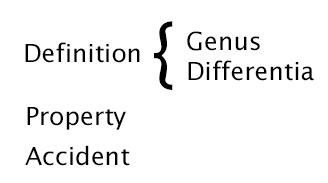
“A genus is what is predicated in the category of essence of a number of things
exhibiting differences in kind.”5
That is to say, the genus is that part of
the essence (or definition) of a kind of thing, which is shared by the essences
of other kinds of things. The genus of triangle, circle, square, ellipse, etc.
is “plane figure” since this is shared by the essences of all these geometrical
forms. The genus of water, sulphuric acid, nitrous oxide, etc. is “chemical
compound.”
The differentia is that part of the essence (definition) which,
being taken with the genus, distinguishes one kind of thing from other kinds
within the same genus. Thus, a circle is a plane figure bounded by a line whose
points are equidistant from a central point, while a triangle is a plane figure
bounded by three straight lines; and so on for other plane figures. The
italicized phrase states the differentia. Water is a chemical compound of
hydrogen and oxygen in the proportions H
2O, while sulphuric acid is a chemical compound of hydrogen, sulphur, and oxygen in the proportions H2SO4
; and so on
for other chemical compounds. Definition, for Aristotle, is thus always per
genus et differentiam.
The conception of the differentia arises from
Aristotle’s metaphysical doctrine of fixed kinds. Each kind within the same
genus has its peculiar and appropriate differentia, and the ideal of definition
is to discover the essential lines of cleavage between the kinds falling under
a genus.6
Nature has secretly organized herself along the lines of the
predicables, if we can only find it out. The notion that there is one and only
one essence of a thing carries with it the notion that there is one and only
one genus, and one and only one differentia. This can be seen in the following
passage from the Topics:
“Again, in regard to the differentire, we must examine in like manner
whether the differentire, too, that he (the proponent of a question) has stated
be those of the genus. For if a man has not defined the object by the
differentire peculiar to it, or has mentioned something such as is utterly
incapable of being a differentia of anything, e. g., ‘animal’ or ‘substance,’
clearly he has not defined it at all.”7
Ordinarily we should say that one kind could be differentiated from another
within the same genus in several alternative ways. Man is distinguished from
other animals by the weight of his brain, by the fact that he walks erect and
speaks, by the fact that he can adapt himself to a wider variety of
environments, and so on. But this is not the Aristotelian view. The forms of
things exhibit a rigid and necessary structure, so far as their definitions are
concerned. Behind the changing and accidental features of the world lies the
hierarchy of natural kinds, each one having its inalienable essence. The
Aristotelian metaphysics is needed to make the doctrine of definition by genus
and differentia intelligible; each kind of thing moves always to the
realization of its substantial form, and each substantial form (or essence)
stands inalterably fixed by a genus and differentia which belong to the
ultimate nature of reality. Whether this metaphysics be true or false, it is in
metaphysics, and not in logic, that the Aristotelian theory of the predicables
is rooted.8
The Tree of Porphyry,
usually given in connection with the predicables, shows how the definition of
the infima species, man, is arrived at by differentiation from the summum
genus, substance:
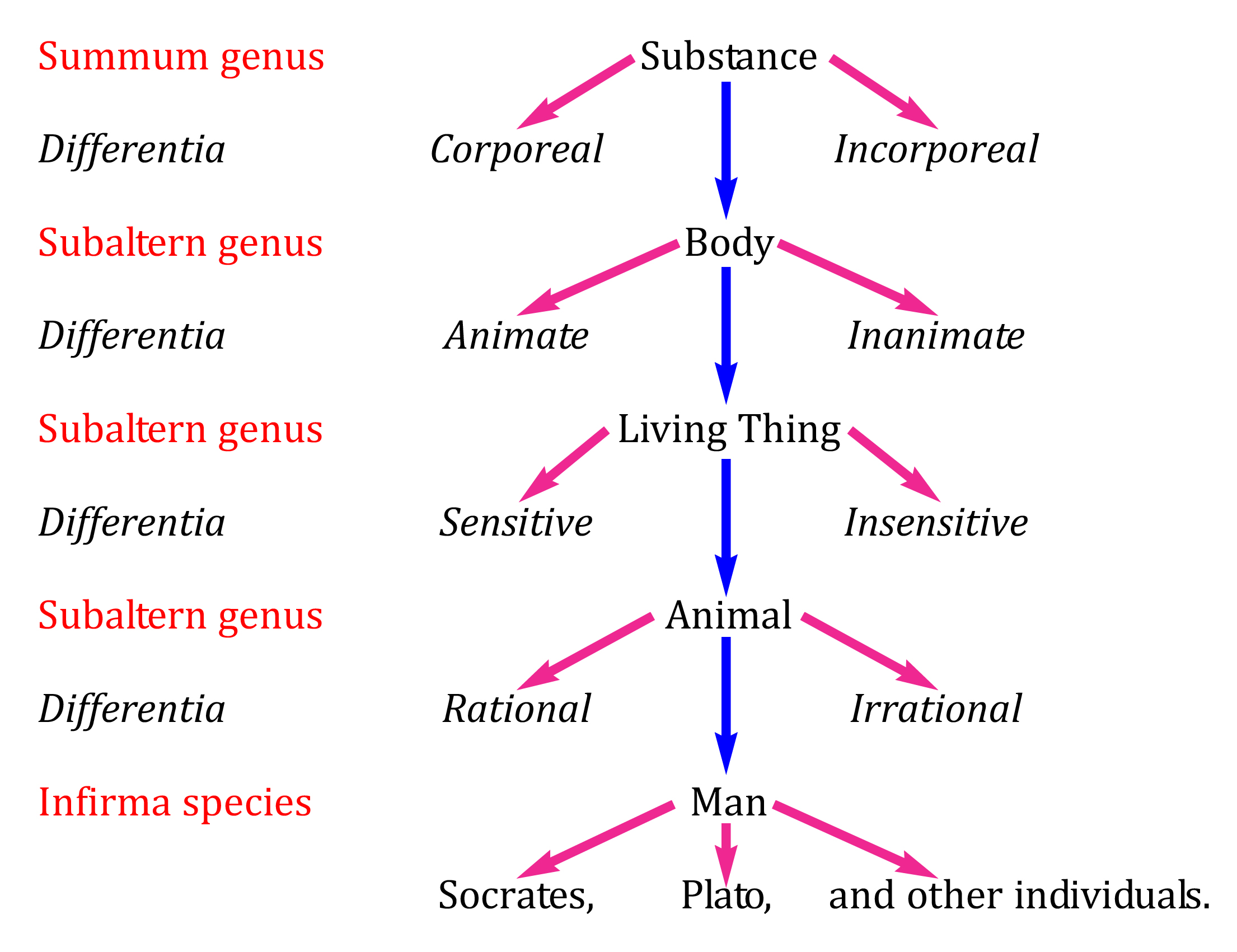
The division of each genus in the Tree of Porphyry is made by dichotomy, i.e.,
the genus is divided into those members marked by a certain differentia, and
those not marked by this differentia. The infinite (negative) classes at the
right are rejected at each step by the process of abscissio infiniti– “cutting
off the infinite”– as irrelevant to the definition.
“A property is a predicate which does not indicate the essence of a thing,
but yet belongs to that thing alone and is predicable convertibly of it. Thus
it is a property of man to be capable of learning grammar, and if he be capable
of learning grammar, he is a man. For no one calls anything a ‘property’ which
may possibly belong to something else, e. g., ‘sleep’ in the case of man, even
though at certain times it may happen to belong to him alone.”9
Aristotle means by “the predicate being convertible with the subject” that
the predicate is logically equivalent to the subject; that is, “x is P” implies
and is implied by “x is S.” Both essence and property are logically equivalent
to the subject of which they are predicated. Thus, if S≡P1≡P2≡P2≡ … Pn, all of
these predicates excepting one will be properties of S, and this one, let us
say P1, will be the essence. The only warrant for such a theory is to be found
in the Aristotelian metaphysics. Why not take any of these equivalent
predicates as the definition of S? The others would then follow from this
definition. A triangle could be defined as a three-sided plane figure and it
would follow (with other principles of geometry) that it was also
three-angular; or it could be defined as three-angular, and it would follow
that it was three-sided. Or it might even be defined as a figure having the sum
of its angles equal to a straight angle, and it would follow that it was
three-sided and three-angular. The choice of the definition from among the
properties of the thing defined, apart from metaphysical considerations, seems
to be a matter of convenience only. Some properties chosen as definitions could
be more easily handled in making deductions than others, but if all are
equivalent, they must yield the same theorems. Aristotle’s answer, however, has
already been given: definitions are fixed in nature, every kind has its
peculiar essence, a definition is distinct from a property.10
The accident stands by itself in contrast to the other predicables: it is
any non-necessary predicate, while genus, differentia, definition, and property
are necessary predicates. What Aristotle means by a necessary predicate is not
easy to say.11
The proper interpretation probably is, that it is a predicate intensionally
connected with the subject;12
one which enters into the meaning of the subject, so that without having that
predicate the subject could not be what it is. Thus man must be an animal, and
must be differentiated from other animals by rationality, in the same sense in
which a green thing must be colored, or a finite number must be greater by one
than some other finite number. Otherwise, man could not be man, green could not
be green, number could not be number; for the predicates are essential elements
in the meaning of the subject terms. When we pass to the accident, however, the
realm of intensional connections is left behind; we are dealing with material13
rather than necessary relations of forms.
“An accident,” the Topics declares, “is (1) something which, though it is
none of the foregoing– i. e., neither a definition nor a property nor a genus–
yet belongs to the thing: (2) something which may possibly either belong or not
belong to any one and the self-same thing, as (e. g.) the ‘sitting posture’ may
belong or not belong to the self-same thing. … Of the definitions of accident
the second is better: for if he adopts the first, any one is bound, if he is to
understand it, to know already what ‘definition’ and ‘genus’ and ‘property’
are, whereas the second is sufficient of itself to tell us the essential
meaning of the term in question.”14
The first is a negative, the second a positive definition of
accident; and positive definitions are always preferable to negative ones.
Aristotle seems to imply that an accident may be (1) that of an individual,
as “sleeping” would be of Socrates, since Socrates might be awake, or (2) that
of a class-concept, i. e., a form or universal. Thus “white-skinned” is an
accident of the concept, man; it is an accident of organisms to be eaten by
other organisms; an accident of polar bears to be kept in cages in circuses.
The second is the more important use of the term accident, since it parallels
the idea that the definition, genus, differentia, and property– and thus all
the predicables– are predicable of kinds rather than individuals. They exhibit
relations between forms.15
Mr. H. W. B. Joseph rejects the idea that Aristotle intends the accident to be
taken as a predicate of an individual at all; he says,16
“But we cannot distinguish between property and accident, so long as the
subject whose predicates we wish to refer to these heads is an individual. A
property is necessary to its subject and an accident is not; but all the
attributes which belong to Cetewayo (an individual) are equally necessary to
him as Cetewayo (as an individual); on what grounds then are some to be called
properties and the others accidents? An accident is an attribute which
coincides in an individual with another general character, or universal; its
accidental relation lies towards that other universal, and not towards the
individual, in which its presence is, historically, necessary.” This
interpretation renders the doctrine of the predicables consistent with itself
on the point that each predicable indicates a type of connection between
general characters. The major division of the whole doctrine is that between
accidental and necessary connections.17
2. Division and Classification
From what has been said it is clear that a definition in the Aristotelian sense
is arrived at by a process of division. Begin with a summum genus; divide this
genus by its peculiar differentiæ, thus giving sub-genera; divide these genera
further by their peculiar differentiæ, and so on, until the species to be
defined is reached.
This process of division, which proceeds from the more
general to the less general, by breaking up wider concepts (genera) into
narrower ones (species), has as its converse classification. Classification
begins with individuals; these are grouped into classes (infima species)
through analogies of structure; these classes are joined into wider classes
(genera); and so on, till a summum genus is reached. Thus classification
proceeds from the less general to the more general; it retraces in the converse
direction the structural lines of genera and species revealed by division. Both
division and classification may– and usually do– go on at once, lending support
to one another; and classification is equally relevant, with division, to an
Aristotelian definition.
Modern logic, leaving aside the metaphysics of a
hierarchy of natural kinds, views definition in a much more formal and strictly
logical way, which dissociates it from classification and division. As
processes useful in science, classification and division belong to the more
elementary stages of development, the pre-theoretical stages.
The rules for
division, applicable also to classification, are three:
(i) The division
must be exhaustive; that is, every member of the genus must be provided for in
some one of the differentiated species.
(ii) The species into which the
genus is divided must exclude one another.
(iii) The division must employ a
single principle of differentiation, i. e., a single fundamentum divisionis,
for each genus and, so far as possible, must continue with the same fundamentum
divisionis at all stages.
Unfortunately, the first rule is a counsel of
perfection, fulfilled only in the most abstract sciences. There is no way of
knowing– unless, as in mathematics, we can lay it down as an a priori condition
for the subject-matter in question– that a genus is exhausted by a division.
Take for instance the division of vertebrates into mammals, birds, reptiles,
amphibians, and fishes. What assurance is there that these species comprise all
possible animals with backbones? In the future course of evolution vertebrates
that could not be fitted into any of these classes might turn up; and only if
we could believe with Linnæus that “there are just so many species as in the
beginning the Infinite Being created,” could we maintain the contrary. On the
other hand, we can be certain that, if space conforms to the axioms of
geometry, the genus of rectilinear plane figures must be divided into the
species, three-sided, four-sided, five-sided, etc. to n-sided, and that this
division is exhaustive.
The second rule, that the species must exclude one another, is violated (1)
by including among the species, as co-ordinate with them, a subordinate or
super-ordinate class; e. g., “fish, flesh, fowl, and good red herring,”18
or “animal, vegetable, mineral, and organic kingdoms;” (2) by a cross-division,
which technically arises through the violation of the third rule, that a single
fundamentum divisionis must be employed throughout the division. (It should
also be noted that if a division is not exhaustive, we cannot be sure that it
is exclusive. If there could be other vertebrates than mammals, birds,
reptiles, amphibians, and fishes, they might possibly exhibit the
distinguishing features of two or three of these species at once.)
The fundamentum divisionis is some principle according to which the
differentiæ of the species separated out from the genus are selected. Thus, in
the division of rectilinear figures into three, four, etc. to n-sided ones, the
fundamentum divisionis is the number of sides; in Cuvier’s division of races
into Caucasian (white-skinned), Mongol (yellow-skinned), and Negro
(black-skinned), the fundamentum divisionis is the color of the skin. To
classify races as white, black, and round-headed would be a departure from the
rule; and would in this case result in an overlapping of the species,– for
there are round-headed races of both whites and blacks. In the same way,
animals might be divided for economic purposes into domestic animals, game
animals, fur-bearing animals, gnawing animals, predacious animals.19
There is no single fundamentum divisionis here: the classes are not exclusive.
The second part of the rule
demands the use, so far as possible, of the same fundamentum divisionis at all
stages of the division. This embodies Aristotle’s idea that each differentia
should be a differentiation of the previous differentia. Thus, if we classified
the inhabitants of the United States into genera according to the state in
which they reside, into species according to the county, and into sub-species
according to the township or smaller unit of residence, we should be using the
same fundamentum divisionis throughout, namely, the region of residence. Or, if
we further subdivided white, black, and yellow-skinned races by the color of
their skin, we should be following out this principle. The application is
plainly difficult, and would often serve no useful purpose, for the important
subdivisions of the species may be those that proceed on a new fundamentum
divisionis, e. g., the important subdivisions of white-skinned, black-skinned,
or yellow-skinned races may not be at all those determined by complexion.
Hence, this part of the rule is not always pressed by logicians.
The failure
to adhere to a single fundamentum divisionis does not necessarily lead to an
overlapping of the species. The rule prevents overlapping, but its violation
does not always produce this result. Here again the logician seems to be giving
to the scientist a counsel of perfection. Actual classifications and divisions
proceed in a much less formal way. The eye of the scientist is fixed on complex
similarities and differences; the web of interlacing characters is too tangled
to exhibit any single principle of differentiation; and though the scientist
wishes his divisions to be exclusive, he cannot secure this by adherence to the
logical rule. The facts are not so simple.
Consider, for example, the following zoological division of the animal
kingdom into genera:20
(a)
Vertebrates: animals with a backbone;
(b) Arthropoda; animals with jointed
appendages and segmented bodies, e. g., crayfishes, centipedes, insects, etc.;
(c) Molluscs; animals with a ventral muscle, called the foot, usually serving
as an organ of locomotion; often with a heavy shell;
(d) Annelida: segmented
worms;
(e) Echinodermata: spiny-skinned sea animals, e. g., the starfish;
(f) Nemathelminthes: unsegmented round or thread worms;
(g) Platyhelminthes:
flat unsegmented worms;
(h) Coelenterata: animals with simple sac-like
bodies, e. g., the jellyfish;
(i) Porifera: sponges;
(j) Protozoa: the
simplest animals, only visible to the microscope.
No attempt to employ a
single fund amen tum divisionis is in evidence here, unless it be degrees of
simplicity and complexity of structure; and this is an extremely elastic
principle. Again, if we consider the species within one of the above genera of
animals, namely, the species of vertebrates, we can find no one principle of
division. Vertebrates fall into,
(a) Mammals: vertebrates which possess
hair, and, with few exceptions, nourish their young with milk secreted from
mammary glands; they breathe air by means of lungs and are said to be
warm-blooded;
(b) Birds: vertebrates characterized by the presence of
feathers;
(c) Reptiles: vertebrates having lungs, and in most cases covered
with armor of scales or bony plates; called cold-blooded;
(d) Amphibians:
vertebrates that resemble reptiles, but do not possess scales and are
anatomically different; in early life they breathe through gills, but later
become air-breathers;
(e) Fishes: vertebrates with scales, who spend their
entire existence in water; breathe through gills, and swim by means of fins.
The whole conception of a rigid differentia, and a single principle for its
selection, seems to be abandoned in these actual cases of classification; and
the possibility of intermediate forms– of animals that fall, e. g., between
birds and reptiles, amphibians and fishes,– is never excluded. At the same
time, the naturalist is attempting to separate out distinct species, and to
avoid as far as possible overlapping; but he does not achieve this result in
the simple manner prescribed by the Aristotelian logic, i. e., by following the
rule of the single fundamentum divisionis. Departure from this rule, whether
the species do or do not overlap in fact, is technically cross-division, since
there might be forms (though there may be none in fact) that fall into more
than one species. When the Darwinian theory of the evolution of species became
a factor in natural classifications, the possibility of intermediate forms
between all species, taken in historical order, was admitted. The ideal of a
classification or division that formally avoids cross-division became
unworkable, unempirical, and in fact positively false.
3. Dichotomous Division
In dichotomous division (or dichotomy), a genus is divided by a differentia and
its negative, e. g., the genus animals could be divided into vertebrates and
non-vertebrates; the genus man into white and non-white, and so on. The
division of vertebrates would continue as shown in the table on the opposite
page.
This type of division possesses the merely formal merit of being
exclusive and exhaustive. There can be no question that all members of a genus
are exhausted by the classes A
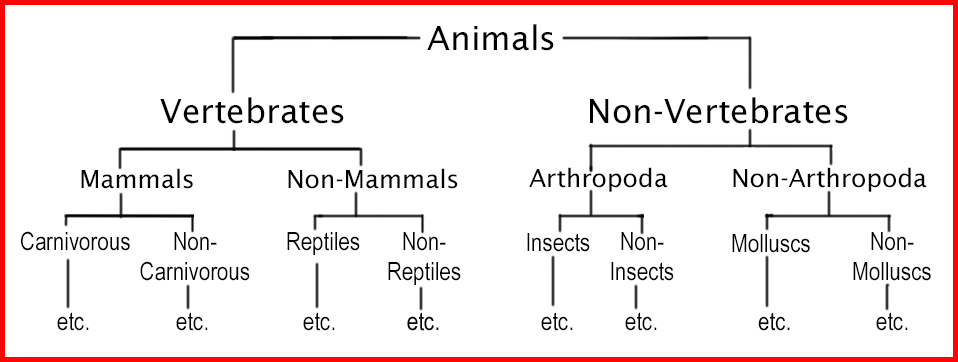
and not-A, if A is some character belonging to certain members; nor can there
be a question that the species A excludes the species not-A. But this formal advantage is gained at the cost of (1) a cumbersome multiplication of “infinite
classes” (i. e., negative classes) which (2) obscures the simpler relationships of genera and species that appear where only positive divisions are made.
The simpler classification of animals (corresponding to the dichotomous
division above) by positive characters alone would be schematized thus:
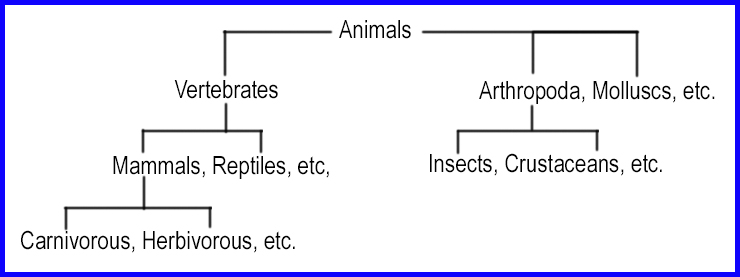
The negative classes of the dichotomous division require to be further divided
if the division is to go forward at all. Thus, nothing whatsoever is gained by
including these negative classes, excepting an a priori guarantee of
exclusiveness and exhaustiveness; a guarantee that has no empirical connection
with the subject-matter. The saner method is to proceed at once to the positive
differentia, omitting the negative classes and thus exhibiting clearly the
co-ordination of the various species and genera, as in the second table above.
The chief argument against dichotomous division as a scientific method is thus
pragmatic; it continually introduces, for no good scientific reason, negative
classes.21
4. Division and Analysis
The two types of division we have described– the positive differentiation of
genera into species and sub-species; the dichotomous differentiation, which
employs negative concepts at every stage– are usually called logical division,
to distinguish them from physical and metaphysical division. The division of an
individual thing into its separate parts is physical division (or partition).
Thus, if I divide a watch into its case, hands, face, and works, I have
performed a process of physical division. Metaphysical division separates out
(conceptually) the various qualities, rather than the physical parts, of a
thing. When I enumerate the qualities of the watch– its size, accuracy, color,
etc.– I am dividing it metaphysically.
These seemingly trivial
distinctions touch an important logical point, namely, the difference between
logical division and analysis. The use of the term “division” for both obscures
the issue; physical and metaphysical division are more clearly described as two
types of analysis.
Logical division traces the route from less specific to
more specific concepts, from wider to narrower classes,– from what Mr. W. E.
Johnson calls the “determinable” to its “determinates.”22 This is scarcely a
process of analysis; or at least it does not seem wise to speak of it as
analysis, if we wish to give precision to this term. We should not say that we
had analyzed the idea of color when we exhibit red, green, orange, etc. as
colors; or that we had analyzed man when we name white, black, and
yellow-skinned races as types of men. This is a specification of a more general
concept in its less general forms. On the other hand, we have analyzed the
watch when we describe its parts, its balance-wheel, jewels, mainspring, etc.,
together with their functioning in the whole, which causes the watch to keep
time. And we have also analyzed the watch in a second– and different–sense when
we assign its qualities; i.e., it is round, flat, made of gold, it belongs to
Mr. X, etc. Both of these processes are different from the exhibition of a less
specific concept in its more specific forms. The first can be spoken of as
partitive analysis (following the term partition which is used for physical
division), and the second as qualitative analysis.
Analysis and synthesis
are inseparable from one another, and both are connected with definition.23 To
analyze is to display the components– we should probably be tempted to say, the
simple components– that constitute some whole; further, it is to display these
components as constituting this whole. We analyze water when we resolve it into
the simpler components, hydrogen and oxygen; we analyze our perception of space
when we resolve it into visual, tactile, and kinæsthetic sensations. But it is
not enough merely to decompose water into hydrogen and oxygen; we must show
that, in the proportions H2O under certain conditions of temperature and
pressure, they actually do constitute water. We must exhibit water as a
synthesis of these elements in order that the analysis may have meaning, that
is, may be the analysis of something. In the same way, we must show how visual,
tactile, and kinæsthetic sensations fuse to give the perception of space;
otherwise, the components are components of nothing. They are disparate and
scattered simples. The recognition that what is analyzed already constitutes a
whole (a synthesis) is implied in the meaning of the term “analysis”: just as
it is implied in the meaning of the term “synthesis” that something analyzable,
namely, a whole of constituents, is presented to us.24
Mr. Johnson puts
this point as follows:
“… since the important process is– not the mere
revelation of the parts contained– but rather the indication of their mode of
combination within the whole, analysis is better defined as the exhibition of a
given object in the form of a synthesis of parts into a whole. In this way we
can say that any process of analysis can also be described as a process of
synthesis; but this does not amount to saying that analysis means the same as
synthesis, any more than that the relation ‘grand-father’ is the same as the
relation ‘grandson,’ although the fact that A is the grandfather of B is the
same fact as that B is the grandson of A. In short, analysis is the inverse of
synthesis; i. e., when the whole X is analyzed into several components a, b, c,
d; then a, b, c, d have to X the inverse relation which X has to a, b, c, and
d. In this way it is clear that to analyze X simply means the same as to
exhibit X as a synthesis.”25
Partitive and qualitative analysis are both
ways of exhibiting elements as constituting a synthesis, though the type of
whole– and the meaning of the term “part”– is different in each case. The
elements analyzed out in a partitive analysis are always related spatially or
temporally (or both). They fall spatially or temporally within the whole; hence
the name “physical division,” since the analysis of such wholes is relevant
only to the physical world. The springs, wheels, etc. are spatio-temporal parts
of the watch. Again, our perception of space is composed of visual, tactile,
and kinæsthetic sensations forming at least a temporal whole. (And if we admit,
from a naively realistic point of view, that spatial relations between
sensations are presupposed in the perception of space, we could say that our
visual, tactile, and kinæsthetic sensations are spatially related to one
another in yielding space-perception.)
Partitive analysis can be divided
into the two kinds, homogeneous and heterogeneous. If the spatial or temporal
parts are of the same genus as the whole (and hence as the other parts), the
analysis is homogeneous; for example, the division of a cube into other cubes,
a surface into surfaces, a line into lines, a quantity of heat into quantities
of heat. But if the parts are of a different genus from the whole (and, as a
rule, from one another), the partition is heterogeneous. The partition of the
watch is of this type: the analytical elements, the springs, wheels, etc. are
not themselves watches.
Homogeneous partitive analysis is required for
measurement. This is what is ordinarily meant by divisibility. Thus, to measure
a volume, we must analyze it into volumes; to measure a duration, we must
analyze it into durations; and so on. The measurement consists in assigning a
number of equal parts, in this sense of “part,” to the whole analyzed.
Heterogeneous partition, on the other hand; is not the type of division which
is relevant to measurement. When we exhibit the mechanisms within mechanisms
which constitute the watch, we are not dividing the whole into measurable
units. The parts can, of course, be enumerated; let us say that there are nine
hundred and ninety-nine parts in a watch; but this tells us nothing about the
size of the watch.26
Qualitative analysis considers– not the spatial or
temporal relatedness of elements with a whole– but the qualities and relations
beyond itself which belong to this whole as a whole. Such analysis need not be
restricted to the physical world; this gives a justification for the name
“metaphysical division.” Clearly, the qualities and relations of an object are
not parts of it in the spatio-temporal meaning of this term. The blueness,
foaminess, saltiness, etc. of the sea are not in the sea, as are the individual
waves and the individual molecules of salt. Nor are we analyzing water from the
same angle when we describe it as colorless, odorless, and tasteless, as when
we decompose it into H2O. We can define qualitative analysis as follows: all
the conjoined qualities and relations which can be predicated of a given
subject S constitute the qualitative analysis of S. This is by far the most
important sense of the term “analysis,” and the one most purely logical in
meaning.27 Obviously, partitive analysis can be brought under it, though the
two are not equivalent; i. e., the fact that S can be partitioned into certain
spatio-temporal parts is a quality of S, and can be predicated of S as a whole.
It is a quality of water– in fact, the most important one,– to be analyzable by
partition into H2O, just as it is a quality of water to be colorless and
odorless.
Since the world is so full of a number of things– both the world
of the actual and the possible– the complete qualitative analysis of anything
would lead to infinite complexity. Whatever can be truly said about a thing is
a part of its qualitative analysis. Thus, for purposes of definition, it
becomes essential to select: we might characterize (real) definition in general
as selective qualitative analysis.
Whatever the type of analysis, the
question arises– Are the elements yielded by any analysis absolutely simple?
To say that there are absolute simples seems a dangerous and unverifiable
assumption. For if we can make any statement at all about anything we are, in
one of the senses described above, analyzing that thing; and it would be rash
to maintain that there is something about which nothing at all can be said. In
so far as analysis is partition, the physical division of spatial or temporal
objects into parts, the question becomes– Is there anything absolutely simple
in the physical world?– a simple, indivisible substance?– a simple physical
individual? The question cannot, in any case, be answered by logic, and the
answer seems doubtful from a metaphysical point of view. The sanest solution
is, that what appears to be unanalyzable is probably merely unanalyzed; what is
taken in analysis as simple lies at the limit of the process, but is not– in
its nature– incapable of further characterization or partition.
Mr. Bertrand
Russell, holding the view that there must be simples, declares:28
“When I
speak of ‘simples’ I ought to explain that I am speaking of something not
experienced as such, but known only inferentially as the limit of analysis. It
is quite possible that, by a greater logical skill, the need for assuming them
could be avoided. A logical language will not lead to error if its simple
symbols (i. e., those not having any parts that are symbols, or any significant
structure) all stand for objects of some one type,29 even if these objects are
not simple. The only drawback to such a language is that it is incapable of
dealing with anything simpler than the objects which it represents by simple
symbols. But I confess it seems obvious to me (as it did to Leibniz) that what
is complex must be composed of simples, though the number of constituents may
be infinite. It is also obvious that the logical uses of the old notion of
substance (i. e., those uses which do not imply temporal duration) can only be
applied, if at all, to simples; objects of other types do not have that kind of
being which one associates with substances. The essence of a substance, from
the symbolic point of view, is that it can only be named– in old-fashioned
language, it never occurs in a proposition except as the subject or as one of
the terms of a relation. If what we take to be simple is really complex, we may
get into trouble by naming it, when what we ought to do is to assert it. For
example, if Plato loves Socrates, there is not an entity ‘Plato’s love for
Socrates,’ but only the fact that Plato loves Socrates. And in speaking of this
as ‘a fact,’ we are already making it more substantial and more of a unity than
we have any right to do.”
If we reject Mr. Russell’s notion that there are
absolute simples, there is no reason why we should get into trouble by treating
a complex– e. g., a fact– as if it were simple. A proposition analyzes a fact;
it exhibits terms in relation, or qualities as characterizing a subject. But,
so far as logic is concerned, we can substitute an unanalyzed x for any fact,
and begin our analysis at a different level. The corollary of the view that
there are– for logic at least– no absolute simples, would be that any complex
could be treated as if it were simple.
5. Nominal and Real Definitions
A tangle of ambiguities clusters about the idea of definition. We find
Aristotle holding, on the one hand, that the primary truths of science are
indemonstrable definitions stating what the essences of certain things are;30
and, on the other, we read in the works of some modern logicians that “a
definition is, strictly speaking, no part of the subject in which it occurs”
and “is not true or false.”31
This wide divergence of opinion springs from two utterly different
interpretations of the term “definition.” Aristotle is speaking always of real
definitions, while recent logic tends to treat all definitions as verbal, or
nominal.
A verbal or nominal definition is a declaration of intention to use a certain
word or phrase as a substitute for another word or phrase. The original word or
phrase is the definiens; the substituted one, the definiendum. Such definitions
have value, usually, as linguistic or symbolic conveniences. If an expression
becomes too long to be easily handled, we can– by stating our intention to do
so in a nominal definition– replace this expression by a shorter one. In
writing on logic, for example, where reference is frequently made to “the type
of relation such that if a R b and b R c, then a R c,” I can shorten my
exposition by substituting for this expression the term “a transitive
relation.” Or, in Euclidean geometry, I can replace the phrase, “lines that do
not intersect in a plane” by the words “parallel lines.”
What is important about a verbal definition is this: (1) the meaning of the
definiendum is not independent of that of the definiens, i. e., the expression
defined has literally no other meaning, in the discussion, than that given
arbitrarily to it; (2) a verbal definition is neither true nor false, and
therefore (3) cannot serve as a premise for deductions.
It is often said that definitions cannot be questioned. This refers to nominal
definitions. Thus, if I take the word “good” to mean “any object of desire,” it
would be vain– and meaningless– to question my statement that “any object of
desire is good,” for I am not asserting a truth about objects of desire or
goods. All I am saying is that this is how I intend to use the word “good,” and
one may use words in any way he chooses. However, I could not conclude from
this definition that “no objects of desire are evil.” The only legitimate
process which the definition permits is verbal substitution; and all that this
statement can mean is that “no objects of desire are non-good, i. e., are not
objects of desire.”
In adopting this notion of definition, the authors of Principia Mathematica
give the following explanation:32
“A definition is a declaration that a certain newly-introduced symbol or
combination of symbols is to mean the same as a certain other combination of
symbols of which the meaning is already known. … We will give the names of
definiendum and definiens respectively to what is defined and to that which it
is defined as meaning. We express a definition by putting the definiendum to
the left and the definiens to the right, with the sign ‘=’ between, and the
letters ‘Df’ to the right of the definiens. … An example of definition is, p ⊃
q = ~ p ⋁ q Df.
“It is to be observed that a definition is, strictly
speaking, no part of the subject in which it occurs. For a definition is
concerned wholly with the symbols, not with what they symbolize. Moreover it is
not true or false, being the expression of a volition, not of a proposition.
(For this reason, definitions are not preceded by the assertion-sign.)
Theoretically, it is unnecessary ever to give a definition: we might always use
the definiens instead, and thus wholly dispense with the definiendum. Thus
although we employ definitions and do not define ‘definition,’ yet ‘definition’
does not appear among our primitive ideas, because the definitions are no part
of our subject, but are, strictly speaking, mere typographical conveniences.
Practically, of course, if we introduced no definitions, our formulæ would very
soon become so lengthy as to be unmanageable; but theoretically, all
definitions are superfluous.”
A real definition does not merely provide
verbal substitutes for expressions already introduced: (1) it states that two
expressions, each of which has an independent meaning, are equivalent to one
another; (2) it is either true or false, and (3) can therefore serve as a
premise in deductions.
Such definitions– which would not be definitions at
all, but statements of equivalence, for Principia Mathematica, and which would
be the only kind of definitions worth taking seriously for Aristotle– could be
questioned and even disproved. If the term “good,” for example, has a meaning
of its own, and the phrase “object of desire” has also a meaning of its own,
the real definition– “the good is any object of desire”– might be false. We can
ask, is it true that what is meant (independently) by “good” is the same as
what is meant by “any object of desire”? And, if evil, as most religions
maintain, can be desired, this definition cannot stand as “a primary and
indemonstrable truth.”
In the same way, the definition of implication given
in Principia Mathematica, that “p implies q” is a verbal substitute for “either
p is false or q is true,” can be questioned if we treat it (though it is not
intended to be taken in this way) as a real definition. Is this really what
implication means?– is it a proper analysis of this idea, considered as having
an independent meaning? We can then bring forward the paradoxes that a false
proposition implies any proposition, and a true proposition is implied by any
proposition; “today is Wednesday,” whether true or false, implies that
“Columbus discovered America in 1492.” Does the proper meaning of implies
permit these paradoxes?33 But these objections are precluded by the theory of
definition itself which Principia Mathematica advances. “Implies” is simply
shorthand for the longer expression, “either p is false or q is true.”
This divergence in the use of the term “definition” leads to the question– What
is the purpose of a definition?
We can differentiate its logical from its
psychological purpose. Psychologically, a definition serves to make the meaning
of a concept, or group of concepts, clear to the mind. Logically, its purpose
is to aid in the adequate exposition of the subject-matter in question. That
is, a good definition from a logical point of view would be one which, taken in
conjunction with certain premises, leads to true conclusions (or theorems)
completely covering, so far as possible, the field under investigation. Thus
if, in the field of economics, money were defined as “any imperishable medium
of exchange,” paper currency would be left out; we could not, by this
definition, cover most of the intangible transactions of business, and the
definition would be logically bad because of its inadequacy. In the same way,
if we defined number so that infinite numbers were excluded, the definition
would be inadequate. The logical test of a good definition is not, then, its
clarity to the mind, but its ability to give us what we want in our
conclusions.
Now, obviously the process of definition cannot be led back ad
infinitum. It must terminate in the undefined, or indefinable. Any discussion
must begin with certain primitive concepts from which it proceeds in an orderly
way. Psychologically, it would always be best to take as undefined those
concepts which are most clearly understood; but logically, such a procedure
might be very limiting indeed, being confined by the circumference of the
understanding to which we appeal.34 What is best taken as primitive (or
undefined) may therefore be some extremely complex idea, so far as
understanding it is concerned. A glance at any mathematical system easily
convinces us that this is the case. Mr. H. M. Sheffer,35 for example, uses as
primitive in logic (and defines all other propositional relationships through
it) the idea of rejection, i. e., “neither p nor q,”– a notion much less easily
grasped by most people than that of “p or q,” “p and q,” etc.
How, then, is
the undefined understood, if not through definition? The only answer is, by
apprehending it, or “demonstrating” it, not in the sense of proving but of
showing what it is. If I define the parallelism of lines as non-intersection,
and define the intersection of lines as “having a point in common,” I cannot
(perhaps) go further and define what is meant by having a point in common, but
must show or exhibit to you what I mean. The undefined, therefore, is not that
which is without meaning, but that which has its meaning by an external
reference to the realm of objects thought about.
Returning to the
distinction between nominal and real definitions, we see that nominal
definitions can fulfill only a psychological purpose: a (more or less) clear
significance is assigned as a matter of convenience to an expression which is
otherwise taken as meaningless. Nominal definitions do not analyze the ideas
they define, in the sense of stating that these ideas exhibit such and such
components; for they are not statements of truths about these ideas, as are
real definitions. Nor could the question as to whether they do or do not
adequately cover the subject-matter be raised.
Having introduced definitions
as purely nominal, many writers tend later to treat them as if they were real–
as if they conveyed some information about the concept defined, and so,
analyzed this concept. Ethical philosophers who nominally define “the good” as
“any object of desire” often end by arguing that this is the only meaning
“good” can have, since everything that is good is an object of desire, and
there is no object of desire that is not good. Tacitly they assign an
independent meaning to the term “good”; and their erstwhile nominal definition
becomes an important truth in their minds.
The same tendency is illustrated
in logic by the further remarks on definition made in the Introduction to
Principia Mathematica36
“In spite of the fact that definitions are
theoretically superfluous, it is nevertheless true that they often convey more
important information than is contained in the propositions in which they are
used. This arises from two causes. First, a definition usually implies that the
definiens is worthy of careful consideration. Hence the collection of
definitions embodies our choice of subjects and our judgment as to what is most
important. Secondly, when what is defined is (as often occurs) something
already familiar, such as cardinal or ordinal numbers, the definition contains
an analysis of a common idea, and may therefore express a notable advance.”
A nominal definition can never be an analysis of an idea; a real definition is
always an analysis of an idea.37 For, a real definition states an equivalence
between expressions of independent meaning, each of which is undefined and can
be merely exhibited as having that meaning.
By what warrant can such
statements of equivalence be called definitions if both sides of the equation
are undefined?– if one side does not assign a meaning to the other? The warrant
is this: (1) they are primary, i. e., they come first in the discussion or
proof, and any other statements of equivalence that occur follow from them; (2)
though both sides of the equation are undefined, one meaning elucidates the
other; i. e., any idea is more clearly understood if it is analyzed or
expressed in different terms; thus, they serve the psychological purpose of
definitions. They are in Aristotle’s sense “primary and indemonstrable truths.”
Recent logic, however, would speak of such definitions as “axioms,” “primitive
propositions” or “postulates,” reserving the term “definition” for the
assignment of a meaning, in terms already introduced, to an expression that
otherwise has no meaning.
6. Rules of Definition
The usual rules of definition (as given by Mr. Joseph)38
are as follows:
(i) A definition must give the essence of that which is to be defined.
(ii) A definition must be per genus et differentiam.
(iii) A definition should not be expressed in obscure or figurative language;
and it is sometimes added that the definition should be clearer and simpler
than the thing to be defined.
(iv) A definition must not be in negative where it can be in positive terms.
(v) A definition must be commensurate with that which is to be defined.
(vi) A definition must not, directly or indirectly, define the thing by itself.
The first two rules, that the definition must state the essence of what is
defined and must be per genus et differentiam, are relevant only to definition
in the Aristotelian sense. If we reject the notion of a fixed essence, peculiar
to a thing and different from its properties– which would also entail the
rejection of a peculiar genus and a rigid differentia,– these two rules will
not be applicable. Any concept equivalent to the one defined could be used as a
definition, and the choice would depend on the adequacy of the definition to
cover the subject matter we wish to include in the discussion. The choice, in
other words, would be pragmatic. For the purposes of a lawyer it would be
sufficient, perhaps, to define an argument as “a discussion in which various
sides of an issue are put forward;” but such a definition would never do for a
logician.
The third rule turns upon the psychological purposes of definition. It must
always be recognized that the obscurity or clarity of the definiens is a
relative matter; what is obscure or clear to one person may not be so to
another. Figurative definitions ought not to be completely excluded; e. g.,
“money is the root of all evil.” They are illuminating for some purposes, for
those of the poet or stylist, though scarcely for the scientist or philosopher.
Rule iv has its basis in the same considerations as the previous rule;
namely, in the ambiguity and obscurity of negative concepts. Strictly speaking,
a negative concept, construed as infinite or purely negative, includes, as we
have seen, everything excluded by the positive. Thus, if I were to define a
chair as a “non-table,” this might refer to a bed, a book, or an infinity of
other things. In the same way, if parallel lines are defined as lines
not-intersecting in a plane, a series of concentric circles would conform to
the definition-and the question arises whether this is the meaning of parallel
lines.39
The fifth and sixth rules, like the third and fourth, apply to definition in
any sense, not only to the Aristotelian type of definition. Rule v states what
we have considered in the previous section on nominal and real definition: that
the definiens must be coextensive with the definiendum, either in the sense of
equivalence, i. e., of implying and being implied by it, where the definition
is real; or in the sense of being a verbal substitute for it, where the
definition is nominal. No definition could violate this rule.
The sixth rule, that the definition must not be circular, is equally
important with the fifth. Whether we view definition as resting on real
analysis, or as a provision for verbal substitution, no definition should use
the concept to be defined as the defining notion. Take the following flagrant
example: “Justice is the doing of just acts.” Considered as an analysis of
“justice,” this is faulty, since the unanalyzed idea “justice” is represented
as the chief element in the analysis. We are still faced with the same
unanalyzed notion. Considered as a verbal substitute for the word “justice,”
which is otherwise meaningless, the definition assigns no meaning to this word.
As an example of circular definition, Aristotle gives the following: “supposing
anyone had defined the sun as a ‘star that appears by day,’ … in bringing in
‘day,’ he brings in the sun.”40
The fault of defining a thing by itself is said to be committed (1)
whenever the term to be defined, or any other term synonymous with it, is
introduced in the definition (as illustrated above); or (2) when we define
relative terms by their correlatives, or counter-alternative terms by one
another.41
Relative terms are those into whose meaning a relation to some
other term enters. Thus, parent, wife, successor, etc. are relative terms; the
correlatives being, respectively, offspring, husband, predecessor. If a wife is
defined as “a woman who has a husband,” the definition is circular, since
“having a wife” enters into the meaning of “being a husband.” The proper way to
treat such terms is to define the relation between them; in defining the
relation, we also define its converse and hence, both correlative terms at
once. “A is the wife of B” means “A is a woman who has entered into a marriage
contract with a man B.” The converse of this relation is, “B is a man who has
entered into a marriage contract with a woman A;” and this defines “B is the
husband of A.”
The notion that no part of the expression to be defined
can appear in the definiens has often been construed too rigidly, so that
definitions which are not really circular are excluded on the grounds of
circularity. I could correctly define “the first element in a series” as “any
element of that series such that all the other elements follow it;” e. g., Adam
was the first man because all other men were his descendants. Here the
definiendum is “the first element in a series,” and the words “element” and
“series” are repeated in the definiens. Is the definition circular? If the rule
is literally construed to mean that no word can appear on both sides of the
defining equation, the definition is circular. But, plainly, we are not
defining element or series, though these terms enter into the definiendum. We
are defining one part of the whole expression, “the first element in a series,”
namely, first.
Mr. W. E. Johnson remarks on the rule forbidding circularity
in definition:42
“In this connection it is worth noting that, when what has
to be defined is a verbal phrase rather than a single word, we may italicize–
so to speak– that part of the phrase for which an explanation is asked. In such
cases the remaining components of the phrase may be, and generally ought to be,
repeated in the phrase constituting the definition. … this mode of definition,
so far from being a ground of condemnation, exactly answers in the most
adequate sense the requirements. The more exactly we repeat in our definition
the actual words and their form of combination, used in the phrase to be
explained, the more precisely do we meet the demands for an explanation.”
Thus, it would be less accurate to define “a regular student in Harvard
College” as “a young man who enters Harvard College by examination,” than to
repeat verbatim, with the exception of the italicized word, the other words in
the definiendum: i. e., “a regular student in Harvard College” is “a student in
Harvard College who enters by examination.” For, there are old men as well as
young ones who enter in this way.
NOTES
1 The Aristotelian doctrine of the categories, as well as that of the
predicables is usually given a place in treatises on logic. But the bearing of
this doctrine on purely logical issues is very remote indeed; and for that
reason it is not treated at length here. The theory of the predicables, though
its background is metaphysical, does constitute in Aristotle’s mind a part of
the analysis of propositions. It is an inquiry into the formal types of
relationship which the predicate bears to the subject in any proposition;
i. e., is the relationship necessary or accidental?– and if it is necessary, is
it that of definition, genus, differentia, or property? The doctrine of the
categories, on the other hand, is not a part of the analysis of propositions,
or of the formal types of relationship which a predicate may bear to the
subject in a proposition. It examines the meaning of “words uncombined,” and
lists “the widest predicates which are predicable essentially of the various
namable entities, i. e., which tell us what kinds of entity at bottom they
are.” In the Metaphysics, Aristotle speaks of the categories as a catalogue of
the “various meanings of being.” (The quotations are from W. D. Ross,
Aristotle, pp. 21 ff.) In other words, the categories form a list of the
fundamental kinds of realities with which the metaphysician must deal; the
doctrine belongs to general philosophy, and not specifically to logic. The ten
categories as given by Mr. Ross (op. cit., p. 21) are: (1) substance, e. g.,
man; (2) quantity, e. g., two cubits long; (3) quality, e. g., white; (4)
relation, e. g., double; (5) place, e. g., in the Lyceum; (6) date, e. g.,
yesterday; (7) position, e. g., sits; (8) state, e. g., is shod; (9) action, e.
g., cuts; (10) passivity, e. g., is cut. Substance is divided into (a) primary
substance, i. e., the individual, which is always a subject and never a
predicate, and (b) secondary substance, i. e., the species and genera in which
the primary substances are included.
2 Aristotle, Topica, 101b-39, W. D.
Ross trans., Oxford Press, 1928.
3 Aristotle, Topica, 101b-19.
4 Porphyry
(A. D. 233-304) in his Isagoge (An Introduction to the Categories of Aristotle)
“hopelessly muddled” the doctrine of the predicables, according to W. D. Ross,
by adding the idea of species in place of definition. Porphyry’s list, which
was more current than Aristotle’s almost up to the present time, was: (1)
species, (2) genus, (3) differentia, (4) property, (5) accident.
5
Aristotle, Topica, 102a-31.
6 The idea of the differentia, however, went
through an evolution in Aristotle’s mind, which is traced by W. D. Ross,
Aristotle, Scribners, 1924, p. 57, as follows: “In the present passage (the
Topics) the distinction between genus and differentia is slurred over.
Differentia, like genus, is treated as being wider than that whose differentia
it is. The implied doctrine is one which we find also in the Posterior
Analytics (96a-24-b14), that a definition is made by collecting attributes each
wider than the term to be defined but collectively coextensive with it. In the
Metaphysics (Z. 12), on the other hand, Aristotle lays it down that each
differentia stated should be a differentiation of the previous differentia, and
that the last differentia should be coextensive with the definiendum.”
7
Aristotle, Topica, 143a-29.
8 The distinctions between the specific
difference and the generic difference, the summum genus and the proximate genus
should be noted. The proximate genus is the genus immediately above the kind
defined; e. g., “animal” is the proximate genus of “ox”, but “organism” is the
proximate genus of “animal,” since both animals and plants are organisms, A
summum genus is one above which no further genus stands, e. g” “substance,”
“thing,” “being,” A specific differentia is one which marks off kinds within
the proximate genus; e. g., “having three sides” distinguishes triangles
within the proximate genus “plane figure” and is a specific difference; whereas
“plane” is, with reference to “triangle,” a generic difference, since it
distinguishes the genus “plane figure” from other geometrical figures, namely,
linear and solid, within the higher genus “geometrical figure.” An infima
species is one which is not differentiated further into species; only
individuals, and not species, stand under it. Thus, “rat” is an infima species
of the genus vertebrate.
But it is obviously a question whether there are
any infima species at all; and for a logic like that of Leibnitz, which takes
the individual to be an infinitely complex set of predicates, individuals alone
could be ranked as infima species. There seems to be no reason, except the
doctrine of fixed species, why there should not be species within species ad
infinitum.
9 Aristotle, Topica, 102a-17.
10 Porphyry elaborates the
Aristotelian theory of the property by departing from the idea that the
property must be equivalent to the subject of which it is predicated; he was
followed by the mediaeval logicians. He distinguished (1) properties that
belong to the species alone, though not to all its members; e. g., only human
beings are mathematicians or philosophers, though not all human beings have
these properties; (2) properties that belong to all the members of a species,
but not to them alone; e. g., all men have five toes, but so also do all
monkeys, and some other animals; (3) properties that belong to a certain
species only and to all members of this species but not always, e. g.,
“white-haired” as connected with the species of aged-people; (4) properties
that belong always to all members of a certain species, and to it alone. The
latter is the same as the Aristotelian notion of property.– These trivial
distinctions illustrate the sterility of much of the post-Aristotelian logic
11 W. D. Ross, Aristotle, p. 45, characterizes this necessity of the first four
predicables in relation to their subject as follows: “… they are (1) true of
every instance of their subject. But (2) the relation which they state between
subject and predicate must be a per se or essential relation.”
12 This is
Mr. H. W. B. Joseph’s interpretation (op. cit., ch. IV). Mr. Joseph’s
discussion of the predicables is admirable, and should be referred to by the
student.
13 See above, pp. 227-230.
14 Aristotle, Topica, 102b-4.
15
Aristotle discusses the relation between accidents and properties as follows
(Topica, 102b-21): “It is clear on the face of it that there is nothing to
prevent an accident from becoming a temporary or a relative property. Thus the
sitting posture is an accident, but will be a temporary property, whenever a
man is the only person sitting, while if he be not the only one sitting, it is
still a property relatively to those who are not sitting. So then, there is
nothing to prevent an accident from becoming both a relative and a temporary
property; but a property absolutely it will never be.” The notion that
properties may be temporary and relative is an abandonment of the idea of a
strictly necessary connection between the subject and its properties; these are
really accidents; only absolute properties are necessary to the subject, and
are properties in the strict sense.
16 Op. cit., p. 94.
17 Porphyry
introduced a distinction between separable and inseparable accidents. The
separable accident would be the accident as defined by Aristotle in the passage
quoted above from the Topics– that which is sometimes present and sometimes
absent in the case of an individual or a class. The inseparable accident would
belong to all members of a class (or invariably to an individual), but would
not be necessarily connected with the class-concept; i. e., it would be a part
of the comprehension rather than of the connotation (see above, p. 244 ff.) of
the class-concept. Thus, blackness is sometimes said to be an inseparable
accident of crows, since all crows are as a matter of fact black, but this does
not seem to be necessary to them. The idea at the back of this notion of a
separable accident seems to be that something which is “always true” of a
subject need not be necessarily (intensionally) connected with this subject;
“always true” merely indicates a conjunction in fact, and not a necessity.
18 Mr. H. W. B. Joseph’s illustration.
19 Cf. R. W. Henger, College Zoology,
Macmillan, 1920, p. 689.
20 Such classifications vary. The one above is
taken from R. W. Henger (op. cit.), pp. 2 ff. It is written for elementary
students.
21 Mr. H. W. B. Joseph (op. cit., p. 109) makes several
interesting objections to this type of division. “A negative conception affords
no basis for further subdivision, and a division which attempts to classify by
dichotomy is forever subdividing negative conceptions.” This objection would
hold if, as Mr. Joseph maintains, a division must always “exhibit our various
species as alternative developments of a common notion.” Certainly it is more
useful to exhibit alternative positive developments within the genus; but there
seems to be no formal reason why a negative concept cannot be further
subdivided, unless we accept the idea that infinite terms are meaningless.
Strictly speaking, of course, the infinite term non-vertebrates includes, not
only crayfish, spiders, etc., but also tables, chairs, moons, and suns. All
this irrelevant lumber can be eliminated if we take this negative term to mean
what is obviously intended in the classification, non-vertebrate animals. But
in any case a negative class is logically divisible.– Mr. Joseph also points
out that the negative classes overlap some of the positive classes in
dichotomous division; he could have added that they also overlap other negative
classes. Thus, non-mammal, taken to include everything that is not a mammal, i.
e., as an infinite class, would overlap molluscs, arthropoda, insects, etc. in
the first table above; and this infinite class would also overlap
non-vertebrates, non-molluscs, etc. This is avoided, however, if each negative
class is construed (as is obviously intended) as being conjoined with the
positive and negative classes standing above it. For example, the class
non-reptiles, in the dichotomous division above, means non-reptiles that are
non-mammals and also vertebrates, e. g., birds, fishes. With this construction,
it does not overlap insects, non-insects, etc.– In general we can say that
where the negative classes are taken as infinite (as including everything
excluded by the co-ordinate positive classes) there must be overlapping in a
dichotomous division; but this is not the meaning usually given to the negative
classes.
22 W. E. Johnson, op. cit., part I, p. 174. “I propose to call such
terms as colour and shape determinables in relation to such terms as red and
circular which will be called determinates; and in introducing this new
terminology, to examine the distinction between the relation of red to colour
and the relation of Plato to man.” In Aristotelian terminology, the
determinable would be the genus of which the determinate is a species.
23
Mr. W. E. Johnson, op. cit., part I, 106 ff., discusses briefly and brilliantly
the notions of analysis and synthesis, together with their relation to
definition. What is said in the text largely parallels his discussion.
24
Two extreme metaphysical positions can be taken here: (1) that nothing but the
components are real, e. g., Hume, who says (Appendix to the Treatise of Human
Nature): “all our distinct perceptions (sense-data) are distinct existences,
and the mind never perceives any real connection between distinct existences;”
(2) that nothing but the whole is real, and that the components are falsified
and destroyed when considered apart from the whole, e. g., Absolutism.– Kant,
adopting Hume’s alternative, that the manifold of disparate sensations is the
originally given element in knowledge, makes all synthetic wholes creatures of
the mind’s activity. He has fastened on philosophy the idea that a synthetic
whole requires an act of synthesis in order to be in any sense. From a logical
point of view, the synthetic-analytic character of wholes must be considered
apart from all these metaphysical and epistemological theories.
25 Op. cit.,
p. 107
26 What we have termed “homogeneous partitive analysis” is called by
Mr. Johnson simply “partition.” “Heterogeneous partitive analysis” corresponds
roughly to what he calls “resolution.” “… resolution means the exhibition of
what is presented as simple in the form of a composite of which the components
are assigned.” (Op. cit., p. 111.)
27 Mr. Johnson, loc. cit., limits the
term” analysis” to this meaning: “… I should restrict the word ‘analysis’ to a
process which is distinctively logical, and which assumes its simplest form
when we combine various adjectives as predicable of one and the same
substantive, by means of the conjunction ‘and.’’’
28 B. Russell in the
article, Logical Atomism, in Contemporary British Philosophy, ed. by J. H.
Muirhead, Macmillan, 1924, p. 375.
29 Mr. Russell is referring to “types” as
defined in the “theory of types;” cf. pp. 452 ff.
30 Cf. Analytica
Posteriora, 90b, 23-33.
31 Whitehead and Russell, Principia Mathematica, 1st
ed., p. 11.
32 1st ed., p. II.
33 Cf. above, pp. 228-229.
34 Mr. W. E.
Johnson, viewing the indefinable largely from the psychological angle, remarks
(op. cit., part I, p. 106): “A certain misunderstanding as to what in logic is
meant by the indefinable must here be removed; for it has been frequently
supposed that the indefinable means that which is admittedly not understood.
But so far from meaning the ‘not-understood,’ the indefinable means that which
is understood; and philosophy or logic may ultimately adopt a term as
indefinable only where, because it is understood, it does not require a further
process of definition.”
35 A Set of Independent Postulates for Boolean
Algebras, Trans. Amer. Math. Soc., vol. XIV, No.4, pp. 481-488.
36 1st ed.,
p. 12.
37 With reference to the “nominal definitions” of Principia
Mathematica, the present writer believes them not to be nominal at all, as they
seem. (The point is difficult and may be passed over by the elementary
student.) From among the equivalences which hold for truth-functions of
propositions, e. g., ~p ⋁ q ≡ p ⊃ q ≡ ~(p ~q), etc., certain ones are selected
and treated as nominal definitions, with the astonishing result that what is
originally introduced as a nominal definition, p ⊃ q = ~p ⋁ q Df, comes out
*4.6 as a true statement of equivalence, p ⊃ q. ≡ ~p ⋁ q– The present writer
holds that, where any phrase has a structure, it cannot be nominally defined by
a phrase with a structure. What the so-called nominal definitions of Principia
Mathematica, such as that of “implication” given above, really mean is that a
propositional structure like that on the left side is equivalent to the
different structure on the right side. Only a single word (or symbol) could be
given a nominal definition in the strict sense, for it has no structure. The
existence of a structure in a propositional expression is already the existence
of an independent framework of meaning; that which has an independent meaning
can be analyzed, or shown to be equivalent to, some other independent meaning,
but it cannot be nominally defined.
38 Op. cit., 1st ed., p. 97ff. The order
is altered here.
39 Some concepts of negative form, those signified by words
with the prefixes in, un, etc., have through use a positive significance, e.
g., injustice, instability. Such terms are sometimes wrongly taken to be
negative, and are said to be susceptible of a negative definition. Mr. Joseph
quotes Hobbes’s definition of injustice as permissible: “Injustice is the not
keeping of covenant.” But here the same objection to negative definitions
holds: the not-keeping of covenants could, logically, be almost anything. A
negative definition is acceptable only where there is a tacit limitation of the
meaning of the negative to something specific and positive. Hobbes’s definition
of injustice is really understood to mean, “injustice is the violation of
covenant.” Violation is a positive idea, as positive as keeping a covenant.
“Privative” concepts are those (not negative in form) such as “blindness,”
“baldness,” etc., which mean “the privation or absence of some quality.” It is
generally said that privation or absence is a negative notion, and that such
concepts must be negatively defined– since negation is a part of their meaning.
“Blindness is not seeing,” “baldness is not having hair.” But there is a
question whether “privation” is essentially negative; the loss of one’s sight
or one’s hair seems a positive phenomenon. If this is so, to define blindness
as “the loss of sight” is not to give it a negative definition. In general,
negative definitions should be avoided.
40 Topica, 142a-35.
41
Counter-alternatives are two mutually exclusive terms such that everything to
which they are applicable is an example of either one or the other; e. g., odd
and even as predicated of numbers, male and female as predicated of animals,
straight and curved as predicated of lines, etc. Now, if we use such
counter-alternatives to define one another, as is only natural, our definition
will be circular. We might say “an odd number is one that immediately follows
an even number (or the number zero) in the series of positive integers,” and
“an even number is one that immediately follows an odd number.” To avoid this
circularity, one of the counter-alternatives must be independently defined.
Thus, if we defined an even number as “any number divisible by two,” the
previous definition of an odd number could stand. (On the surface, at least,
there is no circularity here, though further analysis might reveal a circle.)
Such counter-alternatives offer traps in definition, the escape from which
often requires much ingenuity, and it may sometimes be necessary to take both
alternatives as undefined.
42 Op. cit., Part I, p. 104.
Ralph M. Eaton; General Logic; 1931; ch7
AVOIDING AMBIGUITY; DEFINITIONS
When we encounter words that cause confusion
because their meanings are ambiguous, it is often helpful to define them. A
traditional way of characterizing the definition of a word is to say that
the definition is a verbal formulation of its meaning. However, the word
“meaning” itself is ambiguous. Thus a general term may be said to mean each
individual thing to which it applies (for example, the general term “man”
means Socrates, Caesar, and each other man). This is called
extensional
meaning, and the totality of things to which the general term applies is called the
extension of
the term. But also a general term may be said to mean those characteristics
which anything must possess in order that the term correctly apply to it
(for example, the term “bachelor” means being a man and being unmarried).
This is called
intensional
meaning, and the totality of characteristics which anything would have to
possess in order that the term apply to it is called the
intension of
the term.
A definition of a general term tries to specify
the intension; the definition does not tell us what the extension is.
From another point of view, however, we can characterize definitions
without employing the term “meaning.” We may say that a definition of a word
is a recipe for eliminating the word by paraphrasing, that is, for
transforming sentences containing the word into equivalent sentences that
contain other expressions instead. Recipes of this kind are of especial
practical value when they tell us how to eliminate ambiguous, confusing, or
unfamiliar words by paraphrasing— replacing them with clearer or more
familiar words.
The most fundamental way of explaining a word is to give examples.
Sometimes we do this by pointing to visible examples. When a child asks
‘‘What’s a dog?” we respond by pointing to Fido, Rover, and Bruno. Some
philosophers have called this procedure ‘‘ostensive
definition,” but it is better to call it
merely ostensive teaching of words. This ostensive procedure differs from
definition in that it gives no recipe for paraphrasing the word. Although
explaining a word by giving examples often can be indispensably valuable, it
is not the same as giving a definition. Sometimes a definition is much more
helpful than a list of examples.
In ordinary discourse we often express definitions in ways that do not
clearly show that they are definitions. Wishing to define the word
“dormouse,” a speaker may say, “A dormouse is a small hibernating European
rodent resembling a squirrel.” The hearer is then expected to realize that
the speaker is intending to define the word “dormouse,” rather than
intending to make an ordinary statement about dormice (as he would be doing
if he said, “Dormice are rather prolific animals”). A careful speaker can
make his intention clearer by stating his definition in such a way as to
leave no doubt that it is a definition. If he says ‘‘The word ‘dormouse’
means ‘small hibernating European rodent resembling a squirrel,’” then he
has made it perfectly clear that he is defining the word. Moreover, here he
has given what is called an
explicit
definition, that is, a definition in which the
definiendum
(the expression being defined) is declared to be replaceable by another
explicitly given expression, the
definiens
(that which does the defining.)
Definitions that are useful in preventing
ambiguity may be subdivided into two types. Some of them serve the purpose
of describing the meaning that a word already has in language. We might call
these
analytical definitions.
In giving this kind of definition of a word, the speaker does not aim to
change its meaning; he aims only to characterize the meaning it already has.
Dictionary definitions are of this type. When a definition has this purpose,
we can properly ask whether the definition is correct or incorrect.
In order to be correct in its description of
the meaning of a word, an analytical definition must not be
too broad; that
is, it must not embrace things that do not really belong. (To define
“pneumonia” as “disease of the lungs” would be too broad, for there are many
lung diseases besides pneumonia.) Also, in order to be correct in its
description of the meaning of a word, an analytical definition must not be
too narrow;
that is, it must not exclude things that really belong. (To define
“psychosis” as “schizophrenia” would be too narrow, for there are other
kinds of psychoses.) Sometimes an incorrect definition errs by being too
broad in one respect and also too narrow in some other respect (for
instance, defining “liberalism” as “the view that the power of the
government should be increased”).
Furthermore, analytical definitions should be
clear enough to be understood by those for whom they are intended; otherwise
they are of little use. When in his dictionary Dr. Johnson defined a net as
“anything made with interstitial vacuities,” his readers would not have
understood the definiens as well as they already understood the definiendum;
the definition uses murky works to explain a relatively clear one and so is
not helpful.
Finally, a definition cannot serve much useful purpose if it is circular,
that is, if the definiendum occurs within the definiens in such a way that
no one could understand the definiens who did not already understand the
definiendum. For example, to define “straight line” as “the line along which
a ray of light travels when it goes straight” is circular and uninformative.
Traditional logic used to prescribe
additional rules for definitions, including the rule that definitions should
be given by
genus and species
and the rule that a definition ought not to be
negative. However, these rules need not
always be obeyed. Granted, in giving a definition it often is helpful to
proceed by genus and species, that is, first saying what general kind of
thing the word means and then saying what the specific form is. But not all
legitimate definitions follow this pattern. Also, it is often wise to avoid
definitions couched in negative terms (“A lion is a big cat; not a tiger,
not a leopard, not an ocelot”), for such definitions are likely to be too
broad. But some negative definitions are perfectly legitimate.
A second type of definition useful in
preventing ambiguity is the
stipulative definition,
whose purpose is to declare how a speaker intends that a certain word,
phrase, or symbol shall be understood (“Let ‘S’ mean ‘Samoans’”; “Let ‘heavy
truck’ mean ‘truck that can carry a load of 5 tons or more’”; etc.). Perhaps
the expression being defined is one that previously had no meaning, or
perhaps it had a different or a vaguer meaning. At any rate, the point of
the stipulative definition is that the expression now is deliberately
endowed with a particular meaning. Obviously, a stipulative definition
cannot be of much use if it is unclear or circular. However, we do not have
to worry about whether it is too broad or too narrow, for that sort of
correctness cannot pertain to stipulative definitions. A stipulative
definition is arbitrary, in that it expresses only the speaker’s intention
to use the word in the stipulated manner, and the speaker is, after all,
entitled to use it in any desired way, so long as it does not cause
confusion.
In order to avoid causing confusion, however, a
stipulative definition should not assign to a word that already has an
established meaning some new meaning that is likely to be confused with it.
Consider the following dialogue:
Smith:
General Green is insane, you know. He
ought to be dismissed.
Jones:
He is? I agree that we should not have insane persons serving in the Army. But how do you know he’s insane?
Smith:
It’s
obvious. He says he believes in extrasensory perception, and according to my
definition— surely I’m entitled to use words as I please— anyone who does
that is insane.
Here the stipulative definition is used to
promote ambiguity rather than to prevent it. In the ordinary sense of the
term “insane,” Jones agrees with Smith that insane persons ought not to be
generals. But Smith offers no evidence that General Green is insane in this
sense. All that Smith shows is that the general is ‘insane’ in a special,
idiosyncratic sense of the word. From that, nothing follows about whether he
ought to be dismissed. Smith is causing confusion by failing to keep
distinct these two very different senses of the word; this happens because
he fails to recognize the difference here between a stipulative and an
analytical definition.
Confusion can be caused in another way by a
stipulative definition if a word or symbol that purports to name some
individual thing (such a word or symbol is a singular term) is introduced
even though it is not known that there is any such thing. Suppose I say “let
‘n’ stand for the largest whole number.” And then I go on to use this symbol
“n” in making supposed assertions about this largest whole number. Here I am
guilty of constructing a confused definition, for there is no largest whole
number; hence, I have no right to introduce and use a singular term for this
nonentity. I may become badly confused if I assume that this definition is
enough to entitle me to start talking about this largest whole number as if
it existed. There is no such number, and a mere definition cannot create a
number or any other object.
The two kinds of definitions mentioned so far
both aim to inform us about verbal usage. The stipulative definition
expresses a speaker’s intention henceforth to use his definiendum in a
certain way, and the analytical definition describes the way in which the
definiendum already is used in language. These two kinds of definitions are
valuable in helping to prevent ambiguity.
It would be a mistake, however, to suppose that
everything called a definition belongs to one of these two kinds. In fact,
the profoundest and most valuable definitions usually do not fit tidily into
either kind. When Newton defined force as the product of mass times
acceleration, when Einstein defined simultaneity of distant events in terms
of the transmission of light rays, and when Whitehead and Russell defined
zero as the class of all empty classes, these important definitions
expressed stipulations about how Newton, Einstein, and Whitehead and Russell
proposed to use their terms. But these definitions did not merely do this;
they also reflected previously established usage. What these definitions did
was to propose new verbal usages growing out of the previously established
usages. It was felt that these new usages perfected tendencies of thought
implicit in the old usages and offered more insight into the subject matter
being treated.
We might give the name
revelatory
definitions
to definitions like these, which do not fit into either of the two
categories of
stipulative
and
analytical.
Revelatory definitions
constitute a third category. Further examples of revelatory definitions can
be found in other, diverse fields. For example, when a nineteenth-century
writer defined architecture as frozen music, he was not trying to describe
how the word “architecture” is used in our language. (He took it for granted
that his readers would know what kinds of constructions are considered
architecture.) Nor was he proposing some arbitrary new usage. We should not
censure his definition on the ground that it is unhelpful for the purpose of
preventing ambiguity; that is not the purpose of this kind of definition.
This definition is a metaphor, and it suggests a new way of looking at
architecture, comparing the structural organization of the parts of a
building with the structural organization of the parts of a musical
composition. In trying to decide whether the definition is a good one or
not, we must reflect about the extent and validity of this comparison
between music and buildings; the definition is a good one if and only if the
comparison is revealing.
Or again, when a writer on psychoanalysis says
that man is to be defined as the neurotic animal, this definition does not
have the purpose of explaining the meaning of the word “man” to someone
unfamiliar with it. Instead, its purpose is to call attention to something
about human beings that the writer thinks is of fundamental importance in
making humans what they are and in explaining the differences between the
life of humans and the life of animals. The definition is a good one if it
achieves this. These revelatory definitions have no relation to the
elimination of ambiguity; they are mentioned merely to indicate that
analytical and stipulative definitions are not the only kinds of
definitions.
How
frequently are definitions needed? People sometimes think that one always
should define one’s terms at the beginning of any discussion. But this idea
becomes absurd if carried too far. Suppose that we as speakers did undertake
to define all our terms in noncircular ways. However far we proceeded, we
would always still have at least one definiens containing as yet undefined
terms; therefore this task is an impossible one to complete. Moreover, we do
have a fairly adequate understanding of the meanings of many words that we
have never bothered to define and also of many words that we would not know
how to define satisfactorily even if we tried. Thus, it would be foolish to
try indiscriminately to define all or even most of our terms before
proceeding with our thinking. What we should do at the beginning of a
discussion is seek definitions of those particular words which are
especially likely to make trouble in the discussion because they are
harmfully ambiguous, obscure, or vague.
This is especially true with regard to
discussions in which confusion is caused by failure to notice the different
meanings of a term. A
verbal dispute
is a dispute arising solely from the fact that some word is being used with
different meanings; this kind of dispute can be settled merely by giving the
definitions that clarify the situation (though to say this is not to say
that such disputes always are easy to settle).
The American philosopher William James gives a classic example of such a
verbal dispute (Pragmatism, Lecture II). Suppose there is a squirrel on the
trunk of a tree, and a man walks around the tree. The squirrel moves around
the tree trunk so as to stay out of sight, always facing the man but keeping
the tree between them. Has the man gone around the squirrel or not? Some of
James’s friends disputed hotly for a long time about this question. Here is
a purely verbal dispute; it can be settled by pointing out that in one sense
the man has gone ‘around’ the squirrel, for he has moved from the north to
the west and then to the south and east of the squirrel’s location, but in
another sense the man has not gone ‘around’ the squirrel, for the squirrel
has always been facing him. Once we have pointed out these two different
senses of the word, we have done all that can reasonably be done; there is
nothing more worth discussing (though this does not ensure that discussion
will cease). With a verbal dispute like this, giving definitions is the way
to resolve the dispute. But it would be utterly wrong to assume that all
disputes are verbal in this way. There are many serious problems for the
settling of which definitions are not needed, and there are many other
problems where if definitions help, they mark only the beginning of the
thinking needed to resolve the issue.
Stephen F. Barker;
The Elements of Logic; 1989; p172ff
CHAPTER XII
CLASSIFICATION AND DEFINITION
§ 1. THE SIGNIFICANCE OF CLASSIFICATION
We have been calling the reader’s attention to
the fact that the process of classifying things really involves, or is a
part of, the formation of hypotheses as to the nature of things. It is well
to consider this in some detail.
There is a general feeling, shared by many
philosophers, that things belong to “natural” classes, that it is by the
nature of things that fishes, for instance, belong to the class of
vertebrates, just as vertebrates “naturally” belong to the class of animals.
Those who hold this view sometimes regard other classifications as
“artificial.” Thus a division of animals into those that live in the air, on
land, and in water would be regarded as artificial. This distinction
involves a truth which is confusedly apprehended. Strictly speaking, the
last division, or any division of animals according to some actual trait
arbitrarily chosen, is perfectly natural. For in every classification, we
pick out some one trait which all the members of the class in fact possess,
and therefore we may call it natural. All classification, however, may also
be said to be artificial, in the sense that we select the traits upon the
basis of which the classification is performed. For this reason
controversies as to what is the proper classification of the various
sciences are interminable, since the various sciences may be classified in
different ways, according to the objectives of such classification.
Various classifications, however, may differ
greatly in their logical or scientific utility, in the sense that the
various traits selected as a basis of classification differ widely in their
fruitfulness as principles of organizing our knowledge. Thus the old
classification of living things into animals that live on land, birds that
live in the air, and fish that live in water gives us very little basis for
systematizing all that we know and can find out about these creatures. The
habits and the structure of the porpoise or the whale have many more
significant features in common with the hippopotamus or the horse than with
the mackerel or the pickerel. The fact that the first two animals named have
mammary glands and suckle their young, while all species of fish deposit
their eggs to be fertilized, makes a difference which is fundamental for the
understanding of the whole life cycle. In the same way, the fact that some
animals have a vertebral column, or, to be more exact, a central nervous
cord, is the key which enables us to see the significance of the various
structures and enables us to understand the plan of their organization and
functioning. Some traits, then, have a higher logical value than others in
enabling us to attain systematic knowledge or science.
When, therefore, it is said that the business
of science is first to gather the facts and then to classify them, we do not
have a clear or adequate account of the situation. Some classification is
involved in determining what facts we should gather; but this is not all.
The most important thing is to pick out that trait in the objects studied
which will be the most significant clue to their nature.
Obviously, there can be no a priori rules as
to how we may hit upon such significant traits. Generally it depends upon
genius, except that, other things being equal, we can say that he who has
more knowledge is more likely to reject irrelevant or insignificant traits.
Formal logic, however, may aid us by defining
the objects or traits considered so that our reasonings about them may be
accurate, and may permit of being put into systematic deductive form.
§ 2. THE PURPOSE
AND THE NATURE OF DEFINITION
The language of everyday conversation is
notoriously vague, and the language of even technical treatises is not
always very much better. Everyone is familiar with the difficulty of
deciding whether certain micro-organisms are “plants” or “animals,” whether
certain books are or are not “obscene,” whether a certain symphony is or is
not the work of a “genius,” whether a given society is or not a “democracy,”
whether we do or do not have certain “rights.” Such words are vague, because
their denotation shades off imperceptibly into the denotation of other
words. Many of the fatuities of actual thinking take place because the
inescapable vagueness of most words makes a careful check upon one’s
thoughts well-nigh impossible. The vagueness of ordinary words is one of the
principal reasons why technical vocabularies must be constructed in the
special sciences.
To the vagueness of words their ambiguity must be added as a serious
danger to accurate thinking. Serious blunders in reflective thinking occur
because the meaning that a word has in some context is replaced, without
the fact being noticed, by an allied but different meaning. A famous
instance of how the ambiguity of words may invalidate a reasoned discourse,
is found in Mill’s Utilitarianism. Mill is trying to prove “that happiness
is desirable, and the only thing desirable, as an end.” He argues as
follows: “What ought to be required of this doctrine— what conditions is it
requisite that the doctrine should fulfill— to make good its claim to be
believed? The only proof capable of being given that an object is visible,
is that people actually see it. The only proof that a sound is audible, is
that people hear it: and so of the other sources of our experience. In like
manner, I apprehend, the sole evidence it is possible to produce that
anything is desirable, is that people do actually desire it.” Now to say
that a thing is “desirable” may mean either that it should be the object of
desire, or that it is in fact the object of desire. These two meanings are
different. But in order that Mill may prove his thesis that happiness is the
only end, “desirable” must be taken in the first sense; all his argument
shows, however, is that happiness is “desirable” in the second sense.
Ambiguity arising from the grammatical
structure of sentences, rather than from the ambiguity of its constituent
words, was a common feature of the deliverances of the ancient oracles. Thus
a celebrated response of an oracle was, “Pyrrhus the Romans shall, I say,
subdue.”
Much
of the best effort of human thought must go, therefore, to delimit the
vagueness of words and eliminate their ambiguity. Vagueness can be reduced,
but never completely eliminated. Ambiguity also can with care be
successfully overcome. Thus the specific meaning of an ambiguous word may be
determined from the context in which it is found on a specific occasion. For
example, as we have noted before, when Christ declares, “Blessed are they
that mourn: for they shall be comforted,” it is clear from the context that
the “mourners” meant are those who “hunger and thirst after righteousness.”
But such a method of clarifying the meaning
of a word is not always possible or even desirable. A much more deliberately
devised process must be employed, and a standard or formal rule for defining
symbols must be adopted. Let us examine it.
The reader is no doubt familiar with the
famous scene in Moliere’s Le Bourgeois Gentilhomme between Monsieur Jourdain
and the Teacher of Philosophy. We reproduce it somewhat abridged:
Teacher. What do you wish to learn?
M. Jour. Everything I can, for I am intensely anxious to be learned; it troubles me
that my father and mother did not see to it that I was thoroughly grounded
in all knowledge when I was young.
Teacher. An
admirable sentiment: Nam sine doctrina vita est quasi mortis imago.
Doubtless you know Latin and understand that?
M. Jour.
Yes,
but proceed as though I did not know it: explain to me what it means.
Teacher. It
means, “Without knowledge, life is little more than the reflection of
death.”
M. Jour.
That
Latin is right. … I must tell you something. I am in love with a person of
high estate, and I would like you to help me to write something to her in a
billet-doux, which I propose to let fall at her feet.
Teacher. Very
good.
M. Jour.
Something very gallant.
Teacher. Certainly. Do you wish to write in verse?
M. Jour.
No,
no, no verses.
Teacher. You only want prose?
M. Jour.
No. I
do not want either prose or verse.
Teacher. It must
really be either one or the other.
M. Jour.
Why?
Teacher. Because,
monsieur, one can only express oneself in prose or verse.
M. Jour.
Is
there nothing but prose or verse?
Teacher. No,
monsieur: all that is not prose is verse; and all that is not verse is
prose.
M. Jour.
And
what is it when one speaks?
Teacher. Prose.
M. Jour.
What?
when I say, “Nicole, bring me my slippers, and give me my nightcap,” is that
prose?
Teacher. Yes,
monsieur.
M. Jour.
Upon
my word! I have spoken prose for more than forty years without knowing
anything about it; I am infinitely obliged to you for having taught me this.
We shall compare the above “lesson” with the
following (also abridged) scene from Plato’s dialogue Euthyphro. Socrates
meets Euthyphro, who is on his way to the Athenian court in order to accuse
his father of murder. Socrates is surprised, and asks Euthyphro whether it
is pious to behave thus to one’s father. Euthyphro thereupon claims adequate
knowledge about the nature of piety.
Soc.
… What is piety, and what is impiety?
Euth. Piety is
doing as I am doing; that is to say, prosecuting anyone who is guilty of
murder, sacrilege, or of any other similar crime and not to prosecute them
is impiety.
Soc.
But … I
would rather hear from you a more precise answer, which you have not as yet
given, my friend, to the question, What is ‘piety’? When asked, you only
replied, Doing as you, charging your father with murder.
Euth. And what
I said was true, Socrates.
Soc.
No doubt,
Euthyphro; but you would admit that there are many other pious acts?
Euth. There
are.
Soc.
Remember
that I did not ask you to give me two or three examples of piety, but to
explain the general idea which makes all pious things to be pious. Do you
not recollect that there was one idea which made the impious impious, and
the pious pious? Tell me what is the nature of this idea, and then I shall
have a standard to which I may look.
Euth. I will
tell you, if you like.
Soc.
I should
very much like.
Euth.Piety,
then, is that which is dear to the gods, and impiety is that which is not
dear to them.
Soc.
Very good,
Euthyphro; you have now given me just the sort of answer which I wanted. But
whether what you say is true or not I cannot as yet tell, although I make no
doubt that you will prove the truth of your words.
Nominal Definition
We have before us now several attempts at the
definition of verbal symbols. There are important differences between some
of them, which we must note. To M. Jourdain, who knew no Latin, the
explanation of the Latin sentence consisted in a translation. He was
informed of the meaning of a set of symbols with which he had previously
been totally unfamiliar by being told that they were equivalent to a set of
symbols with which he had been familiar. Ordinarily, we regard translations
as true or false. Thus if the words “sine pecunia” were used for “without
knowledge” those who know Latin would call it a false translation. If,
however, there were no reference to the fact that the new words were part of
the language historically called Latin, the question of truth or falsity
would not be involved. There would simply be a substitution of a new set of
words or symbols for old familiar ones, as is the case’ in the creation of
cryptograms, private codes, and artificial languages, as well as in the
invention of technical terms in the various sciences. Thus the word
“sociology” was invented by Auguste Comte as a name for the study of human
relations in organized group life, and other writers have chosen to follow
him. But the word might have;! been introduced to denote the study of legal
or business partnerships, the phenomena of clubbing together, or the way
things in general are associated together. That, unlike many other proposed
new terms, this one has been generally adopted, and that its denotation has
been confined to human relations but not restricted to any special form of
them, are results of choice, to which we may agree or not as we please
without thereby asserting anything true or false. This is also the case when
in mathematics we introduce symbols like + for “plus” after the latter had
become used as equivalent to “added to.” Careful writers since Aristotle
have been aware of this and have often used the imperative form to define a
new word, for example, Let the process of grasping meanings be called
“apperception.”
A nominal definition,
then, is an agreement or resolution concerning the use of verbal symbols. A
new symbol called the definiendum is to be used for an already known group
of words or symbols (the definiens). The definiendum is thus to have no
meaning other than the definiens. In the Principia Mathematica by Whitehead
and Russell a definition of this type is written by putting the definiendum
to the left and the definiens to the right with the sign of equality between
them and the letters “Df.” to the right of the definiens. Thus
implication,
symbolized by ⊃, is defined thus: p ⊃ q = p´ ⋁ q. Df. Or, in words, “p
implies q” is equivalent by definition to “not p or q.” In algebra the same
procedure could be followed. Exponents could be introduced as follows: a
2
=
a • a. Df.
A
nominal definition, then, is a resolution and not anything true or
false― though of course the assertion that anyone has or has not consistently
lived up to his resolution may be true or false. And since that which is
neither true nor false cannot be a proposition, nominal definitions cannot
be real premises of any argument. There are no implications of truth or
falsity in words themselves.
But while nominal definitions do not extend
our real knowledge, they aid in scientific inquiry in the following ways:
1.
In the first
place, we economize space, time, and attention or mental energy if we use a
new and simple symbol for a group of old familiar ones. Thus if we continued
to use ordinary words and did not introduce such technical terms of higher
mathematics and physics as “differential coefficient,” “energy,” “entropy,”
and the like, our expressions would become so long and involved that we
could not readily grasp the complex relations indicated by these terms.
Thus, it is easier to read Newton’s Principia translated into the technical
language of the modern calculus than in the more familiar language of
geometry in which Newton wrote.
2.
The
translation of the familiar into unfamiliar terms tends to clarify our ideas
by depriving our symbols of accidental or irrelevant associations. Familiar
or ordinary words have strong emotional associations and carry penumbras of
suggested meanings which obstruct the process of rigorous deduction.
Definition
by Denotation
Another way in which the meaning of words is clarified is by exhibiting a
part of their denotation. Thus the word “prose” was explained to M. Jourdain
by giving him examples to which it can be correctly applied. For
psychological reasons this method may have something to recommend it. Such a
method, however, does not yield a “definition” in any usual sense of that
word. We may understand what a word means when we know what it symbolizes,
that is, to what it may be applied; but we do not thereby define its
meaning.
Euthyphro’s attempt to define “piety” in this way was naturally
unsatisfactory to Socrates. That which is offered as an instance of piety
may also be an instance of something else. Unless we have some sense of the
connotation of the term, how can we be at all sure that we can recognize in
the example what it is an instance of? It is partly for this reason that
Socrates rejected Euthyphro’s first attempt.
Real
Definitions
Euthyphro grasped the nature of a satisfactory definition in his second
trial. We must examine his attempted definition of “piety,” for it
introduces us to real, as contrasted with verbal definition.
Both Socrates and his friend knew, in a rough
way, what “piety” was. They understood, that is, to what sort of acts the
term could be applied correctly. But in seeking for a definition of “piety,”
Socrates was searching for an analysis of that which the term represented.
Consequently, he was pleased with the sort of answer Euthyphro gave,
although, as the dialogue shows, he rejected it as false. Euthyphro’s
definition may be put in the form:
Piety = that which is dear to the gods. Df.
Like a nominal definition, this real
definition defines the word “piety” by means of an equivalent group of
words. But, and this is the important point, the definiens is an analysis of
the idea, form, type, or universal symbolized by “piety.” Both the definiens
and the definiendum refer to the same thing or character. They each possess
a meaning independently of the process of definition which equates them. The
definiens, however, indicates the structure of that to which both refer.
A real definition,
therefore, is a genuine proposition, which may be either true or false.
Since the definiendum and the definiens must symbolize the same universal,
and since the definiens must express the structure of that universal, a real
definition can be true only if the two sides of the definition are
equivalent in meaning and the right-hand side represents a correct analysis
of it.
We may give another illustration of real
definitions. Everyone may be supposed to be familiar with the meaning of
“similar figures.” Such figures resemble one another in a way most people
untutored in geometry would find it hard to state, but which they can
identify in a crude way. The following is a real definition of similarity:
Figure A is similar to figure
A´. = .
The ratio of the distance between any two
points P, Q, on A and the distance between the corresponding points
P´, Q´, on A´, is constant. Df.
This is a true definition of what is
ordinarily meant by similar figures, because the right-hand side means
precisely what the left-hand side does, and at the same time the right-hand
side offers an analysis of the structure of that which both sides symbolize.
We may now survey some of the purposes of
definitions.
Psychological Motives for Definitions
There is, in the first place, the desire to learn
the meaning of new words. This may be satisfied by expressing that meaning
in more familiar words. In the second place, there is a desire to find a
conveniently short expression for one that is long and cumbersome. Thus
instead of using the phrase “the son of my mother’s sister” we introduce the
shorter one “my cousin.” In the third place, we wish to make the meaning of
a word better known to us by resolving that meaning into its constituent
elements. This requires a real definition. All these motives are
psychological.
The reader may have noted that the definiens is generally a longer
expression than the definiendum, not only in nominal definitions, where it
is to be expected, but in real definitions also. This fact is intimately
connected with the psychological purpose of definitions. Since the definiens
contains a larger number of symbols than the definiendum, it brings to the
mind a larger number of ideas also. These ideas, however, are structurally
related, so that they limit one another and at the same time are equivalent
as a whole to the meaning of the definiendum. Thus in the definition of
similarity above, the right-hand side contains the symbols “ratio,”
“distance,” “corresponding points,” “constant”; the notions which they
represent are familiar, and they are so organized that the fringe of
vagueness each one may have does not affect the sense of the complex whole.
This same psychological phenomenon is more
clearly observable if, as is sometimes done, the meaning of a word is
clarified by means of a series of synonyms. Thus “to be honest” means “to be
candid, equitable, frank, genuine, ingenuous, straightforward, trustworthy,
upright.” No one of the so-called synonyms has precisely the same meaning as
“honest.” But the intensions of the synonyms overlap, so that they mutually
delimit each other. The part of the intensions which is common to all may
then convey, more or less precisely, the meaning of the word required.
Logical
Purpose of Definitions
But these psychological reasons for making
definitions must not be confused with the logical function that definitions
have. Logically, definitions aim to lay bare the principal features or
structure of a concept, partly in order to make it definite, to delimit it
from other concepts, and partly in order to make possible a systematic
exploration of the subject matter with which it deals. A real definition may
always serve as the premise, or part of the premise, of a logical inquiry
concerning a subject matter. Thus from the definition of similar figures,
together with other premises, we can deduce the theorem that the volumes of
any two similar figures are to each other as the cubes of any two
corresponding distances. Aristotle saw this clearly when he declared that
“the basic premises of demonstrations are definitions.”
Unfortunately the terminology concerning
these matters has undergone much change, so that any attempt to bring
together traditional and modern opinions must seem confusing. In the
technique of modern mathematics, as we have already seen, all real
definitions are implicit. No explicit definitions except nominal ones are
required. However, what Aristotle called “undemonstrable definitions” which
reveal the essence of a subject matter, appear in modern logical techniques
as axioms or primitive propositions. Such axioms define the subject matter
implicitly, as one which satisfies or verifies the axioms. For example, the
nature of electricity is defined by Maxwell’s equations, the nature of
gravitation by Newton’s laws. It is perhaps unnecessary to remind the
reader, however, that while in a given system the real definitions or axioms
may be logically prior to all the theorems, these axioms are not first in
the order of the development of our knowledge, nor are they more evident or
certain than any of the theorems which they imply.
We have drawn a sharp distinction between
verbal and real definitions. In practice, however, the distinction is never
so sharp, and even in definitions which seem altogether verbal there is
generally some reference to the analysis of what the words stand for. Words
are so fundamentally symbolic that it would be strange if it were otherwise.
Moreover, the emotional associations and overtones of words may often
prevent a clear apprehension of the issues at stake. This is particularly
true in the social sciences. Words like “democracy,” “liberty,” “duty,”
have a powerful emotive function; they are frequently used as battle cries,
as appeals to emotions, and as substitutes for thought. Many of the disputes
about the true nature of property, of religion, of law, which undoubtedly
arise from a conflict of emotional attitudes, would assuredly disappear if
the precisely defined equivalents were substituted for these words.
However, issues other than emotional ones may
also be involved. Religion, for example, has sometimes been defined in terms
of some dogma, sometimes in terms of a social organization and ritual, and
sometimes in terms of emotional experiences. The resulting conflicts over
the meaning or essence of religion have been regarded, perhaps not without
some justice, as conflicts over words. But this is only a half-truth. For
the disputants frequently have their eye on a concrete phenomenon which
presents all these aspects. The quarrels over the right definition of
religion are attempts to locate the fundamental features of a social
phenomenon. For if those features are taken as the definition of religion,
it is possible to deduce many important consequences from it. Thus if belief
in some doctrine is the essence of religion, other things follow than if
some type of emotional experience is taken as defining religion: in the one
case there is an emphasis upon intellectual discipline and conformity, in
the other, an emphasis upon esthetic elements and a neglect of theology.
The age-long dispute about the nature of law
involves similar issues. Is “law” to be construed as a command, as a
principle certified by reason, or as an agreement? The controversy is not
simply about words. It is concerned with making one rather than another
aspect of law central, so that the appropriate consequences may be drawn
from it. A schoolroom illustration is the question, “Is a bat a bird?” The
two parties to the dispute concerning the answer may agree that a bird is a
warm-blooded vertebrate having its fore limbs modified as wings, and yet not
agree as to whether a bat is a bird. Why? Because one party to the dispute
may believe there is a closer affinity of the bat to rodents than to birds,
and may wish to regard those common features of rodents as central in the
bat.
We may
now summarize our discussion of real definitions. A real definition involves
two sets of expressions, each with a meaning of its own and these meanings
are equivalent if the definition is true. In a true definition, the
definiens may be substituted for the definiendum without any alteration of
sense. The definiens must be easier to understand, even though a longer or
more complicated expression than the definiendum, if the psychological as
well as the logical function of the definition is to be fulfilled.
Are there any general rules which are of help
in the formulation of definitions? We shall reserve the reply until after we
have examine the traditional discussion of definition.
§ 3. THE PREDICABLES
Aristotle’s discussion of definition is central
to his entire theory of science, and is itself based upon his analysis of
the possible ways in which a predicate may be related to the subject. His
inquiry grew out of his reflections upon the method and results of the
speculations of Socrates and Plato. His writings upon the syllogism cannot
really be understood without reference to his analysis of the possible kinds
of propositions, each kind depending upon the nature of the relation between
subject and predicate. This analysis, called the theory of the predicables,
was in turn closely connected with fundamental metaphysical doctrines,
especially with the doctrine of fixed natural kinds or types. Into these
important matters we cannot go except for a brief discussion of the
predicables.
Aristotle obtains an exhaustive enumeration of the possible relations
between predicate and subject, in the following way: Every predicate must be
either convertible with its subject or not; that is, if A is B, then either
B is so related to A that if anything is B it is A, or this is not the case.
If it is convertible (Aristotle also calls it commensurable), it either
signifies its essence, in which case it is the definition; or it is a
property. If the predicate is not convertible with the subject, either it is
contained in the definition of the subject, in which case it is the genus or
the differentia, or it is not contained in the definition, in which case it
is an accident. A predicate must therefore stand to the subject in some one
of these five possible relations: it must be either definition, property,
genus, differentia, or accident. We must now explain the significance of
each of these distinctions. But the reader must understand that the subject
term is taken by Aristotle to represent a form, type, or universal, and not
a singular, concrete thing. The predicables indicate the possible ways in
which universals are related to one another. The concrete individual as such
is not a subject matter for science, according to Aristotle; only in so far
as the individual embodies a type or form is a science of individuals
possible. It is never of Socrates as an individual, but only of Socrates as
“man” that we may have scientific (or systematic) knowledge. Aristotle’s
discussion of the predicables, therefore, stressed the intensional aspect of
terms. But it is possible to give an extensional interpretation of them
also, and traditionally this has usually been done.
Definition
“A ‘definition,’ according to Aristotle, “is a
phrase signifying a thing’s essence.” By the essence of a thing he
understood the set of fundamental attributes which are the necessary and
sufficient conditions for any concrete thing to be a thing of that type. It
approximates to what we have called the conventional intension of a term.
Thus the essence or definition of a circle is that it is a plane figure
every point of which is equidistant from a fixed point. The predicate (a
plane figure every point of which is equidistant from a fixed point) is
convertible or commensurate with the subject: it may be predicate of
everything that is a circle, and everything to which it can be applied is a
circle. The predicate is the essence, because it tells what a circle is, so
that all the “peculiarities” of the circle necessarily follow from it.
Genus
The definition contains two terms as components,
the genus and the differentia. “A ‘genus’ is what is predicated in the
category of •essence of a number of things exhibiting differences in kind.”
Thus the genus of “circle” is “plane figure.” The circle, on the other hand,
is a species of plane figure. But “plane figure” is also the genus of
“triangle,” “ellipse,” “hyperbola,” and so on. These different species
exhibit differences in kind, but they all belong to the same genus.
Differentia
The differentia is that part of the essence which
distinguishes the species from the other species in the same genus. The
differentia of “circle” is “having all its points equidistant from a fixed
point”; the differentia of “triangle” is “being bounded by three straight
lines.”
The distinction between genus and differentia was absolute
for Aristotle, and was connected with his metaphysical views. But from a
purely logical or formal point of view, the distinction is absolute only
within a specific context. For consider the definition, “Man is a rational
animal.” According to Aristotle, the genus is “animal,” the differentia is
“rational.” But formally we may regard with equal right “rational” as the
genus and “animal” as the differentia. This will be clear if we express the
definition explicitly as a logical conjunction of two attributes. Thus, X is
a man: =: X is rational and X is an animal. It doesn’t make any logical
difference which conjunctive is regarded as the more important. The logical
function of the differentia is to limit or qualify the genus. And this
function is performed by either term in the definition with respect to the
other. A definition may, therefore, be regarded as the logical product of
two terms. This interpretation is particularly adapted to an extensional
emphasis upon the predicables.
The relation of a genus to its species is
clearly illustrated by the device known as the Tree of Porphyry. The
following is the traditional illustration, and has evoked from Bentham the
characterization of “the matchless beauty of the Tree of Porphyry.”
The reader will note, however, that the
relation between the genus “animal,” say, to its species “man,” is different
from the relation of the species man to its individual members. The first is
a relation between a class and its subclass, the second a relation between a
class and its members. Porphyry, who considerably modified Aristotle’s
theory of the predicables, also confused it irreparably.
Property
“A ‘property’ is a predicate which does not
indicate the essence of a thing, but yet belongs to that thing alone, and is
predicated convertibly of it. Thus it is a property of man to be capable of
learning grammar: for if A be a man, then he is capable of learning grammar,
and if he be capable of learning grammar, he is a man.” Thus, a property of
a circle is that it has the maximum area with a given perimeter; another
property is that the product of the segments of the chords passing through a
fixed point is constant. The property is an attribute which follows
necessarily from the definition.
The distinction between essence and property
was regarded by Aristotle as absolute, for a subject has, according to him,
only one essence. From a purely logical point of view, however, the
distinction is absolute only relatively to a given system. Thus if we define
a circle as the locus of points equidistant from a fixed point, we can
formally deduce the property that its area is maximum with a given
perimeter. On the other hand, if the circle is defined as the plane figure
having a maximum area with a given circumference, it follows necessarily
that all its points are equidistant from a fixed point. The roles of
definition and property are therefore interchangeable. Which character of a
subject is taken as the definition turns upon extralogical considerations.
Hence, while the distinction between essence and property is perfectly
sound, it is absolute only within a given system. We have already seen, in
connection with the discussion of the nature of mathematics, that there are
no intrinsically undemonstrable propositions or intrinsically undefinable
terms. The points we made there are relevant here. We have also suggested
above that the “undemonstrable definitions” of Aristotle are the axioms of
modern mathematical technique. The reader will therefore have no difficulty
in interpreting the “properties” which flow from the definition as none
other than the theorems of a system which are implied by the axioms.
Unfortunately, in the example above we have quoted from him, Aristotle does
not show how the property of being capable of learning grammar follows from
the definition of man.
Accident
Finally, “an ‘accident’ is (1) something which,
though it is none of the foregoing, i.e., neither a definition nor a
property nor a genus-yet belongs to the thing: (2) something which may
possibly either belong or not belong to anyone and the self-same thing, as
(e.g.) the ‘sitting posture’ may belong or not belong to the self-same
thing.” To have a triangle inscribed in it is, therefore, an accident of the
circle. From a purely logical point of view, an accident is a proposition
not formally derivable from the definition. So stated, it is perhaps
unnecessary to warn the reader once more that an accidental predicate is not
to be predicated of a concrete individual, but only of an individual as
representing a kind. Thus, snub-nosedness is an accident not of Socrates as
an individual; but of Socrates as a man. Man, the type, need not be,
although it may be, conjoined with snub-nosedness. Snub-nosedness is an
accident, because it is not a necessary consequence of being a man.
Such, in brief, is the Aristotelian theory of predicables. In terms of the doctrine, therefore, the condition which
satisfactory definitions must satisfy is that they be stated in terms of genus and differentia.
§ 4. RULES FOR
DEFINITIONS
It is
convenient, however, to discuss the rules for satisfactory definitions
without restricting ourselves to the Aristotelian analysis. The following
rules are the substance of those usually given:
1. A definition
must give the essence of that which is to be defined. The definiens must be
equivalent to the definiendum― it must be applicable to everything of which
the definiendum can be predicated, and applicable to nothing else.
2. A definition must not be circular; it must not, directly or indirectly, contain the subject to be defined.
3. A definition must not be in the negative where it can be in positive terms.
4. A definition should not be expressed in obscure or figurative language.
We shall comment briefly upon each of these precepts.
1. The first rule expresses in different words
the substance of our discussion in the previous sections of this chapter.
When the traditional doctrine of the predicables is made the basis for
discussion, this rule may be replaced by the injunction that a definition
must be per genus et differentiam. Real definitions are definitions of
words, and at the same time are analyses of the universal symbolized by both
the definiens and the definiendum.
We have already called the reader’s attention
to the fact that in modern treatments of mathematics real definitions are
implicit, the subject being defined in terms of the axioms which it must
satisfy. It frequently happens, therefore, that several undefined terms must
be defined on the basis of their relations to one another, and not in
isolation from one another. Thus in Hilbert’s study of the foundations of
geometry, points, lines, and planes are taken as the “undefined” elements.
But they are implicitly defined by the axioms. These axioms state the
relations which must hold between points taken by themselves, lines taken by
themselves, planes taken by themselves, and also the relations between
points and lines, points and planes, and so on. But whether explicit or
implicit, the definition should be so selected that the attributes known to
belong to the things defined must be formally derivable from the definition.
Since, therefore, the logical aim of
definitions is to state those features of a thing from which its other
features follow, it is not always possible to satisfy the psychological
motives behind the need for definitions. When the psychological objectives
of definitions are emphasized, it is often said that the definiens should
contain more familiar ideas than the definiendum. But if the logical goal of
definitions is in the foreground, it may be advantageous to neglect this
advice and to use less familiar notions in the definiens than in the
definiendum. The undefined terms (and of necessity there must be undefined
terms in every system) should be so selected as to give scope for a
deductive treatment of the subject matter. Such undefined terms cannot be
made meaningful by further definition, but only by some carefully selected
process of exhibiting that which they denote. In some instances the
undefined terms may be invested with significance by a direct process of
exhibition. In others, however, the denotation of such terms cannot be
exhibited. This is generally true of terms defined implicitly through the
axioms. Such terms, although they function as undefined elements in the
system, are virtually defined by the system itself. Thus in electrical
theory a hypothetical electrical fluid may be an undefined term. Its meaning
becomes known to us, however, in virtue of the fact that many of the
properties of such a fluid with which the theory endows it can be directly
exhibited.
2. If the term to be defined, or some synonym, appears in the definiens, no
logical advance has been made in the analysis of the concept for which it
stands, although it may be that the psychological purpose of the definition
is satisfied. Thus if “courage” is defined through its synonym “bravery,”
the meaning of “courage” may have become clearer to us because we are more
familiar with the meaning of “bravery.” But the net effect of the definition
is verbal, and the structure of “courage” (what it signifies, not the word)
has not been analyzed. Such tautological definitions sometimes escape
detection. The prese
nt rule is violated if the sun is defined as “the star
which shines by day”: for “day” itself is defined in terms of the shining of the sun.
A definition may seem to violate this rule when in fact it does not do so. A
famous example is Russell’s definition of “number.” According to him, “A
number is anything which is the number of, some class.” Here “number” is
defined in terms of “the number of some class.” The definition does not
violate the present rule, for the definiendum is “number,” or “number in
general,” while the definiens contain the term “number of some class.”
Definitions of this type are frequent in mathematics. Thus the series u0 +u1
+ u2 + … un + … is defined to be convergent, if the sequence of
successive terms S0 = u0, S1 = u0 +u1, S2 = u0 +u1 +u2 + …,
Sn = u0 +u1 +
… +un + … is convergent.
3. It is obviously preferable to define a thing in terms of what it is, rather
than in terms of what it is not. For in general, to state what a thing is
not does not sufficiently delimit it from other things. Thus to define a
watch as a timepiece which is not a clock will be unsatisfactory if there
are other timepieces besides watches and clocks. However, it is easy to
overemphasize this rule, for in some cases an adequate definition can be
given this way. Thus to define a scalene triangle as one which is neither
equilateral nor isosceles delimits perfectly scalene triangles from all
others, provided it is stated in what system of geometry the triangle is to
be included. In some cases negative definitions are inescapable. Thus the
definition of an orphan as a child who has not parents must of necessity be
in negative terms, for the state of orphanhood is a denial of the state of
having parents. Other instances, like “independence,” “parallel,”
“bankrupt,” or “insolvent” will readily occur to the reader. Moreover,
whether a definition is considered negative or positive often depends upon
linguistic conventions. Some languages may possess a positive term for an
idea which must be expressed negatively in another language. Finally, a
definition may have the appearance of being negative simply because one of
the terms in it is negative in form. Thus to define a drunkard as a man who
is intemperate in drink is not to violate the present rule: intemperance
itself is defined in terms of an excessive imbibing of alcoholic liquids.
4. The chief danger from definitions expressed in figurative language is that
the metaphors which are employed may suggest meanings that they are not
intended to convey. Thus to define a king as the “captain of the ship of
state” may be misleading because it may suggest that a king can guide the
destinies of a nation by following a charted path. The injunction that the
definiens should not be obscure expresses the psychological motives for
definitions. Samuel Johnson’s definition of a net as a “reticulated fabric,
decussated at regular intervals, with interstices at the intersections” is a
classic example of a definition which violates this psychological
requirement.
However, the occurrence in the definiens of terms unfamiliar to most readers
does not make the definition obscure. In physics, the definition of “the
action of a system of particles,” is given as “the sum for all the particles
of the mean momentum for equal distances multiplied by the distance
traversed by each particle.” This definition is by no means obscure to the
competent student of analytical dynamics, whatever it may appear to be to
the untrained.
§ 5. DIVISION AND CLASSIFICATION
According to the traditional account, definition consists in the analysis of
a species in terms of its genus and differentia. But a genus may be
differentiated into other species as well. Thus the genus “plane figure” may
be differentiated not only into the species “triangle,” but into the species
“quadrilateral,” “conic section,” and so on. The exhibition of the various
species in the same genus is called logical division, or more simply,
division. The genus with which the process of division starts is called the
summum genus. Now the species obtained by a division may be capable of
further division. The species with which a division ends is called the
infirma species, while the species intermediary between the summum genus and
the infirma species are called the subaltern genera.
The process of division, from an extensional
point of view, is the breaking-up of a class into its constituent
subclasses. Division is therefore related to definition, because it marks
off the limits of the extension of a class denoted by a term. If, however,
division is looked at from the point of view not of its constituent species,
but of its individual members, the process is allied to classification.
While division breaks up a genus into species, classification is the
grouping of individuals into classes, and these classes into wider ones.
A number of rules have been stated for
satisfactory logical division. They are also applicable to classification.
They are:
1. A division must be exhaustive.
2. The constituent species of the genus must exclude one another.
3. A division must proceed at every stage upon one principle, the fundamentum divisionis.
Thus if we divide rational numbers into odd
integers and even integers, the first rule is violated, for we have omitted
the fractions. The purpose of the first rule is to take account of every
species in the genus. We violate the second rule when we divide the genus
“quadrilateral” into “rhomboids,” “parallelograms,” “rectangles,” since if
anything is a rectangle it is also a parallelogram. The principle upon which
a division is made is called the fundamentum divisionis. In dividing the
genus “professor” into “mathematicians,” “physicists,” and so on, the
fundamentum divisionis is the subject matter which they profess; if we
divide it into “dull lecturers,” “brilliant lecturers,” and so on, the
principle is their rhetorical ability. A division which conforms to the
third rule will necessarily conform to the second. But the converse is not
true. Thus, the division of the genus “number” into “odd,” “even,”
“fractional,” yields exclusive species, although the principle of the
division is not single.
However, these rules, although unexceptional
from a formal point of view, are of little help in practice. They express an
ideal rather than state a method. Moreover, the ideal is inadequate for a
well-developed science; it is more suitable to sciences in their infancy.
Until we have explored a subject matter
thoroughly we cannot achieve either a satisfactory definition, a
satisfactory division, or a satisfactory classification. In the first place,
we can never be sure, in any existential subject matter, that the division
or classification is exhaustive. A hitherto unknown and unpredictable aspect
of the subject matter may suddenly turn up and undo, or at least call for a
serious revision of, our efforts at system. Nor can we be certain that the
subaltern genera are in fact exclusive. Indeed, this warning is a corollary
from the proposition that the division cannot be known for certain to be
exhaustive, for a hitherto unfamiliar subclass may turn up which possesses
the common characters of several of the already recognized species.
In the second place, the process of
scientific classification is much more groping and less formal than the
rules would suggest. Even before science was deliberately pursued, everyday
experiences compelled the recognition of kinds of things in which certain
groupings of qualities occurred more or less invariably. Thus unreflective
experience takes cognizance of trees, earth, animals, and so on, on the
basis of obvious similarities between instances of these types. With growth
of knowledge, however, features that are less obvious may be taken as the
basis for classification or division. Thus although the porpoise is like a
fish in many ways, it is classified in modern biology as a mammal because it
suckles its young. The basis of classification depends on the discovery of
some significant traits, significant in the sense that on the basis of the
traits the subject matter can be organized into a system. Such traits,
however, are only slowly discovered, and cannot be determined on formal
grounds alone.
All sciences in their early days are classificatory, and almost any
arbitrary scheme of grouping objects may be tentatively adopted in the
interest of mastery of the subject matter. The classification of genera in
modern biology still does not conform to the third of the rules above.
Anthropology has not yet grown out of the classificatory stage, and until
recently chemistry too was content to classify its subject matter in terms
of elements, compounds, and reactions. Today, however, chemistry is
organized on the basis of physical principles, which show more clearly than
the older scheme the structure of its subject matter and the interrelation
of chemistry and other sciences.
An exhaustive and exclusive division can
always be obtained by dividing a genus in terms of a differentia and its
negative. Aristotle obtained an exhaustive set of possible relations between
a subject and predicate by this method. It is called dichotomous division.
It can be represented as follows:
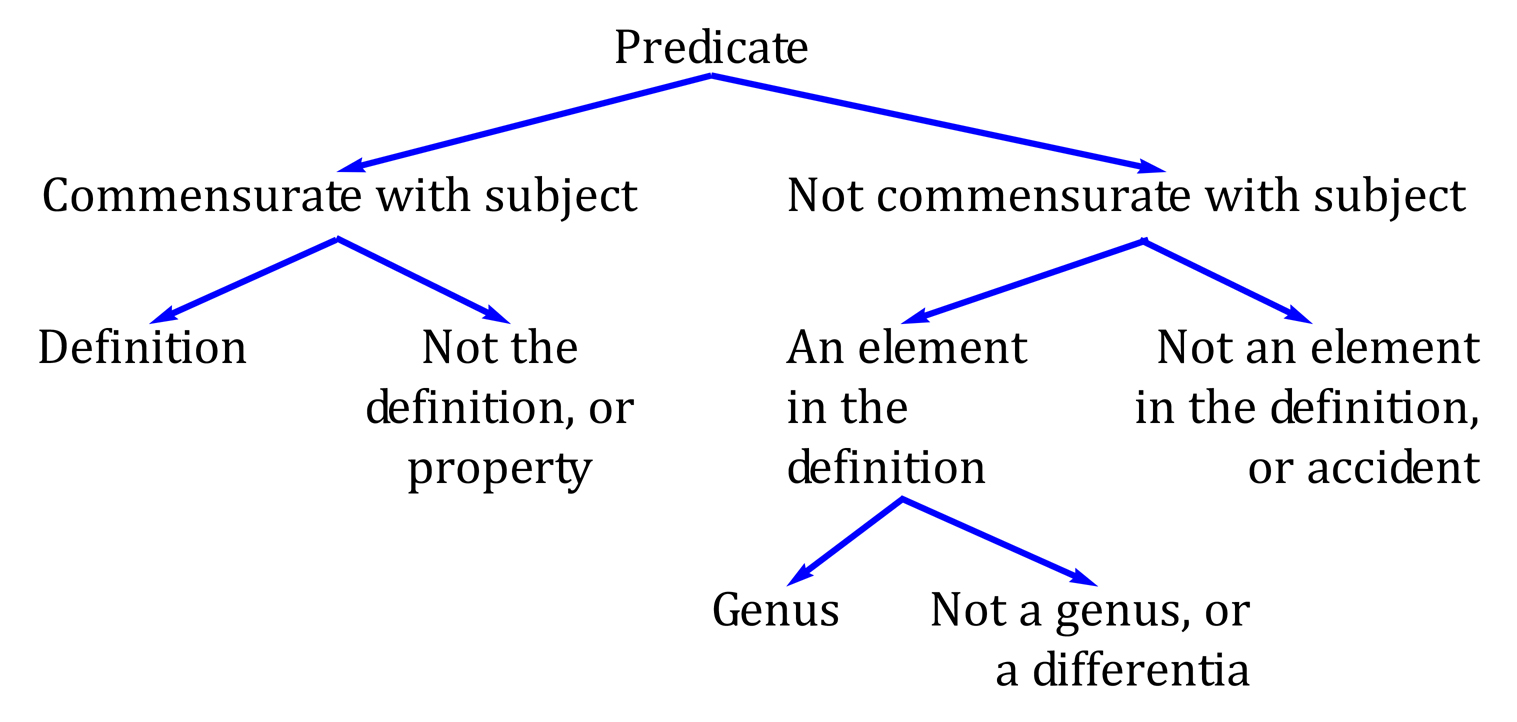
Nevertheless, although dichotomy insures
exhaustiveness and exclusiveness of the species, it is not much of an
advance over ordinary division. The practical difficulty of finding
significant principles of division still remains. And in dichotomous
division we cannot be sure that all the subclasses have members. Moreover,
the method is somewhat clumsy, and modern symbolic logic has shown how
dichotomous division can be effected in an almost mechanical manner. Thus
suppose we wish to classify the population of the United States on the bases
of sex, of being over thirty years of age, and of being in good or
exceptional health. Let 1 represent, as usual, the universe of discourse; a
those of male sex, a´ those of female sex; b those over thirty, b´ those
thirty or under thirty; c those in good or exceptional health, c´ those in
poor health. Then the population of the United States is divided into eight
groups as follows:
1 = (a +a´) = (a +a´)
(b + b´) = (a +a´) (b + b´) (c
+ c´)
= abc +abc´ +
ab´c + ab´c´ + a´bc + a´bc´ + a´b´c
+ a´b´c´
The symbol abc will then represent
the males over thirty and in good health; a´bc´ will represent the
females over thirty who are in poor health, and so on.
Morris R. Cohen; Ernest
Nagel; An Introduction to Logic and Scientific Method; 1939; ch12
Summary of Chapter 3
Introduction to Logic
To explain the meaning of a term is to give
the definition of it. In this chapter we have discussed the several
kinds of definitions and their uses,
and techniques for constructing
definitions, with
rules for applying these techniques.
In section 3.1, we have explained three kinds of disputes:
[See graphic above.]
1. Obviously genuine disputes,
in which there is no ambiguity present and the disputers do disagree,
either in attitude or in belief.
2. Merely verbal disputes,
in which there is ambiguity present but there is no genuine disagreement
at all.
3.
Apparently verbal disputes that are
really genuine, in which there is ambiguity present and the
disputers disagree, either in attitude or in belief.
In section 3.2, we first explained that
definitions are always of symbols,
and we introduced the terms
definiendum (the symbol that is
defined) and definiens
(the symbols used to explain the meaning of the definiendum.)
We also distinguished among five kinds of definition and their principal
uses:
1.
Stipulative definitions, in which a
meaning is assigned to some symbol. A stipulative definition is not a
report and cannot be true or false; it is a proposal, resolution,
request, or instruction to use the definiendum to mean what is
meant by the definiens.
2. Lexical definitions,
which report the meaning that the definiendum already has and
which therefore can be correct or incorrect.
3. Precising definitions,
which go beyond ordinary usage in such a way as to eliminate troublesome
uncertainty regarding borderline cases. Its definiendum has an
existing meaning, but that meaning is vague; what is added to achieve
precision is partly a matter of stipulation.
4. Theoretical definitions,
which seek to formulate a theoretically adequate or scientifically
useful description of the objects to which the term applies.
5. Persuasive definitions,
which seek to influence attitudes or stir the emotions, using language
expressively rather than informatively.
Of these five kinds of definition the
first two (stipulative and lexical) are used chiefly to eliminate
ambiguity; the third (precising) is used chiefly to reduce vagueness;
the fourth (theoretical) is used to advance theoretical understanding;
and the fifth (persuasive) is used to influence conduct.
In section 3.3, we explained that a
general term denotes the several objects to which that term may
be correctly applied. The collection of these objects constitutes the
extension
of the term. We explained that the set of attributes shared by all and
only the objects within a term’s extension is the intension
of the term. The extension of a term is determined by its intension, but
the intension is not determined by the extension; so terms may have
different intensions and yet the same extension; but terms with
different extensions cannot possibly have the same intension.
In section 3.4, we explained how, using
the extension
of a general term, we may construct
extensional definitions, of which
there are several varieties, whose limitations also are noted:
1.
Definitions by example, in which we
list or give examples of the objects denoted by the term.
2. Ostensive definitions,
in which we point or indicate by gesture the extension of the term being
defined.
3.
Quasi-ostensive definitions, in which
the gesture or pointing is accompanied by some descriptive phrase whose
meaning is taken as being known.
In section 3.5, we explained how, using
the intension
of a general term, we can construct
intensional definitions, of which
there are also several varieties, whose limitations are also noted:
1.
Synonymous definitions, in which we
provide another word, whose meaning is already understood, that has the
same meaning as the word being defined.
2. Operational definitions,
which state that the term is correctly applied to a given case if and
only if the performance of specified operations in that case yields a
specified result.
3. Definition by genus and difference,
in which we first name the genus of which the species designated by the
definiendum is a subclass, and then name the attribute (or
specific difference) that distinguishes the members of that species from
members of all other species in that genus.
The techniques of intensional definition
may be used in constructing definitions of any one of the five kinds
identified in section 3.2: stipulative, lexical, precising, theoretical,
or persuasive.
In section 3.6, we formulated and explained five rules
traditionally laid down for definitions by genus and difference:
1. A definition should state the essential attributes of the species.
2. A definition must not be circular.
3. A definition must be neither too broad nor too narrow.
4. A definition must not be expressed in ambiguous, obscure, or figurative language.
5. A definition should not be negative where it can be affirmative.
Irving M. Copi; Carl Cohen; Introduction to Logic;
2002; p134
* * * * * * * *
* * * * * * * *
* * * * * * * *
* * * * * *
GLOSSARY
Causal
- Defines a
word by stating how instances to which it is applicable are produced
(e.g. a sphere is a solid generated by rotating a circular disc
around its diameter). The use of the term “causal definition” is
sometimes objectionable since it is hard to distinguish such alleged
definitions from causal statements.
Deductive argument
-
Argument whose conclusion follows necessarily from the premises; that is, it would be self-contradictory to affirm the premises and to deny the conclusion.
Deductive logic
- Science aiming at explicit formulation of the
conditions under which arguments of various deductive forms are
valid. Subsidiary to this aim there are such investigations as the
classification of propositions on the basis of their logical form,
the analysis of logical concepts such as implication, contradiction,
etc.
Definiendum-
Expression to be defined.
Definiens- Expression used to
define.
Definition- Explanation of the meaning of a linguistic expression, i.e. word,
phrase (series of words that has meaning but is no sentence— e.g.
descriptions), or sentence.
Degree of a predicate- A predicate has the degree one if it
designates a property; if it designates a relation its degree is
equal to the number of terms between which the relation holds; thus
“between” is a predicate of the third degree.
Denotation-
A
word is said to denote the entities to which it is applicable by
virtue of its connotation. A word may have a connotation without
having a denotation, viz. if the connotation is a property which
nothing has; on the other hand, there are words which have a
denotation but no connotation (“this,” “here,” etc.). Again, one and
the same entity may be denoted by one word and connoted by another
word, e.g. the property blueness is connoted by “blue” and denoted
by “color.”
Explicit- Definition
of the form “A = B and C” or “A = B or C,” where A is the defined
concept and B and C are properties which anything to which “A” is
applicable must jointly or alternately have. The defined term stands
by itself to the left of the equality sign, and is, by the
definition, declared substitutable for the definiens, no matter in
what context it appears.
Genetic- Causal definition.
Implicit- (postulational)- A set of postulates containing several
explicitly undefined predicates is said to define the latter
implicitly in the sense of delimiting the number of interpretations
for the predicates which satisfy the postulates. Once, however, an
interpretation for one primitive term has been fixed, the
interpretation for the other primitives is likewise fixed by the
conditions of significant substitution.
In use- (contextual)
-Defines a word or phrase by showing how sentences containing it may
be translated into synonymous sentences that do not contain the
defined expression.
Logical- p and q are logically dependent if
either p entails q, or q entails p, or p contradicts q. In a
derivative sense, one also speaks of logical dependence as a
relation between properties.
Nominal- A definition whose sole purpose
is abbreviation, by introducing a simpler term as a synonym for a
complex term already in use.
Ostensive- Explanation of the
meaning of a word by exhibiting an example of the kind to which it
is applicable; also called “denotative.”
Real- In
non-metaphysical uses synonymous with “explication” (Carnap) or
“analysis” (Moore): analysis of the meaning of an expression already
in use, involving the discovery of a necessary and sufficient
condition for the applicability of an expression or the truth of
sentences of a certain form (the latter case corresponds to
definitions in use).
Recursive- Indicates how the definiendum
may be eliminated from expressions that contain it in a finite
number of steps. There are two lines which jointly constitute the
recursive definition: the first line indicates how complex
expressions containing the definiendum are reducible to simpler
expressions that still contain it; the second line shows how it may
be eliminated from the simplest expressions. In exceptional cases,
there are more than two lines.
Verbal- Non-ostensive
definition. The meaning of the words making up the definiens,
however, must already be understood, otherwise we know only that two
expressions are synonymous without knowing the meaning of either.
Arthur Pap;
Elements of Analytic
Philosophy; 1949; pp485-487
* * * * * * * *
* * * * * * * *
* * * * * * * *
* * * * * *
Definition
From Wikipedia, the free encyclopedia
A
definition
states
the meaning of a word using other words. This is sometimes challenging.
Common dictionaries contain lexical descriptive definitions but there
are various types of definition - all with different purposes and
focuses.
A
definition
is
a statement of the meaning of a term (a word, phrase, or other set of
symbols).[1] Definitions
can be classified into two large categories, intensional
definitions
(which try to give the essence of a
term) and extensional
definitions (which proceed by listing the objects
that a term describes).[2]Another
important category of definitions is the class of ostensive
definitions, which convey the meaning of a term by
pointing out examples. A term may have many different senses and
multiple meanings, and thus require multiple definitions.[3][a]
In mathematics, a definition is used to give a precise meaning to a new
term, instead of describing a pre-existing term. Definitions and axioms
are the basis on which all of modern mathematics is constructed.[4]
Contents
• 1 Basic terminology
• 2 Intensional definitions vs. extensional definitions
o 2.1 Classes
of intensional definitions
o 2.2 Classes of extensional definitions
o 2.3 Divisio and partitio
o 2.4 Nominal definitions vs. real
definitions
• 3 Terms with multiple definitions
o 3.1 Homonyms
o 3.2 Polysemes
• 4 In logic and mathematics
o 4.1 Classification of mathematical
definitions
o 4.2 Recursive definitions
• 5 In medicine
• 6 Issues with definitions
o 6.1 Fallacies of definition
o
6.2 Limitations of definition
•
7 Notes
•
8 References
1- Basic terminology
In modern usage, a definition
is
something, typically expressed in words, that attaches a meaning to a
word or group of words. The word or group of words that is to be defined
is called the definiendum, and the word, group of
words, or action that defines it is called the definiens.
In the definition “An elephant is a large gray animal native to Asia and
Africa”, the word “elephant” is the definiendum, and
everything after the word “is” is the definiens.[5]
Note that the definiens
is not the
meaning of the word defined, but is instead something that conveys the
same meaning as that word.[5]
There are many sub-types of definitions, often specific to a given field
of knowledge or study. These include, among many others,
lexical
definitions, or the common dictionary definitions of words
already in a language;
demonstrative
definitions, which define something by pointing to
an example of it (“This,” [said while pointing to a large grey animal],
“is an Asian elephant.”); and
precising
definitions, which reduce the vagueness of a word,
typically in some special sense (“‘Large’, among female Asian elephants,
is any individual weighing over 5,500 pounds.”).[5]
2- Intensional definitions vs.
extensional definitions
An
intensional
definition, also called a connotative definition, specifies the
necessary
and sufficient conditions for a thing being a member
of a specific set.[2] Any
definition that attempts to set out the essence of something, such as
that by
genus and
differentia, is an intensional definition.
An
extensional
definition, also called a denotative definition, of a concept or
term specifies its
extension.
It is a list naming every object that is a member of a specific set.[2]
Thus, the “seven deadly sins” can be defined intensionally as those
singled out by Pope Gregory I as particularly destructive of the life of
grace and charity within a person, thus creating the threat of eternal
damnation. An extensional definition would be the list of wrath, greed,
sloth, pride, lust, envy, and gluttony. In contrast, while an
intensional definition of “Prime Minister” might be “the most senior
minister of a cabinet in the executive branch of government in a
parliamentary system”, an extensional definition is not possible since
it is not known who future prime ministers will be.
2.1- Classes of intensional
definitions
A genus–differentia definition is a type of
intensional definition that takes a large category (the genus) and
narrows it down to a smaller category by a distinguishing characteristic
(i.e. the differentia).[6]
More formally, a genus-differentia definition consists of:
1.
a genus
(or family): An existing definition that serves as a portion of the new
definition; all definitions with the same genus are considered members
of that genus.
2.
the differentia: The portion of the new definition
that is not provided by the genus.
For example, consider the
following genus-differentia definitions:
• a triangle: A plane figure
that has three straight bounding sides.
• a quadrilateral: A plane
figure that has four straight bounding sides.
Those definitions can
be expressed as a genus (“a plane figure”) and two differentiae (“that
has three straight bounding sides” and “that has four straight bounding
sides”, respectively).
It is possible to have two different
genus-differentia definitions that describe the same term, especially
when the term describes the overlap of two large categories. For
instance, both of these genus-differentia definitions of “square” are
equally acceptable:
• a square: a rectangle that is a rhombus.
• a
square: a rhombus that is a rectangle.
Thus, a “square” is a member
of both the genus “rectangle” and the genus “rhombus.”.
2.2- Classes of extensional
definitions
One important form of the extensional definition
is ostensive definition. This gives the meaning of a term by pointing,
in the case of an individual, to the thing itself, or in the case of a
class, to examples of the right kind. So one can explain who Alice (an
individual) is by pointing her out to another; or what a rabbit (a
class) is by pointing at several and expecting another to understand.
The process of ostensive definition itself was critically appraised by
Ludwig Wittgenstein.[7]
An enumerative definition of a concept or term is an extensional
definition that gives an explicit and exhaustive listing of all the
objects that fall under the concept or term in question. Enumerative
definitions are only possible for finite sets and only practical for
relatively small sets.
2.3 - Divisio
and partitio
Divisio and partitio are classical terms for
definitions. A partitio is simply an intensional definition. A divisio
is not an extensional definition, but an exhaustive list of subsets of a
set, in the sense that every member of the “divided” set is a member of
one of the subsets. An extreme form of divisio lists all sets whose only
member is a member of the “divided” set. The difference between this and
an extensional definition is that extensional definitions list members,
and not subsets.[8]
2.4- Nominal definitions vs. real
definitions
In classical thought, a definition was taken to be
a statement of the essence of a thing. Aristotle had it that an object’s
essential attributes form its “essential nature”, and that a definition
of the object must include these essential attributes.[9]
The idea that a definition should state the essence of a thing led to
the distinction between nominal
and real
essence,
originating with Aristotle. In a passage from
the Posterior Analytics,[10] he
says that the meaning of a made-up name can be known (he gives the
example “goat stag”), without knowing what he calls the “essential
nature” of the thing that the name would denote, if there were such a
thing. This led medieval logicians to distinguish between what they
called the quid nominis
or
“whatness of the name”, and the underlying nature common to all the
things it names, which they called the quid rei
or
“whatness of the thing.” (Early modern philosophers like Locke used the
corresponding English terms “nominal essence” and “real essence”). The
name “hobbit”, for example, is perfectly meaningful. It has a
quid
nominis. But one could not know the real nature of hobbits, even if
there were such things, and so the real nature or
quid rei
of hobbits
cannot be known. By contrast, the name “man” denotes real things (men)
that have a certain quid rei. The meaning of a name is distinct from the
nature that thing must have in order that the name apply to it.
This
leads to a corresponding distinction between nominal and real
definitions. A nominal definition is the definition explaining what a
word means, i.e. which says what the “nominal essence” is, and is
definition in the classical sense as given above. A real definition, by
contrast, is one expressing the real nature or
quid rei of the thing.
This preoccupation with essence dissipated in much of modern philosophy.
Analytic philosophy in particular is critical of attempts to elucidate
the essence of a thing. Russell described essence as “a hopelessly
muddle-headed notion.”[11]
More recently Kripke’s formalization of possible world semantics in
modal logic led to a new approach to essentialism. Insofar as the
essential properties of a thing are necessary to it, they are those
things it possesses in all possible worlds. Kripke refers to names used
in this way as rigid designators.
3- Terms with multiple definitions
3.1- Homonyms
A homonym is,
in the strict sense, one of a group of words that share the same
spelling and pronunciation but have different meanings.[12] Thus homonyms are simultaneously homographs (words that share the same
spelling, regardless of their pronunciation) and homophones (words that
share the same pronunciation, regardless of their spelling). The state
of being a homonym is called homonymy. Examples of homonyms are the pair
stalk (part of a plant) and stalk (follow/harass a person) and the pair
left (past tense of leave) and left (opposite of right). A distinction
is sometimes made between “true” homonyms, which are unrelated in
origin, such as skate (glide on ice) and skate (the fish), and
polysemous homonyms, or polysemes, which have a shared origin, such as
mouth (of a river) and mouth (of an animal).[13][14]
3.2- Polysemes
Polysemy is
the capacity for a sign (such as a word, phrase, or symbol) to have
multiple meanings (that is, multiple semes or sememes and thus multiple
senses), usually related by contiguity of meaning within a semantic
field. It is thus usually regarded as distinct from homonymy, in which
the multiple meanings of a word may be unconnected or unrelated.
4- In
logic
and mathematics
In mathematics, definitions are generally not
used to describe existing terms, but to give meaning to a new term.[15] The
meaning of a mathematical statement changes if definitions change. The
precise meaning of a term given by a mathematical definition is often
different than the English definition of the word used,[16] which
can lead to confusion for students who do not pay close attention to the
definitions given.
4.1-
Classification of mathematical definitions
Authors have used
different terms to classify definitions used in formal languages like
mathematics. Norman Swartz classifies a definition as
“stipulative” if
it is intended to guide a specific discussion. A stipulative definition
might be considered a temporary, working definition, and can only be
disproved by showing a logical contradiction.[17] In
contrast, a “descriptive” definition can be shown to be
“right” or
“wrong” with reference to general usage.
Swartz defines a precising
definition as one that extends the descriptive dictionary definition
(lexical definition) for a specific purpose by including additional
criteria. A precising definition narrows the set of things that meet the
definition.
C. L.. Stevenson has identified persuasive definition as a
form of stipulative definition which purports to state the
“true” or
“commonly accepted” meaning of a term, while in reality stipulating an
altered use (perhaps as an argument for some specific belief). Stevenson
has also noted that some definitions are “legal” or
“coercive” – their
object is to create or alter rights, duties, or crimes.[18]
4.2- Recursive definitions
A recursive definition, sometimes also called an inductive definition,
is one that defines a word in terms of itself, so to speak, albeit in a
useful way.
Normally this consists of three steps:
1.
At least one
thing is stated to be a member of the set being defined; this is
sometimes called a “base set.”
2.
All things bearing a certain
relation to other members of the set are also to count as members of the
set. It is this step that makes the definition recursive.
3.
All
other things are excluded from the set
For instance, we could define
a natural number as follows (after Peano):
1. “0” is a natural number.
2.
Each natural number has a unique successor, such that:
• the successor of a natural number is also a natural number;
• distinct natural numbers have distinct successors;
• no natural number is succeeded by “0.”
3. Nothing else is a natural number.
So
“0”
will have exactly one successor, which for convenience can be
called
“1.” In turn,
“1” will have exactly one successor, which could be
called
“2”, and so on. Notice that the second condition in the
definition itself refers to natural numbers, and hence involves
self-reference. Although this sort of definition involves a form of
circularity, it is not vicious, and the definition has been quite
successful.
In the same way, we can define ancestor as follows:
1. A parent is an ancestor.
2. A parent of an ancestor is an ancestor.
3. Nothing else is an ancestor.
Or simply: an ancestor is a parent or a parent of an ancestor.
5- In
medicine
In medical dictionaries, definitions should to the greatest extent
possible be:
• simple and easy to understand,[19] preferably
even by the general public;[20]
• useful clinically[20] or
in related areas where the definition will be used;[19]
• specific,[19] that
is, by reading the definition only, it should ideally not be possible to
refer to any other entity than the definiendum;
• measurable;[19]
• reflecting current scientific knowledge.[19][20]
6- Issues with definitions
6.1- Fallacies of definition
Certain rules have traditionally been given for definitions (in
particular, genus-differentia definitions). [21][22][23][24]
1. A definition must set out the essential attributes of the thing
defined.
2. Definitions should avoid circularity. To define a horse
as “a member of the species equus” would convey no information
whatsoever. For this reason, Locking adds that a definition of
a term must not consist of terms which are synonymous with it. This
would be a circular definition, a circulus in definiendo. Note, however,
that it is acceptable to define two relative terms in respect of each
other. Clearly, we cannot define “antecedent
” without using the term
“consequent”, nor conversely.
3. The definition must not be too wide
or too narrow. It must be applicable to everything to which the defined
term applies (i.e. not miss anything out), and to nothing else (i.e. not
include any things to which the defined term would not truly apply).
4. The definition must not be obscure. The purpose of a definition is to
explain the meaning of a term which may be obscure or difficult, by the
use of terms that are commonly understood and whose meaning is clear.
The violation of this rule is known by the Latin term
obscurum per
obscurius. However, sometimes scientific and philosophical terms are
difficult to define without obscurity.
5. A definition should not be
negative where it can be positive. We should not define
“wisdom” as the
absence of folly, or a healthy thing as whatever is not sick. Sometimes
this is unavoidable, however. For example, it appears difficult to
define blindness in positive terms rather than as
“the absence of sight
in a creature that is normally sighted.”
6.2- Limitations of definition
Given that a natural language such as English contains, at any given
time, a finite number of words, any comprehensive list of definitions
must either be circular or rely upon primitive notions. If every term of
every definiens must itself be defined, “where
at last should we stop?” [25][26] A
dictionary, for instance, insofar as it is a comprehensive list of
lexical definitions, must resort to circularity.[27][28][29]
Many philosophers have chosen instead to leave some terms undefined. The
scholastic philosophers claimed that the highest genera (the so-called
ten generalissima) cannot be defined, since a higher genus cannot be
assigned under which they may fall. Thus
being,
unity
and similar concepts cannot be defined.[22] Locke supposes in
An Essay Concerning Human Understanding[30] that the names of
simple concepts do not admit of any definition. More recently Bertrand
Russell sought to develop a formal language based on logical atoms.
Other philosophers, notably Wittgenstein, rejected the need for any
undefined simples. Wittgenstein pointed out in his Philosophical
Investigations that what counts as a “simple” in one circumstance might
not do so in another.[31] He rejected the very idea that every
explanation of the meaning of a term needed itself to be explained: “As
though an explanation hung in the air unless supported by another
one”,[32] claiming instead that explanation of a term is only needed to
avoid misunderstanding.
Locke and Mill also argued that individuals cannot
be defined. Names are learned by connecting an idea with a sound, so
that speaker and hearer have the same idea when the same word is used.[33] This
is not possible when no one else is acquainted with the particular thing
that has “fallen under our notice.”[34] Russell
offered his theory of descriptions in part as a way of defining a proper
name, the definition being given by a definite description that
“picks
out” exactly one individual. Saul Kripke pointed to difficulties with
this approach, especially in relation to modality, in his book Naming
and Necessity.
There is a presumption in the classic example of a
definition that the definiens can be stated. Wittgenstein argued that
for some terms this is not the case.[35] The
examples he used include game, number and family. In such cases, he
argued, there is no fixed boundary that can be used to provide a
definition. Rather, the items are grouped together because of a family
resemblance. For terms such as these it is not possible and indeed not
necessary to state a definition; rather, one simply comes to understand
the use of the term.[b]
7- Notes
1. Terms with the same pronunciation and spelling but unrelated meanings
are called homonyms, while terms with the same spelling and
pronunciation and related meanings are called polysemes.
2. Note that
one learns inductively, from ostensive definition, in the same way, as
in the Ramsey–Lewis method.
8- References
1. Bickenbach, Jerome E., and Jacqueline M. Davies. Good reasons for
better arguments: An introduction to the skills and values of critical
thinking. Broadview Press, 1996. p. 49
2. Lyons, John. “Semantics,
vol. I.” Cambridge: Cambridge (1977). p.158 and on.
3. Dooly,
Melinda. Semantics and Pragmatics of English: Teaching English as a
Foreign Language. Univ. Autònoma de Barcelona, 2006. p.48 and on
4.
Richard J. Rossi (2011) Theorems, Corollaries, Lemmas, and Methods of
Proof. John Wiley & Sons p.4
5. Hurley, Patrick J. (2006). Language:
Meaning and Definition. A Concise Introduction to Logic (9 ed.).
Wadsworth. pp. 86–91.
6. Bussler, Christoph, and Dieter Fensel, eds.
Artificial Intelligence: Methodology, Systems and Applications: 11th
International Conference, AIMSA 2004: Proceedings. Springer-Verlag,
2004. p.6
7. Philosophical investigations, Part 1 §27–34
8.
Katerina Ierodiakonou, “The Stoic Division of Philosophy”, in Phronesis:
A Journal for Ancient Philosophy, Volume 38, Number 1, 1993, pp. 57–74.
9. Posterior Analytics, Bk 1 c. 4
10. Posterior Analytics Bk 2 c. 7
11. A history of Western Philosophy, p. 210
12. homonym, Random House
Unabridged Dictionary at dictionary.com
13. Linguistics 201: Study
Sheet for Semantics. Pandora.cii.wwu.edu. Retrieved 2013-04-23.
14.
Semantics: a coursebook, p. 123, James R. Hurford and Brendan Heasley,
Cambridge University Press, 1983
15. David Hunter (2010) Essentials
of Discrete Mathematics. Jones & Bartlett Publishers, Section 14.1
16. Kevin Houston (2009) How to Think Like a Mathematician: A Companion
to Undergraduate Mathematics. Cambridge University Press, p. 104
17.
Norman Swartz - Biography. sfu.ca.
18. Stevenson, C.L., Ethics and
Language, Connecticut 1944
19. McPherson, M.; Arango, P.; Fox, H.;
Lauver, C.; McManus, M.; Newacheck, P. W.; Perrin, J. M.; Shonkoff, J.
P.; Strickland, B. (1998). A new definition of children with special
health care needs. Pediatrics. 102 (1 Pt 1): 137–140.
doi:10.1542/peds.102.1.137. PMID 9714637.
20. Morse, R. M.; Flavin,
D. K. (1992). The Definition of Alcoholism. JAMA. 268 (8): 1012–1014.
doi:10.1001/jama.1992.03490080086030. PMID 1501306.
21. Copi 1982 pp
165–169
22. Joyce, Ch. X
23. Joseph, Ch. V
24. Macagno & Walton
2014, Ch. III
25. Locke, Essay, Bk. III, Ch. iv, 5
26. This
problem parallels the diallelus, but leads to scepticism about meaning
rather than knowledge.
27. Generally lexicographers seek to avoid
circularity wherever possible, but the definitions of words such as
“the” and “a” use those words and are therefore circular. [1] [2]
Lexicographer Sidney I. Landau’s essay “Sexual Intercourse in American
College Dictionaries” provides other examples of circularity in
dictionary definitions. (McKean, p. 73–77)
28. An exercise suggested
by J. L. Austin involved taking up a dictionary and finding a selection
of terms relating to the key concept, then looking up each of the words
in the explanation of their meaning. Then, iterating this process until
the list of words begins to repeat, closing in a “family circle” of
words relating to the key concept.
(A plea for excuses in
Philosophical Papers. Ed. J. O. Urmson and G. J. Warnock. Oxford: Oxford
UP, 1961. 1979.)
29. In the game of Vish, players compete to find
circularity in a dictionary.
30. Locke, Essay, Bk. III, Ch. iv
31.
See especially Philosophical Investigations Part 1 §48
32. He
continues: “Whereas an explanation may indeed rest on another one that
has been given, but none stands in need of another – unless we require
it to prevent a misunderstanding. One might say: an explanation serves
to remove or to avert a misunderstanding – one, that is, that would
occur but for the explanation; not every one I can imagine.”
Philosophical Investigations, Part 1 §87, italics in original
33.
This theory of meaning is one of the targets of the private language
argument
34. Locke, Essay, Bk. III, Ch. iii, 3
35. Philosophical
Investigations
• Copi, Irving (1982). Introduction to Logic. New
York: Macmillan. ISBN 0-02-977520-5.
• Joseph, Horace William
Brindley (1916). An Introduction to Logic, 2nd edition. Clarendon Press
repr. Paper Tiger. ISBN 1-889439-17-7. (full text of 1st ed. (1906))
• Joyce, George Hayward (1926). Principles of logic, 3d ed., new
impression. London, New York: Longmans, Green and co. (worldcat) (full
text of 2nd ed. (1916))
• Locke, John (1690). An Essay Concerning
Human Understanding. ISBN 0-14-043482-8. (full text: vol 1, vol 2)
•
McKean, Erin (2001). Verbatim: From the bawdy to the sublime, the best
writing on language for word lovers, grammar mavens, and armchair
linguists. Harvest Books. ISBN 0-15-601209-X.
• Macagno, Fabrizio;
Walton, Douglas (2014). Emotive Language in Argumentation. New York:
Cambridge University Press.
• Robinson, Richard (1954). Definition.
Oxford: At The Clarendon Press. ISBN 978-0-19-824160-7.
• Simpson,
John; Edmund Weiner (1989). Oxford English Dictionary, second edition
(20 volumes). Oxford University Press. ISBN 0-19-861186-2.
•
Wittgenstein, Ludwig (1953). Philosophical Investigations, Blackwell
Publishing. ISBN 0-631-23127-7.
Definitions
First published Thu Apr 10, 2008; substantive revision Mon Apr 20, 2015
Definitions have interested philosophers since ancient times. Plato’s early dialogues portray Socrates raising questions about definitions
(e.g., in the Euthyphro, “What is piety?”)— questions that seem at once
profound and elusive. The key step in Anselm’s “Ontological Proof” for
the existence of God is the definition of “God,” and the same holds of
Descartes’s version of the argument in his Meditation V. More recently,
the Frege-Russell definition of number and Tarski’s definition of truth
have exercised a formative influence on a wide range of contemporary
philosophical debates. In all these cases— and many others can be cited—
not only have particular definitions been debated; the nature of, and
demands on, definitions have also been debated. Some of these debates
can be settled by making requisite distinctions, for definitions are not
all of one kind: definitions serve a variety of functions, and their
general character varies with function. Some other debates, however, are
not so easily settled, as they involve contentious philosophical ideas
such as essence, concept, and meaning.
• 1. Some varieties of
definition o 1.1 Real and nominal definitions o 1.2 Dictionary
definitions o 1.3 Stipulative definitions o 1.4 Descriptive
definitions o 1.5 Explicative definitions o 1.6 Ostensive
definitions o 1.7 A remark • 2. The logic of definitions o
2.1 Two criteria o 2.2 Foundations of the traditional account o
2.3 Conservativeness and eliminability o 2.4 Definitions in normal
form o 2.5 Implicit definitions o 2.6 Vicious-Circle Principle o 2.7 Circular definitions • Bibliography • Acknowledgements
1. Some varieties of definition
Ordinary discourse recognizes several
different kinds of things as possible objects of definition, and it
recognizes several kinds of activity as defining a thing. To give a few
examples, we speak of a commission as defining the boundary between two
nations; of the Supreme Court as defining, through its rulings, “person”
and “citizen”; of a chemist as discovering the definition of gold, and
the lexicographer, that of ‘cool’; of a participant in a debate as
defining the point at issue; and of a mathematician as laying down the
definition of “group.” Different kinds of things are objects of
definition here: boundary, legal status, substance, word, thesis, and
abstract kind. Moreover, the different definitions do not all have the
same goal: the boundary commission may aim to achieve precision; the
Supreme Court, fairness; the chemist and the lexicographer, accuracy;
the debater, clarity; and the mathematician, fecundity. The standards by
which definitions are judged are thus liable to vary from case to case.
The different definitions can perhaps be subsumed under the Aristotelian
formula that a definition gives the essence of a thing. But this only
highlights the fact that “to give the essence of a thing” is not a
unitary kind of activity.
In philosophy, too, several different kinds
of definitions are often in play, and definitions can serve a variety of
different functions (e.g., to enhance precision and clarity). But, in
philosophy, definitions have also been called in to serve a highly
distinctive role: that of solving epistemological problems. For example,
the epistemological status of mathematical truths raises a problem.
Immanuel Kant thought that these truths are synthetic a priori, and to
account for their status, he offered a theory of space and time— namely,
of space and time as forms of, respectively, outer and inner sense.
Gottlob Frege and Bertrand Russell sought to undermine Kant’s theory by
arguing that arithmetical truths are analytic. More precisely, they
attempted to construct a derivation of arithmetical principles from
definitions of arithmetical concepts, using only logical laws. For the
Frege-Russell project to succeed, the definitions used must have a
special character. They must be conceptual or explicative of meaning;
they cannot be synthetic. It is this kind of definition that has
aroused, over the past century or so, the most interest and the most
controversy. And it is this kind of definition that will be our primary
concern. Let us begin by marking some preliminary but important
distinctions.
1.1 Real and nominal definitions
John Locke distinguished, in his
Essay, “real essence” from “nominal essence.” Nominal essence, according
to Locke, is the “abstract Idea to which the Name is annexed
(III.vi.2).” Thus, the nominal essence of the name ‘gold’, Locke said,
“is that complex Idea the word Gold stands for, let it be, for instance,
a Body yellow, of a certain weight, malleable, fusible, and fixed.” In
contrast, the real essence of gold is “the constitution of the
insensible parts of that Body, on which those Qualities [mentioned in
the nominal essence] and all other Properties of Gold depend
(III.vi.2).” A rough way of marking the distinction between real and
nominal definitions is to say, following Locke, that the former states
real essence, while the latter states nominal essence. The chemist aims
at real definition, whereas the lexicographer aims at nominal
definition.
This characterization of the distinction is rough because
a zoologist’s definition of “tiger” should count as a real definition,
even though it may fail to provide “the constitution of the insensible
parts” of the tiger. Moreover, an account of the meaning of a word
should count as a nominal definition, even though it may not take the
Lockean form of setting out “the abstract idea to which the name is
annexed.” Perhaps it is helpful to indicate the distinction between real
and nominal definitions thus: to discover the real definition of a term
XX one needs to investigate the thing or things denoted by XX; to
discover the nominal definition, one needs to investigate the meaning
and use of XX. Whether the search for an answer to the Socratic question
“What is virtue?” is a search for real definition or one for nominal
definition depends upon one’s conception of this particular
philosophical activity. When we pursue the Socratic question, are we
trying to gain a clearer view of our uses of the word ‘virtue’, or are
we trying to give an account of an ideal that is to some extent
independent of these uses? Under the former conception, we are aiming at
a nominal definition; under the latter, at a real definition.
For a
critical discussion of the different activities that have been subsumed
under “real definition,” see Robinson 1950. For ancient views about
definitions, see the essays in Charles 2010.
1.2 Dictionary definitions
Nominal definitions— definitions that
explain the meaning of a term— are not all of one kind. A dictionary
explains the meaning of a term, in one sense of this phrase.
Dictionaries aim to provide definitions that contain sufficient
information to impart an understanding of the term. It is a fact about
us language users that we somehow come to understand and use a potential
infinity of sentences containing a term once we are given a certain
small amount of information about the term. Exactly how this happens is
a large mystery. But it does happen, and dictionaries exploit the fact.
Note that dictionary entries are not unique. Different dictionaries can
give different bits of information and yet be equally effective in
explaining the meanings of terms.
Definitions sought by philosophers are not of the sort found in a
dictionary. Frege’s definition of number (1884) and Alfred Tarski’s
definition of truth (1983, ch. 8) are not offered as candidates for
dictionary entries. When an epistemologist seeks a definition of
“knowledge,” she is not seeking a good dictionary entry for the word ‘know’.
The philosophical quest for definition can sometimes fruitfully be
characterized as a search for an explanation of meaning. But the sense of
‘explanation of meaning’ here is very different from the sense
in which a dictionary explains the meaning of a word.
1.3 Stipulative definitions
A stipulative definition imparts a
meaning to the defined term, and involves no commitment that the
assigned meaning agrees with prior uses (if any) of the term.
Stipulative definitions are epistemologically special. They yield
judgments with epistemological characteristics that are puzzling
elsewhere. If one stipulatively defines a “raimex” as, say, a rational,
imaginative, experiencing being then the judgment “raimexes are
rational” is assured of being necessary, certain, and a priori.
Philosophers have found it tempting to explain the puzzling cases of,
e.g., aprioricity by an appeal to stipulative definitions.
Saul
Kripke (1980) has drawn attention to a special kind of stipulative
definition. We can stipulatively introduce a new name (e.g., ‘Jack the
Ripper’) through a description (e.g., “the man who murdered X,YX,Y, and
ZZ”). In such a stipulation, Kripke pointed out, the description serves
only to fix the reference of the new name; the name is not synonymous
with the description. For, the judgment
• (1) Jack the Ripper is
the man who murdered X,YX,Y, and ZZ, if a unique man committed the
murders is contingent, even though the judgment
Jack the Ripper
is Jack the Ripper, if a unique man committed the murders is
necessary. A name such as ‘Jack the Ripper’, Kripke argued, is rigid:
it picks out the same individual across possible worlds; the
description, on the other hand, is non-rigid. Kripke used such
reference-fixing stipulations to argue for the existence of contingent
a priori truths— (1) being an example. Reference-fixing stipulative
definitions can be given not only for names but also for terms in other
categories, e.g., common nouns.
See Frege 1914 for a defense of the
austere view that, in mathematics at least, only stipulative
definitions should be countenanced.[1]
1.4 Descriptive
definitions
Descriptive definitions, like stipulative ones, spell
out meaning, but they also aim to be adequate to existing usage. When
philosophers offer definitions of, e.g., ‘know’ and ‘free’, they are
not being stipulative: a lack of fit with existing usage is an
objection to them.
It is useful to distinguish three grades of
descriptive adequacy of a definition: extensional, intensional, and
sense. A definition is extensionally adequate iff there are no actual
counterexamples to it; it is intensionally adequate iff there are no
possible counterexamples to it; and it is sense adequate (or analytic)
iff it endows the defined term with the right sense. (The last grade of
adequacy itself subdivides into different notions, for “sense” can be
spelled out in several different ways.) The definition “Water is H2O,”
for example, is intensionally adequate because the identity of water
and H2O is necessary (assuming the Kripke-Putnam view about the
rigidity of natural-kind terms); the definition is therefore
extensionally adequate also. But it is not sense-adequate, for the
sense of ‘water’ is not at all the same as that of ‘H2O’. The
definition ‘George Washington is the first President of the United
States’ is adequate only extensionally but not in the other two grades,
while ‘man is a laughing animal’ fails to be adequate in all three
grades. When definitions are put to an epistemological use, intensional
adequacy is generally insufficient. For such definitions cannot
underwrite the rationality or the aprioricity of a problematic subject
matter.
See Quine 1951 & 1960 for skepticism about analytic
definitions; see also the entry on the analytic/synthetic distinction.
Horty 2007 offers some ways of thinking about senses of defined
expressions, especially within a Fregean semantic theory.
1.5 Explicative definitions
Sometimes a definition is offered neither
descriptively nor stipulatively but as, what Rudolf Carnap (1956, §2)
called, an explication. An explication aims to respect some central uses
of a term but is stipulative on others. The explication may be offered
as an absolute improvement of an existing, imperfect concept. Or, it may
be offered as a “good thing to mean” by the term in a specific context
for a particular purpose. (The quoted phrase is due to Alan Ross
Anderson; see Belnap 1993, 117.)
A simple illustration of explication
is provided by the definition of ordered pair in set theory. Here, the
pair ⟨x,y⟩⟨x,y⟩ is defined as the set {{x},{x,y}}{{x},{x,y}}. Viewed as
an explication, this definition does not purport to capture all aspects
of the antecedent uses of ‘ordered pair’ in mathematics (and in ordinary
life); instead, it aims to capture the essential uses. The essential
fact about our use of ‘ordered pair’ is that it is governed by the
principle that pairs are identical iff their respective components are
identical:
⟨x,y⟩=⟨u,v⟩ iff x=u&y=v.⟨x,y⟩=⟨u,v⟩ iff x=u&y=v.
And it
can be verified that the above definition satisfies the principle. The
definition does have some consequences that do not accord with the
ordinary notion. For example, the definition implies that an object xx
is a member of a member of the pair ⟨x,y⟩⟨x,y⟩, and this implication is
no part of the ordinary notion. But the mismatch is not an objection to
the explication. What is important for explication is not antecedent
meaning but function. So long as the latter is preserved, the former can
be let go. It is this feature of explication that led W. V. O. Quine
(1960, §53) to extol its virtues and to uphold the definition of
“ordered pair” as a philosophical paradigm.
The truth-functional
conditional provides another illustration of explication. This
conditional differs from the ordinary conditional in some essential
respects. Nevertheless, the truth-functional conditional can be put
forward as an explication of the ordinary conditional for certain
purposes in certain contexts. Whether the proposal is adequate depends
crucially on the purposes and contexts in question. That the two
conditionals differ in important, even essential, respects does not
automatically disqualify the proposal.
1.6 Ostensive definitions
Ostensive definitions typically depend on
context and on experience. Suppose the conversational context renders
one dog salient among several that are visible. Then one can introduce
the name ‘Freddie’ through the stipulation “let Freddie be this dog.”
For another example, suppose you are looking at a branch of a bush and
you stipulatively introduce the name ‘Charlie’ thus: “let Charlie be the
insect on that branch.” This definition can pin a referent on ‘Charlie’
even if there are many insects on the branch. If your visual experience
presents you with only one of these insects (say, because the others are
too small to be visible), then that insect is the denotation of your use
of the description ‘the insect on that branch’. We can think of
experience as presenting the subject with a restricted portion of the
world. This portion can serve as a point of evaluation for the
expressions in an ostensive definition.[2] Consequently, the definition
can with the aid of experience pin a referent on the defined term when
without this aid it would fail to do so. In the present example, the
description ‘the insect on that branch’ fails to be denoting when it is
evaluated at the world as a whole, but it is denoting when it is
evaluated at that portion of it that is presented in your visual
experience.
An ostensive definition can bring about an essential
enrichment of a language. The ostensive definition of ‘Charlie’ enriches
the language with a name of a particular insect, and it could well be
that before the enrichment the language lacked resources to denote that
particular insect. Unlike other familiar definitions, ostensive
definitions can introduce terms that are ineliminable. (So, ostensive
definitions can fail to meet the Eliminability criterion explained
below; they can fail to meet also the Conservativeness criterion, also
explained below.)
The capacity of ostensive definitions to introduce
essentially new vocabulary has led some thinkers to view them as the
source of all primitive concepts. Thus, Russell maintains in
Human
Knowledge that all nominal definitions, if pushed back far enough,
must lead ultimately to terms having only ostensive definitions, and in
the case of an empirical science the empirical terms must depend upon
terms of which the ostensive definition is given in perception. (p. 242)
In “Meaning and Ostensive Definition”, C. H. Whiteley takes it as a
premise that ostensive definitions are “the means whereby men learn the
meanings of most, if not all, of those elementary expressions in their
language in terms of which other expressions are defined.” (332) It
should be noted, however, that nothing in the logic and semantics of
ostensive definitions warrants a foundationalist picture of concepts or
of language-learning. Such foundationalist pictures were decisively
criticized by Ludwig Wittgenstein in his Philosophical Investigations.
Wittgenstein’s positive views on ostensive definition remain elusive,
however; for an interpretation, see Hacker 1975.
Ostensive
definitions are important, but our understanding of them remains at a
rudimentary level. They deserve greater attention from logicians and
philosophers.
1.7 A remark
The kinds into which we have sorted definitions are not
mutually exclusive, nor exhaustive. A stipulative definition of a term
may, as it happens, be extensionally adequate to the antecedent uses of
the term. A dictionary may offer ostensive definitions of some words
(e.g., of color words). An ostensive definitions can also be
explicative. For example, one can offer an improvement of a preexisting
concept “one foot” thus: “let one foot be the present length of that
rod.” In its preexisting use, the concept “one foot” may be quite vague;
the ostensively introduced explication may, in contrast, be relatively
precise. Moreover, as we shall see below, there are other kinds of
definition than those considered so far.
2.
The
logic of definitions
Many definitions— stipulative,
descriptive, and explicative— can be analyzed into three elements: the
term that is defined (X)(X), an expression containing the defined term
(…X…)(…X…), and another expression (−−−−−−−)(−−−−−−−) that is equated by
the definition with this expression. Such definitions can be represented
thus:
X:…X…=df−−−−−−−.(2)(2)X:…X…=df−−−−−−−.
(We are setting aside
ostensive definitions, which plainly require a richer representation.)
When the defined term is clear from the context, the representation may
be simplified to
…X…=df−−−−−−−.…X…=df−−−−−−−.
The expression on
the left-hand side of ‘=df=df’ (i.e., …X…)…X…) is the definiendum of the
definition, and the expression on the right-hand side is its
definiens— it being assumed that the definiendum and the definiens belong
to the same logical category. Note the distinction between defined term
and definiendum: the defined term in the present example is XX; the
definiendum is the unspecified expression on the left-hand side of
‘=df=df’, which may or may not be identical to XX. (Some authors call
the defined term ‘the definiendum’; some others use the expression
confusedly, sometimes to refer to the defined term and sometimes to the
definiendum proper.) Not all definitions found in the logical and
philosophical literature fit under scheme (2). Partial definitions, for
example, fall outside the scheme; another example is provided by
definitions of logical constants in terms of introduction and
elimination rules governing them. Nonetheless, definitions that conform
to (2) are the most important, and they will be our primary concern.
Let us focus on stipulative definitions and reflect on their logic. Some
of the important lessons here carry over, as we shall see, to
descriptive and explicative definitions. For simplicity, let us consider
the case where a single definition stipulatively introduces a term.
(Multiple definitions bring notational complexity but raise no new
conceptual issues.) Suppose, then, that a language LL, the ground
language, is expanded through the addition of a new term XX to an
expanded language L+L+, where XX is stipulatively defined by a
definition DD of form (2). What logical rules govern DD? What
requirements must the definition fulfill?
Before we address these
questions, let us take note of a distinction that is not marked in logic
books but which is useful in thinking about definitions. In one kind of
definition— call it homogeneous definition— the defined term and the
definiendum belong to the same logical category. So, a singular term is
defined via a singular term; a general term via a general term; a
sentence via a sentence; and so on. Let us say that a homogenous
definition is regular iff its definiendum is identical to the defined
term. Here are some examples of regular homogeneous definitions:
1:1 man:man The True: The True=df the successor of 0,=df rational
animal,=df
everything is identical to itself.(3)(3) 1:1=df the successor
of 0, man:man=dfrational animal, The True:The True=df everything is
identical to itself.
Note that ‘The True’, as defined above, belongs
to the category of sentence, not that of singular term.
It is
sometimes said that definitions are mere recipes for abbreviations.
Thus, Alfred North Whitehead and Bertrand Russell say of definitions— in
particular, those used in Principia
Mathematica— that they are “strictly
speaking, typographical conveniences (1925, 11).” This viewpoint has
plausibility only for regular homogeneous definitions—though it is not
really tenable even here. (Whitehead and Russell’s own observations make
it plain that their definitions are more than mere “typographical
conveniences.”[3]) The idea that definitions are mere abbreviations is
not at all plausible for the second kind of definition, to which let us
now turn.
In the second kind of definition— call it a
heterogeneous
definition— the defined term and the definiendum belong to different
logical categories. So, for example, a general term (e.g., ‘man’) may be
defined using a sentential definiendum (e.g., ‘xx is a man’). For
another example, a singular term (e.g., ‘1’) may be defined using a
predicate (e.g., ‘is identical to 1’). Heterogeneous definitions are far
more common than homogenous ones. In familiar first-order languages, for
instance, it is pointless to define, say, a one-place predicate GG by a
homogeneous definition. These languages have no resources for forming
compound predicates; hence, the definiens of a homogeneous definition of
GG is bound to be atomic. In a heterogeneous definition, however, the
definiens can easily be complex; for example
Gx=dfx>3&x<10.(4)(4)Gx=dfx>3&x<10.
If the language has a device for
abstraction— e.g., for forming sets— we could give a different sort of
heterogeneous definition of GG:
the set of Gs=dfthe set of numbers
between 3 and 10.(5)(5)the set of Gs=dfthe set of numbers between 3 and
10.
Observe that a heterogeneous definition such as (4) is not a
mere abbreviation. For, if it were, the expression xx in it would not
be a genuine variable, and the definition would provide no guidance on
the role of GG in contexts other than GxGx. Moreover, if such
definitions were abbreviations, they would be subject to the
requirement that the definiendum must be shorter than the definiens,
but no such requirement exists. On the other hand, genuine requirements
on definitions would make little sense. The following stipulation is
not a legitimate definition:
Gx=dfx>y&x<10.(6)(6)Gx=dfx>y&x<10.
But if it is viewed as a mere abbreviation, there is nothing
illegitimate about it.
Some stipulative definitions are nothing but
mere devices of abbreviation (e.g., the definitions governing the
omission of parentheses in formulas; see Church 1956, §11). However,
many stipulative definitions are not of this kind; they introduce
meaningful items into our discourse. Thus, definition (4) renders GG a
meaningful unary predicate: GG expresses, in virtue of (4), a
particular concept. In contrast, under stipulation (6), GG is not a
meaningful predicate and expresses no concept of any kind. But what is
the source of the difference? Why is (4) legitimate, but not (6)? More
generally, when is a definition legitimate? What requirements must the
definiens fulfill? And, for that matter, the definiendum? Must the
definiendum be, for instance, atomic, as in (3) and (4)? If not, what
restrictions (if any) are there on the definiendum?
2.1 Two criteria
It is a plausible requirement on any answer to these
questions that two criteria be respected.[4] First, a stipulative
definition should not enable us to establish essentially new claims—
call this the Conservativeness criterion. We should not be able to
establish, by means of a mere stipulation, new things about, for
example, the moon. It is true that unless this criterion is made
precise, it is subject to trivial counterexamples, for the introduction
of a definition materially affects some facts. Nonetheless, the
criterion can be made precise and defensible, and we shall soon see some
ways of doing this.
Second, the definition should fix the use of the
defined expression XX— call this the Use criterion. This criterion is
plausible, since only the definition— and nothing else— is available to
guide us in the use of XX. There are complications here, however. What
counts as a use of XX? Are occurrences within the scope of ‘say’ and
‘know’ included? What about the occurrence of XX within quotation
contexts, and those within words, for instance, ‘Xenophanes’? The last
question should receive, it is clear, the answer, “No.” But the answers
to the previous questions are not so clear. There is another
complication: even if we can somehow separate out genuine occurrences of
XX, it may be that some of these occurrences are rightfully ignored by
the definition. For example, a definition of quotient may leave some
occurrences of the term undefined (e.g., where there is division by 0).
The orthodox view is to rule such definitions as illegitimate, but the
orthodoxy deserves to be challenged here. Let us leave the challenge to
another occasion, however, and proceed to bypass the complications
through idealization. Let us confine ourselves to ground languages that
possess a clearly determined logical structure (e.g., a first-order
language) and that contain no occurrences of the defined term XX. And
let us confine ourselves to definitions that place no restrictions on
legitimate occurrences of XX. The Use criterion now dictates then that
the definition should fix the use of all expressions in the expanded
language in which XX occurs.
A variant formulation of the Use
criterion is this: the definition must fix the meaning of the
definiendum. The new formulation is less determinate and more
contentious, for it relies on “meaning,” an ambiguous and theoretically
contentious notion.
Note that the two criteria govern all stipulative
definitions, irrespective of whether they are single or multiple, or of
whether they are of form (2) or not.
2.2 Foundations of the traditional account
The traditional account of
definitions is founded on three ideas. The first idea is that
definitions are generalized identities; the second, that the sentential
is primary; and the third, that of reduction. The first idea— that
definitions are generalized identities— motivates the traditional
account’s inferential rules for definitions. These are, put crudely,
that (i) any occurrence of the definiendum can be replaced by an
occurrence of the definiens (Generalized Definiendum Elimination); and,
conversely, (ii) any occurrence of the definiens can be replaced by an
occurrence of the definiendum (Generalized Definiendum Introduction).
The second idea— the primacy of the sentential— has its roots in the
thought that the fundamental uses of a term are in assertion and
argument: if we understand the use of a defined term in assertion and
argument then we fully grasp the term. The sentential is, however,
primary in argument and assertion. Hence, to explain the use of a
defined term XX, the second idea maintains, it is necessary and
sufficient to explain the use of sentential items that contain XX.
(Sentential items are here understood to include sentences and
sentence-like things with free variables, e.g., the definiens of (4);
henceforth, these items will be called formulas.) The issues the second
idea raises are, of course, large and important, but they cannot be
addressed in a brief survey. Let us accept the idea simply as a given.
The third idea— reduction— is that the use of a formula ZZ containing the
defined term is explained by reducing ZZ to a formula in the ground
language. This idea, when conjoined with the primacy of the sentential,
leads to a strong version of the Use criterion, called the Eliminability
criterion: the definition must reduce each formula containing the
defined term to a formula in the ground language, i.e., one free of the
defined term. Eliminability is the distinctive thesis of the traditional
account and, as we shall see below, it can be challenged.
Note that
the traditional account does not require the reduction of all
expressions of the extended language; it requires the reduction only of
formulas. The definition of a predicate GG, for example, need provide no
way of reducing GG, taken in isolation, to a predicate of the ground
language. The traditional account is thus consistent with the thought
that a stipulative definition can add a new conceptual resource to the
language, for nothing in the ground language expresses the predicative
concept that GG expresses in the expanded language. This is not to deny
that no new proposition— at least in the sense of truth-condition— is
expressed in the expanded language.
2.3 Conservativeness and eliminability
Let us now see how
Conservativeness and Eliminability can be made precise. First consider
languages that have a precise proof system of the familiar sort. Let the
ground language LL be one such. The proof system of LL may be classical,
or three-valued, or modal, or relevant, or some other; and it may or may
not contain some non-logical axioms. All we assume is that we have
available the notions “theorem of LL” and “provably equivalent in LL,”
and also the notions “theorem of L+L+” and “provably equivalent in L+L+”
that result when the proof system of LL is supplemented with a
definition DD and the logical rules governing definitions. Now, the
Conservativeness criterion can be made precise as follows.
Conservativeness criterion (syntactic formulation): Any formula of LL
that is provable in L+L+ is provable in LL.
That is, any formula of
LL that is provable using definition DD is also provable without using
DD: the definition does not enable us to prove anything new in LL. The
Eliminability criterion can be made precise thus:
Eliminability
criterion (syntactic formulation): For any formula AA of L+L+, there is
a formula of LL that is provably equivalent in L+L+ to AA.
(Folklore
credits the Polish logician S. Leśniewski for formulating the criteria
of Conservativeness and Eliminability, but this is a mistake; see Dudman
1973, Hodges 2008, Urbaniak and Hämäri 2012 for discussion and further
references.)[5]
Now let us equip LL with a model-theoretic semantics.
That is, we associate with LL a class of interpretations, and we make
available the notions “valid in LL in the interpretation MM” (a.k.a.:
“true in LL in MM”) and “semantically equivalent in LL relative to MM.”
Let the notions “valid in L+L+ in MM” and “semantically equivalent in
L+L+ relative to MM” result when the semantics of LL is supplemented
with that of definition DD. The criteria of Conservativeness and
Eliminability can now be made precise thus:
Conservativeness
criterion (semantic formulation): For all formulas AA of LL and all
interpretations MM, if AA is valid in L+L+ in MM then AA is also valid
in LL in MM.
Eliminability criterion (semantic formulation): For any
formula AA of L+L+, there is a formula BB of LL such that, relative to
all interpretations M,BM,B is semantically equivalent in L+L+ to AA.
The syntactic and semantic formulations of the two criteria are plainly
parallel. However, even if we suppose that strong completeness theorems
hold for LL and L+L+, the two formulations are not equivalent. Indeed,
several different, non-equivalent formulations of the two criteria are
possible within each framework, the syntactic and the semantic.
Observe that the satisfaction of Conservativeness and Eliminability
criteria, whether in their semantic or their syntactic formulation, is
not an absolute property of a definition; the satisfaction is relative
to the ground language. Different ground languages can have associated
with them different systems of proof and different classes of
interpretations. Hence, a definition may satisfy the two criteria when
added to one language, but may fail to do so when added to a different
language. For further discussion of the criteria, see Suppes 1957 and
Belnap 1993.
2.4 Definitions in normal form
For concreteness, let us fix the
ground language LL to be a classical first-order language with identity.
The proof system of LL may contain some non-logical axioms TT; the
interpretations of LL are then the classical models of TT. As before,
L+L+ is the expanded language that results when a definition DD of a
non-logical constant XX is added to LL; hence, XX may be a name, a
predicate, or a function-symbol. Call two definitions equivalent iff
they yield the same theorems in the expanded language. Then, it can be
shown that if DD meets the criteria of Conservativeness and
Eliminability then DD is equivalent to a definition in normal form as
specified below.[6] Since definitions in normal form meet the demands of
Conservativeness and Eliminability, the traditional account implies that
we lose nothing essential if we require definitions to be in normal
form.
The normal form of definitions can be specified as follows. The
definitions of names a,na,n-ary predicates HH, and nn-ary function
symbols ff must be, respectively, of the following forms:
a=xH(x1,…,xn)f(x1,…,xn)= y= dfψ(x),= dfϕ(x1,…,xn),=
dfχ(x1,…,xn,y), (7)(8)(9)(7) a=x= dfψ(x),(8)
H(x1,…,xn)= dfϕ(x1,…,xn),(9)f(x1,…,xn)=y= dfχ(x1,…,xn,y),
where the variables x1x1, …, xnxn, yy are all distinct, and the
definiens in each case satisfies conditions that can be separated into
a general and a specific part.[7] The general condition on definiens is
the same in each case: it must not contain the defined term or any free
variables other than those in the definiendum. The general conditions
remain the same when the traditional account of definition is applied
to non-classical logics (e.g., to many-valued and modal logics). The
specific conditions are more variable. In classical logic, the specific
condition on the definiens ψ(x)ψ(x) of (7) is that it satisfy an
existence and uniqueness condition: that it be provable that something
satisfies ψ(x)ψ(x) and that at most one thing satisfies ψ(x)ψ(x).[8]
There are no specific conditions on (8), but the condition on (9)
parallels that on (7). An existence and uniqueness claim must hold: the
universal closure of the formula
∃yχ(x1,…,xn,y) & ∀u∀v[χ(x1,…,xn,u)
&χ(x1,…,xn,v)→
u=v]∃yχ(x1,…,xn,y) &∀u∀v[χ(x1,…,xn,u)
&χ(x1,…,xn,v)→u=v]
must be provable.[9]
In a logic that allows
for vacuous names, the specific condition on the definiens of (7) would
be weaker: the existence condition would be dropped. In contrast, in a
modal logic that requires names to be non-vacuous and rigid, the
specific condition would be strengthened: not only must existence and
uniqueness be shown to hold necessarily, it must be shown that the
definiens is satisfied by one and the same object across possible
worlds.
Definitions that conform to (7)–(9) are heterogeneous; the
definiendum is sentential, but the defined term is not. One source of
the specific conditions on (7) and (9) is their heterogeneity. The
specific conditions are needed to ensure that the definiens, though not
of the logical category of the defined term, imparts the proper logical
behavior to it. The conditions thus ensure that the logic of the
expanded language is the same as that of the ground language. This is
the reason why the specific conditions on normal forms can vary with
the logic of the ground language. Observe that, whatever this logic, no
specific conditions are needed for regular homogeneous definitions.
The traditional account makes possible simple logical rules for
definitions and also a simple semantics for the expanded language.
Suppose definition DD has a sentential definiendum. (In classical
logic, all definitions can easily be transformed to meet this
condition.) Let DD be
ϕ(x1,…,xn)= dfψ(x1,…,xn),(10)(10)ϕ(x1,…,xn)=
dfψ(x1,…,xn),
where x1x1, …, xnxn are all the variables free in
either ϕϕ or ψψ. And let ϕ(t1,…,tn)ϕ(t1,…,tn) and ψ(t1,…,tn)ψ(t1,…,tn)
result by the simultaneous substitution of terms t1t1, …, tntn for
x1x1, …, xnxn in, respectively, ϕ(x1,…,xn)ϕ(x1,…,xn) and
ψ(x1,…,xn)ψ(x1,…,xn); changing bound variables as necessary. Then the
rules of inference governing DD are simply these:
ϕ(t1,…,tn)ψ(t1,…,tn)ψ(t1,…,tn)ϕ(t1,…,tn) Definiendum Elimination
Definiendum Introduction ϕ(t1,…,tn)ψ(t1,…,tn) Definiendum Elimination
ψ(t1,…,tn)ϕ(t1,…,tn) Definiendum Introduction
The semantics for
the extended language is also straightforward. Suppose, for instance,
DD is a definition of a name aa and suppose that, when put in normal
form, it is equivalent to (7). Then, each classical interpretation MM
of LL expands to a unique classical interpretation M+M+ of the extended
language L+L+. The denotation of aa in M+M+ is the unique object that
satisfies ψ(x)ψ(x) in MM; the conditions on ψ(x)ψ(x) ensure that such
an object exists. The semantics of defined predicates and
function-symbols is similar. The logic and semantics of definitions in
non-classical logics receive, under the traditional account, a parallel
treatment.
Note that the inferential force of adding definition (10)
to the language is the same as that of adding as an axiom, the
universal closure of
ϕ(x1,…,xn)↔ψ(x1,…,xn).(11)(11)ϕ(x1,…,xn)↔ψ(x1,…,xn).
However, this
similarity in the logical behavior of (10) and (11) should not obscure
the great differences between the biconditional (‘↔↔’) and definitional
equivalence (‘=df=df’). The former is a sentential connective, but the
latter is trans-categorical: not only formulas, but also predicates,
names, and items of other logical categories can occur on the two sides
of ‘=df=df’. Moreover, the biconditional can be iterated—e.g.,
((ϕ↔ψ)↔χ)((ϕ↔ψ)↔χ); not so for definitional equivalence. Finally, a
term can be introduced by a stipulative definition into a ground
language whose logical resources are confined, say, to classical
conjunction and disjunction. This is perfectly feasible, even though
the biconditional is not expressible in the language. In such cases,
the inferential role of the stipulative definition is not mirrored by
any formula of the extended language.
The traditional account of
definitions should not be viewed as requiring definitions to be in
normal form. The only requirements that it imposes are (i) that the
definiendum contain the defined term; (ii) that the definiendum and the
definiens belong to the same logical category; and (iii) the definition
satisfies Conservativeness and Eliminability. So long as these
requirements are met, there are no further restrictions. The
definiendum, like the definiens, can be complex; and the definiens,
like the definiendum, can contain the defined term. So, for example,
there is nothing formally wrong if the definition of the functional
expression ‘the number of’ has as its definiendum the formula ‘the
number of FFs is the number of GGs’. The role of normal forms is only
to provide an easy way of ensuring that definitions satisfy
Conservativeness and Eliminability; they do not provide the only
legitimate format for stipulatively introducing a term. Thus, the
reason why (4) is, but (6) is not, a legitimate definition is not that
(4) is in normal form and (6) is not.
GxGx=dfx>3&x<10.=dfx>y&x<10.(4)(6)(4)Gx=dfx>3&x<10.(6)Gx=dfx>y&x<10.
The reason is that (4) respects, but (6) does not, the two criteria.
(The ground language is assumed here to contain ordinary arithmetic;
under this assumption, the second definition implies a contradiction.)
The following two definitions are also not in normal form:
GxGx=df(x>3&x<10)&y=y.=df[x=0&(G0∨G1)]∨[x=1&(∼G0&∼G1)].(12)(13)(12)
Gx=df(x>3&x<10)&y=y.(13)Gx=df[x=0&(G0∨G1)]∨[x=1&(∼G0&∼G1)].
But both
should count as legitimate under the traditional account, since they
meet the Conservativeness and Eliminability criteria. It follows that
the two definitions can be put in normal form. Definition (12) is
plainly equivalent to (4), and definition (13) is equivalent to (14):
Gx=dfx=0.(14)(14)Gx=dfx=0.
Observe that the definiens of (13) is not
logically equivalent to any GG-free formula. Nevertheless, the
definition has a normal form.
Similarly, the traditional account is
perfectly compatible with recursive (a.k.a.: inductive) definitions
such as those found in logic and mathematics. In Peano Arithmetic, for
example, exponentiation can be defined by means of the following
equations:
m0mn+1=1,=mn⋅m.(15)(15)m0=1,mn+1=mn⋅m.
Here the first
equation— called the base clause— defines the value of the function when
the exponent is 0. And the second clause— called the recursive clause—
uses the value of the function when the exponent is nn to define the
value when the exponent is n+1n+1. This is perfectly legitimate,
according to the traditional account, because a theorem of Peano
Arithmetic establishes that the above definition is equivalent to one in
normal form.[10] Recursive definitions are circular in their format, and
indeed it is this circularity that renders them perspicuous. But the
circularity is entirely on the surface, as the existence of normal forms
shows. See the discussion of circular definitions below.
2.5 Implicit definitions
The above viewpoint allows the traditional
account to bring within its fold ideas that might at first sight seem
contrary to it. It is sometimes suggested that a term XX can be
introduced axiomatically, that is, by laying down as axioms certain
sentences of the expanded language L+L+. The axioms are then said to
implicitly define XX. This idea is easily accommodated within the
traditional account. Let a theory be a set of sentences of the expanded
language L+L+. Then, to say that a theory T*T* is an implicit
(stipulative) definition of X is to say that XX is governed by the
definition
ϕ=dfThe True,ϕ=df The True,
here ϕϕ is the conjunction
of the members of T*T*. (If T*T* is infinite then a stipulation of the
above form will be needed for each sentence ψψ in T*T*.)[11] The
definition is legitimate, according to the traditional account, so long
as it meets the Conservativeness and Eliminability criteria. If it does
meet these criteria, let us call T*T* admissible (for a definition of
X). So, the traditional account accommodates the idea that theories can
stipulatively introduce new terms, but it imposes a strong demand: the
theories must be admissible.[12]
Consider, for concreteness, the
special case of classical first-order languages. Let the ground language
LL be one such, and let its interpretations be models of some sentences
TT. Say that an interpretation M+M+ of L+L+ is an expansion of an
interpretation MM of LL iff MM and M+M+ have the same domain and they
assign the same semantic values to the non-logical constants in LL.
Furthermore, let us say that
T*T* is an implicit semantic definition
of X iff, for each interpretation MM of LL, there is a unique model
M+M+ of T*T* such that M+M+ is an expansion of MM.
Then the
following claim is immediate:
If T*T* is admissible then T*T* is an
implicit semantic definition of XX.
That is, an admissible theory
fixes the semantic value of the defined term in each interpretation of
the ground language. This observation provides one natural method of
showing that a theory is not admissible:
Padoa’s method. To show
that T*T* is not admissible, it suffices to construct two models of
T*T* that are expansions of one and the same interpretation of the
ground language LL. (Padoa 1900)
Here is a simple and
philosophically useful application of Padoa’s method. Suppose the proof
system of LL is Peano Arithmetic and that LL is expanded by the
addition of a unary predicate TrTr (for “Gödel number of a true
sentence of LL”). Let HH be the theory consisting of all the sentences
(the “Tarski biconditionals”) of the following form:
Tr(s)↔ψ,Tr(s)↔ψ,
where ψψ is a sentence of LL and ss is the
canonical name for the Gödel number of ψψ. Padoa’s method implies that
HH is not admissible for defining TrTr. For HH does not fix the
interpretation of TrTr in all interpretations of LL. In particular, it
does not do so in the standard model, for HH places no constraints on
the behavior of TrTr on those numbers that are not Gödel numbers of
sentences. (If the coding renders each natural number a Gödel number of
a sentence, then a non-standard model of Peano Arithmetic provides the
requisite counterexample: it has infinitely many expansions that are
models of HH.) A variant of this argument shows that Tarski’s theory of
truth, as formulated in L+L+, is not admissible for defining TrTr.
What about the converse of Padoa’s method? Suppose we can show that in
each interpretation of the ground language, a theory T*T* fixes a
unique semantic value for the defined term. Can we conclude that T*T*
is admissible? This question receives a negative answer for some
semantical systems, and a positive answer for others. (In contrast,
Padoa’s method works so long as the semantic system is not highly
contrived.) The converse fails for, e.g., classical second-order
languages, but it holds for first-order ones:
Beth’s
Definability Theorem. If T*T* is an implicit semantic definition of XX
in a classical first-order language then T*T* is admissible.
Note
that the theorem holds even if T*T* is an infinite set. For a proof of
the theorem, see Boolos, Burgess, and Jeffrey 2002; see also Beth 1953.
The idea of implicit definition is not in conflict, then, with the
traditional account. Where conflict arises is in the philosophical
applications of the idea. The failure of strict reductionist programs
of the late-nineteenth and early-twentieth century prompted
philosophers to explore looser kinds of reductionism. For instance,
Frege’s definition of number proved to be inconsistent, and thus
incapable of sustaining the logicist thesis that the principles of
arithmetic are analytic. It turns out, however, that the principles of
arithmetic can be derived without Frege’s definition. All that is
needed is one consequence of it, namely, Hume’s Principle:
Hume’s Principle. The number of FFs = the number of GGs iff there is a
one-to-one correspondence between the FFs and GGs.
If we add Hume’s
Principle to second-order logic, then we can analytically derive
(second-order) Peano Arithmetic. (The essentials of the argument are
found already in Frege 1884.) It is a central thesis of Neo-Fregeanism
that Hume’s Principle is an implicit definition of the functional
expression ‘the number of’ (see Hale and Wright 2001). If this thesis
can be defended then logicism about arithmetic can be sustained while
foregoing Frege’s explicit (and inconsistent) definition. However, the
neo-Fregean thesis is in conflict with the traditional account of
definitions, for Hume’s principle violates both Conservativeness and
Eliminability. The principle allows one to prove, for arbitrary nn,
that there are at least nn objects. (A related application aims to
sustain the analyticity of a geometry through the idea that the axioms
of geometry are implicit definitions of geometrical concepts such as
“point” and “line.” Here, too, there is conflict with the traditional
account, for Conservativeness and Eliminability are violated.)
Another example: The reductionist program for theoretical concepts
(e.g., those of physics) aimed to solve epistemological problems that
these concepts pose. The program aimed to reduce theoretical sentences
to (classes of) observational sentences. However, the reductions proved
difficult, if not impossible, to sustain. Thus arose the suggestion
that perhaps the non-observational component of a theory can, without
any claim of reduction, be regarded as an implicit definition of
theoretical terms. The precise characterization of the
non-observational component can vary with the specific epistemological
problem at hand. But there is bound to be a violation of one or both of
the two criteria, Conservativeness and Eliminability.[13]
A final
example: We know by a theorem of Tarski that no theory can be an
admissible definition of the truth predicate, TrTr, for the language of
Peano Arithmetic considered above. Nonetheless, perhaps we can still
regard theory HH as an implicit definition of TrTr. (Paul Horwich has
made a closely related proposal for the ordinary notion of truth.)
Here, again, pressure is put on the bounds imposed by the traditional
account. HH meets the Conservativeness criterion, but not that of
Eliminability.
In order to assess the challenge these philosophical
applications pose for the traditional account, we need to resolve
issues that are under current philosophical debate. Some of the issues
are the following. (i) It is plain that some violations of
Conservativeness are illegitimate: one cannot make it true by a
stipulation that, e.g., Mercury is larger than Venus. Now, if a
philosophical application requires some violations of Conservativeness
to be legitimate, we need an account of the distinction between the two
sorts of cases: the legitimate violations of Conservativeness and the
non-legitimate ones. And we need to understand what it is that renders
the one legitimate, but not the other. (ii) A similar issue arises for
Eliminability. It would appear that not any old theory can be an
implicit definition of a term XX. (The theory might contain only
tautologies.) If so, then again we need a demarcation of theories that
can serve to implicitly define a term from those that cannot. And we
need a rationale for the distinction. (iii) The philosophical
applications rest crucially on the idea that an implicit definition
fixes the meaning of the defined term. We need therefore an account of
what this meaning is, and how the implicit definition fixes it. Under
the traditional account, formulas containing the defined term can be
seen as acquiring their meaning from the formulas of the ground
language. (In view of the primacy of the sentential, this fixes the
meaning of the defined term.) But this move is not available under a
liberalized conception of implicit definition. How, then, should we
think of the meaning of a formula under the envisioned departure from
the traditional account? (iv) Even if the previous three issues are
addressed satisfactorily, an important concern remains. Suppose we
allow that a theory TT, say, of physics can stipulatively define its
theoretical terms, and that it endows the terms with particular
meanings. The question remains whether the meanings thus endowed are
identical to (or similar enough to) the meanings the theoretical terms
have in their actual uses in physics. This question must be answered
positively if implicit definitions are to serve their philosophical
function. The aim of invoking implicit definitions is to account for
the rationality, or the aprioricity, or the analyticity of our ordinary
judgments, not of some extraordinary judgments that are somehow
assigned to ordinary signs.
For further discussion of these issues,
see Horwich 1998, especially chapter 6; Hale and Wright 2001,
especially chapter 5; and the works cited there.
2.6
Vicious-Circle Principle
Another departure from the traditional
theory begins with the idea not that the theory is too strict, but that
it is too liberal, that it permits definitions that are illegitimate.
Thus, the traditional theory allows the following definitions of,
respectively, “liar” and the class of natural numbers NN:
• (16)zz
is a liar =df=df all propositions asserted by zz are false;
• (17)zz
belongs to NN =df=df zz belongs to every inductive class, where a class
is inductive when it contains 0 and is closed under the successor
operation.
Russell argued that such definitions involve a subtle
kind of vicious circle. The definiens of the first definition invokes,
Russell thought, the totality of all propositions, but the definition,
if legitimate, would result in propositions that can only be defined by
reference to this totality. Similarly, the second definition attempts
to define the class NN by reference to all classes, which includes the
class NN that is being defined. Russell maintained that such
definitions are illegitimate. And he imposed the following requirement—
called, the “Vicious-Circle Principle”— on definitions and concepts.
(Henri Poincaré had also proposed a similar idea.)
Vicious-Circle
Principle. “Whatever involves all of a collection must not be one of
the collection (Russell 1908, 63).”
Another formulation Russell gave
of the Principle is this:
Vicious-Circle Principle (variant
formulation). “If, provided a certain collection had a total, it would
have members only definable in terms of that total, then the said
collection has no total (Russell, 1908, 63).”
In an appended
footnote, Russell explained, “When I say that a collection has no
total, I mean that statements about all its members are nonsense.”
Russell’s primary motivation for the Vicious-Circle Principle were the
logical and semantic paradoxes. Notions such as “truth,” “proposition,”
and “class” generate, under certain unfavorable conditions, paradoxical
conclusions. Thus, the claim “Cheney is a liar,” where “liar” is
understood as in (16), yields paradoxical conclusions, if Cheney has
asserted that he is a liar, and all other propositions asserted by him
are, in fact, false. Russell took the Vicious-Circle Principle to imply
that if “Cheney is a liar” expresses a proposition, it cannot be in the
scope of the quantifier in the definiens of (16). More generally,
Russell held that quantification over all propositions, and over all
classes, violates the Vicious-Circle Principle and is thus
illegitimate. Furthermore, he maintained that expressions such as
‘true’ and ‘false’ do not express a unique concept—in Russell’s
terminology, a unique “propositional function”—but one of a hierarchy
of propositional functions of different orders. Thus the lesson Russell
drew from the paradoxes is that the domain of the meaningful is more
restricted than it might ordinarily appear, that the traditional
account of concepts and definitions needed to be made more restrictive
in order to rule out the likes of (16) and (17).
In application to
ordinary, informal definitions, the Vicious-Circle Principle does not
provide, it must be said, a clear method of demarcating the meaningful
from the meaningless. Definition (16) is supposed to be illegitimate
because, in its definiens, the quantifier ranges over the totality of
all propositions. And we are told that this is prohibited because, were
it allowed, the totality of propositions “would have members only
definable in terms of the total.” However, unless we know more about
the nature of propositions and of the means available for defining
them, it is impossible to determine whether (16) violates the
Principle. It may be that a proposition such as “Cheney is a liar”— or,
to take a less contentious example, “Either Cheney is a liar or he is
not”— can be given a definition that does not appeal to the totality of
all propositions. If propositions are sets of possible worlds, for
example, then such a definition would appear to be feasible.
The
Vicious-Circle Principle serves, nevertheless, as an effective
motivation for a particular account of legitimate concepts and
definitions, namely that embodied in Russell’s Ramified Type Theory.
The idea here is that one begins with some unproblematic resources that
involve no quantification over propositions, concepts, and such. These
resources enable one to define, for example, various unary concepts,
which are thereby assured of satisfying the Vicious-Circle Principle.
Quantification over these concepts is thus bound to be legitimate, and
can be added to the language. The same holds for propositions and for
concepts falling under other types: for each type, a quantifier can be
added that ranges over items (of that type) that are definable using
the initial unproblematic resources. The new quantificational resources
enable the definition of further items of each type; these, too,
respect the Principle, and again, quantifiers ranging over the expanded
totalities can legitimately be added to the language. The new resources
permit the definition of yet further items. And the process repeats.
The result is that we have a hierarchy of propositions and of concepts
of various orders. Each type in the type hierarchy ramifies into a
multiplicity of orders. This ramification ensures that definitions
formulated in the resulting language are bound to respect the
Vicious-Circle Principle. Concepts and classes that can be defined
within the confines of this scheme are said to be predicative (in one
sense of this word); the others, impredicative.
For further
discussion of the Vicious-Circle Principle, see Russell 1908, Whitehead
and Russell 1925, Gödel 1944, and Chihara 1973. For a formal
presentation of Ramified Type Theory, see Church 1976; for a more
informal presentation, see Hazen 1983. See also the entries on type
theory and Principia Mathematica, which contain further references.
2.7 Circular definitions
The paradoxes can also be used to
motivate a conclusion that is the very opposite to Russell’s. Consider
the following definition of a one-place predicate GG:
Gx=dfx=Socrates ∨(x=Plato&Gx)∨ (x=Aristotle&∼Gx).
(18)(18)Gx=dfx=Socrates ∨(x=Plato&Gx) ∨(x=Aristotle&∼Gx).
This
definition is essentially circular; it is not reducible to one in
normal form. Still, intuitively, it provides substantial guidance on
the use of GG. The definition dictates, for instance, that Socrates
falls under GG, and that nothing apart from the three ancient
philosophers mentioned does so. The definition leaves unsettled the
status of only two objects, namely, Plato and Aristotle. If we suppose
that Plato falls under GG, the definition yields that Plato does fall
under GG (since Plato satisfies the definiens), thus confirming our
supposition. The same thing happens if we suppose the opposite, namely,
that Plato does not fall under GG; again our supposition is confirmed.
With Aristotle, any attempt to decide whether he falls under GG lands
us in an even more precarious situation: if we suppose that Aristotle
falls under GG, we are led to conclude by the definition that he does
not fall under GG (since he does not satisfy the definiens); and,
conversely, if we suppose that he does not fall under GG, we are led to
conclude that he does. But even on Plato and Aristotle, the behavior of
GG is not unfamiliar: GG is behaving here in the way the concept of
truth behaves on the Truth Teller (“What I am now saying is true”) and
the Liar (“What I am now saying is not true”). More generally, there is
a strong parallel between the behavior of the concept of truth and
concepts defined by circular definitions. Both are typically well
defined on a range of cases, and both display a variety of unusual
logical behavior on the other cases. Indeed, all the different kinds of
perplexing logical behavior found with the concept of truth are found
also in concepts defined by circular definitions. This strong
parallelism suggests that since truth is manifestly a legitimate
concept, so also are concepts defined by circular definitions such as
(18). The paradoxes, according to this viewpoint, cast no doubt on the
legitimacy of the concept of truth. They show only that the logic and
semantics of circular concepts is different from that of non-circular
ones. This viewpoint is developed in the revision theory of
definitions.
In this theory, a circular definition imparts to the
defined term a meaning that is hypothetical in character; the semantic
value of the defined term is a rule of revision, not as with
non-circular definitions, a rule of application. Consider (18) again.
Like any definition, (18) fixes the interpretation of the definiendum
ifif the interpretations of the non-logical constants in the definiens
are given. The problem with (18) is that the defined term GG occurs in
the definiens. But suppose that we arbitrarily assign to GG an
interpretation— say we let it be the set UU of all objects in the
universe of discourse (i.e., we suppose that UU is the set of objects
that satisfy G)G). Then it is easy to see that the definiens is true
precisely of Socrates and Plato. The definition thus dictates that,
under our hypothesis, the interpretation of GG should be the set
{Socrates, Plato}{Socrates, Plato}. A similar calculation can be
carried out for any hypothesis about the interpretation of GG. For
example, if the hypothesis is {Xenocrates}{Xenocrates}, the definition
yields the result {Socrates, Aristotle}{Socrates, Aristotle}. In short,
even though (18) does not fix sharply what objects fall under GG, it
does yield a rule or function that, when given a hypothetical
interpretation as an input, yields another one as an output. The
fundamental idea of the revision theory is to view this rule as a
revision rule: the output interpretation is better than the input one
(or it is at least as good; this qualification will be taken as read).
The semantic value that the definition confers on the defined term is
not an extension— a demarcation of the universe of discourse into
objects that fall under the defined term, and those that do not. The
semantic value is a revision rule.
The revision rule explains the
behavior, both ordinary and extraordinary, of a circular concept. Let
δδ be the revision rule yielded by a definition, and let VV be an
arbitrary hypothetical interpretation of the defined term. We can
attempt to improve our hypothesis VV by repeated applications of the
rule δδ. The resulting sequence,
V,δ(V),δ(δ(V)), δ(δ(δ(V))),…,
V,δ(V),δ(δ(V)), δ(δ(δ(V))),…,
is a revision sequence for δδ. The
totality of revision sequences for δδ, for all possible initial
hypotheses, is the revision process generated by δδ. For example, the
revision rule for (18) generates a revision process that consists of
the following revision sequences, among others:
U,{Socrates,
Plato},{Socrates, Plato, Aristotle},{Socrates, Plato},…U,{Socrates,
Plato},{Socrates, Plato, Aristotle},{Socrates, Plato},…
{Xenocrates},{Socrates, Aristotle},{Socrates},{Socrates,
Aristotle},…{Xenocrates},{Socrates, Aristotle},{Socrates},{Socrates,
Aristotle},…
Observe the behavior of our four ancient philosophers
in this process. After some initial stages of revision, Socrates always
falls in the revised interpretations, and Xenocrates always falls
outside. (In this particular example, the behavior of the two is fixed
after the initial stage; in other cases, it may take many stages of
revision before the status of an object becomes settled.) The revision
process yields a categorical verdict on the two philosophers: Socrates
categorically falls under GG, and Xenocrates categorically falls
outside GG. Objects on which the process does not yield a categorical
verdict are said to be pathological (relative to the revision rule, the
definition, or the defined concept). In our example, Plato and
Aristotle are pathological relative to (18). The status of Aristotle is
not stable in any revision sequence. It is as if the revision process
cannot make up its mind about him. Sometimes Aristotle is ruled as
falling under GG, and then the process reverses itself and declares
that he does not fall under GG, and then the process reverses itself
again. When an object behaves in this way in all revision sequences, it
is said to be paradoxical. Plato is also pathological relative to GG,
but his behavior in the revision process is different. Plato acquires a
stable status in each revision sequence, but the status he acquires
depends upon the initial hypothesis.
Revision processes help provide
a semantics for circular definitions.[14] They can be used to define
semantic notions such as “categorical truth” and logical notions such
as “validity.” The characteristics of the logical notions we obtain
depend crucially on one aspect of revision: the number of stages before
objects settle down to their regular behavior in the revision process.
A definition is said to be finite iff, roughly, its revision process
necessarily requires only finitely many such stages.[15] For finite
definitions, there is a simple logical calculus, C0C0, that is sound
and complete for the revision semantics.[16] With non-finite
definitions, the revision process extends into the transfinite.[17] And
these definitions can add considerable expressive power to the
language. (When added to first-order arithmetic, these definitions
render all Π12Π21 sets of natural numbers definable.) Because of the
expressive power, the general notion of validity for non-finite
circular definitions is not axiomatizable (Kremer 1993). We can give at
best a sound logical calculus, but not a complete one. The situation is
analogous to that with second-order logic.
Let us observe some
general features of the revision theory of definitions. (i) Under this
theory, the logic and semantics of non-circular definitions— i.e.,
definitions in normal form— remain the same as in the traditional
account. The introduction and elimination rules hold unrestrictedly,
and revision stages are dispensable. The deviations from the
traditional account occur only over circular definitions. (ii) Under
the theory, circular definitions do not disturb the logic of the ground
language. Sentences containing defined terms are subject to the same
logical laws as sentences of the ground language. (iii)
Conservativeness holds. No definition, no matter how vicious the
circularity in it, entails anything new in the ground language. Even
the utterly paradoxical definition
Gx=df∼GxGx=df∼Gx
respects the
Conservativeness requirement. (iv) Eliminability fails to hold.
Sentences of the expanded language are not, in general, reducible to
those of the ground language. This failure has two sources. First,
revision theory fixes the use, in assertion and argument, of sentences
of the expanded language but without reducing the sentences to those of
the ground language. The theory thus meets the Use criterion, but not
the stronger one of Eliminability. Second, in this theory, a definition
can add logical and expressive power to a ground language. The addition
of a circular definition can result in the definability of new sets.
This is another reason why Eliminability fails.
It may be objected
that every concept must have an extension, that there must be a
definite totality of objects that fall under the concept. If this is
right then a predicate is meaningful—it expresses a concept—only if the
predicate necessarily demarcates the world sharply into those objects
to which it applies and those to which it does not apply. Hence, the
objection concludes, no predicate with an essentially circular
definition can be meaningful. The objection is plainly not decisive,
for it rests on a premise that rules out many ordinary and apparently
meaningful predicates (e.g., ‘bald’). Nonetheless, it is noteworthy
because it illustrates how general issues about meaning and concepts
enter the debate on the requirements on legitimate definitions.
The
principal motivation for revision theory is descriptive. It has been
argued that the theory helps us to understand better our ordinary
concepts such as truth, necessity, and rational choice. The ordinary as
well as the perplexing behavior of these concepts, it is argued, has
its roots in the circularity of the concepts. If this is correct, then
there is no logical requirement on descriptive and explicative
definitions that they be non-circular.
For more detailed treatments
of these topics, see Gupta 1988/89, Gupta and Belnap 1993, and Chapuis
and Gupta 1999. See also the entry on the revision theory of truth. For
critical discussions of the revision theory, see and the papers by Vann
McGee and Donald A. Martin, and the reply by Gupta, in Villanueva 1997.
See also Shapiro 2006.
Bibliography
• Belnap, N., 1993, “On Rigorous Definitions,” Philosophical Studies, 72: 115–146.
• Beth, E. W., 1953, “On Padoa’s Method in the
Theory of Definitions,” Indagationes Mathematicae, 15: 330–339.
• Boolos, G. S.; Burgess, J. P.; and Jeffrey, R.
C., 2002, Computability and Logic, fourth edition, Cambridge: Cambridge
University Press.
• Carnap, R., 1956, Meaning and Necessity: A
Study in Semantics and Modal Logic, enlarged edition, Chicago: University of
Chicago Press.
•
Chapuis, A., and Gupta, A., (eds.),1999, Circularity, Definition, and Truth,
New Delhi: Indian Council of Philosophical Research.
• Charles, D. (ed.), 2010, Definition in Greek
Philosophy, Oxford: Oxford University Press.
• Chihara, C. S., 1973, Ontology and the
Vicious-Circle Principle, Ithaca: Cornell University Press.
• Church, A., 1956, Introduction to Mathematical
Logic, Princeton: Princeton University Press.
• –––, 1976, “Comparison of Russell’s Resolution
of the Semantical Antinomies with that of Tarski,” Journal of Symbolic
Logic, 41: 747–760.
• Demopoulos, W., 2003, “On the Rational
Reconstruction of our Theoretical Knowledge,” British Journal for the
Philosophy of Science, 54: 371–403.
• Dudman, V. H., 1973, “Frege on Definitions,”
Mind, 83: 609–610.
• Frege, G., 1879, Begriffschrift, in From Frege
to Gödel: A Source Book in Mathematical Logic, 1879–1931, edited by J. van
Heijenoort, Cambridge MA: Harvard University Press (1967), pp. 1–82.
• –––, 1884, The Foundations of Arithmetic: A
Logico-Mathematical Inquiry into the Concept of Number, second revised
edition (1980), Evanston: Northwestern University Press.
• –––, 1914, “Logic in Mathematics,” in Gottlob
Frege: Posthumous Writings, edited by H. Hermes, F. Kambartel, and F.
Kaulbach, Chicago: University of Chicago Press (1979), pp. 203–250.
• Gödel, K., 1944, “Russell’s Mathematical
Logic,” reprinted in his Collected Works: Volume II: Publications 1938–1974,
New York: Oxford University Press (1990), pp. 119–141
• Gupta, A., 1988/89, “Remarks on Definitions
and the Concept of Truth,” Proceedings of the Aristotelian Society, 89:
227–246.
• –––,
2006, “Finite Circular Definitions,” in Self-Reference, edited by T.
Bolander, V. F. Hendricks, and S. A. Andersen, Stanford: CSLI Publications,
pp. 79–93.
•
Gupta, A. and Belnap, N., 1993, The Revision Theory of Truth, Cambridge MA:
MIT Press.
•
Hacker, P.M.S., 1993, “Wittgenstein on Ostensive Definitions,” Inquiry, 18:
267–287.
• Hale
B., and Wright C., 2001, The Reason’s Proper Study: Essays towards a
Neo-Fregean Philosophy of Mathematics, Oxford: Clarendon Press.
• Hazen, A., 1983, “Predicative Logics,” in
Handbook of Philosophical Logics: Volume I: Elements of Classical Logic,
edited by D. Gabbay and F. Guenthner, Dordrecht: Reidel, pp. 331–407.
• Hodges, W., 1993, “Tarski’s Theory of
Definition,” in New Essays on Tarski and Philosophy, edited by D. Patterson,
Oxford: Oxford University Press, pp. 94–132.
• Horty, J., 2007, Frege on Definitions: A Case
Study of Semantic Content, New York: Oxford University Press.
• Horwich, P., 1998, Meaning, Oxford: Clarendon
Press.
• Kremer,
P., 1993, “The Gupta-Belnap systems S#S# and S∗S∗ are not axiomatisable,”
Notre Dame Journal of Formal Logic, 34: 583–596.
• Kripke, S. A., 1980, Naming and Necessity,
Cambridge MA: Harvard University Press.
• Locke, J., 1689, An Essay concerning Human
Understanding, edited by P. H. Nidditch, Oxford: Oxford University Press
(1975).
•
Martinez, M., 2001, “Some Closure Properties of Finite Definitions,” Studia
Logica, 68: 43–68.
• Moschovakis, Y., 1974, Elementary Induction on
Abstract Structures, Amsterdam: North-Holland.
• Padoa, A., 1900, “Logical Introduction to Any
Deductive Theory,” in From Frege to Gödel: A Source Book in Mathematical
Logic, 1879–1931, edited by J. van Heijenoort, Cambridge MA: Harvard
University Press (1967), pp. 118–123.
• Quine, W. V. O., 1951, “Two Dogmas of
Empiricism,” reprinted in his From a Logical Point of View, Cambridge MA:
Harvard University Press (1953), pp. 20–46.
• –––, 1960, Word and Object, Cambridge MA: MIT
Press.
•
Robinson, R., 1950, Definition, Oxford: Clarendon Press.
• Russell, B., 1908, “Mathematical Logic as Based on the Theory of Types,” reprinted in his Logic and Knowledge: Essays
1901–1950, London: George Allen & Unwin (1956), pp. 59–102.
• –––, 1948, Human Knowledge: Its Scope and Limits, New York: Simon and Schuster.
• Shapiro, L., 2006, “The Rationale Behind Revision-Rule Semantics,” Philosophical Studies, 129: 477–515.
• Suppes, P., 1957, Introduction to Logic, New York: Van Nostrand Reinhold.
• Tarski, A., 1983, Logic, Semantics, Metamathematics: Papers from 1923 to 1938, second edition, edited by J.
Corcoran, Indianapolis: Hackett Publishing Company.
• Urbaniak, R., and Hämäri, K. S., 2012, “Busting a Myth about Leśniewski and Definitions,” History and Philosophy of
Logic, 33: 159–189.
• Villanueva, E., (ed..), 1997, Truth (Philosophical Issues 8), Atascadero: Ridgeview Publishing Company.
• Whitehead, A. N., and Russell, B., 1925, Principia Mathematica, vol. 1, second edition, Cambridge: Cambridge
University Press.
• Whiteley, C. H., 1956, “Meaning and Ostensive Definition,” Mind, 65: 332–335.
• Wittgenstein, L., 1953, Philosophical Investigations, New York: Macmillan.
Acknowledgments
The author would like to thank Ed Zalta and any anonymous editor for helpful suggestions for improving this entry. Copyright ©2015 by Anil Gupta
* * * * * * * * * * * * * * * * * * * * * * *
MORE QUOTES
Since all terms are defined by means of other terms, it
is clear that human knowledge must always be content to accept some terms as intelligible without definition, in order to have a starting point for its definitions.
Bertrand Russell
[…] in the right definition of names lies the first use of speech, which
is the acquisition of science; and in wrong, or no definitions, lies the first abuse; from which proceed all false and senseless tenets.
Thomas Hobbes; (1588–1679). Of Man, Being the
First Part of Leviathan; Chapter IV; Of Speech
[…] it has been frequently supposed that the indefinable means that which
is admittedly not understood. But so far from meaning the ‘not-understood,’ the indefinable means that which is understood; and
philosophy or logic may ultimately adopt a term as indefinable only where, because it is understood, it does not require a further process of definition.
W. E. Johnson
§6. I think, it is agreed, that a definition is nothing else,
but the showing the meaning, of one word by several other not
synonymous terms. The meaning of words being only the ideas they
are made to stand for by him that uses them; the meaning of any term is
then showed, or the word is defined when by other words, the idea it is
made the sign of, and annexed to in the mind of the speaker, is as it
were represented, or set before the view of another, and thus its
signification ascertained: this is the only use and end of definitions;
and therefore the only measure of what is, or is not a good definition.
John Locke; An Essay Concerning Human
Understanding; 1689/1997; Bk 3, Ch 4
The definition of an object is the declaration of its essential
characteristics. Hence, a definition is given in the form of a
proposition in which the object defined stands as the subject, and the
essential characteristics form the predicate. It is this predicate which
is the definition properly so called. […] the definition is the concept
which expresses the true nature of the thing defined. […] The true
definition must do more than enable us to recognize it. It must unfold
its nature.
George H. Joyce; Principles of Logic; 1908; p150,151
[…] definition is ordinarily supposed to produce clarity in thinking […]
S. I. Hayakawa; Language In Action; 1939
REFERENCES
Ajdukiewicz, Kazimierz
>> Three Concepts of Definition >> Logique et Analyse >> 1958
Anonymous
>>
Definition
Anonymous
>>
Definition >> Wikipedia >> 2018, 2022
Anonymous
>>
Definition >> Wikipedia >> 2022
Anonymous
>>
Definitions, Uses and Varieties of
Anonymous
>>
Difference Between Definition and Meaning >> www.differencebetweenz.com/difference-between-definition-and-meaning >> 2017
Anonymous
>>
Difference Between Meaning and Definition >> www.differencebetween.com/What-is-the-difference-between-definition-and-meaning >> 2022
Anonymous
>> Meaning vs Definition >> 2003
Anonymous
>>
The Difference Between Definition and Meaning >> 2019
Anonymous
>>
What is the Difference Between Meaning and Definition
Anonymous
>>
What is the Difference Between Meaning and Definition? >>
www.english.stackexchange.com/questions/33127/
www.differencebetween.com/what-is-the-difference-between-meaning-and-definition
>> 2016
Barker, Stephen F.
>> The Elements of Logic >> 1965, 1989
Bayer, Greg
>> Definition Through Demonstration: The Two Types of Syllogisms in “Posterior Analytics” >> Phronesis >> 1995
Beck, Lewis White
>> Kant’s Theory of Definition >> Philosophical Review >> 1956
Belnap, Nue
l
>> On Rigorous Definitions >> Philosophical Studies: An Int Jrnl for Philosophy in the Analytic Tradition >> 1993
Bernard, L. L.
>> The Definition of Definition >> Social Forces >> 1941
Beversluis, John
>> Socratic Definition >> American Philosophical Qrtrly >> 1974
Black, Max
>>
Critical Thinking >> 1949
Boghossian, Paul A.
>> Analyticity and Conceptual Truth >> Philosophical Issues >> 1994
Braithwaite, R. B.
>> Two Ways of Definition by Verification >>
Erkenntnis >> 1938
Brown, Harold Chapman
>> The Definition of Logic >> Jrnl of Philosophy, Psychology and Scientific
Methods >> 1919
Brown, James R.
>> Philosophy of Mathematics >> 1999
Brown, Lesley
>> Definition and Division in Plato’s Sophist >> Definition in Greek
Philosophy; Charles, David; ed. >> 2014
Burdick, Howard
>> On a Criterion of Definition >> Jrnl of Philosophy >> 1973
Burge, Tyler
>> Concepts, Definitions, and Meaning >>
Metaphilosophy >> 1993
Butler, John F.
>> On Definition >> The Monist >> 1936
Casullo, Albert
>> The Definition of A Priori Knowledge >> Philosophy & Phenomenological
Research >> 1977
Chapin, F. Stuart
>> Definition of Definitions of Concepts >> Social Forces >> 1939
Chapman, H. W.
>> Synthetic Necessary Truths >> Mind >> 1952
Chapuis, André; Gupta, Anil; eds.
>> Circularity, Definition and Truth >> 2000
Charles, David
>> Definition and Explanation in the Posterior Analytics and Metaphysics >>
Definition in Greek Philosophy; Charles, David; ed. >> 2014
Charles, David
>> The Paradox in the Meno and Aristotle’s Attempts to Resolve It >>
Definition in Greek Philosophy; Charles, David; ed. >> 2014
Charles, David; ed.
>> Definition in Greek Philosophy >> 2014
Chiba, Kei
>>
Aristotle on Essence and Defining-Phrase in his Dialectic >> Definition in
Greek Philosophy; Charles, David; ed. >> 2014
Church, Alonzo
>> Comparison of Russell’s Resolution of the
Semantical Antinomies with that of Tarski >> Jrnl of Symbolic Logic >> 1976
Cohen, Morris R.; Nagel, Ernest
>> An Introduction to Logic and Scientific
Method >> 1934, 1939
Copi, Irving M.
>> Analytical Philosophy and Analytical Propositions >> Philosophical
Studies: An Int Jrnl for Philosophy in the Analytic Tradition >> 1953
Copi, Irving M.
>> Further Remarks on Definition and Analysis >>
Philosophical Studies: An Int Jrnl for Philosophy in the Analytic Tradition
>> 1956
Copi, Irving M.; Cohen, Carl
>> Introduction to Logic >> 2002
Corcoran, John
>> Meanings of Implication >> Philosophical Companion to First-Order Logic;
R. I. G. Hughes; ed. >> 1993
Crivelli, Paolo
>> The Stoics on Definition >> Definition in Greek Philosophy; Charles,
David; ed. >> 2014
Curry, Haskell B.
>> Remarks on the Definition and Nature of
Mathematics >> Dialectica >> 1954
Davidson, William Leslie
>> The Logic of Definition >> 1885
Demoss, David; Devereux, Daniel
>> Essence, Existence, and Nominal Definition in Aristotle’s “Posterior
Analytics” II 8-10 >> Phronesis >> 1988
Dewey, John
>> How We Think >> 1997/2019
Dewey, John
>> Knowing and the Known >> 1949
Dewey, John; Bentley, Arthur F.
>> “Definition” >> Jrnl of Philosophy >> 1947
Dubs, Homer H.
>> Definition and Its Problems >> Philosophical Review >> 1943
Dudman, V. H.
>> Frege on Definition >> Mind >> 1973
Eaton, Ralph M.
>> General Logic >> 1959
Edwards, Rem B.
>> The Truth and Falsity of Definitions >>
Philosophy of Science >> 1966
Emmet, E. R.
>> Handbook of Logic >> 1960, 1981
Ferejohn, Michael T.
>> Definition and the Two Stages of Aristotelian Demonstration >> Review of
Metaphysics >> 1982
Fine, Gail
>> Sceptical Enquiry >> Definition in Greek
Philosophy; Charles, David; ed. >> 2014
Fitch, Frederic B.
>> Review: Definition and Its Problems by Homer
H. Dubs >> Jrnl of Symbolic Logic >> 1944
Frege, Gottlob
>> Frege on Definitions - I >> Philosophical Writings of Gottlob Frege;
Peter T. Geach & Max Black; trs. >> 1960
Frege, Gottlob
>> Frege on Definitions - II >> Philosophical Writings of Gottlob Frege;
Peter T. Geach & Max Black; trs. >> 1960
Frege, Gottlob
>> The Argument for my Stricter Canons of Definition >> Posthumous Writings;
Frege, Gottlob >> 1979
Frye, A. M.; Levi, A. W.
>> Rational Belief >> 1941
Gerson, Lloyd P.
>> Definition and Essence in the Platonic Dialogues >> Méthexis >> 2006
Gill, Mary Louise
>> Division and Definition in Plato’s Sophist and Statesman >> Definition in
Greek Philosophy; Charles, David; ed. >> 2014
Giuliani, Alessandro
>> The Aristotelian Theory of the Dialectical Definition >> Philosophy &
Rhetoric >> 1972
Goldstein, Irwin
>> Ontology, Epistemology, and Private Ostensive Definition >> Philosophy &
Phenomenological Research >> 1996
Goodstein, R. L.
>> The Definition of Number >> Mathematical Gazette >> 1957
Gupta, Anil
>> Definitions >> Stanford Encyc of Philosophy
>> 2015
Gupta, Anil
>> Remarks on Definitions and the Concept of Truth >> Proc of the
Aristotelian Society >> 1989
Gupta, Anil; Belnap, Nuel
>> The Revision Theory of Truth >> 1993
Haack, Susan
>> Philosophy of Logics >> 1978, 2000
Hadgopoulos, Demetrius J.
>> The Definition of the ‘Predicables’ in Aristotle >> Phronesis >> 1976
Hambourger, Robert
>> A Difficulty with the Frege-Russell
Definition of Number >> Jrnl of Philosophy >> 1977
Hasa
>> Difference between Definition and Meaning >>
2016
Haserot, Francis S.
>> Spinoza’s Definition of Attribute >> Philosophical Review >> 1953
Heinaman, Robert
>> Frede and Patzig on Definition in “Metaphysics” Z.10 and 11 >> Phronesis
>> 1997
Henry, Carl F. H.; ed.
>> Revelation and the Bible >> 1958
Hintikka, Jaakko
>> Definite Descriptions and Self-Identity >> Philosophical Studies: An Int
Jrnl for Philosophy in the Analytic Tradition >> 1964
Hood, Jane
>>
Galen’s Aristotelian Definitions >> Definition in Greek Philosophy; Charles,
David; ed. >> 2014
Horty, John
>> Frege on Definitions >> 2007
Joyce, George Hayward
>> Principles of Logic >> 2018
Judson, Lindsay
>> Carried Away in the Euthyphro >> Definition in Greek Philosophy; Charles,
David; ed. >> 2014
Kaplan, Abraham
>> Definition and Specification of Meaning >> Jrnl of Philosophy >> 1946
Keiser, Jane M.
>> The Role of Definition >> Mathematics
Teaching in the Middle School >> 2000
Kemerling, Garth
>> Definition and Meaning >> Britannica >> 2011
Kevan, Ernest F.
>> The Principles Of Interpretation >> Revelation and the Bible; Henry, Carl
F. H.; ed. >> 1958
kitkathy
>>
What is the difference between Meaning and Definition?
Kroedel, Thomas
>> Implicit Definition and the Application of Logic >> Philosophical
Studies: An Int Jrnl for Philosophy in the Analytic Tradition >> 2012
Lamb, F. Bruce
>> On Further Defining Mahogany >> Economic Botany >> 1963
Lennox, James G.
>> Bios and Explanatory Unity in Aristotle’s
Biology >> Definition in Greek Philosophy; Charles, David; ed. >> 2014
Lewis, C. I.
>> An Analysis of Knowledge and Valuation >> 1950, 1971
Li, Chenyang
>> Natural Kinds: Direct Reference, Realism, and the Impossibility of
Necessary a Posteriori Truth >> Review of Metaphysics >> 1993
Locke, Don
>>
The Necessity of Analytic Truths >> Philosophy >> 1969
Malone, Kemp
>> Notes on the Word Mahogany >> Economic Botany >> 1965
Malone, Kemp
>> On Defining Mahogany >> Language >> 1940
Martinez, Maricarmen
>> Some Closure Properties of Finite Definitions >> Studia Logica: An Intl
Jrnl for Symbolic Logic >> 2001
Mercier, Charles Arthur
>> A New Logic >> 2013
Mews, Constant J.
>> Bernard of Clairvaux, Peter Abelard and Heloise on the Definition of Love
>> Revista Portuguesa de Filosofia >> 2004
Modrak, Deborah
>> Nominal Definition in Aristotle >> Definition in Greek Philosophy;
Charles, David; ed. >> 2014
Moosa, Rahim
>> A Note on Uniform Definability and Minimal Fields of Definition >> Jrnl
of Symbolic Logic >> 2000
Nagel, Ernest
>> Some Reflections on the Use of Language in
the Natural Sciences >> Jrnl of Philosophy >> 1945
Nicholas, C. P.
>> A Dilemma in Definition >> American Mathematical Monthly >> 1966
niharika
>>
Difference Between Definition and Meaning >> 2019
Orilia, Francesco
>> Meaning and Circular Definitions >> Jrnl of Philosophical Logic >> 2000
Pap, Arthur
>> Elements of Analytic Philosophy >> 1949
Pap, Arthur
>> Ostensive Definition and Empirical Certainty >> Mind >> 1950
Pap, Arthur
>> Semantics and Necessary truth >> 1969
Pap, Arthur
>> Synonymity and Logical Equivalence >> Analysis >> 1949
Pap, Arthur
>> Theory of Definition >> Philosophy of Science >> 1964
Pardey, Ulrich
>> Frege on Absolute and Relative Truth >> 2012
Pepper, Stephen C.
>> The Descriptive
Definition >> Jrnl of Philosophy >> 1946
Politis, Vasilis
>> Explanation and Essence in Plato’s Phaedo >> Definition in Greek
Philosophy; Charles, David; ed. >> 2014
Poster, Carol
>> Being, Time, and Definition: Toward a Semiotics of Figural Rhetoric >>
Philosophy & Rhetoric >> 2000
Quine, Willard V. O.
>> Implicit Definition Sustained >> Jrnl of
Philosophy >> 1964
Quora
>> What
is the Difference Between Definition and Meaning
Rader, Melvin
>> Dickie and Socrates on Definition >> Jrnl of Aesthetics and Art Criticism
>> 1974
Reid, John R.
>> A Definition of Value >> Jrnl of Philosophy >> 1931
Reid, John R.
>> Definitions, Criteria, Standards, and Norms >> Philosophical Review >>
1944
Reid, John R.
>> The Dilemma of Definition >> Jrnl of Philosophy >> 1939
Reid, John R.
>> What are Definitions? >> Philosophy of Science >> 1946
Reid, Thomas
>> Essays on the Intellectual Powers of Man >> 1859
Richards, I. A.
>> Multiple Definition >> Proc of the Aristotelian Society >> 1934
Robbins, John W.
>> Thinking Biblically >> The Trinity Review >> 2015
Robbins, John W.
>> Thinking Biblically: Part 3: The Source of
Thinking: The Definition of God >> The Trinity Review >> 2016
Robinson, Richard
>> Definition >> 1962
Rolf, Bertil
>> The Port-Royal Theory of Definition >> Studia
Leibnitiana >> 1983
Royce, Josiah
>> On Definitions and Debates >> Jrnl of Philosophy, Psychology and
Scientific Methods >> 1912
Rudrum, David
>> From Narrative Representation to Narrative Use: Towards the Limits of
Definition >> Narrative >> 2005
Sagal, Paul T.
>> Implicit Definition >> The Monist >> 1973
Salmon, Wesley C.
>> Logic >> 1973
Sayward, Charles
>> Williams’ Definition of ‘X Is True’ >>
Analysis >> 1970
Schaff, Adam
>> Marxist Dialectics and the Principle of Contradiction >> Jrnl of
Philosophy >> 1960
Schaff, Adam
>> Marxist Dialectics and the Principle of Contradiction >> Readings on
Logic; Copi, Irving M. & Gould, James A.; eds. >> 1972
Schiaparelli, Annamaria
>> Essence and Cause in Plotinus’ Ennead VI. 7 [38] 2: An Outline of Some
Problems >> Definition in Greek Philosophy; Charles, David; ed. >> 2014
Shapiro, Lionel
>> The Rationale Behind Revision-Rule Semantics
>> Philosophical Studies: An Intnl Jrnl for Philosophy in the Analytic
Tradition >> 2006
Shearman, A. T.
>> Definition in Symbolic Logic >> Mind >> 1910
Simon, Herbert A.
>> Definable Terms and Primitives in Axiom Systems >> Studies in Logic and
the Foundations of Mathematics; Brouwer, L. E. J.; Beth, E. W. & Heyting, A;
eds. >> 1959
Smith, Henry Bradford
>> Fact, Definition, and Choice >> Jrnl of Philosophy, Psychology and
Scientific Methods >> 1916
Soames, Scott
>> No Class: Russell on Contextual Definition and the Elimination of Sets >>
Philosophical Studies: An Int Jrnl for Philosophy in the Analytic Tradition
>> 2008
Sorabji, Richard
>> The Ancient Commentators on Concept Formation >> Definition in Greek
Philosophy; Charles, David; ed. >> 2014
Stevenson, Charles L.
>> Ethics and Language >> 1969
Stevenson, Charles Leslie
>> Persuasive
Definitions >> Mind >> 1938
Stewart, Donald
>> Metaphor, Truth, and Definition >> Jrnl of Aesthetics and Art Criticism
>> 1973
Stirton, William R.
>> A Problem Concerning the Definition of ‘Proper Name’ >> Philosophical
Qrtrly >> 1994
Tarski, Alfred
>> A Problem Concerning the Notion of Definability >> Jrnl of Symbolic Logic
>> 1948
Tarski, Alfred
>> Introduction to Logic >> 1941, 1995
Tarski, Alfred
>> On Definable Sets Of Real Numbers >> Logic, Semantics, Metamathematics;
Alfred Tarski >> 1983
Tarski, Alfred
>> Some Methodological Investigations On The Definability Of Concepts >>
Logic, Semantics, Metamathematics; Alfred Tarski >> 1983
Weitz, Morris
>> Analysis and Real Definition >> Philosophical Studies: An Int Jrnl for
Philosophy in the Analytic Tradition >> 1950
Whiteley, C. H.
>> Meaning and Ostensive Definition >> Mind >> 1956
Wittgenstein, Ludwig
>> Philosophical Investigations >> 2009
Wrenn, Chase B. >> Truth and Other Self-Effacing Properties >> Philosophical Qrtrly >> 2004