What is a Proposition?
A proposition is a sentence of the form “
A IS B”
> The Lord IS my refuge.
> God IS Love.
> Jesus IS Lord.
Not all sentences are propositions.
Questions, commands and exclamations are sentence patterns which are NOT propositions.
> What a cute puppy! is an exclamation.
> Do you like ice cream? is a question.
> Clean your room! is a command.
But because the linking verb IS can have several different meanings, a proposition must
be analyzed before we can be sure of its correct meaning.
The ability to analyze the linking verb is of great importance.
It is impossible to deal with challenges to your faith effectively without having a clear understanding of the use
of the linking verb IS. Another name for the linking verb is Copula.
How are we to understand the following propositions?
God IS Love.
Faith IS the assurance of things hoped for […]
The linking verb is an ambiguous term because it can have several different meanings. If we do
not know which meaning is being used in a proposition, we cannot know the correct meaning of that proposition.
The COPULA has at least
ELEVEN different meanings or uses,
with additional
variations.
1- The IS of Existence
Example: God IS.
In this proposition, “IS” means the same as “Exists”
God IS = God Exists
2- The IS of
Predication
Example: Laura IS Beautiful.
Laura displays the attribute of beauty.
To make a predication is to
make a declaration, or an assertion about something or someone.
Both
Subject and Complement are defined.
3- The IS of Class Belonging
Example: Lisa IS Married.
In other words, we can say that Lisa belongs
in the class of people who are married.
Both Subject and Complement
are defined.
4- The
IS of Finding Oneself
Example: Mariam IS in Armenia.
In other words, Mariam Finds Herself in Armenia.
Find in Space.
var. Mariam’s time IS eight hours ahead of ours.
Find in Time.
Both Subject and Complement are defined.
5- The IS of Consequence
Example: Knowledge IS Power.
The consequence of having knowledge is to have power.
The more
knowledge that a person has, the more power he has in dealing
with his problems.
Both Subject and Complement are defined.
6- The IS of a Metaphor
A Metaphor asserts that one thing is
something that it literally is not.
Example:
Time IS Money.
Money is
not a predication about Time,
and it is not a Class to which Time belongs.
Time is not an object
that can be found in a location, and Money is not a Consequence of
Time, or vice versa.
Time
and Money
are Not Identicates.
The Subject is an Indefinable term.
7- The IS of a Simile
A Simile likens one thing to another unlike thing;
the copula links a non-literal
attribute to the subject.
Example: She IS as cute as a kitten.
Both Subject and Complement are defined.
8- The IS of an Idiom
An idiom is a commonly used expression whose meaning does not relate to the literal meaning of its words.
Example:
It IS a piece of cake.
Both Subject and Complement are defined.
9-
The IS of Identity
Example: Truth IS God. Identity of
Titles. (T/T)
var.: Example:
Mark Twain IS Samuel Clemens. Identity of Proper Names. (N/N)
var.:
Example: John Smith is my husband. Identity of Proper Name and
Title. (N/T)
The IS of identity has a feature that can be used to detect errors.
The
above propositions can be converted
and still remain valid.
Example: God IS Truth.
Example: Samuel Clemens IS Mark Twain.
Example: My husband IS John Smith.
The Subject and the Complement can exchange places,
and the
proposition remains valid.
This is
called Convertibility.
Both Subject and Complement are defined.
10- The IS of
Activity
Example: Gayle IS Walking/Thinking.
Both
Subject and Complement are defined.
11-
The IS of Quantity
Example: Common Sense IS Rare.
Both Subject and Complement are defined.
There are at least two incontrovertible reasons why
God and
Love
are NOT identicates.
The IS in
God IS Love is not the
IS of
Identity for the following reasons:
1-
God IS Love cannot be
converted into Love IS God
because Love IS God is not
correct.
2- The term God
has a sound definition because it is a complex term.
But the
term Love is a simple term
and is indefinable, it has no definition.
The term
God can and has been
explained in simpler terms which have been previously defined.
The term Love cannot be
explained in simpler terms which have been previously defined.
A term which has a definition
cannot be the identity of a term which has NO definition.
The meanings of two such terms cannot be compared with
each other.
We know the
meaning of the term God.
We do not know the meaning of the
word Love.
The nature of the Copula in the following Propositions.
A- Truth IS God
1- Both Truth and God have clearly delineated definitions.
2- The Definitions agree with each other and no part of their definition
contradicts the other.
3- Truth and God are Titles of Office. They are
not personal names.
4- Although referring to God as a personal being
introduces attributes of God which are personal qualities such as
Omniscience, Omnipotence, etc., and these qualities are NOT part of the
definition of Truth; Truth and God as Titles are still identicates, since
their Titular attributes are identical to each other and do not contradict
each other in any way. i.e. The definition of one title does not have to be
identical with the definition of the other title for there to exist an
identity between the two titles.
5- Thus the IS in “Truth IS God” is the
IS of identity.
6- Therefore “Truth IS God” is convertible to “God IS
Truth.”
B- Samuel Clemens IS Mark Twain
1- Both the subject and
the complement of the Copula are Personal or Proper names.
2- The
“definitions” of “Samuel Clemens” and “Mark Twain” are identical to each
other.
3- Being proper names which refer to the same person, the copula
in this proposition is the IS of identity.
4- This proposition is a valid
identity relation and can be converted without dispute: “Mark Twain IS
Samuel Clemens.”
C- God IS Love
1- God is a well-defined term,
whereas Love is an indefinable.
2- An undefined term cannot be the
identity of a well-defined term because their meanings cannot be compared.
3- Since God and Love are NOT identities, the proposition “God IS Love”
cannot be converted: i.e. “Love is God” is an invalid statement.
4- Thus
we conclude that the IS in “God IS Love” is the IS of Predication. Love is
an attribute of God, similar to Just, Holy and Merciful.
D- John
Smith IS my husband *** A New meaning of the Copula
1- The subject of the
proposition is a Proper Name but the complement is a Title.
2- Both “John
Smith” and “Husband” can be well defined terms.
3- The identity is not
because of a private relation between wife and husband John Smith.
4-
“Donald Trump IS my president” expresses a similar relationship, even though
the relationship between me and the President is not private but a public
one, and which can be claimed by millions of people; whereas “John Smith is
my husband” can be claimed only by wives whose husband’s name is “John
Smith.”
5- The Converted “My husband IS John Smith” is a valid claim by
the wife and “My President is Donald Trump” is a valid claim that can be
made by millions of US citizens.
6- Thus the IS in “John Smith is my
husband” is the IS of identity and the proposition is convertible. This type
of proposition is a third variety of Identication:
a- Identity of Titles
and their Conversions. IdenticateT
b- Identity of Proper Names and their
Conversions. IdenticateN
c- Identity of Proper Names with Titles and
their Conversions. IdenticateNT
E- Gayle IS walking/thinking, etc.
*** A New meaning of the Copula
1- The subject of the copula can be either
a proper name or a title.
2- The complement of the copula can be either
an action verb or a mental activity.
3- This use of the copula will be
called an Activicate.
9/6/2025
God and Truth are Identicates.
BOTH
God IS Truth
and
Truth IS God
are valid propositions.
--------------------------
Summary
To properly interpret and understand any proposition, we must be able to correctly identify the copula that is being used in that proposition.
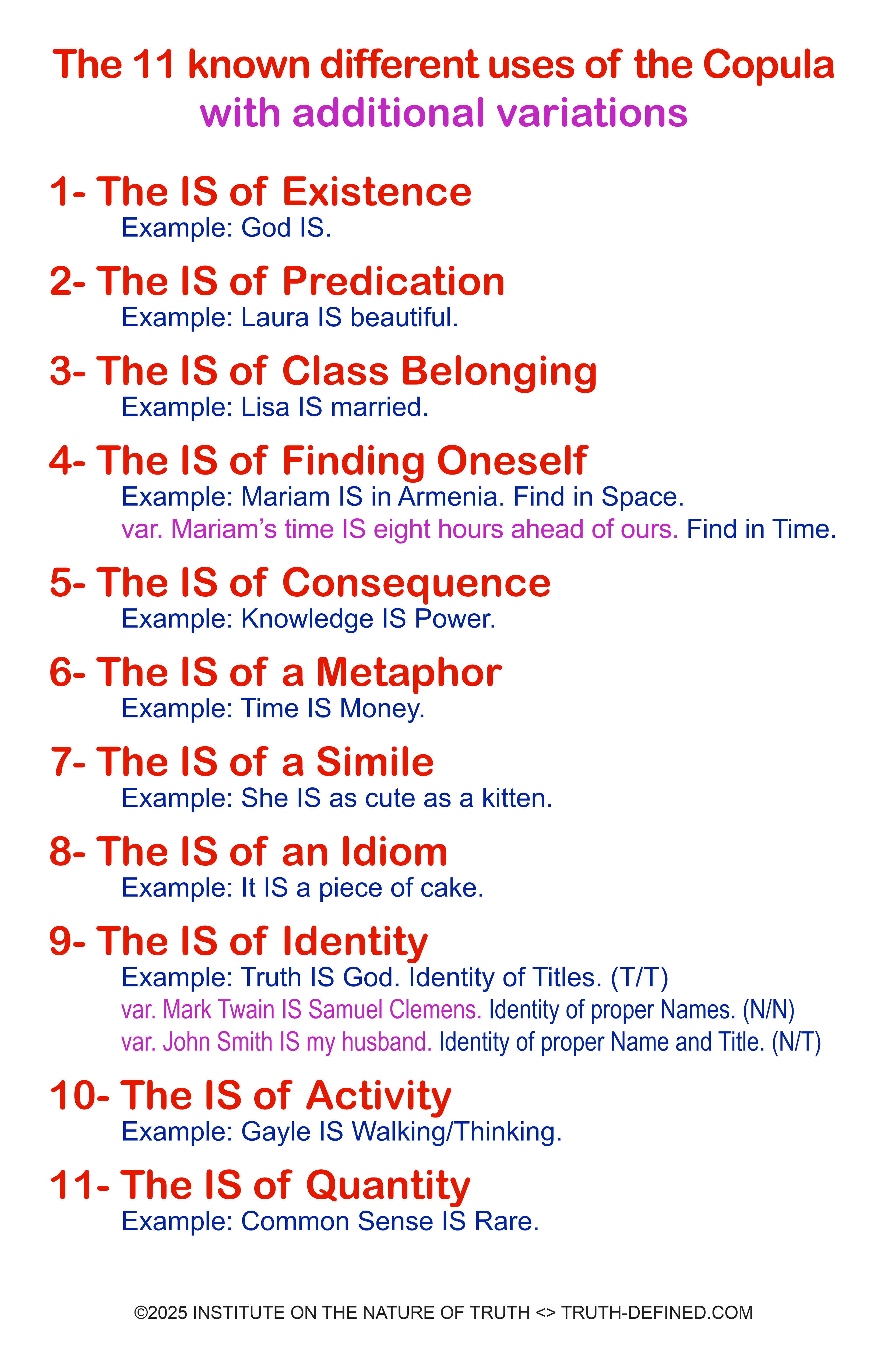
1- The IS of Existence
2- The IS of Predication
3- The IS of Class Belonging
4- The IS of Finding Oneself
5- The IS of Consequence
6- The IS of a Metaphor
7- The IS of a Simile
8- The IS of an Idiom
9- The IS of Identity
10- The IS of Activity
11- The IS of Quantity
---------------------------------
The Copula connects a subject and its complement.
To correctly differentiate between the several kinds of complements, I find it necessary
to invent a new name for each one.
Thus the complement of the IS of Existence I call “Existicate”
The complement of the IS of Predication is a “Predicate”
The complement of the IS of Class Belonging is a “Classicate”
The complement of the IS of Finding Oneself is a “Findicate”
The complement of the IS of Consequence is a “Consequate”
The complement of the IS of a Metaphor is a “Metaphorate”
The complement of the IS of a Simile is a “Similicate”
The complement of the IS of an Idiom is an “Idiomate”
The complement of the IS of Identity is an “Identicate”
The complement of the IS of Activity is an “Activicate”
The complement of the IS of Quantity is a “Quanticate”
RELEVANT QUOTATIONS
In the language of everyday life it very often happens that the same
word signifies in two different ways— and therefore belongs to two
different symbols— or that two words, which signify in different
ways, are apparently applied in the same way in the proposition.
Thus the word “is” appears as the copula, as the sign of equality,
and as the expression of existence; “to exist” as an intransitive
verb like “to go”; “identical” as an adjective; we speak of something but also of the fact of
something happening.
(In the proposition “Green is
green”— where the first word is a proper name and the last an
adjective— these words have not merely different meanings but they
are different symbols.)
Ludwig Wittgenstein; Tractatus Logico-Philosophicus; 3.323
These many differences in translation are due to the
Greek sentence structure. In this type of equational sentence [John 1:1]
in Greek (A=B) the subject can be distinguished from the predicate by
the fact that the subject has the article before it and the predicate
does not. Since “God” does not have the article preceding it, “God” is
clearly the predicate and “the Word” is the subject. This means that
“God” is here the equivalent of an adjective, and this fact justifies
the rendering he (the
Word) was the same as God.
John is not saying that “the Word” was God the Father, but he is
affirming that the same divine predication can be made of “the Word” as
can be made of God the Father, and so “the Word” can be spoken of as God
in the same sense.
Many languages have two quite different types
of equational sentences. One type indicates complete identity in such a
sentence as “My husband is John Smith” or “John Smith is my husband,”
that is, the two parts of the sentence are completely equivalent. In the
second type, however, one may say “John Smith is a teacher” but cannot
say “A teacher is John Smith.” “A teacher” merely qualifies “John Smith”
and indicates the class of persons to which he belongs. The latter is
precisely the type of equational sentence which occurs in this verse.
“God” completely characterizes “the Word,” and all that is true of God
is true of the Word. This does not mean, however, that the two elements
can be inverted, and that one can translate “God was the Word” any more
than one can make “Love is God” an inversion of the biblical statement
“God is love.” It is difficult for some people to recognize that this
equational sentence in Greek belongs to the second class because in the
predicate the term “God” refers to a unique object. Since this type of
equational sentence may be misleading with “God” in the predicate, it is
better to translate it “The Word was the same as God” or “Just what God
was that is what the Word also was.”
Barclay M. Newman and Eugene A. Nida; A Translator’s Handbook on the
Gospel of John; 1980; p9
“IS”, SEMANTICAL GAMES, AND SEMANTICAL RELATIVITY
1. The Frege Trichotomy
If there is a doctrine shared by almost all analysts
of the semantics of natural language these days, it is the
distinction between different senses of
“is”: the
“is” of predication, the
“is” of identity, and the
“is” of existence.
The “is” of predication is often called the copula.
Some writers add an alleged “is” of class inclusion as the fourth reading. The most
forceful philosophical proponent of the polysemy of “is” is undoubtedly Bertrand Russell. In
The Principles of Mathematics he
writes:
The word is is terribly ambiguous, and great care is
necessary in order not to confound its various meanings. We have
(1) the sense in which it asserts Being, as in “A is”;
(2) the sense of identity;
(3) the sense of predication, as in “A is human”;
(4) the sense of “A is a-man” … which is very like identity. In addition to
these there are less common uses, as “to be good is to be happy,” where a relation of
assertions is meant, that relation, in fact, which, where it exists, gives rise to formal implication.
Doubtless there are further meanings which have not occurred to me.
Russell goes on to refer to De Morgan’s
Formal Logic (1847, pp.
49-50) for an earlier treatment of the distinction. In fact, De
Morgan there distinguishes from each other “the ‘is’ of
applicability”, “the ‘is’ of possession of all essential
characteristics”, and “the ‘is’ of identity”, but not the “is” of
existence. The importance that Russell assigns to the trichotomy
is seen from Our Knowledge of the External World, where it is
introduced as “the first serious advance in real logic since the
time of the Greeks.” What Russell is now emphasizing is the
contrast between “Socrates is mortal” and “All men are mortal,” in
other words, between predication and class-inclusion.
In 1914
Russell no longer refers to De Morgan’s trichotomy as a precursor of
his distinction. He now shows a much firmer grasp of the main
gateway of the trichotomy into modern discussion, ascribing it to
Frege’s and Peano’s work.
It is indeed true that the respective
formalisms of Frege and Peano are probably the original sources for
the distinction in recent philosophy. However, the distinction is
for Frege not only a feature of a convenient formalism but reflects
important semantical and even ontological (categorical)
differences, even though Frege did not think that we can explicitly
discuss semantical matters of this sort. The trichotomy is such an
integral part of Frege’s main achievement‒ the modern conception of
a system of logic‒ that in this chapter I shall call it the Frege
trichotomy.
Through the formalism of Frege and Peano, and even more
through the notation of the Principia of Russell and
Whitehead, the trichotomy became an important constituent of the
contemporary concept of first-order logic. (Among the aliases of
this basic part of logic there are “lower predicate calculus”, “quantification
theory”, “elementary logic”, etc.) In first-order logic, the
“is” of identity is typically expressed by “=”, the “is” of existence by
the existential quantifier, and the “is” of predication by
predicative juxtaposition, as in “P(a).” These are entirely
different ingredients of first-order language both semantically and
syntactically.
Hence, anyone who uses first-order logic as a
canonical notation for semantical purposes is committed to the
trichotomy. The same goes for its immediate extensions. Accordingly,
philosophers, logicians, and linguists as divergent as Quine,
Davidson, Chomsky, and Lakoff are in the same boat with respect to
the Frege trichotomy.
Jaakko Hintikka;
The Game of Language;
1983; ch7; pp161-62
The little word ‘is’ is perhaps for philosophers the most troublesome in the language.
John Hick
REFERENCES
Angelelli, Ignacio > Hintikka vs. Frege on the “Logic of Being”
> 1987
Anonymous > An Introduction to the Main AIT Argument >
[2008]
Anonymous > Existence > 2008
Anonymous > Guide to Verb
Structures and Patterns
Anonymous > Other Sentence Types
Anonymous > Verb Types: Linking > 2016
Anonymous > Verbs and
Verbals
Buckner, Dean > Understanding Universal Quantification >
2003
Buckner, E. D. > Existential Import > 2005
Calvo, Tomás >
The Verb ‘Be’ and Aristotelian Ontology > 2014
Chapman, James A.
> Handbook of Grammar & Composition
Church, Alonzo > Review:
Notes on Existence and Necessity by Willard V. Quine > 1943
Copi,
Irving M.; Gould, James A.; eds. > Readings on Logic > 1972
Corazzon, Raul > Gottlob Frege on Being, Existence and Truth > 2008
Corazzon, Raul > Theory and History of Ontology
De Morgan,
Augustus > Formal Logic > 1926
Decker, Rodney J. > What’s the
Subject?
Englebretsen, George > A Note on Identity, Reference and
Logical Form > 1981
Englebretsen, George > Predicates,
Predicables and Names > 1981
Englebretsen, George > Quine on
Aristotle on Identity > 1985
Englebretsen, George > The Unifying
Copula > 1997
Garner, Bryan > Verb “to be” > 2003
Gaskin,
Richard > Bradley’s Regress, the Copula and the Unity of the
Proposition > 1995
Geach, Peter T. > Reference and Generality >
1962
Goodwin, George L. > Review: The Being of God: Theology and
Experience of Truth by Robert P. Scharlemann > 1985
Hautala, Earl
> Searching For Truth > 1982
Hintikka, Jaakko > Frege Synthesized
> 1986
Hintikka, Jaakko > “Is”, Semantical Games, and Semantical
Relativity > 1979
Hintikka, Jaakko > Kant on Existence,
Predication, and the Ontological Argument
Hintikka, Jaakko > On
Aristotle’s Notion of Existence > 1999
Hintikka, Jaakko >
Semantical Games, the Alleged Ambiguity of ‘Is’, and Aristotelian
Categories > 1983
Hintikka, Jaakko > Studies in the Logic of
Existence and Necessity: I. Existence > 1966
Hintikka, Jaakko >
The Game of Language > 1983
https://en.wikipedia.org/wiki/Copula_(linguistics)
https://en.wikipedia.org/wiki/Indo-European_copula
Kahn, Charles
H. > Some Philosophical Uses of “To Be” in Plato > 1981
Kahn,
Charles H. > The Greek Verb ‘To Be’ and the Concept of Being > 1966
Keller, Philipp > How to Tell Universals from Particulars > 2003
Klima, Gyula > Aquinas’ Theory of the Copula and the Analogy of
Being > 2002
Kneepkens, C. H. > From Eternal to Perpetual Truths:
A Note on the Mediaeval History of Aristotle, De Interpretatione,
Ch. 1, 16a18 > 1994
Körner, Stephan; ed. > Philosophy of Logic > 1976
MacKenzie, P.
T. > Truth and the Magic of ‘Is’ > 2005
Matthen, Mohan > Greek
Ontology and the ‘Is’ of Truth > 1983
May, Robert > Frege on
Identity Statements > 2000
McNamara, J. M. > The Verb “To Be”
Mendelsohn, Richard L. > Frege’s Two Senses of ‘Is’ > 1987
Mercier, Charles Arthur > A New Logic > 2013
Miller, Barry >
Existence > 2008
Neivens, Jon; Evans, Jud > The Frege-Russell
Classification of ‘is.’ > 2002
Nelson, Michael > Existence > 2008
Newman, Barclay M.; Nida, Eugene A.; >
A Translator’s Hanbook on the Gospel of John; 1980
Nusenoff, Ronald E. > Frege on Identity Sentences > 1979
Rota,
Gian-Carlo > In Focus ... What “is” Mathematics? > 2000
Russell,
Bertrand > The Principles of Mathematics > 1996
Sayward, Charles
> What is the Logic of Propositional Identity? > 2006
Schaff,
Adam > General Semantics: A Marxist Philosopher’s View > 1962
Scharlemann, Robert P. > The Being of God > 1981
Shwayder, D. S.
> “=” > 1956
Swan, Michael > Verbs to be > 2000
Weingartner,
Paul > Basic Questions on Truth > 2000
Wiggins, David > The Sense
and Reference of Predicates: A Running Repair to Frege’s Doctrine
and a Plea for the Copula > 1984


