HOW DID I ARRIVE AT A NEW THEORY OF TRUTH?
This New Theory of Truth is based upon the following four observations:
I-
The
inability
of Logicians and Philosophers
to define the word Truth.
II-
The fact that there is no truth in Mathematics, Geometry, Logic or Science.
III-
Augustine’s proof of the
existence of God based upon the nature of Truth.
IV- The Apostle John’s teaching about Truth and
Christ, especially the statement in John 14:6 where Christ identifies Himself with the Truth.
******
I-
Many Theories of Truth
have been proposed by philosophers, logicians and mathematicians. In return, every theory has been ably critiqued and refuted as a source of truth. In addition, it has been admitted that a Theory or Criterion or Condition of Truth is not a Definition of Truth, even though the confusion is still evident in many texts. (The question “What is Truth?”
should NOT be confused with the question “What is the truth?” The latter question cannot be addressed until the former one is answered.) A Definition of Truth must
necessarily precede a Theory of Truth.
We must be thankful for the work of these sincere and honest thinkers, because
we now know where NOT to look for Truth.
II- Since the time of the early Greek philosophers
and mathematicians, most people have assumed that the most reliable source of truth exists in Numbers. But inventions in Mathematics during the last one
hundred and fifty years have shown that there is No truth in mathematics and geometry. Surprisingly, Mathematicians and not Theologians have
been at the forefront of the search for a definition of the word Truth.
Any modern philosopher who is exploring The Nature of Truth and does not take into
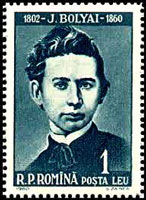
account the work done by philosophers of Mathematics is at a great disadvantage. The vast majority of philosophers prior to Janos Bolyai, stumbled when
confronted with the “truths” of mathematics, but they can be excused. Philosophers after Bolyai and Gödel have no excuse for being ignorant of the
fact that there is no truth in mathematics.
We are indebted to mathematicians for their perseverance and tireless efforts. We must express our deepest gratitude to them, because
we now know where NOT to look for Truth.
III- Augustine’s Exposition of the nature of Truth
must be resurrected and reinterpreted in light of the above facts.
I believe that Augustine himself did not understand the implications of his work. He continued to believe that numbers and geometric figures represented eternally true essences.
(He believed that numbers and geometric shapes existed in God’s mind.
The commonly held belief that men can know what is in God’s mind is refuted by Matt. 11:27; Luke 10:22; Isa. 55:8; Rom. 1:33,34; ICor. 2:11 among others.)
Augustine cannot be blamed because it took mankind over 2000 years to understand the nature of numbers. Even though the idea that
Truth is God existed in the Hermetic writings to which Augustine had access, we must be thankful for his
concise and powerful exposition of Truth.
I strongly suspect that the discourse on Truth in the De Libero is not a totally original work and that he owes much to unnamed sources. Yet I
have not found an earlier work as well reasoned as his.
In addition, as far as I have seen, Augustine does not use this narrow analysis of Truth
elsewhere in his writings, but almost always reverts back to incorrect assumptions and definitions. His careless use of the word Truth
puzzles me greatly, because he discusses the subject very often, but almost always assumes that Truth
is in some sense Correspondence of thought with reality, a theory which is fatally flawed.
IV- The Gospel of John
contains statements about Truth that make sense only in the context of a One True Proposition theory. (Except those noted, all references are from the Gospel of John.) 1:17- the grace and the truth came through Jesus Christ.
If truth came through Jesus Christ, then it was not available to mankind prior to His Incarnation. Truth is God. It cannot be discovered or acquired through human efforts. Truth must be revealed.
“[…] very Truth, not retaining within Himself the riches of His good things, but overflowing with them unto all others, and after the overflowing remaining full, in nothing diminished by supplying others, but
streaming ever forth, and imparting to others a share of these blessings, He remains in sameness of perfection.
And see how he [St. John] makes the comparison easy even to the weaker sort; for he does not prove the superiority by argument, but points out the difference by
the bare words, opposing “grace and truth” to “law,” and “came” to “was given.” Between each of these there is a great difference; for one,
“was given,” belongs to something ministered, when one has received from another, and given to whom he was commanded to
give; but the other, “grace and truth came,” befits a king forgiving all offenses, with authority, and himself furnishing the gift.”
Chrysostom;
Homily XIV on John; NPNF I-14; p47ff.
8:32- you shall know the truth & the truth shall make you free.
If “1+1=2” is true, then most everyone knows truth, and thus has become free. Then the incarnation was not necessary for the acquisition of truth, contradicting John 1:17.
8:44- He (Satan) was a murderer from the beginning, and does not stand in the truth, because
there is no truth in him.
A clear statement that Satan, who was the highest created angelic being, does not know any truth. This is strong support for the idea that Truth is a God-given gift, and Satan does not possess any of it.
8:47- He that is of God hears the words of God […]
14:6- I am the Way and the Truth and the Life, no one comes to the Father, but through me.
“I am the Truth” means nothing less than “I am God.”
14:7- If you had known me, you would have known my Father also.
14:16-17- And I will ask the Father, and He will give you another advocate, that He may be with you forever; that is the Spirit of Truth, whom the world cannot receive, because it does not behold Him or know Him, but you know Him because He abides with you, and will be in you.
The idea that knowledge of truth is possible only through divine revelation is central to the whole Bible.
P. D. Woodbridge; Truth; New Dictionary of Biblical Theology; 2000; p826
15:26- When the Helper comes, whom I will send from the Father, that is the spirit of Truth, who proceeds from the Father, He will bear witness of me […]
18:37- For this I have been born, and for this I have come into the world, to bear witness to the Truth. Everyone who is of the truth hears My voice.
Without the Incarnation, all humans would be devoid of Truth.
A few other relevant verses:
2Cor.4:18- that which is seen is temporal, that which is not seen is eternal.
Rom. 1:25- they exchanged the Truth of God for the lie.
ICor.1:20,21- Where is the wise man? Where is the scholar? Where is the
philosopher of this age? Has not God made foolish the wisdom of the world? For
since in the wisdom of God the world through its wisdom did not know him, God
was pleased through the foolishness of what was preached, to save those who
believe.
2Thes.2:12,13 […] so that all will be condemned who have not believed the truth
but have delighted in wickedness. But we ought always to thank God for you
[…] because from the beginning God chose you to be saved […] through belief in
the truth.
2Tim.3:7- always learning but never able to come to a knowledge of the truth.
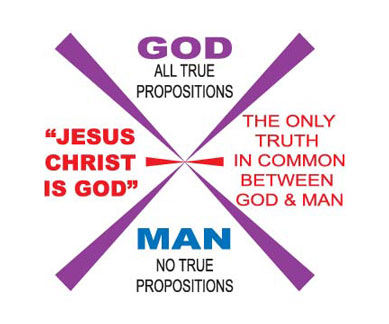
In the past, there have been two contradictory ideas about the knowledge of God or Truth:
First,
that it is
not
possible to have
any
common knowledge between God and man. That is, it is impossible for man to know
anything that God knows, even if God wants to reveal himself.
Second,
man is able to know and does know
many
truths, truths that God also knows, simply by studying the creation.
Both positions are in error.
At the present time, there is only ONE True Proposition that is in common between God and Man:
“Jesus Christ is Lord God”


