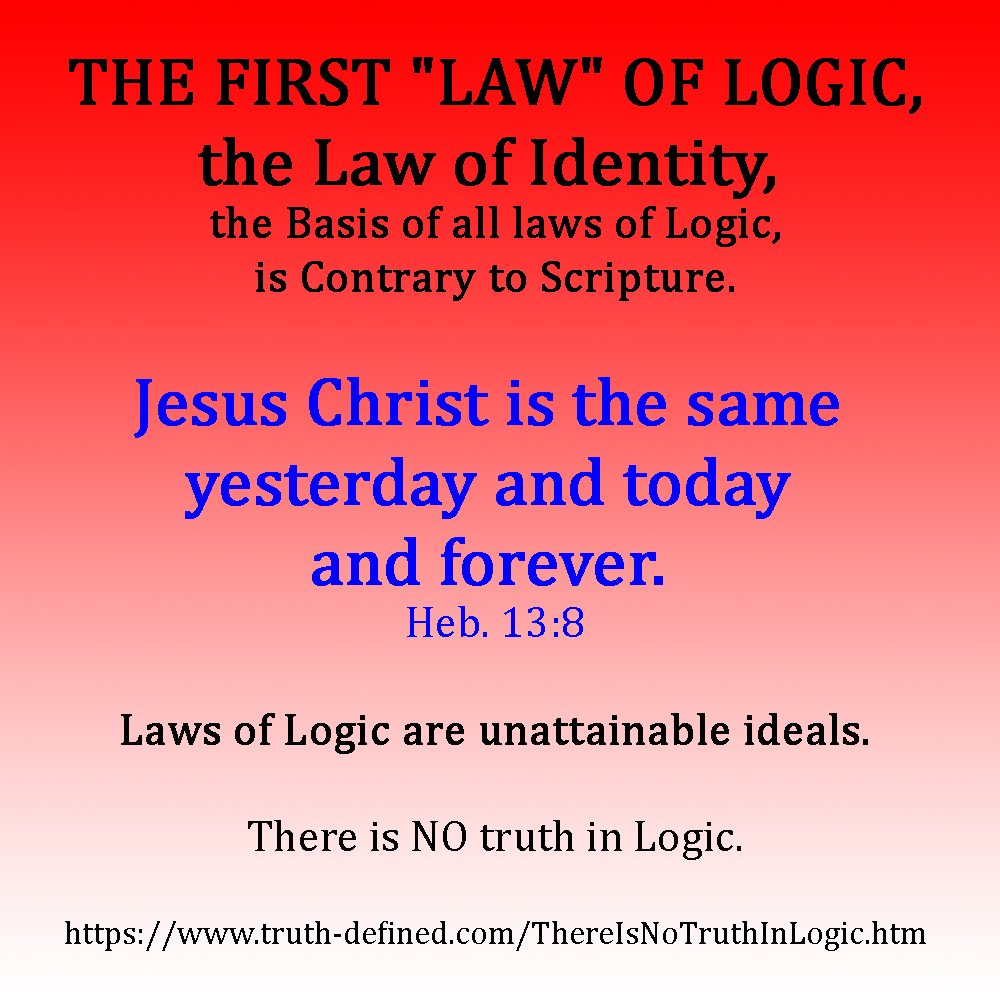
What is Logic?
Logic is the study of reasoning.
Logic is the study of the methods and
principles used to distinguish correct reasoning from incorrect reasoning.
There are objective criteria with which correct reasoning may be defined. If
these criteria are not known, then they cannot be used. The aim of the study
of logic is to discover and make available those criteria that can be used
to test arguments, and to sort good arguments from bad ones.
Copi and Cohen; Introduction
to Logic; pxiii; p3; 2002
According to Aristotle, logic is a branch of philosophy which studies
valid inference. Logic is a way to reason well about reality.
Doug Renselle;
What is Logic?; Quantonics, Inc.; 2009
In
the
Nov.-Dec. 1980
issue of
The Trinity Review entitled
God and Logic,
which is available online,
Dr. Gordon Clark, translates the first Verse
of John 1:1 thus:
“In the beginning was Logic, and Logic was with God, and Logic was God.”
Until recently,
I did not have the tools with which to evaluate such a bold statement. But now
that I have understood the natures of Truth and Logic, I can see that Dr. Clark
made
a grave
error
in identifying Logic with God.
Dr. Clark bases his definition for
Logos
by referring to the most authoritative Lexicons, and also noting the similarity of the words
Logos and
Logic. But his conclusion that
Logos means
Logic does not hold up under scrutiny. Even though
Logos
and Logic have three letters in common, they have different meanings. A search of the lexicons by Liddell & Scott, and Bauer Arndt Gingrich reveals dozens of meanings for the word
Logos, but not a single one of the instances used means
Logic.
Furthermore,
if the Apostle meant
Logic, he would have used the Greek word for
Logic
which existed then and is still in use today:
λογικη. (See Rom. 12:1 and 1Pet. 2:2) In addition, according to the Fourth Revised Edition of the
Greek New Testament by Kurt Aland et al. there is no evidence that the word
λογικη
ever appears in the Greek manuscripts of the Fourth Gospel.
The absurdity of translating Logos as Logic becomes
evident when we read down further into the Gospel record where the nature and attributes of the Logos are further disclosed.
-------------------------------------
1 In the beginning was the Logos, and the Logos was with God, and the Logos was God.
2
The same was in the beginning with God.
3 All things were made by him;
and without him
was not any thing made that was made.
4 In him was life;
and the life was the light of men.
5 And the light shined in darkness; and
the darkness comprehended it not.
6
There was a man sent from God, whose name was John.
7 The same came for a
witness, to bear witness of the Light, that all men through him might believe.
8 He was not that Light, but was sent to bear witness of that Light.
9 That was the true Light, which lighted every man that cometh into the world.
10 He was in the world, and the world was made by
him, and the world knew
him not.
11 He came
unto his own, and his own received him not.
12 But as many as received him,
to them gave he
power to become the sons of God, even to them that believe on his name:
13
Which were born, not of blood, nor of the will of the flesh, nor of the will of
man, but of God.
14 And the Logos was made
flesh, and dwelt among us, (and we beheld his glory, the glory as of the only begotten of the Father,) full of grace and
truth.
15 John bare witness of him,
and cried, saying, This was he of whom I spoke, He
that cometh after me is preferred before me: for
he was before
me.
16 And of his fullness have all we received, and grace for grace.
17 For the law was given
by Moses, but grace and truth came by Jesus
Christ.
18 No man hath seen God at any
time; the only begotten Son, which is in the
bosom of the Father, he hath declared him.
-------------------------------------
We must conclude that the
word
Logos
(λογος)
that is used in the Gospel of John, does NOT mean
Logic.
What Dr. Clark meant to state and did state elsewhere is that God is a “Logical
Being.” And since He is a logical being, then any of His communication with men
would also be logical, comprehensible, etc.
But then the inevitable
question arises: Is God a being who needs to Submit to the “laws” of Logic?
Would not that make the “laws” of logic superior to God Himself? Did Aristotle
have access to God’s mind when he formulated the “laws” of logic? If “Logic is
God,” was Aristotle then able to acquire knowledge of God without resorting to
the Scriptures? Dr. Clark has not answered these questions satisfactorily.
But since he did not want to dismiss Logic as unimportant, he goes further into
the wrong direction and tries to IDENTIFY Logic with God. But is that a Biblical
stance?
We need to analyze the phrase “Logic is God,” to see if such a proposition is
Biblically sound.
We know from the Nature of Truth page that
the word
IS
can have at least
ELEVEN
possible meanings.
1- The IS of Existence
2- The IS of Predication
3- The IS of Class-Inclusion
4- The IS of Finding Oneself
5- The IS of Consequence
6- The IS of a Metaphor
7- The IS of a Simile
8- The IS of an Idiom
9- The IS of Identity
10- The IS of Activity
11- The IS of Quantity
1- Existence
- Logic IS
= Logic Exists
Since we are not arguing about the existence of Logic, the
IS of existence is not our concern.
2- Predication
- Logic IS God
In other words, God is an attribute, quality or
characteristic of Logic. This proposition makes no sense.
3- Class-Inclusion -
Logic IS God
In other words, Logic
belongs to a Class of beings called God. Clearly this is not what Dr. Clark
meant.
4- Finding Oneself - Logic IS God
In other words, Logic
Finds Itself in God. This is not what Dr. Clark
meant.
5- Consequence - Logic IS God
There is more than one way to interpret this proposition.
a- The consequence
of knowing the laws of logic is to know God.
b- The consequence of knowing
God is to know the laws of logic.
c- The consequence of being logical is
being Godly.
d- The consequence of being Godly is being logical.
Neither of these choices is biblically sound. A person can be an expert logician
and still deny Jesus as Lord, and just because a person is a devout believer
does not in any way guarantee that they will always form valid syllogisms.
6- Metaphor - Logic IS God
Dr. Clark did not mean it as a Metaphor.
7- Simile - Logic IS God
Dr. Clark did not mean it as a Simile.
8- Idiom - Logic IS God
Dr. Clark did not mean it as an Idiom.
9- Identity - Logic IS God
Meaning, that Logic and God are Identities. Logic and God are Syn-titles; (Not syno-nyms, since “God”
is a Title and NOT a proper Name.) That is, Logic and God are two Titles referring to the same person.
If Logic and God are Identicates, then we should be able to reverse the proposition and still have a valid biblical concept: God is Logic.
Are Logic and God Identical? Does being logical means being Godly? Is knowing the laws of logic the same as knowing God? What is Logic? What about Logic is God? Are the laws
of logic and
God Identical? Is being logical being God? What does “Logic is God” mean?
If we begin with the definition of logic as “the principles of valid inference and correct reasoning,” did Dr. Clark really mean to say that the “principles of valid inference and correct reasoning” are God?
Since knowing Truth is
being Indwelt by God, does that mean that being logical means being indwelt by God? Does it mean that one who knows the “laws” of Logic or uses them correctly, is being indwelt by God?
In trying to maintain that God and his revelation are “logical,” Dr. Clark has betrayed his poor understanding of the nature of God and the nature of Logic.
By trying to deify Logic, Dr. Clark believed that he had protected the logical
integrity of God and the Scriptures. But that is unnecessary. Laws of Logic are
tools needed by ignorant humans.
Laws of logic have no bearing on God’s mind or thoughts.
Laws of logic have no claim on an omniscient being because they are completely
irrelevant to Him. Dr. Clark’s serious error is due to the fact that he had not
understood the nature of Omniscience and the purpose of Logic.
10- Activity - Logic IS God
Dr. Clark did not mean
that Logic is an
Activity.
11- Quantity - Logic IS God
Dr. Clark did not
mean that Logic is a Quantity.
A pauciscient being needs to make deductions, an omniscient being does
not
need to do so.
A pauciscient being must form syllogisms, an omniscient being does
not
need to do so.
A pauciscient being must resort to making inferences, an omniscient being does
not
need to do so.
A pauciscient being needs to adhere to the laws of logic to arrive at valid conclusions and to avoid contradictions. Laws of logic are
irrelevant
to an omniscient being.
To claim that God “thinks logically” is of the same rank as the question
“What does God eat to maintain His omnipotence?”, namely, an utterly
irrelevant question. This in no way affects the fact that God and His people
have, at the present time, ONE True Proposition in common, i.e. “Jesus
Christ is Lord.”
Therefore, in view of the fact that “Truth is God”, and Jesus’
identification of Himself with the Truth, (I myself AM the Truth. Jn
14:6), it is far more reasonable to translate “Logos” as “Truth.” Thus,
Jn 1:1 becomes:-
In the beginning was the Truth,
And the Truth was face to face with God,
And the Truth was God.
Logic is not a person, but Truth is a person.
Jesus said “I am the Truth.” He did not say
“I am logic.”
Jesus is the Logos,
Jesus is the Truth,
Jesus is God.
 It is thus surprising to note that the most insightful words on the question of the nature of logic and its relationship to God, has been written by a philosopher of mathematics.
His article is
here.
Part 2 -
Laws of Logic are
idealizations
which cannot be rigorously applied to our present reality.
1. The law of Identity.
The law of identity states that an object is identical to itself: A ≡ A.
OBJECTIONS:
We cannot point to any object or make a statement about any created being
that remains identical to itself even for an instant. For this “law” to be
valid, we must be able to state a proposition about something which is
immutable, but such objects DO NOT exist. The “law” of Identity cannot be
applied to any part of any experience by anyone living on this earth. In fact,
the Law of Identity is in direct contradiction to
Biblical revelation. The Law of Identity can apply only to ONE
being, the Immutable God Himself: Jesus Christ, the same
yesterday, and today, and forever. (Heb. 13:8) To
consider anything other than God as Immutable would be to deny plain Biblical
teaching, leading to innumerable serious errors.
Bringing to mind the
only being that has an Immutable nature: Truth/God, we see that the “law” of
Identity is an attempt to mimic the immutable nature of Truth by trying to
ascribe immutability to fallen men’s erroneous thoughts and to a fallen, mutating
creation.
The first “law” of logic upon which the rest of the “laws” are
founded, is shown to be an impossible to describe, much less an attainable,
ideal. It is an attempt to replace Truth/God with figments of men’s
self-deceiving imaginations.
Furthermore, the Law of Identity is in
direct contradiction to scripture, which states:
“I the Lord do
not change.” Mal. 3:6
“Jesus Christ is the same yesterday and
today and forever.” Heb. 13:8
There is not a single immutable
object in creation.
-----------------------------------
[…] the law of identity will be presupposed in the other two laws:
without a grasp of the law of identity the other two laws are not even
so much as intelligible.
Colin McGinn; Logical Properties; 2000; p12
-------------------------------------------
To confuse “laws” of logic with Truth or as a tool to attain Truth has been a hindrance to understanding the correct
definition of the nature of Truth and the nature of God.
-------------------------------
[…] This is why such statements as ‘the evening star is the morning star’ have cognitive value, unlike the vacuous ‘a=a’.
O. Hanfling; Theories of Meaning: from ‘Reference’ to ‘Use’; in The Handbook of Western Philosophy; G.H.R.
Parkinson; ed.; p25
2. The law of Non-Contradiction.
The law of non-contradiction states that a Proposition cannot be Both True
and False at the same time and in the same respect.
OBJECTION:
This “law” is based upon the erroneous belief that humanly invented propositions
are restricted to the two truth-values of True or False. Again, it is a vain
attempt to try and mimic the nature of Truth, knowledge of which can come only
from a self-revealing God and solely about Himself.
In its simplest
aspect, it is a trivial “law.” Once we understand the definitions of the words
True and False, we see that this “law” does not apply to any statement that we
invent in our daily conversations.
It applies only to the One True Proposition that is available to mankind at
the present time: “Jesus Christ is Lord.” Its denial is the definition of
Falsehood. Other propositions do not have truth values of True or False,
therefore this “law” cannot apply to them.
All other propositions are
neither-True/nor-False.
---------------------------
More disturbing is that the law of non-contradiction fails […]
¬(p
& ¬p) always has the same degree of truth as p v ¬p, and thus is
perfectly true only when p is either perfectly true or perfectly false.
When p is half-true, so are both p & ¬p and ¬(p & ¬p).
At some point [in waking up]
‘He is awake’ is supposed to be half-true,
so ‘He is not awake’ will be half-true too. Then ‘He is awake and he is
not awake’ will count as half-true. How can an explicit contradiction be
true to any degree other than 0?
Timothy Williamson; Definiteness and Knowability; 1995; pp118,136
3.
The law of Excluded Middle
The law of excluded middle is the principle that for any
proposition, either that proposition is true, or its
negation
is true.
Thus for two-valued logic, the law is stated that a Proposition can have
only One of Two possible Truth values: either TRUE or FALSE.
OBJECTIONS:
1- The definitions of the words True and False
are assumed to be known. It is rarely pointed out
that philosophers have not come to an agreement about what those words mean!
Until they decide, these statements barely rise above the level of utopian
aspirations.
2- There are no objects in nature that are wholly
other. All created entities have something in common no matter how different
they seem to be, and thus cannot be described by propositions that are complete
contraries of each other. At the least, everything in creation has the property of being a
Created entity.
3- Several insurmountable objections make it clear that
the “law” of Excluded Middle does NOT apply to the reality with which we deal in
our daily lives.
See the page Truth-Defined.com >>> The Nature of Logic >>> Neither True Nor False.
>>>>>
In the attempt to link logic with God, the following phrases are often repeated “God is a logical being,” or “God’s thoughts are
logical,” or “God thinks in logical terms.” These sound pious, but the dangers of such beliefs must be exposed.
1-
To say that God is a logical being is to place God under a standard
of logic that must necessarily be above God Himself. To say that God
thinks “logically” is to assume that God must comply with “logical”
laws that are above His mind. That His thoughts must satisfy a norm
called “logical.”
Those who want to link logic with God do not realize that a standard
that they call “logical” is their own invention. They have
thoroughly confused the ideal laws of logic that guide the
deductions of fallible and pauciscient humans, and which are
necessary and useful for us, with an imagined standard called
“logical” or “reasonable.” No one seems to ask the question “How can
we decide if God is Logical or His acts Reasonable? Whose standards
of logic or reasonableness do we use to judge and decide the logic
and reasonableness of God and His acts?”
This results from confusing the making of valid deductions, which is
an everyday occurrence, with an imagined ideal which we call
“logical” or “reasonable.” And this imagined ideal is used to pass
judgment upon God and His revelation in the scriptures, as if we are
in any position to be able to judge any doctrine of scripture as
“logical” or “reasonable.”
2-
Substituting the word “truth” for “God” we get:- “Truth is a logical being.” But this is not a valid statement, because nothing can sit
in judgment of truth. There is nothing greater than truth, including “logic.” In this substitution, we can see that “God is Logical” is
not a valid proposition, but is in fact meaningless.
>>
Laws of Logic are not true but useful. And in addition, the notion that a valid deduction leads to truth is unjustified. Being logical
does not guarantee that a person’s deduction is true.
>>
God is not bound by “laws” of logic. Logic is of no relevance when
one is in the presence of nothing but the Truth.
>>
The need for the use of Logic is an unfavorable sign. It is evidence
that the user is pauciscient and not omniscient. He must resort to
deduction to analyze and dissect a proposition, unlike God who has
no need to examine statements. The need for logic is a negative sign
because it is evidence of privation.
>>
Laws of Logic are similar to the “laws” of science or mathematics: temporarily Valid, Necessary & Useful for pauciscient beings, but
not eternal.
3-
Nothing in this world is immutable. There is only ONE immutable being, and HE is outside of the created order. The LOI is in direct
contradiction to Scripture.
A=A posits the idea that there exist innumerable entities which are immutable and unchangeable, contrary to Scripture where God is
revealed to be the sole immutable being in existence.
Part 3 -
Quora Q & A
Where do the laws of logic come from?
Laws of logic were developed from observations of how we use language and how we reason from assumptions (axioms, premises) to conclusions. They became formalized over the centuries into a systematic discipline. The laws are
necessary for humans to be able to communicate effectively because we are not omniscient. An omniscient being would have no use for logic, since he
would have no need for deductions.
Shortly after this study began in earnest in ancient Greece, logical paradoxes, like the Liar Paradox were discovered,
and this caused a great shock. The efforts to try and find a desirable solution to paradoxes is still ongoing, and has caused logic to expand and
change into many varieties.
All laws of logic are ideals, thus are never true, but just like the laws of math, are useful fictions.
Part 4 -
Quotes on the Nature of Logic
 I hope I have made clear that intuitionism […] denounces logic as a source of truth.
L. E. J. Brouwer; (1881-1966);
Consciousness, Philosophy, and Mathematics;
1940
 Logic and mathematics are not true inherently, however cogent or extensive. They are ideal constructions based on ideal axioms […]
George Santayana; (1863-1952);
Scepticism and Animal Faith; 1923/1955; p262
It is not therefore the object of logic to determine whether conclusions be true or false; but whether what are asserted to be
conclusions are conclusions. By a
conclusion
is meant that which is and must be
shut in with
certain other preceding things put in first: it is that which must have been put into a sentence because certain other things were
put in. To infer a conclusion
is to
bring in, as it were, the direct statement of that which has been virtually stated already – has been
shut in. When we say “A is B, B is C; we conclude A is C”; it would be more correct to say “A is B, B is C;
we have concluded
A is C.” … To infer the conclusion then is to bring in a statement that we have
concluded.
Inference does not give us more than there was before: but it may make us
see more than we saw
before: ideally speaking, then, it does give us (in the mind) more than
there was before. … Omniscience need neither compare ideas, nor draw
inferences: the conclusion which we deduce from premises, is always present
with them; truths are concomitants not consequences. When we say that one assertion
follows from another,
we speak purely ideally, and describe an imperfection of our own minds: it
is not that the consequence follows from the premises, but that our
perception of the consequence follows our perception of the premises: the consequence, objectively speaking, is in, and with, and of,
the premises.
Augustus De Morgan;
Formal Logic; 1847/1926; p49ff; [7/4/2023]
The task of logic is not to determine what is true. Because, being only a ‘theory of inference’, it explicates the ways in which one reasons conclusively from given sentences, irrespective of their truth or falsity.
Willem Kuyk;
Complementarity in Mathematics; 1977; p21
[2015]
[…] logic is the science of inference […]
Inference […] is the process
in which we pass from what is known to new knowledge.
J. G. Brennan (1910-2004);
The Meaning of
Philosophy; 1953; p14
 The propositions of logic are tautologies. The propositions of logic therefore say nothing. Theories which make a proposition of logic appear substantial are always false.
[…] the propositions of logic do not stand in any representational relation to reality.
Ludwig Wittgenstein; (1889-1951);
Tractatus Logico-Philosophicus; 1921;s6.1, 6.11, 6.111, 4.462
 Logic, too, rests on assumptions that do not correspond to anything in the real world, e.g., on the assumption of the equality of things, the identity of the same thing at different points of time; but this science arose from the opposite belief– that there were indeed such things in the real world. So it is with mathematics, which would certainly not have originated if it had been known from the beginning that there is no exactly straight line in nature, no real circle, no absolute measure.
F. Nietzsche; (1844-1900); Human, All Too Human; 1878; s1, p11
[…] the propositions of logic are tautologous, they say nothing at all about the objects we want to talk about.
Hans Hahn; (1879-1934);
Logic, Mathematics and Knowledge of Nature; 1933
I begin by excepting from consideration many of the sentences which are often put forward as being “laws of logic”; namely, those
sentences, such as, “AB is A”, “p and not-p cannot both be true”, “p or
q implies q or p”,
which are invented by logicians for their own amusement and do not express any thought about the world. Nothing can be deduced from
such genuine tautologies, and I cannot make out why people seem to find them so interesting. I am prepared to admit that these
sentences state nothing about the world, except perhaps the equivalence of certain phrases in our language.
C. H. Whiteley;
Truth by Convention:
A Symposium; by A. J. Ayer, C. H. Whiteley, M. Black; Analysis; 1936; p22
In Lecture 1 of the 1864-65 lecture series, Peirce also presents and rejects an alternative psychological formulation of the definition
of logic. This is: “Logic is the science of the normative laws of human cognition.” Concerning this definition Peirce says,
It has been supposed that the laws of
logic might be broken. That they say ‘Thou Ought’ not ‘Thou Shalt’,
that, in short, they are statements not of fact but of debt. But why
ought we to be logical? Because we wish our thoughts to be
representations of symbols of fact. It is evident therefore that
logic applies to the thought only in so far as the latter is a
symbol. It is to symbols, therefore, that it primarily applies. Now
by recognizing this fact it becomes plain at once that the objects
of these laws cannot but comply with the laws; and hence that the
whole idea of their being ‘normative’ laws is false.
Peirce argues here that the laws of logic are descriptive, not
normative; they are descriptive of symbols. They are descriptive of
thoughts only insofar as thoughts are symbols.
Such laws are no more prescriptive than the laws of mathematics.
Emily Michael;
Peirce’s Adaptation of Kant’s Definition of Logic: The Early Manuscripts; Transactions of the Charles S. Peirce Society; v14; n3; 1978; p181
The difficulty about deduction is that we have no certain right to our starting point. The difficulty about
induction is that we have no certain right to any conclusion.
William Temple (1881-1944);
Mens Creatrix; 1949; p15
[…] it is the very nature of a postulate that we do not ask if it is true. It is merely some statement that we agree to accept without
proof. The postulates may be any that we please, provided only that they do not lead to flat contradictions.
Gateway to the Great Books; v9; Mathematics; p240
 [Hahn’s theme] is that logic is not about the world
[…] it is about transforming one way of speaking to another equivalent way of speaking
[…] that logical “truth” is not a species of truth: it is a mere artifact of the representational system.
[Hahn’s theme] is that logic is not about the world
[…] it is about transforming one way of speaking to another equivalent way of speaking
[…] that logical “truth” is not a species of truth: it is a mere artifact of the representational system.
Warren Goldfarb;
The Philosophy of Mathematics in Early Positivism; p220 in
Origins of Logical Positivism; vXVI of Minnesota Studies in the Philosophy of Science; Ronald N. Giere; ed.; 1996
Aristotle’s Laws and the Paradox of Change
Aristotle’s three laws of logic, on which foundation rests all mathematical,
physical, and rational thinking, can ordinarily be stated thus:
* The law of identity states that anything is itself. In other words, A = A.
* Tautologies follow the first law, and assert that something is either A,
or not A.
* The final law follows the second, and posits that nothing can be both A
and not A simultaneously.
A variety of arguments can easily be produced to show that these laws are
incomplete; i.e., they do not specify all reality, for parts of reality can
be shown to contradict one or more of Aristotle’s laws.
Indeed, all “observed” reality can be shown to violate all three laws.
Thus, if Aristotle’s laws are taken to be all the fundamental laws of logic,
then logically there can be no change whatsoever, because change negates all
three laws. i.e., either change does not exist or it is totally illogical.
Since all measurements, detections, thoughts, and perceptions are simply
changes, then it follows that these operations logically cannot exist. Or,
if we assume the “operations” to exist, their outputs cannot exist. If the
operations do not exist, then again their outputs do not exist.
So if the products or outputs cannot exist, then by this reasoning no
perceived, detected, measured, conceived thing exists. If we then insist
that such things do indeed exist, then all is paradoxical and illogical.
This is essentially the nature of the paradox posed by Heraclitus.
Heraclitus’s change paradox has not been satisfactorily resolved to this
day, and rigorously all the rational science of the Western world, being
based on paradoxical change (detection, perception, observation) is itself
totally illogical by its own logical standards.
[4/21/24]
https://www.billstclair.com/www.cheniere.org/books/aids/appendixIII.htm
 The laws of logic are purely formal […] They are principles of procedure, the parliamentary rules of intelligent thought and speech. […] Those who suppose that there is, for example,
a
logic which everyone would agree to if he understood it and understood himself, are more optimistic than those versed in the history of logical discussion have a right to be. The fact is that
there are several logics, markedly different, each self-consistent in its own terms and such that whoever
using it, if he avoids false premises, will never reach false conclusions.
The laws of logic are purely formal […] They are principles of procedure, the parliamentary rules of intelligent thought and speech. […] Those who suppose that there is, for example,
a
logic which everyone would agree to if he understood it and understood himself, are more optimistic than those versed in the history of logical discussion have a right to be. The fact is that
there are several logics, markedly different, each self-consistent in its own terms and such that whoever
using it, if he avoids false premises, will never reach false conclusions.
C. I. Lewis; (1883-1964);
A Pragmatic Conception of the a priori; 1923
 The intuitionistic logic is but
one of many non-classical logics.
Several other such “logics” were defined first by Lukasiewicz and Post and later
by other logicians. Some of them were invented for purely formal reasons, but
several others, e.g. modal logic, possess intrinsic philosophical value.
The intuitionistic logic is but
one of many non-classical logics.
Several other such “logics” were defined first by Lukasiewicz and Post and later
by other logicians. Some of them were invented for purely formal reasons, but
several others, e.g. modal logic, possess intrinsic philosophical value.
Andrzej Mostowski; (1913-1975);
Thirty Years of Foundational Studies;
1966; p17
[…] Aristotelian logic yields only the laws of correct or valid thinking; it does not satisfy our demand for truth.
Edgar S. Brightman; (1884-1953);
An Introduction to Philosophy; 1951; p45
 […]
Aristotelian logic is rejected as an absolute description of reasoning, and logic is also seen to be relative to the type of reasoning that it is being used
to describe. A clear understanding of the relativity of logic and mathematics is a great gain, since we require a healthy distrust of logic when it is applied to the real world.
[…]
Aristotelian logic is rejected as an absolute description of reasoning, and logic is also seen to be relative to the type of reasoning that it is being used
to describe. A clear understanding of the relativity of logic and mathematics is a great gain, since we require a healthy distrust of logic when it is applied to the real world.
Mary Hesse; (1924-2016);
Science and the Human Imagination; 1954; p89
[2015]
The principles of rationality – in logic […] are ideals; and ideals are things which do not exist as empirical facts.
The whole development of the last quarter century goes to enforce the fact that
no deductive system, logic itself included, can justly claim to be demonstration
of certain truth from indispensible first principles.
C. I. Lewis; (1883-1964);
The Structure of Logic and its Relation to Other
Systems; 1921; p513
 […] all of logic is independent of a definition of truth […]
Gabriele Lolli; (1942-2025);
Logical completeness, Truth, and Proofs; p119; in Truth in Mathematics; Dales & Oliveri; eds.; 1998
 Logic and truth, as a matter of fact, have very little to do with each other.
Logic is concerned merely with the fidelity and accuracy with which a certain
process is performed, a process which can be performed […] with any assumption.
You can be as logical about griffins and basilisks as about sheep and pigs. On
the assumption that a man has two ears, it is good logic that three men have six
ears, but on the assumption that a man has four ears, it is equally good logic
that three men have twelve. […] Logic has again and again been expended, and
expended most brilliantly and effectively, on things that do not exist at all.
[…] The relations of logic to truth depend, then, not upon its perfection as
logic, but upon certain pre-logical faculties and certain pre-logical
discoveries […]
Logic, then, is not necessarily an instrument for finding truth […] Briefly, you can only find truth with logic if you have already found truth without it.
Logic and truth, as a matter of fact, have very little to do with each other.
Logic is concerned merely with the fidelity and accuracy with which a certain
process is performed, a process which can be performed […] with any assumption.
You can be as logical about griffins and basilisks as about sheep and pigs. On
the assumption that a man has two ears, it is good logic that three men have six
ears, but on the assumption that a man has four ears, it is equally good logic
that three men have twelve. […] Logic has again and again been expended, and
expended most brilliantly and effectively, on things that do not exist at all.
[…] The relations of logic to truth depend, then, not upon its perfection as
logic, but upon certain pre-logical faculties and certain pre-logical
discoveries […]
Logic, then, is not necessarily an instrument for finding truth […] Briefly, you can only find truth with logic if you have already found truth without it.
G. K. Chesterton; (1874-1936); Daily News; Feb 25; 1905
 […] we cannot maintain that the propositions of logic are true, for “truth” is defined for assertions in terms of the rules of method but not for these rules themselves.
Felix Kaufmann; (1895-1949);
Truth and Logic; 1940
[…] we cannot maintain that the propositions of logic are true, for “truth” is defined for assertions in terms of the rules of method but not for these rules themselves.
Felix Kaufmann; (1895-1949);
Truth and Logic; 1940
[…] just as today we know that Euclidean geometry is only ONE kind of geometry, so also do we know that Aristotelian logic is only one kind of formal logic. [it] is by no means the only system which can be worked out within formal logic.
Joseph G. Brennan (1910-2004);
A Handbook of Logic; 1961; p6
The question why and with what right we acknowledge a law of logic to be true, logic can answer only by reducing it to another law of logic. Where that is not possible, logic can give no answer.
Gottlob Frege; (1848-1925); Basic Laws of Arithmetic; 1893
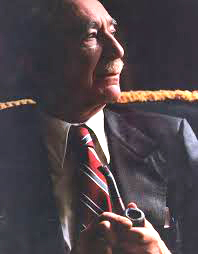 Logic is not a reliable instrument for uncovering truths and can deduce no truths that are not obtainable just as well in some other way.
Morris Kline; (1908-1992); Mathematics: The Loss of Certainty; 1981; p236
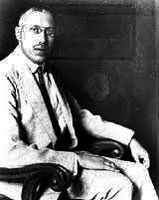 An omniscient being, indeed, would at once know everything that is implicitly contained in the assertion of a few propositions.
An omniscient being has no need for logic and mathematics.
Hans Hahn; (1879-1934); Logic, Mathematics and Knowledge of Nature;1933
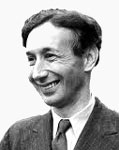 The power of logic and mathematics to surprise us depends, like their usefulness, on the limitations of our reason. A being whose intellect was infinitely powerful would take no interest in logic and mathematics. For he would be able to see at a glance everything that his definitions implied, and, accordingly, could never
learn anything from logical inference which he was not fully conscious of already. But our intellects are not of this order.
The power of logic and mathematics to surprise us depends, like their usefulness, on the limitations of our reason. A being whose intellect was infinitely powerful would take no interest in logic and mathematics. For he would be able to see at a glance everything that his definitions implied, and, accordingly, could never
learn anything from logical inference which he was not fully conscious of already. But our intellects are not of this order.
A. J. Ayer; (1883-1964);
Language, Truth and Logic; 1946; p85
 An omniscient being would thus require neither logic nor mathematics since the relations between all entities would, to him, be self-evident.
[…] once all meaning and all relationships were fully disclosed, these disciplines would be superfluous.
An omniscient being would thus require neither logic nor mathematics since the relations between all entities would, to him, be self-evident.
[…] once all meaning and all relationships were fully disclosed, these disciplines would be superfluous.
Edward Kasner; (1878-1955); & James R. Newman; (1907-1966);
Mathematics and the Imagination; 1940; p361
An omniscient being needs no logic, and contrary to Plato we can say:
God never does mathematics.
Hence, logic is not a theory about the behaviour of the world – on the contrary, a logical proposition states nothing at all about the world – but
a set of directions for making certain transformations within the symbolism we employ.
And once we take this view of logic, a much-discussed problem dissolves of its own accord – the problem of the seemingly mysterious parallelism between the course of our thought and that of the world, the seemingly pre-established harmony between thought and world, which would enable us to discover something about the world by thought. This is impossible in each and every case. Thought can only transform propositions tautologically and in so doing bring them into a form which we find easier to survey, or extract statements from them which had been asserted along with them and are more suitable for checking than the original propositions.
Hans Hahn; (1879-1934);
The Significance of the Scientific World View, Especially for Mathematics and Physics;
1930; in Empiricism, Logic and Mathematics; 1980; p23-24; Brian
McGuinness; ed.
WHAT IS LOGIC?
Logic is the science of necessary inference.
Gordon Clark; Logic; 1988; p1
Logic is the study of correct
reasoning. It includes both formal and informal logic. Formal logic is the science of deductively valid inferences or logical truths. It
studies how conclusions follow from premises independent of their topic and content. Informal logic is associated with informal fallacies,
critical thinking, and argumentation theory. It examines arguments expressed in natural language while formal logic uses formal language.
When used as a countable noun, the term “a logic” refers to a logical formal system that articulates a proof system. Logic plays a central
role in many fields, such as philosophy, mathematics, computer science, and linguistics.
Wikipedia
What
are some basic principles of logic everyone should know?
The three basic laws of logic.
1- The law of identity (LOI)- A=A
2- The
law of non-contradiction (LNC)- A proposition cannot be BOTH True and False at the same time and in the same respect.
3- The law of excluded middle (LEM)- A proposition MUST be EITHER True
or False.
None of the laws of logic are true. They are tautologies,
definitions, which cannot be true or false. Since the words “True” and “False” have not been defined, laws of logic are never true, but may be useful.
There are many variations of sets of laws of logic,
especially the one where the LEM is discarded.
Are laws of logic merely the laws
of human reasoning? Or do they say something very deep about the
foundations of our universe? Can you imagine universes with an
alternative logic?
Laws of logic
are the rules in the game of human communication. God has not revealed
to us these laws. They were formulated over centuries by thoughtful men
who have carefully observed how it is best to communicate and how to
avoid ambiguity and deception in conversations.
There is not just one
set of laws of logic. There are virtually an infinite number of sets,
depending on how one defines true and false.
None of the laws of
logic themselves are true. Rules in a game are conventions which we
agree to follow if we think that they benefit us. If we find that the
rules do not help us to achieve our goals, we are free to change them.
These rules are needed by humans because we are not omniscient. An
omniscient being has no need for logic.
COMMONLY USED TERMS IN LOGIC
A fortiori
- for a still stronger reason; even more certain; all the more.
A priori
- from a general law to a particular instance; valid independently of
observation; existing in the mind prior to and independent of experience,
as a faculty or character trait. not based on prior study or examination;
nonanalytic. an a priori judgment.
Ancien regime
- the political and social system of France before the revolution of 1789.
the system of government during this period.
Aperçu
- a hasty glance; a glimpse. an immediate estimate or judgment; perception;
insight.
Begging the question
- To assume what has still to be proved: “To say that we should help the
region’s democratic movement begs the question of whether it really is
democratic.”
Concomitant -
existing or occurring at the same time.
Empirical -
derived from or guided by direct experience or by experiment, rather than
abstract principles or theory.
Leitmotiv -
a motif or theme associated throughout a music drama with a particular
person, situation, or idea. a unifying or dominant motif; a recurrent theme.
Modus ponens -
the reasoning that, when a conditional statement is accepted as true, as “If
X is red, then Y is blue,” it can be inferred when the antecedent is known
to be true, as “X is red,” that its consequent, “Y is blue,” is affirmed.
Mutatis mutandis -
the necessary changes having been made.
Prima facie -
at first appearance; at first view, before investigation; self-evident;
obvious.
Sui generis -
of his, her, its, or their own kind; unique.
Tautology -
a compound propositional form all of whose instances are true, as “A or not
A.” an instance of such a form, as “This candidate will win or will not
win.”
Toto mundo -
the whole world.
9/16/25
Part 5 -
Select References
Anonymous >
Aristotle did not discuss the Law of Identity and did not say that A is A
Brennan, Joseph Gerard >
A Handbook of Logic
Frege, Gottlob >Posthumous Writings
Hahn, Hans >
Empiricism, Logic, and Mathematics
Hahn, Hans >
Logic, Mathematics and Knowledge of Nature
Horwich, Paul >
Theories of Truth
Hughes, R. I. G.; ed. >
Philosophical Companion to First-Order Logic
Russell, Bertrand >
The Philosophy of Logical Atomism
Schaff, Adam >
Marxist Dialectics and the Principle of Contradiction
Vaihinger, Hans >
The Philosophy of “As If”
Weitz, Morris; ed. >
Twentieth Century Philosophy: The Analytic Tradition
Abelard >
Aristotle’s Logic- Why Aristotelian Logic Does Not Work
Alnes, Jan Harald >
Sense and Basic Law V in Frege’s Logicism
Anonymous >
History of Logic
Anonymous >
Law of Identity
Anonymous >
Law of Identity: Wikis
Aristotle >
Proving the Laws of Thought
Ashworth, E. Jennifer >
Singular Terms and Predication in Some late Fifteenth and Sixteenth century Thomistic Logicians
Ayer, Alfred Jules; ed. >
Logical Positivism
Bahnsen, Greg L. >
Science, Subjectivity and Scripture
Bennett, Jonathan >
Kant, Malcolm, and the Ontological Argument
Black, Max >
Critical Thinking
Bradley, Francis, H. > A Mere Superstition
Carnap, Rudolf > The Old and the New Logic
Church, Alonzo > A Formulation of the Logic of Sense and Denotation
Clark, Gordon H. > God and Logic
Cohen, Morris R.; Nagel, Ernest > An Introduction to Logic and Scientific Method
Copi, Irving M.; Cohen, Carl > Introduction to Logic
Corcoran, John > Meanings of Implication
Dahms, John V. > How Reliable is Logic?
De Morgan, Augustus > Formal Logic
Dummett, Michael >
Truth and Other Enigmas
Eaton, Ralph M. > General Logic
Emmet, E. R. >
Handbook of Logic
Etchemendy, John >
Tarski on Truth and Logical Consequence
Frank, Philipp G. >
The Fall of Mechanistic Physics
Gahringer, Robert E. >
Analytic Propositions and Philosophical Truths
Gasking, Douglas >
Mathematics and the World
Gewirth, Alan >
The Distinction Between Analytic and Synthetic Truths
Giere, Ronald N.; Richardson, Alan W.; eds. >
Origins of Logical Empiricism
Gödel, Kurt >
Russell’s Mathematical Logic
Goldfarb, Warren >
The Philosophy of Mathematics in Early Positivism
Haack, Susan >
Deviant Logic, Fuzzy Logic
Haack, Susan >
Philosophy of Logics
Hacking, Ian >
What is Logic?
Hanfling, O. >
Theories of Meaning: from ‘Reference’ to ‘Use’
Hempel, Carl G. >
The Function of General Laws in History
Henlé, Paul; Kallen H.; Langer, S.; eds. >
Structure, Method and Meaning
Jones, E. E. C. >
Mr. Russell’s Objections to Frege’s Analysis of Propositions
Joyce, George Hayward >
Principles of Logic
Kahn, Charles H. >
On the Theory of the Verb “To Be”
Kaufmann, Felix >
Truth and Logic
Kemeny, John G. >
Semantics in Logic
Klement, Kevin C. >
Russell’s Paradox
Kneale, William C.; Kneale, Martha >
The Development of Logic
Lawson, Hilary; Appignanesi, Lisa >
Dismantling Truth
Lesniewski, Stanislaw >
Is Truth Eternal or is it Eternal and Since Eternity?
Lewis, C. I. >
The Structure of Logic and its Relation to Other Systems
Lukasiewicz, Jan >
On Three-Valued Logic
Lukasiewicz, Jan >
On Variable Functors of Propositional Arguments
Lukasiewicz, Jan; Wedin, Vernon >
On the Principle of Contradiction in Aristotle
Machan, Tibor R. >
C. S. Peirce and Absolute Truth
Maieru, Alfonso; Valente, Luisa; eds. >
Medieval Theories of Assertive and Non-assertive Language
McLaughlin, William I. >
Resolving Zeno’s Paradoxes
Mercier, Charles Arthur >
A New Logic
Michael, Emily >
Peirce’s Adaptation of Kant’s Definition of Logic: The Early Manuscripts
Mill, John Stuart >
Generalizations from Experience
Munitz, Milton K.; ed. >
Logic and Ontology
Nagel, Ernest > Logic Without Ontology
Nagel, Ernest >
Review: Logik, Mathematik, und Naturerkennen by Hans Hahn
Pap, Arthur >
The Laws of Logic
Pap, Arthur >
The Laws of Logic are Conventions
Parent, T. >
Quine and Logical Truth
Poincaré, Henri >
Scientific Hypothesis
Popper, Karl R. >
What Can Logic Do for Philosophy?
Priest, Graham >
Review: Truth, Vagueness, and Paradox by Vann McGee
Putnam, Hilary >
Three-valued Logic
Quine, Willard V. O. >
Introduction
Ramsperger, A. G. >
Logic and the Laws of Nature
Richardson, Alan >
Introduction: Origins of Logical Empiricism
Royce, Josiah >
A Critical Study of Reality
Russell, Bertrand >
Aristotle’s Logic
Russell, Bertrand >
Human Knowledge: Its Scope and Limits
Russell, Bertrand >
Logic as the Essence of Philosophy
Russell, Bertrand >
Logical Positivism
Russell, Bertrand >
Mathematical Logic as Based on The Theory of Types
Russell, Bertrand >
On the Nature of Acquaintance
Russell, Bertrand >
The Relation of Sense-data to Physics
Ryle, Gilbert >
Descartes’ Myth
Ryle, Gilbert >
Systematically Misleading Expressions
Ryle, Gilbert >
Systematically Misleading Sentences
Ryle, Gilbert; ed. >
The Revolution in Philosophy
Salmon, Wesley C. >
Logic
Schlick, Moritz >
The Foundation of Knowledge
Shearman, A. T. >
Definition in Symbolic Logic
Smiley, T. J. >
Mr. Strawson on the Traditional Logic
Strawson, Peter F. >
Logical Appraisal
Swabey, Marie >
Logic as Language Habits versus Logic as Formal Truth
Tarski, Alfred >
Introduction to Logic
Tarski, Alfred >
The Establishment
of Scientific Semantics
Tarski, Alfred >
Truth and Proof
Taschek, William W. >
Truth, Assertion, and the Horizontal: Frege on
‘The Essence of Logic’
Textor, Mark >
Frege on Judging as Acknowledging the Truth
Tharp, Leslie H. >
Which Logic is the Right Logic?
Uebel, Thomas E. > Learning Logical Tolerance: Hans Hahn on the Foundations of Mathematics
Weatherson, Brian >
True, Truer, Truest
Wittgenstein, Ludwig >
Tractatus-Logico-Philosophicus
Yablo, Stephen >
Paradox without Self-Reference